Biodegradable Trash Bags: Definition, Materials & Limitations
Biodegradable trash bags are waste bags designed to break down through biological processes involving microorganisms such as bacteria and fungi.
They may degrade into water, carbon dioxide, and biomass over time. However, the term “biodegradable” does not define how long the process takes, under what disposal conditions it occurs, or whether the final outcome is environmentally safe.
This guide explains what biodegradable trash bags are, how they are made, how they break down, and why their real-world performance varies across disposal environments.
The content is intended for buyers, brands, and waste system stakeholders seeking a clear, non-marketing definition of biodegradable trash bags.
What Is a Biodegradable Trash Bag?
Biodegradable trash bags are waste bags designed to break down through biological processes involving microorganisms such as bacteria and fungi.
Over time, these materials may degrade into smaller components like water, carbon dioxide, and biomass.
However, the term biodegradable does not define:
- How long degradation takes
- Under what disposal conditions it occurs
- Whether the final outcome is environmentally safe
As a result, biodegradation performance can vary significantly depending on material formulation and disposal environment.
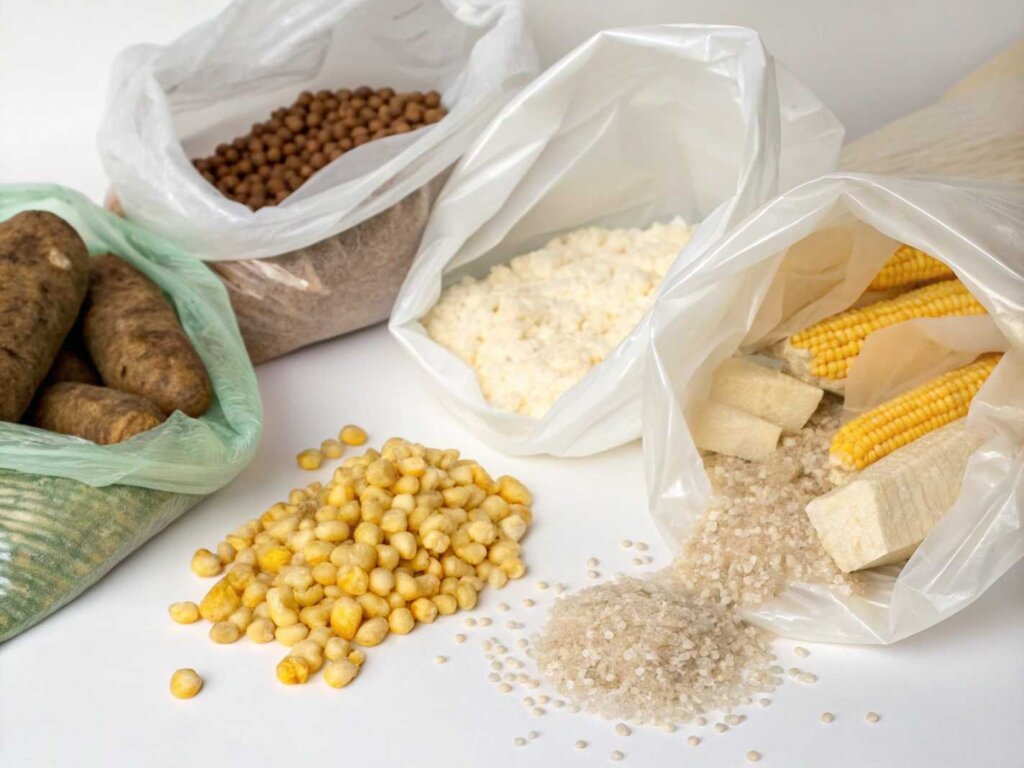
What Are Biodegradable Plastic Bags Made Of?
Biodegradable plastic bags are made from polymer-based materials combined with natural substances such as plant starches.
In most formulations, synthetic or bio-based polymers are blended with corn starch, potato starch, cassava starch, or similar organic fillers. Common polymers include PLA, PBAT, PBS, and PHA.
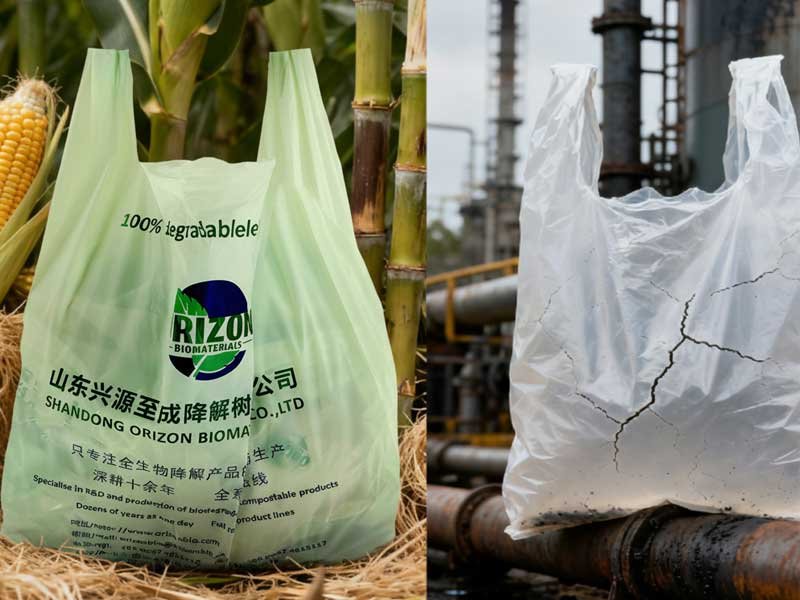
How Are Biodegradable Plastic Bags Different from Regular Plastic Bags?
Unlike conventional polyethylene plastic bags, biodegradable plastic bags are designed to break down through microbial activity.
However, their degradation rate depends heavily on environmental conditions, and many biodegradable bags do not fully decompose in landfills or natural environments.
Common Materials Used in Biodegradable Trash Bags
Biodegradable trash bags may be made from a range of materials, including:
- Plant starch blends (such as corn starch-based polymers)
- Bio-based plastics (including certain PLA or blended materials)
- Conventional plastics with degradation additives
Each material behaves differently once discarded, and biodegradability alone does not guarantee rapid or complete breakdown in real waste systems.
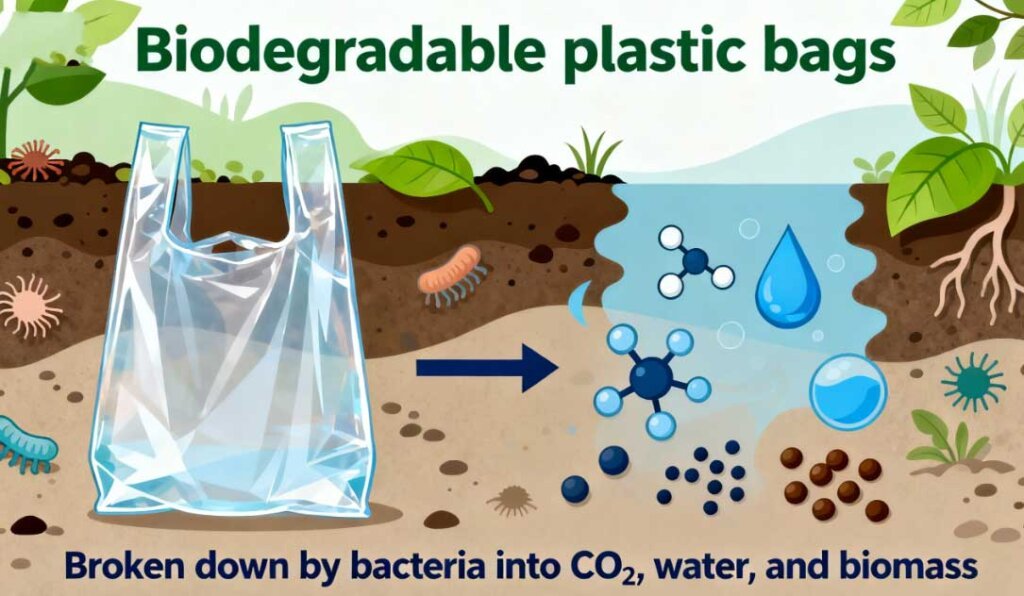
How Do Biodegradable Trash Bags Break Down?
Biodegradation is influenced by several factors:
- Temperature
- Moisture
- Oxygen availability
- Microbial activity
In controlled laboratory conditions, biodegradation may be observed.
In real-world disposal systems—such as landfills or open environments—conditions are often not suitable for effective or complete biodegradation.
Limitations of Biodegradable Trash Bags
While biodegradable trash bags are often marketed as eco-friendly, they have important limitations:
- No standardized global definition
- No required timeframe for breakdown
- Performance varies widely in landfills
- Risk of incomplete degradation and microplastic residues
- Often not accepted in composting or organics programs
Because of these factors, biodegradable trash bags may not deliver the environmental outcomes many users expect.
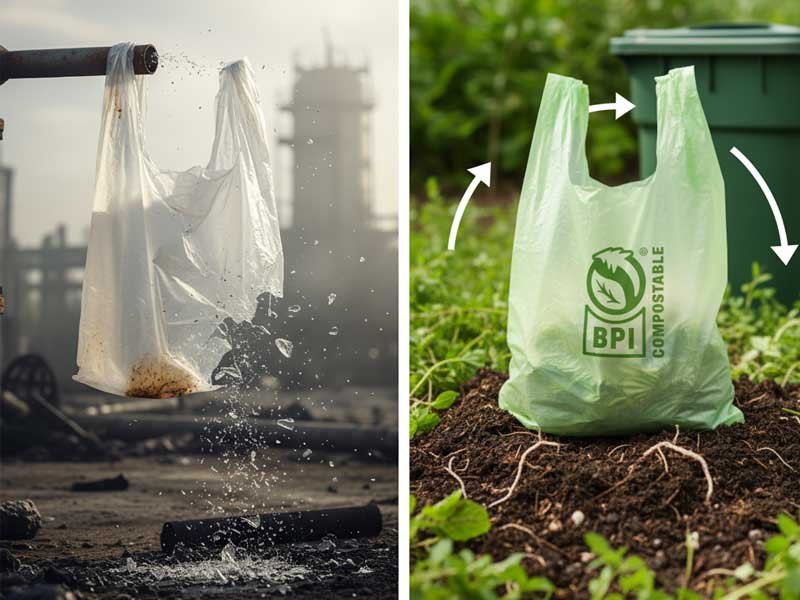
Are Biodegradable Trash Bags Compostable?
No.
Compostable trash bags are a regulated subset of biodegradable bags, but biodegradable trash bags are not necessarily compostable.
Compostable bags must meet strict certification standards that verify:
- Controlled composting conditions
- Defined decomposition timeframes
- No toxic residue
- Positive soil impact
Biodegradable trash bags do not require certification and are not guaranteed to meet composting system requirements.
Biodegradable vs. Compostable Bags (Key Differences)
| Aspect | Biodegradable Plastic Bags | Compostable Bags | Relationship |
|---|---|---|---|
| Material Basis | Plastics (e.g., PBAT, PLA, PBS, PHA, or blends) | Plastics (e.g., PLA, PBAT, PHA, PBS, or blends) | Same material basis |
| Core Definition | Eventually broken down by microbes | Fully breaks down into safe compost under specific conditions | Stricter definition |
| Degradation Environment | Natural environments (soil, water), landfills, or unspecified | Industrial/home composting systems (controlled temp/moisture/microbes) | Specific environment required |
| Time Requirement | No fixed timeline (months to decades) | Certified timeline (e.g., ≤6 months in industrial composting) | Time-bound decomposition |
| Safety & Residues | May leave microplastics or toxic residues | Zero toxic residues; passes ecotoxicity tests; no microplastics | Guaranteed safety |
| Key Standards | None mandated | EN 13432, ASTM D6400, AS 5810 (certification required) | Third-party verification essential |
| Certification | Rarely certified; vague claims | Mandatory labels: • Seedling (  ) )• BPI (  ) )• TÜV AUSTRIA Certification:OK Compost HOME/INDUSTRIAL | Trust through certification |
| End Product | CO₂, H₂O, biomass (quality not guaranteed) | Nutrient-rich compost (safe for agriculture) | Useful output ensured |
Compostable bags are a regulated subset of biodegradable plastic bags that meet stricter, certification-based requirements.
For a full definition-based comparison, see: Biodegradable vs. Compostable: Key Differences Explained
Degradable vs. Biodegradable Plastic Bags (Key Differences)
| Feature | Degradable Plastic Bags | Biodegradable Plastic Bags |
| Breakdown Product | Microplastic fragments, do not disappear completely | Natural substances (water, CO2, biomass), fully integrate into nature |
| Breakdown Mechanism | Typically break down into smaller pieces via oxidants | Decomposed through the action of microorganisms |
| Environmental Impact | Prone to microplastic pollution, can be misleading | Truly eco-friendly, reduces pollution (requires specific conditions) |
| Standards/Certification | Generally no strict international standards or third-party certification | Must comply with standards like ASTM D6400 or EN 13432, often with third-party certifications like BPI |
| Disposal Method | Still destined for landfills, cannot be effectively recycled or composted | Ideally processed in industrial composting facilities; some may be home-compostable under specific instructions |
Degradable plastic bags fragment conventional plastics into smaller pieces, which may contribute to microplastic pollution rather than complete biodegradation.
For a detailed definition-based comparison, see: Biodegradable vs. Compostable: Key Differences Explained
Environmental Considerations of Biodegradable Plastic Bags
Environmental Considerations of Biodegradable Plastic Bags
Biodegradable plastic bags are often promoted as an environmentally improved alternative to conventional plastics.
However, their environmental impact is highly dependent on material composition and disposal conditions.
Potential Benefits (Under Specific Conditions)
Reduced fossil-based content: Many biodegradable bags use plant-based inputs such as starch or bio-based polymers, which may reduce reliance on petroleum-derived plastics.
Lower long-term persistence (theoretical): Under suitable biological conditions, certain biodegradable materials may eventually break down rather than persist indefinitely.
Use in non-regulated waste scenarios: In regions without composting infrastructure, biodegradable bags are sometimes chosen as a transitional material.
Key Limitations and Risks
No guaranteed degradation timeframe: Biodegradable claims do not define how long breakdown takes and may span years or decades.
Highly environment-dependent performance: In landfills or low-oxygen environments, biodegradation may be extremely slow or negligible.
Risk of microplastic formation: Incomplete degradation can result in plastic fragmentation rather than full mineralization.
Recycling system contamination: Biodegradable plastics are generally incompatible with conventional plastic recycling streams.
Lack of certification oversight: Unlike compostable products, biodegradable bags are not subject to mandatory third-party certification.
Practical Implication
Because outcomes vary widely, biodegradability alone should not be treated as a reliable indicator of environmental benefit—especially in regulated organics or food waste systems, where certified compostable alternatives are typically required.
How Biodegradable Trash Bags Are Typically Manufactured (Overview)
Biodegradable trash bags are typically manufactured using polymer blends such as PLA, PBAT, or starch-based compounds.
These materials are processed through blown film extrusion and converted into bags through cutting and heat sealing.
Final performance depends heavily on formulation, thickness, and processing conditions.
How long do biodegradable plastic bags take to decompose
• Landfills: extremely slow, anaerobic conditions
• Natural environments (soil/ocean): decades, risk of microplastics
• Home composting: often ineffective unless certified
Degradation Time in Home Composting
Most products on the market are industrial compost standards, requiring sustained high temperatures to decompose. The temperature and microbial conditions in home composting bins are far from industrial-grade. These plastic bags won’t break down in them for months or even a year, potentially contaminating the composted product.
| Environmental Condition | Certified Compostable Bags | Oxo-Degradable (Pseudo-Degradable) Bags | Traditional PE Bags |
|---|---|---|---|
| Industrial Composting (58℃) | Degrade in 3-6 months | Fragment but do not fully degrade | Do not degrade |
| Home Composting (25-30℃) | Degrade in 6-12 months | Take over 5 years to degrade | Over 400 years |
| Seawater (15℃) | Over 5 years (PHA degrades 90% in 2 years, PLA cost 5x higher) | Over 10 years | Over 400 years |
| Landfill (Anaerobic) | Produces methane | Causes microplastic pollution | Does not degrade |
2019 American Chemical Society Experimental
Related Artical: 2025 Gudie : How Long Does It Take for Biodegradable Plastic to Decompose
Are Biodegradable Trash Bags Accepted in Waste Systems?
In most cases:
- Not accepted in composting programs
- Not suitable for food waste bins
- Often treated as regular landfill waste
Waste authorities typically require certified compostable bags for organics collection to prevent contamination and ensure proper processing.
Environmental Considerations
In landfill environments, biodegradable trash bags may:
Degrade very slowly
Produce methane under anaerobic conditions
Fragment rather than fully mineralize
Because outcomes are unpredictable, biodegradability alone is not a reliable indicator of environmental benefit.
When Are Biodegradable Trash Bags Commonly Used?
Biodegradable trash bags are often chosen when:
- Composting infrastructure is unavailable
- Regulations do not require certified compostable liners
- Buyers prioritize bio-based content over end-of-life certainty
However, for food waste and regulated organics systems, compostable alternatives are generally preferred.
Biodegradable trash bags are often difficult to verify, as the term lacks mandatory certification. In practice, only third-party compostability certifications provide reliable identification.
Learn how to identify biodegradable and compostable bags
Related Topics
FAQ
Not necessarily. Environmental impact depends on disposal conditions and material behavior. Many biodegradable bags degrade slowly or incompletely in landfills
Degradation may occur very slowly. Landfill conditions often lack oxygen and microbial activity needed for effective biodegradation.
There is no widely recognized global certification for biodegradable trash bags. Certification applies to compostable products, not biodegradable claims.
They may reduce fossil-based content, but environmental outcomes are not guaranteed without proper disposal systems.
No. Compostable products must meet strict standards and controlled conditions, while biodegradable products do not.
Conclusion
Biodegradable trash bags are defined by their ability to break down biologically over time, but without standardized requirements for timeframe, conditions, or environmental outcome.
For regulated waste systems and food waste applications, certified compostable trash bags provide clearer performance expectations and compliance assurance.
In regulated waste and organics systems, material claims alone are insufficient—system compatibility and third-party certification ultimately determine acceptance.