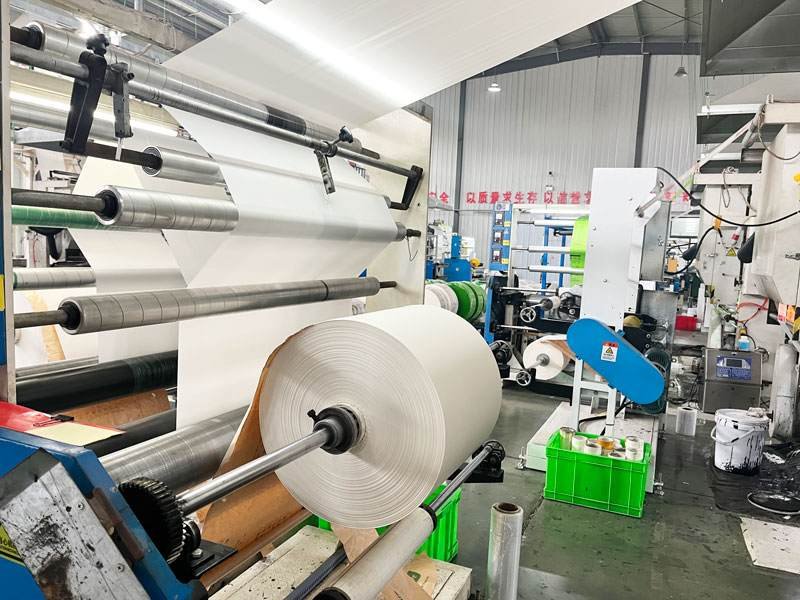
Industrial Compostable Garbage Bags
Industrial compostable garbage bags for factories, food processing, organics handling and high-volume waste operations.
Custom sizes, thicknesses, seal structures, roll packing and printing are available for B2B projects.
- Custom Size & Thickness
- Flat / Star Seal
- Large Industrial Formats
- OEM & Printing
- Certified Options
- MOQ From 500 kg
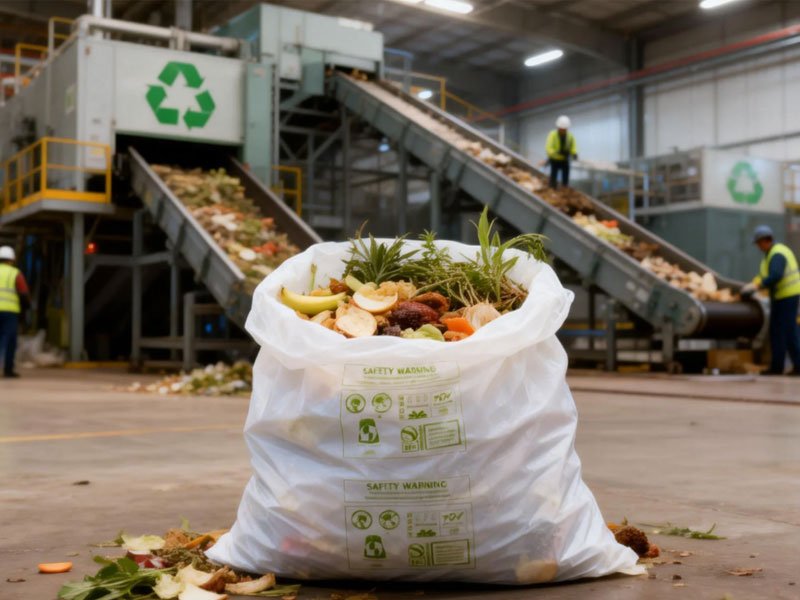
Industrial Compostable Waste Bags for High-Volume Operations
Industrial waste handling is different from ordinary office or household waste collection.
Bags may need to handle larger containers, heavier loads, wet organic material, frequent lifting or repeated movement between work areas.
For this reason, an industrial compostable garbage bag should be selected around the actual operating conditions.
Important factors include:
- container dimensions
- waste type
- expected load
- moisture
- puncture risk
- handling frequency
- film thickness
- bottom seal
- packing format
The goal is not simply to use the thickest bag.
The goal is to match the liner to the waste system.

Industrial vs Commercial vs Heavy-Duty Garbage Bags
These terms describe different things.
| Bag Type | What It Mainly Describes |
|---|---|
| Industrial Garbage Bags | The operating environment and waste-handling process |
| Commercial Garbage Bags | Business and facility waste collection |
| Heavy-Duty Garbage Bags | Higher strength or more demanding loads |
An industrial waste bag does not always need to be the thickest possible bag.
For example, a large liner used for lightweight production waste may need more capacity but not extreme thickness.
A smaller bag carrying wet or sharp waste may need greater strength.
For buyers who are selecting bags mainly by load, puncture risk or wet-waste performance, our Heavy-Duty Compostable Garbage Bags page explains the strength-focused options in more detail.
Industrial Compostable Waste Bags by Application
Different industrial operations place different stresses on the liner.

Food Processing
Food-processing operations may generate:
- food scraps
- vegetable waste
- production residue
- wet organic waste
- rejected ingredients
Important bag requirements may include:
- moisture handling
- bottom-seal strength
- frequent bag replacement
- correct fit for large bins
- suitable compostability certification
For restaurants, hospitality, offices and other daily facility waste rather than factory-level operations, see our Commercial Compostable Trash Bags.
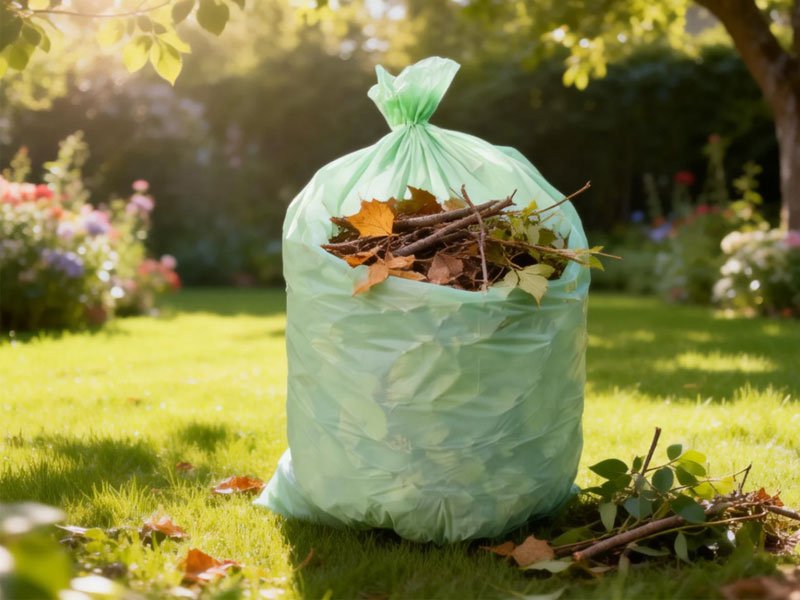
Manufacturing & Organic By-Products
Manufacturing facilities may use industrial rubbish bags for:
- production waste
- biodegradable process residue
- packaging-area waste
- organic by-products
- internal waste transfer
The correct specification depends on what is being collected.
Light production waste and dense organic residue should not automatically use the same liner.
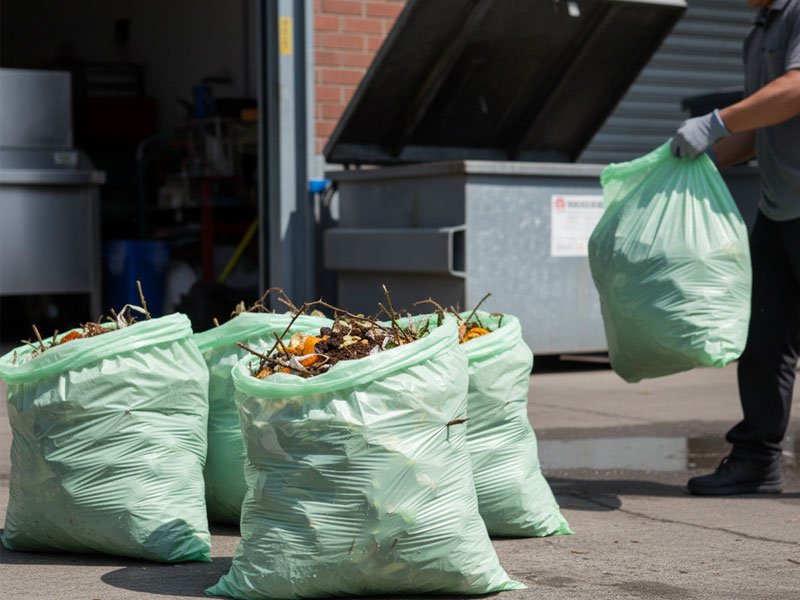
Central Kitchens & Food-Service Operations
Large kitchens and food preparation centers may require industrial compostable bin liners for:
- food preparation waste
- kitchen organics
- centralized waste stations
- back-of-house collection
These applications often combine:
- moisture
- dense waste
- large bins
- frequent lifting
A good specification should balance bag size, thickness and seal design.
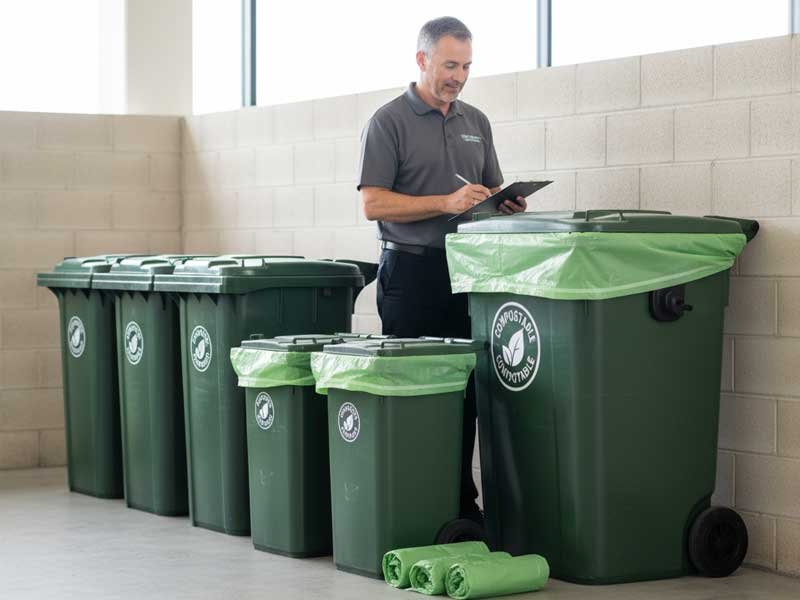
Waste Transfer & Organics Handling
Large industrial waste bags may also be used between collection points and processing areas.
In these applications, consider:
- movement distance
- lifting frequency
- waste density
- container size
- puncture risk
- whether the liner will remain in the container or be removed manually
For organics programs, buyers should also confirm whether compostable liners are accepted by the intended processing facility.
Industrial Compostable Garbage Bag Specifications
Industrial projects are usually specification-driven.
There is rarely one standard bag that fits every factory or waste operation.
| Specification | Available Options |
|---|---|
| Bag Capacity | Large and custom industrial sizes |
| Width & Length | Custom |
| Thickness | Based on waste and handling |
| Bottom Seal | Flat / star seal |
| Film Color | Natural / green / black / custom |
| Printing | Plain / custom printing |
| Packing | Roll / other suitable bulk formats |
| Bags per Roll | Custom |
| Core | Paper core / coreless where applicable |
| Carton Configuration | Custom |
| Pallet Packing | Available |
| OEM / Private Label | Available |
| MOQ | Typically from 500 kg per specification |
| Certification | Based on target market and final specification |
If you already use a conventional PE industrial liner, you can send us the existing specification or sample as a reference.
The compostable version should still be reviewed for thickness, seal and performance rather than copied mechanically.
Industrial Bin & Container Fit
Industrial containers are not always standard household or commercial bins.
They may include:
- large floor bins
- wheelie bins
- drums
- waste stations
- collection containers
- custom factory bins
A stated capacity such as 120L, 240L or 360L is useful, but it does not always guarantee the correct liner size.
For a more accurate fit, buyers can provide:
- container width
- container depth
- container height
- rim dimensions
- circumference for round bins
- required overhang
If the exact liner size is not known, send us the bin drawing, dimensions or an existing bag.
For buyers who need liners developed around non-standard factory bins, drums or collection containers, our guide on how custom compostable bin liners are sized to fit different containers explains the sizing process in more detail.
For buyers who are still comparing 60L, 120L, 240L or larger liner capacities, our Large Compostable Garbage Bag Size Guide explains how bin dimensions and waste type affect the final size.
Thickness & Performance for Industrial Waste
Thickness is important, but micron alone does not define bag strength.
Industrial performance can also be affected by:
- waste density
- bag dimensions
- puncture risk
- film consistency
- bottom seal
- moisture
- lifting method
- handling frequency
A higher micron value uses more material.
It may be appropriate for demanding loads, but it does not automatically solve:
- poor bin fit
- seal stress
- sharp-object punctures
- overfilling
For example, a large liner used for light dry waste may not need the same thickness as a smaller liner carrying wet food residue.
Choose thickness after understanding the waste.
For buyers who want deeper clarity on micron selection, our Compostable Bag Thickness Guide explains how thickness changes across different bag applications and load requirements.
Flat Seal vs Star Seal for Industrial Waste
Bottom structure affects how the waste load is carried.
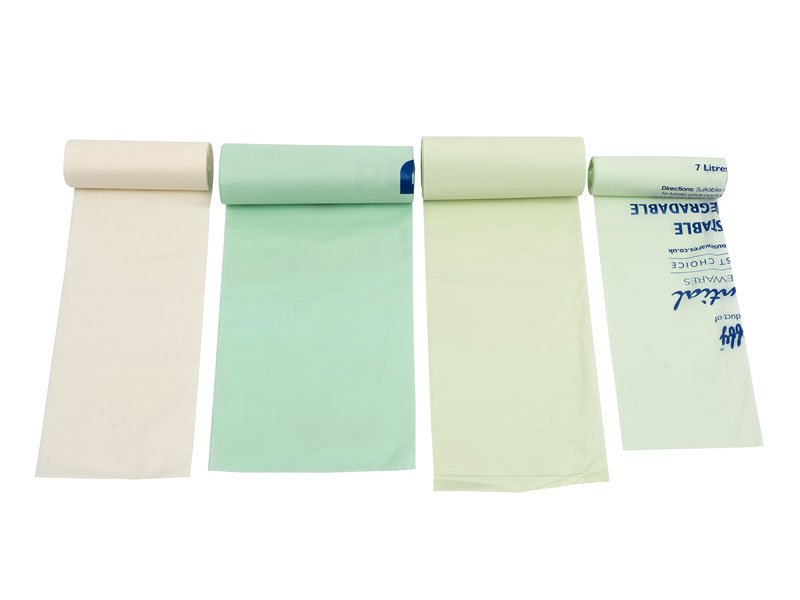
Flat Seal
A flat seal uses a straight bottom seam.
It may suit:
- dry waste
- lighter industrial waste
- simple bin-lining applications
It is a straightforward structure.
However, the load can become concentrated along the bottom seal.
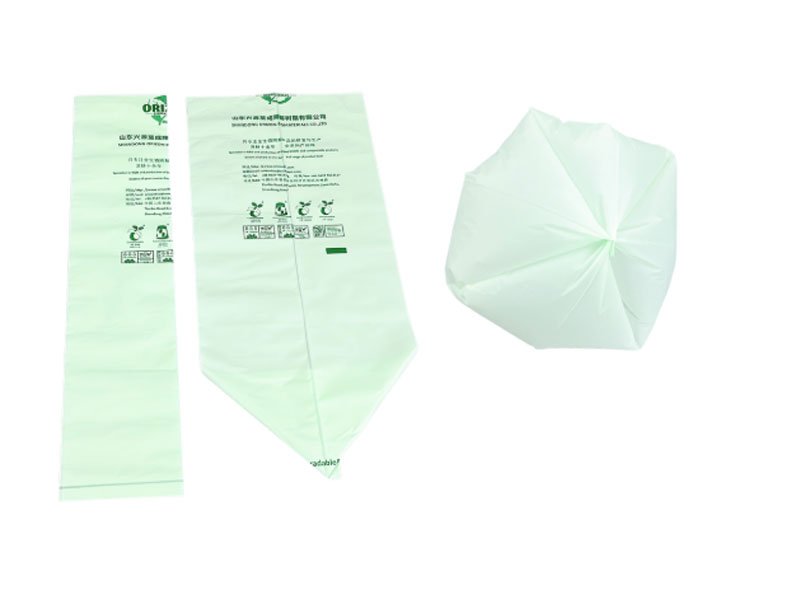
Star Seal
A star-seal bottom folds the film so the base opens more evenly.
It may be considered for:
- round bins
- wet organic waste
- larger loads
- applications where load distribution is important
The best option depends on the waste and container.
Star seal is not automatically required for every industrial bag.
Certification for Industrial Compostable Waste Bags
Certification requirements depend on the destination market, final bag specification and intended waste program.
| Target Market | Common Standard / Program |
|---|---|
| United States | ASTM D6400 / BPI where applicable |
| Europe | EN 13432 |
| Australia | AS 4736 |
| Industrial Composting | TÜV OK Compost INDUSTRIAL where applicable |
The finished specification may include factors such as:
- material formulation
- thickness
- colorants
- printing
- additives
- final bag construction
Certification marks should only be printed where the required authorization applies.
Certification also does not mean that every composting facility automatically accepts the liner.
For industrial organics programs, buyers should confirm both:
- the required product certification
- the acceptance rules of the local collection or composting facility
For US buyers who need more detail on commercially compostable specifications, see our ASTM D6400 Compostable Bags guide.
For buyers comparing certification requirements across different markets, see our Compostable Bag Certifications guide.
Bulk & OEM Industrial Compostable Waste Bags
Industrial projects often require more than a standard stock liner.
ORIZON supports bulk and OEM industrial compostable waste bag projects based on buyer-defined specifications.
Custom Specifications
Buyers can define:
- dimensions
- thickness
- bottom seal
- film color
- printing
- bags per roll
- carton packing
We can also review an existing industrial liner as a starting reference.
For buyers who need broader customization across bag size, thickness, structure, color and packing, see our Custom Compostable Bags capabilities.
For detailed artwork, Pantone color, flexographic printing and plate requirements, review our Custom Printed Compostable Bags capabilities.
Roll & Carton Packing
Industrial bag packing can be developed around warehouse and operational requirements.
Options may include:
- custom bags per roll
- core or coreless rolls
- rolls per carton
- carton markings
- pallet packing
Large or thick bags increase roll and carton weight quickly.
For this reason, bags per roll should be planned together with handling and shipping requirements.
MOQ & Multi-SKU Planning
Standard custom production MOQ typically starts from approximately 500 kg per specification.
Different:
- sizes
- thicknesses
- colors
- artwork designs
may require separate production runs.
For buyers who need deeper clarity on 500 kg MOQ, multiple SKUs and production timing, our Compostable Bags MOQ & Lead Time Guide explains this in detail.
We can then review the most practical production arrangement.
For more detail, see our Compostable Bags MOQ & Lead Time Guide.
What Affects the Price of Industrial Compostable Garbage Bags?
The main cost factors include:
- bag dimensions
- thickness
- individual bag weight
- material formulation
- film color
- printing
- bags per roll
- carton packing
- total order quantity
- pallet configuration
- shipping term
Two industrial waste bags with the same liter capacity may have very different weights and costs.
When comparing quotations, I recommend comparing the same:
- width and length
- thickness
- seal
- bag count
- certification requirement
- packing
- Incoterm
Otherwise, the lowest price may simply represent a different bag.
Industrial Compostable Bag Manufacturer
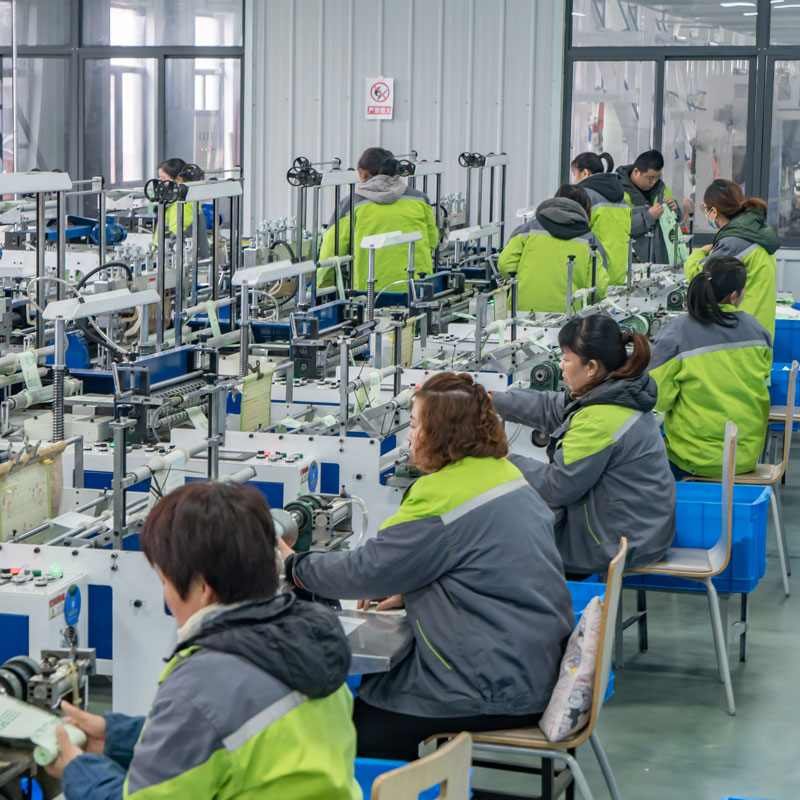
ORIZON manufactures compostable flexible film bags for international B2B projects.
16+ Years Manufacturing Experience
20,000 m² Production Facility
16 Automatic Production Lines
Approx. 500 Tons Monthly Capacity
OEM & Private Label Supply
Global B2B Export
Industrial projects can be managed around one approved specification covering:
- film
- dimensions
- thickness
- seal
- printing
- roll packing
- carton configuration
For buyers who want to review our production lines, manufacturing workflow and capacity, visit our Compostable Bag Factory in China.
What Should Industrial Buyers Send for a Quote?
For a useful quotation, send us your bag or container dimensions, waste type, thickness, bottom seal, bags per roll, film color, printing requirements, estimated quantity and destination market.
If the final bag size is not known, you can send the container dimensions, drawing or an existing liner sample.
Industrial Compostable Garbage Bags FAQ
Start with the waste rather than the micron number.
Consider waste density, moisture, puncture risk, bag size, lifting frequency and bottom seal before selecting the thickness.
It depends on the application.
Flat seals may suit lighter and simpler waste streams, while star seals can be useful for round bins, wet waste and applications where better load distribution is needed.
Yes. You can send the current bag dimensions, specification or physical sample.
We can use it as a starting reference, but the compostable version should still be reviewed for thickness, seal and actual performance.
Sometimes, but not always.
Wet and dense waste places more stress on the film and bottom seal than lightweight dry waste.
If the operating conditions are very different, separate specifications may be more practical.
No.
Certification and facility acceptance are different.
Buyers should confirm the required standard and the rules of the actual organics or composting program.
Not automatically.
Different bag dimensions, thicknesses, colors or print designs may require separate production runs.
Send the quantity for each SKU so the production plan can be reviewed.
I recommend testing:
- container fit
- bag dimensions
- thickness
- waste load
- puncture resistance
- seal performance
- lifting
- roll handling
- packing
The approved sample or confirmed specification can then be used as the reference for mass production.
Related Compostable Waste Bags
If your project is driven mainly by strength, load or puncture risk, see our Heavy-Duty Compostable Garbage Bags.
If you need liners for restaurants, offices, hospitality or general facility waste, see our Commercial Compostable Trash Bags.
For 120L, 240L and 360L wheeled bins, see our Compostable Wheelie Bin Garbage Bags.
If your waste stream is mainly leaves, grass or landscaping material, see our Compostable Yard Waste Bags.
For the full range of commercial, heavy-duty, wheelie-bin, yard-waste and industrial liners, visit our Compostable Trash Bags Manufacturer page.
Start Your Industrial Waste Bag Project
Send us your bag or container size, waste type, thickness, seal structure, packing requirements and estimated quantity.
We will review the specification and recommend a suitable production and packing setup.