EN 13432 Standard for Compostable Packaging: Requirements & Testing
Table of Contents
EN 13432 is the European standard for evaluating packaging intended for recovery through industrial composting and biodegradation.
It defines test and evaluation criteria covering biodegradation, physical disintegration, regulated chemical characteristics, the effect on the biological treatment process, and the quality of the resulting compost.
For packaging buyers, manufacturers and compliance teams, EN 13432 provides a technical framework for determining whether packaging can meet defined industrial compostability requirements.
Under the EU Packaging and Packaging Waste Regulation — Regulation (EU) 2025/40, or PPWR — the regulatory framework for compostable packaging is evolving. EN 13432 remains an important technical reference for industrial compostability while updated and new harmonised European standards are being developed to support the PPWR.
EN 13432 at a Glance
EN 13432 evaluates several different aspects of compostability. A packaging product cannot demonstrate conformity simply by showing that its raw material is biodegradable.
| Test Area | EN 13432 Principle |
|---|---|
| Biodegradation | At least 90% biodegradation within a maximum test period of 6 months under the applicable controlled test conditions |
| Disintegration | After a maximum of 12 weeks, less than 10% of the dry test material may remain in the fraction above 2 mm |
| Chemical Characteristics | Regulated elements and other chemical characteristics must remain within specified limits |
| Biological Treatment | The packaging must not adversely affect the composting process |
| Compost Quality / Ecotoxicity | The resulting compost must satisfy applicable plant-growth and ecotoxicity criteria |
TÜV AUSTRIA’s certification documentation reflects the industrial-compostability criteria used within the applicable certification scheme, including biodegradation and disintegration requirements.
What Is the EN 13432 Standard?
The full title of EN 13432 is:
Packaging — Requirements for packaging recoverable through composting and biodegradation — Test scheme and evaluation criteria for the final acceptance of packaging.
The standard was developed specifically for packaging and packaging materials intended for organic recovery.
It addresses four fundamental questions:
- Does the material biodegrade sufficiently under controlled composting conditions?
- Does the finished packaging physically disintegrate during biological treatment?
- Does the packaging interfere with the composting process?
- Does the resulting compost remain suitable in terms of quality and ecotoxicity?
European Bioplastics describes these same four characteristics as biodegradability, disintegration during biological treatment, effect on the biological treatment process, and effect on the quality of the resulting compost.
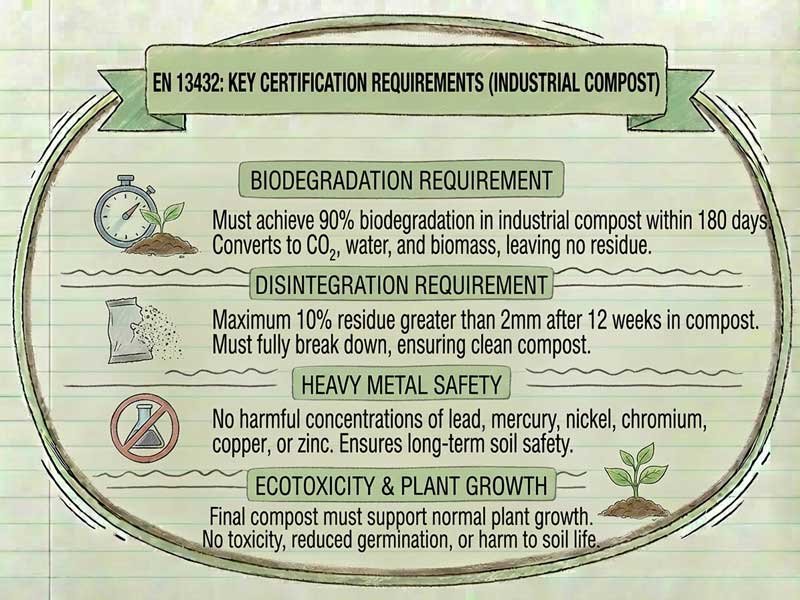
EN 13432 Testing Requirements
Testing is one of the most important parts of EN 13432 compliance.
A claim such as “biodegradable material” is not sufficient because biodegradability depends on defined environmental conditions, timeframes and test methods. European Bioplastics likewise advises that biodegradable claims should specify the relevant conditions and timeframe.
1. Biodegradation Test
The biodegradation test evaluates whether the organic carbon in the material is converted through microbial activity under controlled composting conditions.
For EN 13432-based industrial-compostability assessment, the maximum test period is six months, with a biodegradation requirement of at least 90% under the applicable test method and assessment conditions.
Relevant laboratory methods may include ISO 14855 and related test standards.
This test evaluates molecular biodegradation rather than simply visible fragmentation.
2. Disintegration Test
Biodegradation and disintegration are not the same thing.
Disintegration evaluates whether the physical packaging breaks down sufficiently during the composting process.
After a maximum of 12 weeks, less than 10% of the original dry test material may remain in the fraction larger than 2 mm.
Another way of expressing this is that more than 90% of the material must pass through the 2 mm sieve.
This is more accurate than saying that “all fragments must be smaller than 2 mm.”
3. Chemical Characterisation
EN 13432 also evaluates chemical characteristics of the packaging.
This includes limits for regulated elements and other parameters intended to prevent compostable packaging from introducing unacceptable contaminants into the resulting compost.
Material formulation therefore matters beyond the base polymer alone. Pigments, additives and other components need to be considered within the applicable product and certification scope.
4. Compost Quality and Ecotoxicity
Passing biodegradation and disintegration tests is not enough.
The resulting compost must also satisfy requirements concerning environmental safety and plant performance.
EN 13432-based certification schemes may use plant-growth testing to evaluate parameters such as germination and biomass compared with control compost. The exact test method and acceptance criteria depend on the applicable certification scheme; TÜV AUSTRIA documentation, for example, includes criteria based on modified OECD 208 testing.
EN 13432 Test Methods Used in Practice
EN 13432 defines performance requirements, while laboratories and certification schemes use recognised test methods to evaluate biodegradation, disintegration and ecotoxicity.
| Test Area | Commonly Used Test Methods | What They Measure |
|---|---|---|
| Biodegradation | ISO 14855-1 / ISO 14855-2, EN 14046; some schemes also accept ISO 14851 or ISO 14852 | Conversion of organic carbon under controlled composting conditions |
| Disintegration | ISO 16929, ISO 20200, EN 14045 | Physical breakdown of packaging during controlled composting |
| Ecotoxicity | Modified OECD 208 | Seed germination and plant biomass in resulting compost |
| Chemical Characterisation | EN 13432 limits and scheme-specific analytical methods | Regulated elements and material characteristics |
The exact test programme depends on the certification scheme, material type and product scope. These test methods should therefore be treated as commonly accepted methods used in EN 13432-based assessment rather than as a single universal laboratory sequence.
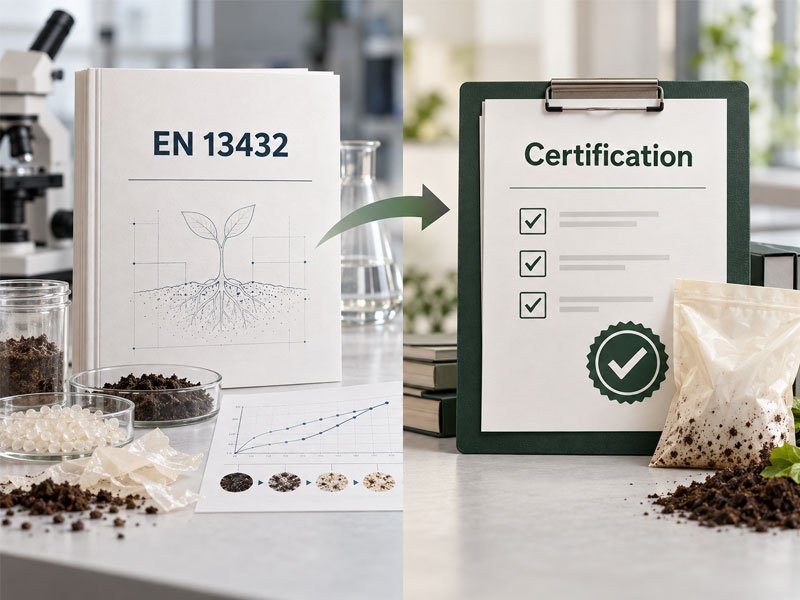
EN 13432 Disintegration vs Biodegradation
These two terms describe different processes.
Biodegradation refers to biological conversion of the material into products such as carbon dioxide, water, mineral salts and biomass.
Disintegration refers to the physical breakdown of the packaging into sufficiently small fragments during composting.
A material therefore cannot demonstrate EN 13432 conformity merely because it disappears visually. Likewise, achieving biodegradation alone does not demonstrate that the finished packaging will physically disintegrate within the required timeframe.
European Bioplastics summarizes EN 13432-certified plastics as requiring disintegration after 12 weeks and at least 90% biodegradation within six months
Why Finished Packaging Matters
EN 13432 should not be evaluated only at the raw-material level.
A finished package may contain:
- base film or resin;
- printing inks;
- pigments or masterbatch;
- labels;
- adhesives;
- coatings; and
- multiple material layers.
Changing these components can change the compostability assessment of the finished product.
For multi-component products, the applicable certification scheme determines how individual components and the complete finished product must be evaluated. TÜV Austria specifically provides procedures for evaluating finished products made from multiple components.
This is why a statement such as “made from EN 13432-certified resin” should not automatically be interpreted as proof that every finished packaging configuration is certified.
EN 13432 Standard vs EN 13432 Certification
EN 13432 is a technical standard.
Certification is a separate process through which an independent certification body evaluates test evidence and determines whether a product falls within an approved certification scope.
Third-party certification is commonly used to demonstrate conformity with industrial-compostability requirements. Where a company wishes to use a certification or conformity mark such as Seedling or OK compost INDUSTRIAL, the applicable certification and mark-use requirements must be satisfied.
For ORIZON’s current certification scope and verification information, see: ORIZON EN 13432-Related Certification Information
EN 13432 vs “Biodegradable” Claims
“Biodegradable” and “EN 13432 compliant” are not interchangeable terms.
A generic biodegradable claim does not necessarily define:
- the environment in which degradation occurs;
- the temperature and moisture conditions;
- the required timeframe; or
- the required level of biodegradation.
EN 13432 provides defined industrial compostability testing and evaluation criteria.
For procurement purposes, buyers should therefore ask for the relevant standard, certification scope and finished-product documentation rather than relying only on the word biodegradable.
Is EN 13432 Home Compostable?
No. EN 13432 should not be treated as a home-compostability standard.
Industrial composting normally uses controlled temperature, moisture, aeration and biological conditions that differ substantially from typical home composting.
The EU PPWR expressly distinguishes industrial compostability from home compostability and requires development of a separate EU-wide home-compostability standard.
A product that meets EN 13432 therefore should not automatically be described as home compostable.
Home-compostability claims require evidence applicable to home-composting conditions and the finished product. Where third-party certification is claimed, the applicable home-compostability certification scope should also be confirmed.
Certification Marks Used by EN 13432-Based Schemes
EN 13432 itself does not issue a certification mark.
Third-party certification schemes may use their own conformity or certification marks to indicate that a product has been certified against applicable industrial-compostability requirements.
Examples include:
Seedling — a certification mark owned by European Bioplastics and used through approved certification schemes.
OK compost INDUSTRIAL — a conformity mark used under the TÜV AUSTRIA certification scheme.
These marks relate to industrial compostability and should not be interpreted as evidence of home compostability.
Certification marks may only be used according to the applicable certification scope and mark-use requirements.
Buyers should verify the certificate holder, certificate number, certified Product Type or scope, relevant finished-product specification and permitted mark use before relying on a certification claim.
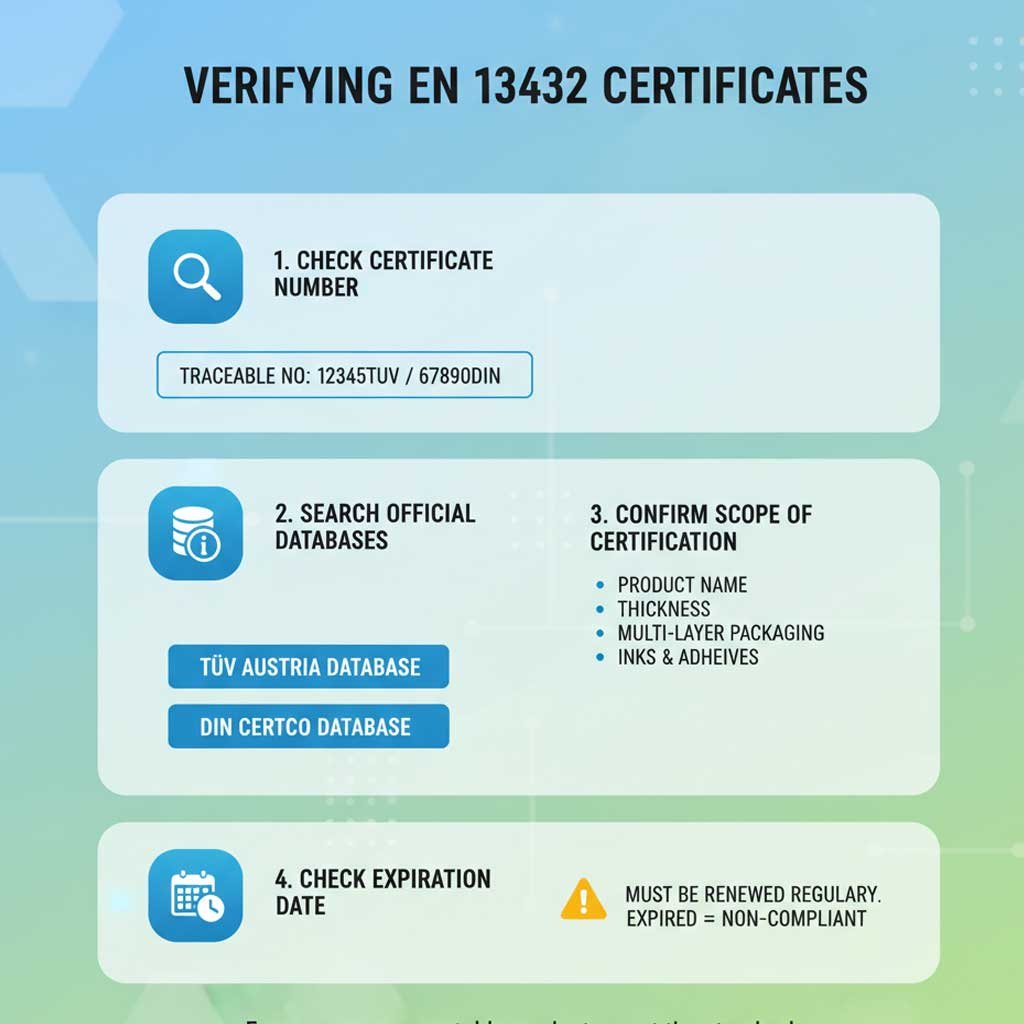
How to Verify EN 13432-Related Certification and Product Claims
For B2B sourcing, do not rely only on a certification logo, supplier statement or raw-material claim. Verify the applicable certificate or official certification record and confirm that its scope covers the actual finished product being purchased.
Verify the certificate against the issuing certification body’s records and confirm that the certificate applies to the product being purchased.
Important details include the certificate holder, certificate number, issuing body, validity status, certified material or finished-product scope, thickness or other applicable restrictions, and authorised certification-mark usage.
For ORIZON documentation:
EN 13432 Testing and Certification Timeline
The standard defines maximum durations for specific technical tests, but it does not establish one universal total certification lead time.
For example:
| Test / Stage | Technical Timeframe |
|---|---|
| Biodegradation testing | Up to 6 months |
| Disintegration testing | Up to 12 weeks |
| Chemical characterisation | Depends on laboratory and scope |
| Ecotoxicity / plant testing | Depends on test programme |
| Certification review | Depends on certification body and available evidence |
Previous valid test data, material composition, product complexity and certification-body requirements can all affect the overall project duration.
For this reason, it is better not to state that every EN 13432 certification project takes “6–12 months.”
What Can Increase EN 13432 Compliance Risk?
Changes to the finished product can affect the applicable compliance or certification scope.
Relevant factors include film thickness, multi-layer construction, inks, pigments, adhesives, labels, coatings and changes to material formulation.
For certified products, manufacturers and brand owners should confirm whether a proposed change remains within the existing approved scope before mass production.
EN 13432 and the EU PPWR in 2026
Regulation (EU) 2025/40 on Packaging and Packaging Waste — the PPWR — has applied from 12 August 2026.
EN 13432 remains an important technical reference for industrial compostability of packaging, but conformity with EN 13432 alone should not be treated as evidence of full compliance with all PPWR requirements.
The European Union is developing updated and new harmonised standards to support the PPWR’s compostability provisions, including work relating to industrial and home compostability.
For EU projects, buyers should therefore review:
- the applicable PPWR requirements;
- the relevant compostability standard;
- the finished-product certification scope;
- the intended composting environment; and
- any additional destination-market requirements.
The practical point is that EN 13432 remains technically relevant, but it should not be used as a blanket synonym for PPWR compliance.
What EN 13432 Covers — and What It Does Not
| EN 13432 Addresses | EN 13432 Does Not Establish |
|---|---|
| Industrial compostability of packaging | Home compostability |
| Biodegradation under defined conditions | Marine biodegradation |
| Disintegration during biological treatment | Soil biodegradation claims |
| Effect on the composting process | Landfill degradation |
| Quality of resulting compost | General environmental superiority |
| Packaging and packaging components | Automatic certification of every product made from a tested resin |
This distinction is important when writing packaging claims.
When Is EN 13432 Relevant?
EN 13432 is particularly relevant when packaging is intentionally designed to enter an industrial organic-waste treatment route and when compostability is appropriate for the intended application and local waste-management system.
Compostability should not automatically be treated as the best end-of-life route for every type of packaging.
Buyers should consider the intended use, contamination with organic waste, local collection rules, industrial composting infrastructure and current EU or national regulatory requirements.
EN 13432:2000 and National Versions
EN 13432:2000 is the European standard on packaging recoverable through composting and biodegradation.
European standards are adopted by national standards bodies and may therefore appear with national prefixes and publication dates, for example:
- DIN EN 13432:2000-12 — Germany
- BS EN 13432:2000 — United Kingdom
- UNI EN 13432:2002 — Italy
- UNE-EN 13432:2001 — Spain
These are national adoptions of the same European EN 13432 framework rather than separate compostability standards.
BSI currently lists BS EN 13432:2000 as current and identical to EN 13432:2000, while UNI identifies UNI EN 13432:2002 as the official Italian version of EN 13432:2000.
Where to Find Official EN 13432 Information
The complete EN 13432 standard is a copyrighted standards document and should be obtained from an authorised standards body.
For regulatory and standards context, useful primary sources include:
- EUR-Lex — Regulation (EU) 2025/40 (PPWR)
- European Commission — PPWR guidance and FAQs
- European Commission standardisation request for updated compostability standards
- National standards bodies such as DIN, BSI, UNI or UNE for the published standard text
The European Commission’s 2026 guidance states that the existing EN 13432 industrial-composting standard can continue to be used as guidance until updated harmonised standards are adopted.
FAQ – EN 13432 Standard
Yes. EN 13432 establishes requirements and evaluation criteria for packaging intended for recovery through industrial composting and biodegradation. It should not be interpreted as proof of home compostability.
EN 13432-based industrial compostability assessment generally requires at least 90% biodegradation within a maximum test period of six months under the applicable controlled test conditions.
After a maximum of 12 weeks, less than 10% of the original dry test material may remain in the fraction larger than 2 mm.
No. EN 13432 is the technical standard. Certification is a third-party assessment process used to verify conformity and, where applicable, authorise use of marks such as Seedling or OK compost INDUSTRIAL.
Not automatically. The finished product may include additional components such as ink, adhesives, labels, pigments or multilayer structures. Certification scope should be confirmed for the actual finished product.
No. EN 13432 is the relevant European packaging compostability standard. “ISO 13432” should not be used as another name for EN 13432.
No. Industrial-compostability and home-compostability conditions are different, and the PPWR specifically distinguishes the two.
Related Compostability Standards
Verify EN 13432-Related Certification Information
If you are evaluating compostable packaging for the European market, verify the applicable certification scope against the exact finished-product specification rather than relying only on the raw material or a certification logo.
ORIZON can provide applicable certification information and product documentation for B2B sourcing projects.