What Is Compostable? (Official Definition)
What Is Compostable?
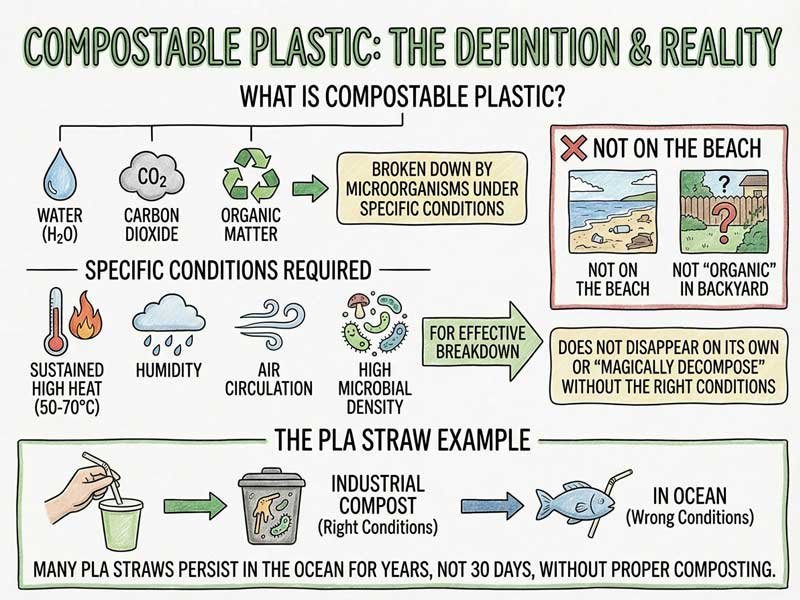
Compostable refers to materials that can be broken down by microorganisms into water, carbon dioxide, and organic matter under specific composting conditions, within a defined timeframe, and without leaving toxic residues or microplastics.
Unlike vague environmental claims, compostability is a regulated and testable standard. To be considered compostable, a material must:
Decompose under controlled composting conditions (temperature, humidity, oxygen, and microbial activity)
Fully disintegrate within a specified period, typically 90–180 days in industrial composting
Leave no harmful residues and support healthy soil quality
In packaging and waste management systems, the term “compostable” applies only to materials certified under recognized standards, such as EN 13432 (EU), ASTM D6400 (USA), AS 4736 (Australia), or OK Compost.
Materials that do not meet these certification requirements may still be biodegradable in theory, but they do not qualify as compostable in regulated composting or waste collection systems.
Composting Conditions Required
Compostable materials do not break down in normal soil, oceans, or landfills.
They require a managed composting environment with:
Sustained elevated temperatures
Controlled humidity
Oxygen circulation
Active microbial populations
Without these conditions, compostable materials may remain intact for long periods and should not be assumed to decompose naturally.
Key Criteria That Define Compostable Materials
To be genuinely compostable, a material must meet all of the following conditions:
- Biological decomposition by microorganisms
- Time-bound breakdown, typically within 90–180 days under industrial composting
- Complete disintegration, not fragmentation into microplastics
- No toxic residue, proven through plant growth and ecotoxicity testing
- Certification under established standards, not self-declared claims
Materials that merely “break down over time” without these controls do not qualify as compostable in regulated systems.
Compostable vs Biodegradable vs Recyclable
These terms are often confused, but they are not interchangeable.
| Term | What It Means | Key Limitation |
|---|---|---|
| Compostable | Fully breaks down into harmless organic matter under certified composting conditions | Requires correct composting system |
| Biodegradable | May break down eventually, with no defined timeframe or residue guarantee | Microplastics risk |
| Recyclable | Can be reprocessed into new products | Contamination if mis-sorted |
All compostable materials are biodegradable, but not all biodegradable materials are compostable.
For a full comparison, see: Biodegradable vs Compostable: Key Differences Explained
Is Compostable the Same as Biodegradable?
Compostable materials are biodegradable, but most biodegradable materials are not compostable.
Biodegradable claims do not guarantee complete breakdown, safe residues, or compatibility with composting systems.
Compostable materials must meet specific certification standards and performance requirements.
What Conditions Are Required for Composting?
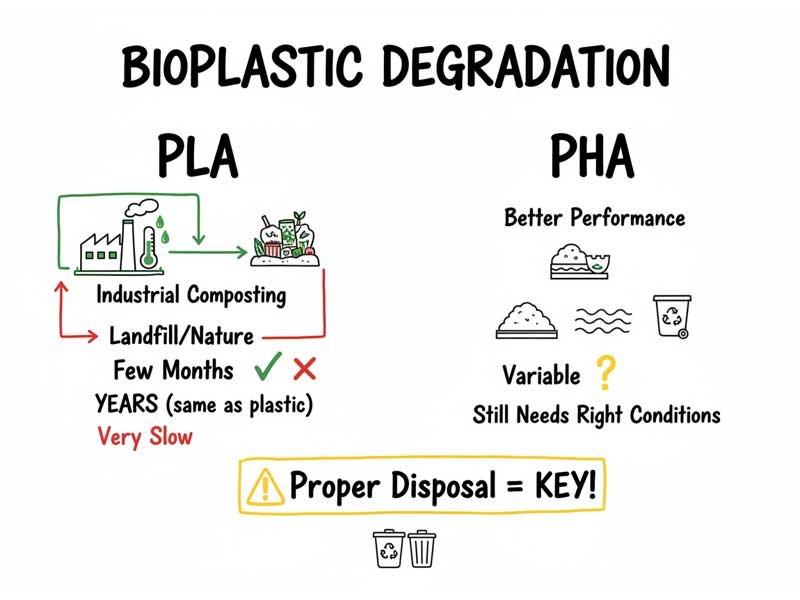
Most compostable materials — especially compostable plastics — are designed for industrial composting, not natural soil or landfills.
To understand why these materials behave differently in backyard systems, see the differences between home composting and industrial composting.
Typical industrial composting conditions include:
- Sustained temperatures above 55 °C
- Controlled humidity
- Adequate oxygen flow
- High microbial activity
Without these conditions, compostable materials will not decompose as intended.
Only products specifically certified for home composting (such as OK Compost HOME or AS 5810) can reliably break down in backyard compost systems.
This distinction exists because home and industrial composting systems are not interchangeable.
To understand what home composting systems can realistically handle, including temperature limits and material restrictions, see our guide on home composting basics.
Common Compostable Materials
Compostable products can be made from various bio-based or bio-derived materials, including:
PLA (Polylactic Acid) – widely used; industrial composting required
PBAT / PBS blends – flexible films and compostable bags
PHA – fully compostable and, in limited cases, marine-degradable
Plant fibers such as bagasse and paper-based composites
Material choice affects performance, cost, durability, and composting compatibility.
Certification Standards That Define Compostability
Compostability is not a marketing claim — it is a verified property.
Common international compostability standards include:
EN 13432 – Industrial compostability (Europe)
ASTM D6400 – Industrial compostability (United States)
AS 4736 – Commercial compostability (Australia)
OK Compost INDUSTRIAL / HOME – TÜV Austria certification
Products without recognized certification should not be marketed as compostable in regulated markets.
Compostability Is Defined by Certification Standards
Compostability is determined by third-party certification, not by marketing language.
Recognized standards include:
EN 13432 (Europe): Industrial compostable packaging
ASTM D6400 (USA): Industrial compostable plastics
AS 4736 (Australia): Commercial compostable plastics
OK Compost (Industrial / Home): TÜV Austria certification programs
Materials that do not meet these standards should not be described as compostable, even if they are bio-based or biodegradable.
How to Identify Genuine Compostable Plastics
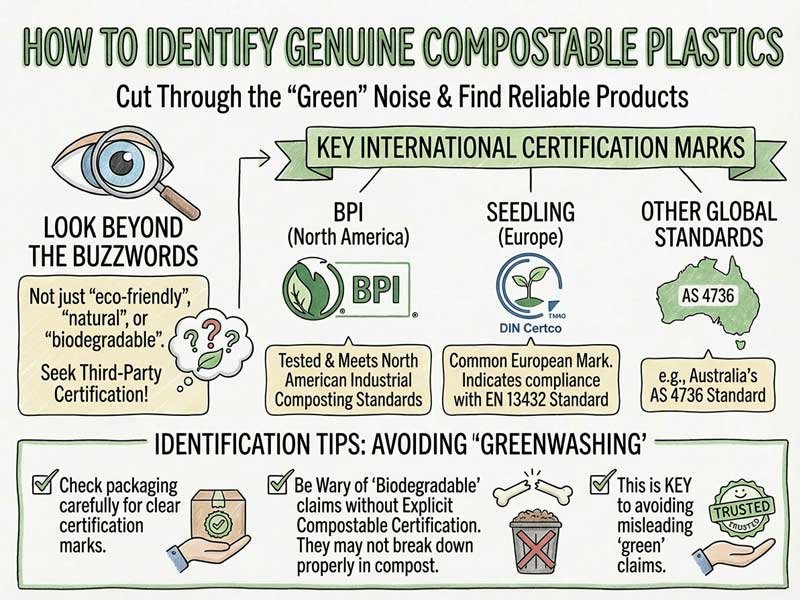
Because environmental claims are often misused, identifying genuine compostable plastics requires more than marketing language.
Compostable materials must display clear third-party certification marks, not vague terms such as “eco-friendly,” “natural,” or “biodegradable.”
Recognized Compostable Certification Marks Include:
BPI (North America)
Indicates compliance with ASTM D6400 standards for industrial composting facilities.Seedling Logo (Europe)
Certified by organizations such as DIN Certco, confirming compliance with EN 13432.AS 4736 (Australia)
Defines compostability requirements for commercial and municipal composting systems.
Identification Tip:
If a product claims to be biodegradable but does not carry a recognized compostable certification, it should not be treated as compostable in regulated waste or composting systems. This distinction is critical for avoiding greenwashing and contamination risks.

Common Misunderstandings About “Compostable”
- Compostable does not mean it breaks down anywhere
- Compostable does not mean recyclable
- Compostable does not guarantee home compostability unless explicitly certified
- Compostable claims without certification increase compliance and contamination risks
What “Compostable” Does Not Mean
Compostable does not mean that a product:
Breaks down in landfills
Decomposes in oceans or natural environments
Can be recycled with conventional plastics
Will compost at home unless explicitly certified
Incorrect disposal can eliminate the environmental benefits of compostable materials and contaminate waste streams.
How Long Does Compostable Plastic Take to Decompose?
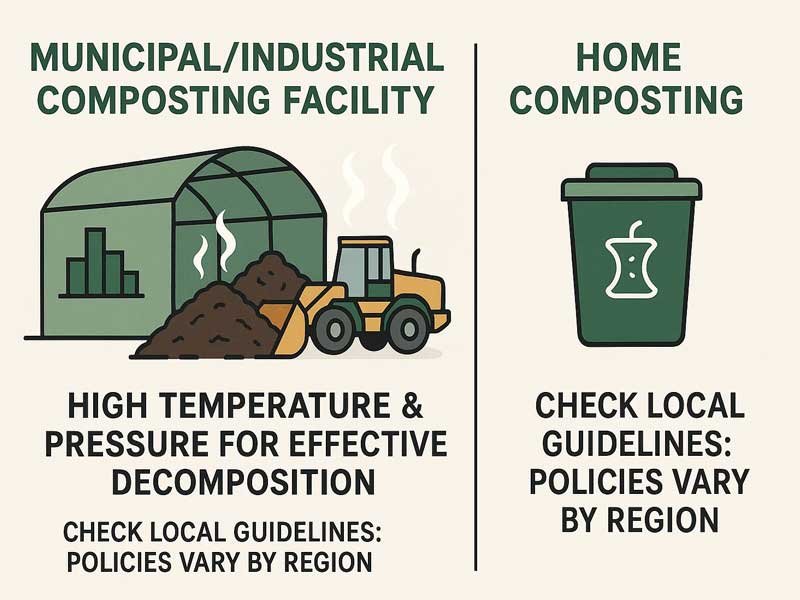
Decomposition time depends entirely on the composting environment:
Industrial composting: ~90–180 days
Home composting (certified products only): up to 12 months
Landfill or uncontrolled environments: unpredictable and often ineffective
Always follow local organics collection rules and product labeling.
Why the Definition of Compostable Matters for Businesses
For brands, packaging buyers, and municipalities, using the correct definition helps to:
Avoid greenwashing and compliance risk
Meet labeling and regulatory requirements
Prevent contamination of recycling systems
Support ESG and sustainability reporting
In regulated waste systems, misusing the term “compostable” can result in fines, rejected packaging, or loss of trust.
Frequently Asked Questions
No. Compostable materials should not be placed in plastic recycling streams.
No. Compostable materials require controlled composting conditions.
No. Home compostable products must meet stricter, separate certification requirements.
No. Compostable plastics must not be placed in plastic recycling streams.
In regulated waste systems, certified compostable materials provide clearer and more verifiable environmental outcomes.
Certified compostable materials should not — when processed under proper composting conditions.
Only when they are correctly certified, correctly disposed of, and supported by composting infrastructure.
Home composting is limited in temperature and consistency. To understand these limits in practice, review our home composting basics guide.
Related Knowledge Pages
Conclusion
Compostable is a scientifically and legally defined term that applies only to materials proven to break down safely under controlled composting conditions.
Understanding this definition helps buyers, brands, and waste systems make accurate, compliant, and responsible decisions — and avoid misleading environmental claims.