Council Bin Liners Australia – Procurement & Tender Supply
Compostable bin liner supply for Australian council programs, waste contractors, procurement teams and distributors.
This guide covers tender specifications, liner sizing, annual volume planning, compliance documentation, custom printing and repeat contract supply.
Council Bin Liner Procurement: What Buyers Should Specify
A council bin liner tender should define the finished product clearly enough for suppliers to quote the same specification.
“Compostable bin liner” alone is not sufficient.
Before requesting quotations, define the following:
| Procurement Item | What to Specify |
|---|---|
| Waste stream | FOGO / food organics / other approved application |
| Bin or caddy | Capacity and actual dimensions |
| Bag dimensions | Width × length, including gusset where applicable |
| Thickness | Required micron or project-specific performance |
| Certification | AS4736 or other project requirement where applicable |
| Color | Green / lime green / custom |
| Printing | Council logo, waste-sorting instructions or unprinted |
| Bags per roll | Project-specific |
| Rolls per carton | Distribution requirement |
| Annual volume | Estimated contract quantity |
| Delivery points | Single depot / multiple locations |
| Delivery schedule | One-off / scheduled / call-off supply |
| Documentation | Certification, specification, TDS and approval records |
| Sample approval | Tender sample or pre-production sample |
Clear specifications reduce quotation differences and make technical comparison between suppliers easier.
Which Council Waste Programs Use Compostable Liners?
Compostable liners are most relevant where the liner itself needs to enter an accepted organics or composting stream.
Typical applications may include:
Kitchen Caddy Programs
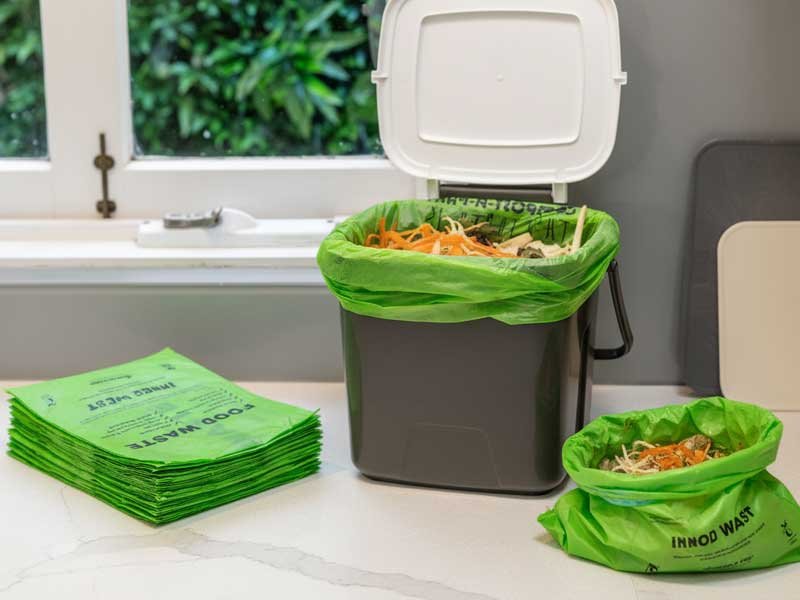
Small compostable liners used to collect household food scraps before transfer to an approved FO or FOGO bin.
Council FOGO Programs
Certified compostable liners may be specified for approved food-organics collection applications depending on the council and receiving processor.
Council Facilities
Council offices, community centres, kitchens and other managed facilities may use compostable liners where a separate food-organics collection system is in place.
Commercial Organics Programs
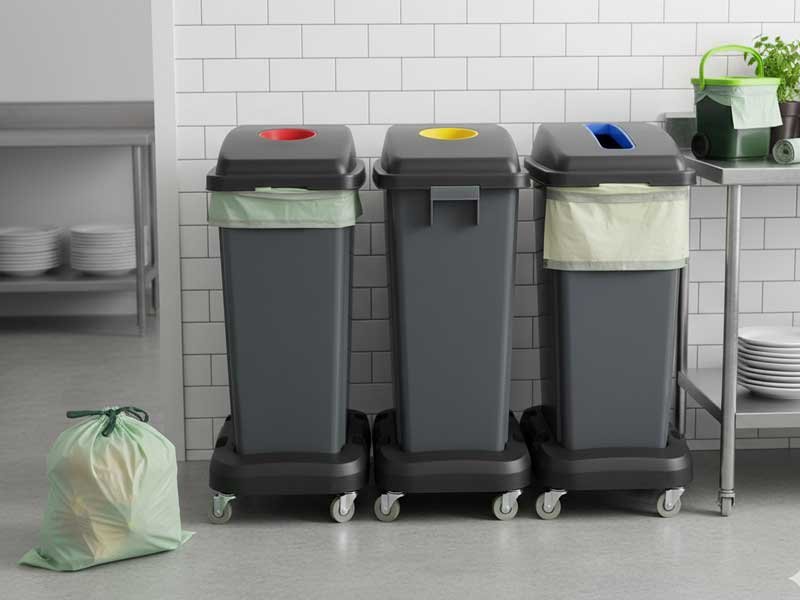
Waste contractors may require larger liners for commercial kitchens, food-service facilities or organics collection points where the receiving processor accepts them.
For general mixed waste, buyers should first confirm whether a compostable liner is technically and commercially appropriate for the intended waste stream.
Council Bin Liner Sizes Depend on the Program
There is no single “standard council bin liner size.”
A council program may use anything from a small kitchen caddy to a larger commercial or wheelie-bin application.
| Application | Typical Format |
|---|---|
| Household kitchen caddy | Approx. 7L–10L |
| Small facility food-waste bin | 10L–20L |
| Medium organics bin | 20L–60L |
| Commercial food-waste station | Project-specific |
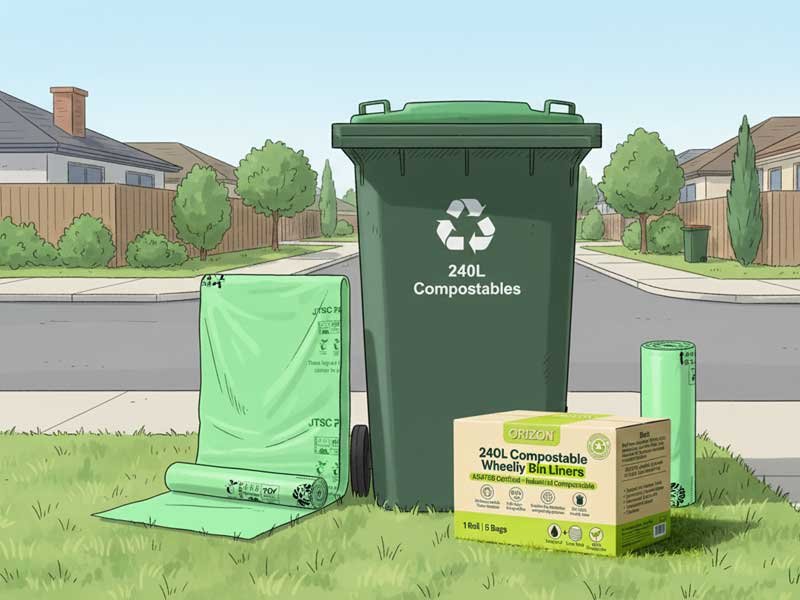
| Larger wheelie-bin application | 60L–240L where liners are accepted |
Actual bin or caddy dimensions should always be confirmed before approving the liner specification.
Two bins with the same nominal litre capacity may have different dimensions.
For smaller formats, see our compostable bin liners for Australia.
For larger applications, see our wheelie bin liners for Australia.
FOGO & Organics Liner Requirements
FOGO liner requirements vary by council, waste contractor and receiving organics processor.
A project may specify requirements such as:
- commercial-compostability certification
- kitchen caddy compatibility
- liner color
- certification mark
- bags per roll
- household distribution packaging
- council printing or sorting instructions
AS4736 is commonly relevant to commercially compostable liners used in Australian organics programs, but certification alone should not be treated as automatic acceptance by every FOGO program.
The receiving council or processor requirements should be confirmed before final specification approval.
For FOGO-specific product selection and local-program considerations, see our FOGO compostable bags guide.
For detailed product information, see our AS4736 compostable bags page.
How Council Bin Liner Contracts Are Structured
Council procurement can involve more than a one-time bag purchase.
Depending on the project, supply arrangements may include:
Initial Rollout Supply
A defined quantity of liners supplied for the launch of a new FOGO or organics program.
Recurring Contract Supply
Regular production based on monthly, quarterly or annual forecasts.
Call-Off Orders
A contract quantity is agreed, with individual shipments released according to council or distributor demand.
Multi-Site Delivery
Cartons or pallets may need to be delivered to council depots, contractor warehouses or nominated distribution locations.
Household Distribution Packs
Kitchen caddy liners may be packed according to the number of rolls or bags allocated to each household.
Multi-Year Supply
Longer contracts require more attention to repeat-order specifications, packaging consistency and production planning.
For these projects, the approved specification should remain the reference for each repeat order.
Planning Annual Council Bin Liner Supply
Annual volume should be calculated from actual program usage rather than estimated only from the number of bins.
Household Caddy Programs
A simple forecast can be calculated as:
Number of Households
× Rolls per Household per Year
× Bags per Roll
= Annual Bag Requirement
For example, the key variables are not only the number of households but also how frequently liners are supplied and how many bags are included in each roll.
Council Facilities or Commercial Sites
A basic calculation can use:
Number of Bins
× Liner Changes per Week
× 52 Weeks
= Estimated Annual Liner Requirement
The forecast may then be adjusted for:
- program growth
- seasonal demand
- replacement stock
- new households or facilities
- rollout buffer inventory
Once annual demand is known, manufacturing and shipping can be planned around full cartons, pallets or container quantities.
What Documentation Should a Council Tender Request?
Compliance and repeatability should be documented before contract production.
A typical procurement file may include:
| Document | Purpose |
|---|---|
| Product specification | Confirms size, thickness, color and bag construction |
| Compostability certification | Confirms applicable certified scope |
| Technical data sheet | Provides technical product reference |
| Approved sample record | Defines the accepted finished product |
| Artwork proof | Confirms council logo, wording and printing |
| Packaging specification | Locks roll, carton and pallet configuration |
| QC specification | Defines manufacturing tolerances and inspection requirements |
| Delivery plan | Supports contract implementation |
| Repeat-order record | Helps maintain consistency over the contract period |
For a customized liner, the quotation, sample, certification information and final production specification should describe the same finished product.
Any change to material, thickness, printing or structure should be reviewed before repeat production.
How to Evaluate a Council Bin Liner Supplier
Price per bag should not be the only procurement criterion.
For council or contractor contracts, buyers should also evaluate whether the supplier can maintain the required specification across repeated production runs.
1. Specification Match
Can the supplier manufacture the exact size, thickness, roll count, color and packaging requested in the tender?
2. Certification Scope
Does the applicable certification relate to the finished product being quoted?
Do not rely only on a raw-material certificate.
3. Production Consistency
Can dimensions, thickness, perforation, printing and roll count remain within agreed tolerances across repeat orders?
4. Sample Approval
Can the buyer approve a representative sample before contract production?
5. Artwork Control
Can printed council logos, waste-sorting instructions and certification marks be controlled through an approved artwork file?
6. Packaging Consistency
Can the supplier maintain the same roll, carton and pallet configuration across the contract?
7. Annual Capacity
Can the supplier allocate sufficient production capacity for the forecast quantity and delivery schedule?
8. Documentation
Can technical specifications, certification information and QC records be supplied when required for procurement review?
These criteria help procurement teams compare suppliers on contract reliability rather than unit price alone.
OEM Printing & Council Program Customisation
Council liner projects can be customized around the approved program specification.
Available options may include:
- custom liner dimensions
- project-specific thickness
- custom green or lime-green shades
- council logos
- FOGO or food-waste instructions
- one- or multi-color printing
- bags per roll
- paper core or coreless rolls
- roll labels
- household distribution packs
- bulk cartons
- palletized export packing
Certification-mark use should be reviewed separately from ordinary logo printing.
Where a certification logo is required, confirm that the proposed product and branding arrangement are eligible before final artwork approval.
For broader OEM development, see our custom compostable bin liners page.
Contract Manufacturing & Repeat Supply
Council and waste-contractor projects require more control than one-off spot purchases.
ORIZON supports B2B compostable bag production based on approved specifications and repeat-order requirements.
Contract supply can include:
- annual volume planning
- scheduled production
- multi-SKU programs
- repeat artwork
- controlled roll counts
- carton standardisation
- pallet planning
- tender samples
- certification documentation
- recurring export shipments
ORIZON operates 16 automated production lines with approximately 500 tons of monthly production capacity.
For long-term programs, the objective is to establish one approved product specification that can be reproduced consistently across future orders.
Council Bin Liner Procurement Checklist
Before requesting a quotation, prepare the following information where available:
- Waste stream or intended application
- Bin or caddy capacity
- Actual bin dimensions
- Required bag dimensions
- Thickness
- Certification requirement
- Color
- Printing
- Bags per roll
- Rolls per carton
- Estimated annual quantity
- Delivery locations
- Delivery schedule
- Packaging requirements
- Required tender documentation
If the final liner size has not yet been determined, provide the actual bin or caddy dimensions.
FAQ About Council Bin Liner Procurement
A tender should define the waste stream, bin or caddy dimensions, bag size, thickness, certification requirement, color, printing, bags per roll, packaging, estimated annual volume and delivery schedule.
The more complete the specification, the easier it is to compare suppliers on the same finished product.
For household programs, calculate the number of households multiplied by the planned rolls per household and bags per roll.
For council facilities, estimate the number of bins multiplied by weekly liner changes and annual operating weeks.
A contingency can then be added for program growth and replacement inventory.
Requirements depend on the council and receiving organics program.
AS4736 is commonly specified for commercially compostable kitchen caddy liners in Australian FOGO applications, but buyers should always confirm the exact program requirement before procurement.
Certification does not automatically guarantee acceptance by every council or composting facility.
Sometimes, but it should not be assumed.
Different councils may use different caddies, bag sizes, colors, certification requirements, artwork or packing formats.
For multi-council contracts, compare all required specifications before deciding whether one common SKU can be used.
Depending on the tender, buyers may request product specifications, certification information, technical data sheets, approved samples, artwork proofs, packaging specifications and quality-control documents.
These records help ensure that repeat production matches the originally approved liner.
Yes.
Bulk liner projects can be planned around annual forecasts, scheduled production and recurring shipments.
The product specification, artwork, packaging and delivery plan should be agreed before contract production begins.
Need Council Bin Liners for a Tender or Waste Program?
Send us your bin or caddy size, liner specification, certification requirement and estimated annual quantity.
We can review the project and prepare a B2B quotation for council, contractor or distributor procurement.