Custom Compostable Garment Bags for Apparel Packaging
Custom size, thickness, flap, adhesive seal, hanger opening, film appearance and logo printing for B2B apparel packaging.
- Custom Size
- Custom Thickness
- Single / Dual Seal
- Hanger Opening
- Custom Printing
- MOQ From 500 kg
B2B supply only · Not sold as retail packs
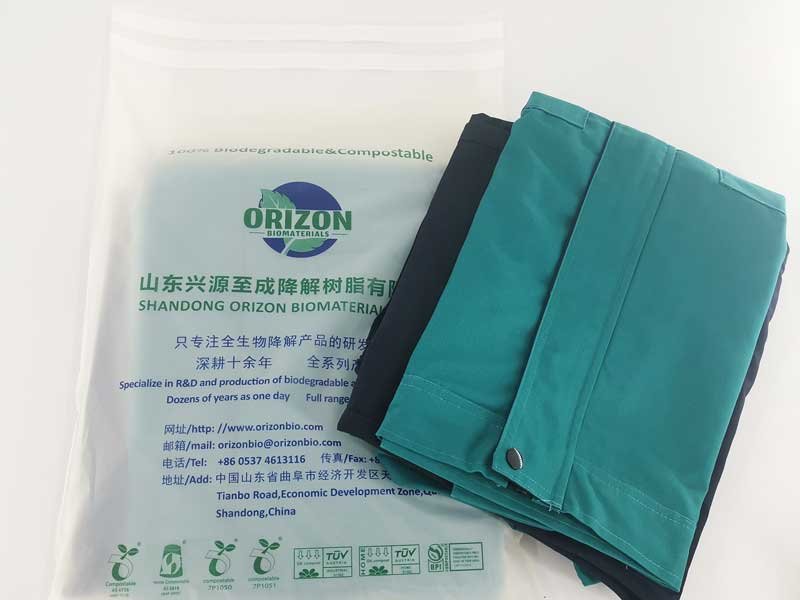
What Can Be Customized on Compostable Garment Bags?
Custom garment bags should be developed around the garment type, packing workflow, storage requirements and distribution process.
ORIZON can review the complete bag specification rather than only changing the bag dimensions or logo.
| Specification | Custom Options |
|---|---|
| Bag Width | Custom |
| Bag Length | Custom |
| Thickness | Based on garment and workflow |
| Flap Length | Custom |
| Closure | Open top / self-adhesive |
| Hanger Opening | Custom where required |
| Ventilation Holes | Custom where applicable |
| Side Gusset | Custom where applicable |
| Film Color | Natural / clear / custom |
| Transparency | Clear / translucent / opaque |
| Printing | Unprinted / custom logo |
| Print Colors | Pantone references |
| Barcode / Size Mark | Available where required |
| Packing | Flat / stacked / bundled |
| Quantity per Pack | Custom |
| Carton Quantity | Custom |
| Carton Marking | Custom |
Bag dimensions, thickness, closure and garment type should be reviewed together because each factor can affect packing efficiency, product visibility and material usage.
For broader physical bag customization across other product categories, explore our Custom Compostable Bags capabilities.
Custom Compostable Garment Bag Styles
Different apparel workflows require different garment bag structures.
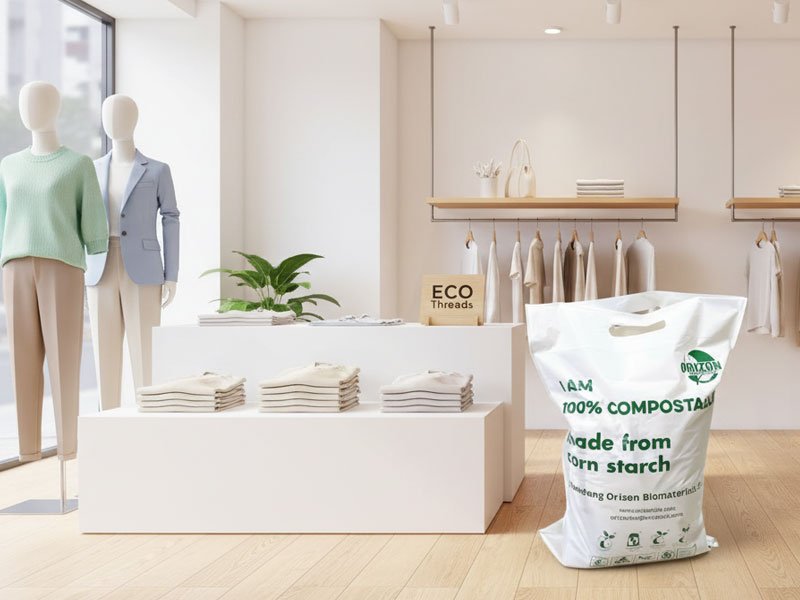
Custom Open-Top Garment Bags
Open-top garment bags are suitable for apparel factories, warehouses, sorting, export packing and internal garment protection.
Typical custom options include:
- width
- length
- thickness
- film transparency
- ventilation holes
- printing
- pack quantity
Open-top structures are useful where garments need to be inserted or removed quickly without an adhesive closure.
For standard product options and bulk supply, see our Compostable Garment Bags range.

Custom Self-Adhesive Garment Bags
Self-adhesive garment bags use a flap and adhesive strip to close the bag after packing.
They are commonly considered for:
- folded apparel
- e-commerce inner packaging
- warehouse packing
- retail preparation
- export garments
Custom specifications may include:
- bag width and length
- flap length
- adhesive position
- thickness
- film appearance
- printing
- packing quantity
The bag body, flap and adhesive strip should be developed as one structure.
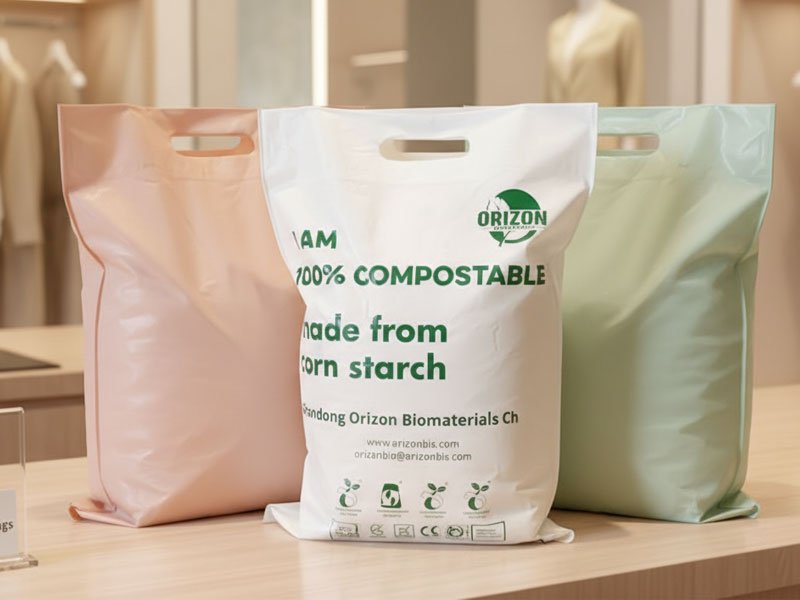
Custom Hanger / Four-Finger Garment Bags
Hanger garment bags are suitable for clothing that remains on hangers during storage, transport or retail preparation.
Important specifications may include:
- garment length
- shoulder width
- bag width
- bag length
- hanger opening
- film thickness
- ventilation holes
- printing position
The hanger opening should be positioned according to the garment and hanger structure rather than using one standard position for every project.
Custom Garment Bag Size & Thickness
Garment bag dimensions should match the clothing format and packing workflow.
Custom Bag Size
Size may depend on the type of garment being packed, such as:
- T-shirts
- shirts
- trousers
- dresses
- jackets
- suits
- coats
- folded apparel
- hanging garments
For folded apparel, width and length should allow the garment to enter easily without excessive unused film.
For hanging garments, shoulder width and garment length become more important.
If you already use a conventional plastic garment bag, the existing dimensions can be used as a reference.
Custom Thickness
Thickness should be selected according to:
- bag dimensions
- garment weight
- warehouse handling
- export transport
- closure structure
- hangers or zippers
- required film feel
- visibility requirements
A thicker film uses more material and may be suitable for heavier handling, but the best specification should balance performance, weight and cost.
Thickness should therefore be selected according to the garment and packing process rather than by bag size alone.
Custom Flap & Adhesive Seal
For self-seal garment bags, the flap and adhesive strip are important parts of the final packing workflow.
Flap Length
Flap length can affect:
- garment loading
- bag closure
- adhesive position
- final bag length
- artwork placement
A flap that is too short may be difficult to seal, while unnecessary flap length increases material usage.
Adhesive Strip
The adhesive strip should be reviewed according to:
- flap length
- bag width
- garment packing method
- required closure
- release-liner position
The useful relationship is:
Bag Size
- Flap Length
- Adhesive Position
- Closure
- Finished Packing
- Workflow
For printed bags, the adhesive and flap area should also be considered before the artwork is finalized.
Custom Hanger Openings & Ventilation
Hanger openings and ventilation holes can be added where required by the apparel packaging workflow.
Hanger Opening
For hanging garments, the opening should be reviewed according to:
- hanger-hook size
- hanger position
- shoulder width
- garment length
- film thickness
The opening should provide practical access for the hanger without creating unnecessary stress around the top of the bag.
Ventilation Holes
Ventilation holes may be used where air release is useful during packing, stacking or carton loading.
Hole size, quantity and position can be reviewed according to the final bag dimensions and packing method.
These features should be treated as structural packaging details rather than automatically applied to every garment bag.
Custom Printed Compostable Garment Bags
Custom printing is available for suitable garment bag projects.
Printed content may include:
- company logo
- brand name
- garment size
- barcode
- SKU information
- handling instructions
- product information
- approved certification marks
- multilingual text
Printing should normally be planned after the bag dimensions, closure structure, hanger opening and film appearance are confirmed.
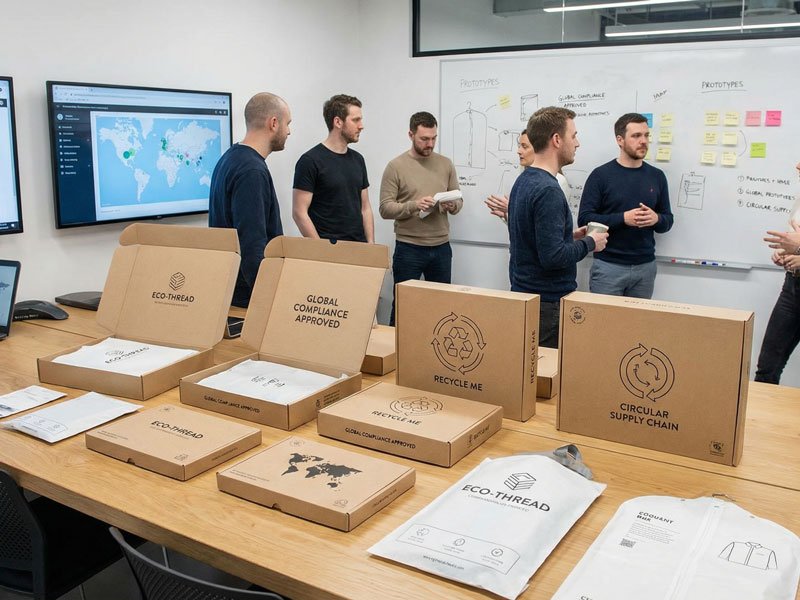
Logo & Brand Printing
Brand artwork can be positioned on the main body panel according to the usable printing area.
For self-seal bags, sufficient clearance should be left around the flap and adhesive area.
Barcode & Size Identification
Apparel programs may require identification such as:
- size
- style code
- barcode
- SKU
- country version
These can be coordinated with the garment bag artwork or label system where applicable.
Pantone Print Colors
Pantone references can be used as print-color targets.
Final print appearance may vary according to:
- film transparency
- film color
- thickness
- ink
- print coverage
The print color should therefore be reviewed together with the film background.
Print Area & Structural Clearance
The full bag dimensions are not always the same as the usable print area.
Artwork may need clearance around:
- flap
- adhesive strip
- hanger opening
- ventilation holes
- side gusset
- folding area
- bag edges
The useful relationship is:
Bag Size
- Structural Features
- Usable Body Panel
- Artwork Size & Position
For detailed information about artwork files, Pantone references, printing plates and flexographic printing, review our Custom Printed Compostable Bags capabilities.
Custom Garment Bags by Apparel Workflow
Different apparel businesses use garment bags in different ways.
| Workflow | Key Custom Requirement |
|---|---|
| Garment Factory | Size, packing speed, quantity per pack |
| Warehouse | Visibility, sorting and SKU identification |
| Retail | Presentation, printing and hanger opening |
| E-Commerce | Inner protection, self-seal closure |
| Export | Thickness, carton packing and handling |
| Hanging Garments | Length and hanger opening |
| Formalwear | Longer bag format and garment protection |
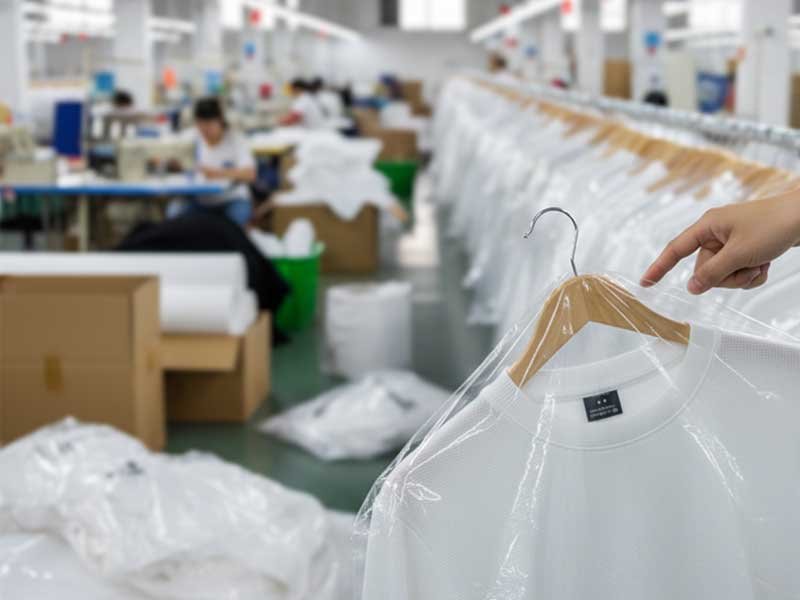
Garment Factories
Factories often prioritize:
- packing speed
- standard dimensions
- bulk quantities
- clear garment identification
- repeat supply
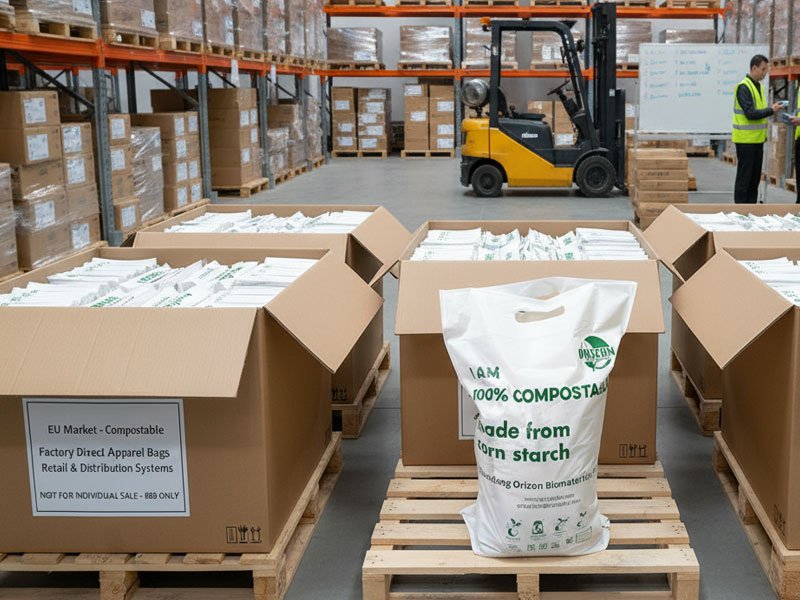
E-Commerce Apparel
E-commerce brands may focus more on:
- self-seal closure
- branding
- SKU identification
- folded garment fit
- customer presentation
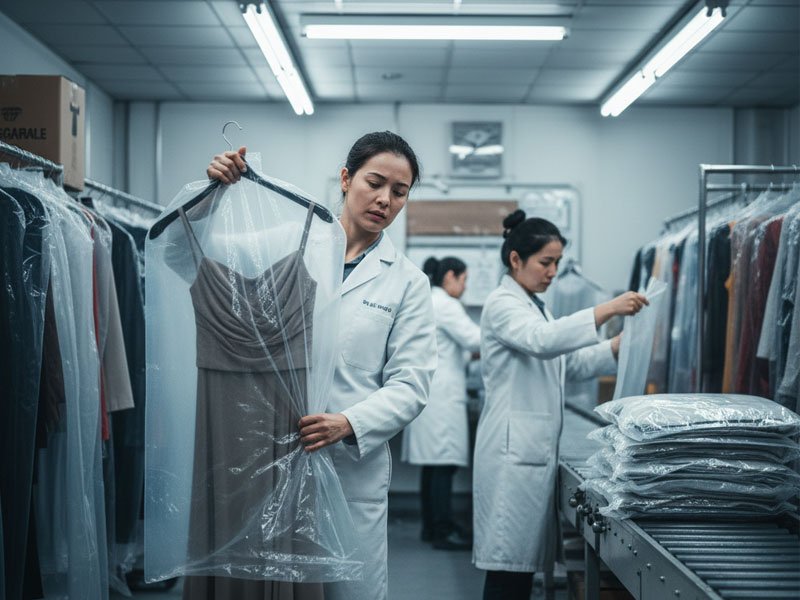
Retail & Hanging Garments
Retail workflows may require:
- longer bag formats
- hanger openings
- clear film
- printed identification
For broader packaging decisions across fashion, retail, e-commerce and apparel logistics, see our Compostable Apparel Packaging Solutions page.
Custom Packing & Carton Configuration
Garment bags are typically supplied flat, stacked or bundled according to the buyer’s packing workflow.
Garment bags are typically supplied flat, stacked or bundled according to the buyer’s packing workflow.
Custom options may include:
- bags per bundle
- bags per pack
- bags per carton
- carton size
- carton markings
- barcode or SKU labels
- pallet packing
Packing should be selected according to:
- garment bag dimensions
- film thickness
- pack quantity
- warehouse handling
- carton gross-weight target
- shipping efficiency
For multi-size programs, each SKU should be clearly identified to reduce warehouse and packing errors.
If your project also requires branded labels, retail packaging, barcode/SKU control or custom carton programs, explore our Private Label Compostable Packaging service.
Certification for Custom Compostable Garment Bags
Certification requirements depend on the target market and final garment bag specification.
Relevant standards may include:
| Market | Common Standard / Program |
|---|---|
| United States | ASTM D6400 / BPI |
| Europe | EN 13432 |
| Australia | AS 4736 / AS 5810 |
| Industrial Composting | TÜV OK Compost INDUSTRIAL |
| Home Compost Projects | TÜV OK Compost HOME where applicable |
Certification applicability should be reviewed against the finished product.
Relevant factors may include:
- material formulation
- film thickness
- colorants
- additives
- adhesive components
- printing
- final bag structure
Certification marks should only be printed where the applicable certification scope and logo-use authorization allow it.
Review our Compostable Certifications for more information.
MOQ for Custom Compostable Garment Bags
Standard custom production MOQ typically starts from approximately 500 kg per specification.
A specification generally includes one combination of:
- bag size
- thickness
- bag structure
- closure
- film appearance
- film color
- print design
Different sizes, colors or artwork designs may require separate production quantities.
Printed or private-label projects may also involve separate setup or packaging requirements.
For multi-SKU apparel programs, send us the required quantity for each size or design so we can review the most practical production arrangement.
For detailed production quantities and timing, see our Compostable Bags MOQ & Lead Time Guide.
Direct Manufacturer for Custom Compostable Garment Bags
Standard custom production MOQ typically starts from approximately 500 kg per specification.
ORIZON manufactures compostable flexible film bags for international B2B buyers.
- 16+ Years Manufacturing Experience
- 20,000 m² Production Facility
- 16 Automatic Production Lines
- Approx. 500 Tons Monthly Capacity
- International B2B Supply
Custom garment bag projects can be coordinated around one approved specification covering:
- film
- dimensions
- thickness
- closure
- hanger opening
- printing
- packing
For a broader overview of our OEM manufacturing capabilities, visit our OEM Compostable Bag Manufacturer page.
Custom Compostable Garment Bags FAQ
Yes. You can send us your current PE bag specification, drawing or physical sample.
We can use it as a reference, but thickness, film behavior, adhesive and other details should still be reviewed for the compostable version.
Thickness should be selected according to bag size, garment weight, closure type and handling conditions.
We recommend testing the bag with the actual garment before confirming mass production.
It depends on film clarity, thickness, barcode contrast and the scanner being used.
For warehouse programs, we recommend testing barcode readability through the finished bag before production approval.
Not always.
Ventilation holes may help release trapped air during packing and carton loading, but the quantity and position should be selected according to the garment and packing workflow.
Yes. Garments should be clean and fully dry before being sealed.
Packing damp garments can trap moisture inside the bag and affect storage conditions.
Not automatically.
The adhesive, release liner and final bag structure should be checked against the applicable certification scope before making compostability claims.
Not always.
Different sizes, thicknesses, colors or print designs may require separate production runs. Send us the quantity for each SKU so we can review the most practical production plan.
We recommend checking:
- garment fit
- bag dimensions
- thickness
- film visibility
- flap and adhesive
- ventilation holes
- barcode readability
- printing and packing
The approved sample or confirmed specification should then be used as the production reference.
Need More Than Garment Bag Customization?
| Your Requirement | Recommended Page |
|---|---|
| Standard / wholesale garment bags | Compostable Garment Bags |
| Broader apparel packaging strategy | Compostable Apparel Packaging Solutions |
| Broader bag customization | Custom Compostable Bags |
| Detailed printing capabilities | Custom Printed Compostable Bags |
| Private label packaging | Private Label Compostable Packaging |
| Custom shipping mailers | Custom Compostable Mailers |
| MOQ and production timing | Compostable Bags MOQ & Lead Time Guide |
| Full OEM manufacturing | OEM Compostable Bag Manufacturer |
Start Your Custom Garment Bag Project
Send us your garment bag size, thickness, closure style, film appearance, printing requirements and estimated quantity.
We’ll review the suitable bag structure, specification and packing requirements for your project.
B2B Bulk Orders Only