AS5810 Home Compostable Certification: The Ultimate Guide
The most complete and practical certification guide for brands, importers, and packaging suppliers.
Table of Contents
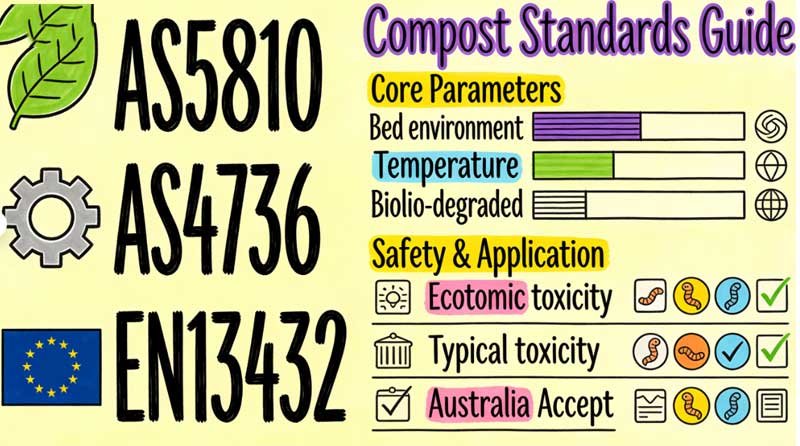
I believe many people are confused by the technical terms in the composting field, such as AS5810, AS4736, and EN13432. When I first heard about AS5810 home compostable certification, I was also confused. The name sounded like code, not something I’d use every day.
But after I started working with buyers, factories, and certification bodies, I realized its importance. Although I’ve worked in a biodegradable compostable bag factory for many years, it took me a considerable amount of time to understand this specialized industry knowledge.
This article explains what the Australian AS5810 home compostable certification standard is, which products can be certified under AS5810, and how businesses can check whether compostable bags are truly AS5810 compliant.
What is AS5810 Home Compostable Certification
AS5810 home compostable certification is the Australian standard for “home compostable” plastics. It defines the requirements a product must meet to be certified as home compostable and safely decompose in a home compost system.
In Australia, many retailers and councils require compostable bags to comply with AS5810 home compostable certification. For any product marketed as “home compostable”, AS5810 is widely treated as the reference standard for certified home compostable bags. This standard protects consumers from misleading advertising and also protects the environment from false “green” packaging.
According to the Australian Bioplastics Association (ABA), only products that pass all AS5810 tests can use the compostable label. However, many buyers are unaware of this, and some manufacturers also misunderstand it.
Learning this standard is not “extra work.” It’s a first step for anyone looking to sell compostable bin liner (rubbish bag), shopping bag, or garment bag packaging in Australia.
Why is the Australian AS5810 Certification Standard So Strict?
Australia places a strong emphasis on environmental protection and waste reduction.
The government aims to reduce plastic waste ending up in landfills and encourages more organic waste to be composted. This initiative is also closely linked to the country’s FOGO (Food Organic and Garden Organic) system.
Many local councils require the use of compostable garbage bags for food waste collection.
Most Australians do not have access to industrial composting facilities. This means that EN13432 (the European standard for industrial compostability) is insufficient. People need packaging that can decompose at low temperatures. This can be done in a typical backyard. No special equipment is required.
The AS5810 standard was developed to simulate the actual composting environment of most Australian households.
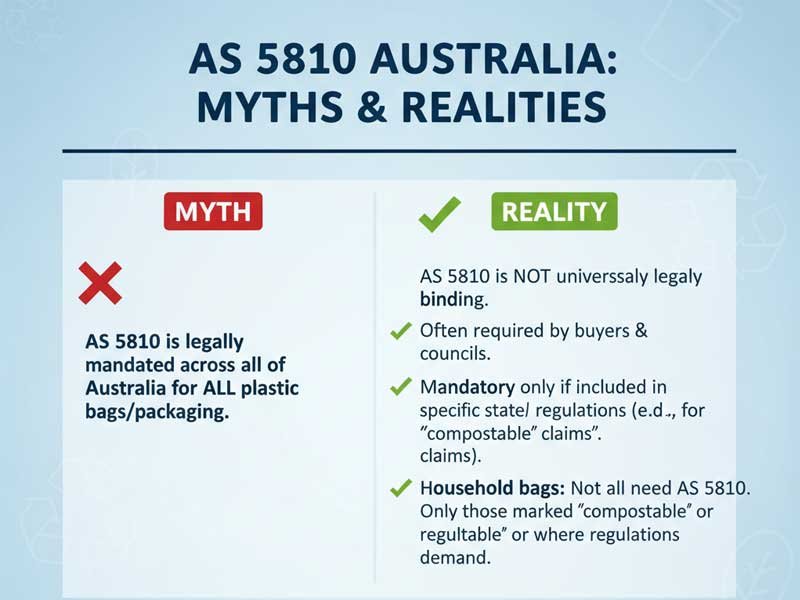
Is AS5810 legally mandatory in Australia?
This statement is incorrect. Many buyers and municipal councils in Australia require the use of AS5810.
There is no blanket law in Australia that mandates all plastic bags or packaging to comply with AS 5810. Whether it is “mandatory” depends on whether each state/local government has included standard certification as part of its regulations/bans.
For household or residential everyday garbage bags/regular plastic bags, not all plastic bags need to meet AS 5810. Only those declared “compostable” or used in situations specifically required by regulations to replace regular plastic may require certification.
Even bags/packaging labeled “compostable” may not actually enter the composting process, depending on the different state/local recycling/composting systems (such as household compost bins, commercial composting facilities, waste treatment facilities).
For example, in some areas, AS 5810 certification does not guarantee that the bags can be placed in the local organic waste collection (FOGO/organics) system.
How AS5810 Supports APCO, National Packaging Targets, and EPR Requirements
While AS5810 is not universally mandated by law, it plays a critical role in helping brands meet Australia’s packaging compliance, sustainability, and extended producer responsibility (EPR) requirements.
1. APCO Sustainable Packaging Guidelines (SPG)
APCO states that packaging can only be described as “compostable” when:
- It is certified to AS5810 (home compostable) or AS4736 (industrial compostable)
- It is realistically recoverable through existing composting systems
- Claims are supported by evidence, certification, and correct labeling
AS5810 certification helps brands avoid misleading environmental claims and ensures compliance during APCO audits.
2. Supports National Packaging Targets 2025
AS5810 certification helps businesses meet:
- 100% reusable, recyclable, or compostable packaging by 2025
- Reduction in problematic plastics
- Clear labeling requirements
- Increased organic recovery through home composting
Home compostable packaging is a key contributor to Australia’s long-term strategy for reducing waste to landfill.
3. Extended Producer Responsibility (EPR) Compliance
Retailers and councils increasingly require:
- Verified certification numbers
- Logo use compliance
- Clear disposal instructions
- Supplier transparency (materials, inks, additives)
AS5810 certification helps manufacturers and importers prove:
- Material safety
- Proper compostability
- Supply chain integrity
- No greenwashing claims
4. Retail & Council Acceptance
Major retailers, e-commerce brands, and local councils prefer AS5810-certified materials because they:
- Break down under low-temperature household composting
- Support FOGO and organics programs where permitted
- Are backed by ABA’s rigorous certification and public database listings
AS5810 certification increases acceptance and reduces risk during retailer packaging audits.
Which Products Can Get AS5810 Home Compostable Certification?
The AS5810 standard applies not only to garbage bags. Its scope is broader.
Types of products compliant with AS5810:
- Kitchen caddy bin liners: Used to collect food scraps. The film is more easily biodegradable.
- Compostable garbage bags: Larger and thicker, but still must meet the standard.
- Retail shopping bags: Reusable or disposable, depending on local regulations.
- E-commerce mailing bags: Many online stores prefer compostable mailing bags over paper ones.
- Pet waste bags: Some local governments do not allow pet waste in FOGO bins.
- The bags themselves may comply with AS5810, but disposal regulations vary by location.
- Food packaging films: For example, produce bags, baking liners, or wrapping paper.
- Compostable labels and stickers: Must use special inks and adhesives.
- Small molded items: For example, clips, seals, or lightweight parts.
In simple terms:
- If a product is made from compostable materials and can decompose naturally in a home environment, then it can pass the AS5810 test.
- It’s important to note that “can” does not necessarily mean “will pass.” It ultimately undergoes rigorous testing.
Only after passing all required tests can the product be certified under the AS5810 home compostable certification program.
8 Things to Check Before You Trust an “AS5810 Certified Home Compostable Bag”
I always use the same checklist to check before trusting a supplier or placing an order.
This helps me avoid buying fake certificates, unreliable materials, and supply chain risks.
1. Check for the official ABA Home Compostable Certification logo
- ABA Home Compostable Logo
Certificate Number
Company Name
Missing any item may indicate a problem.
2. Request a Genuine AS5810 Home Compostable Certification Document (PDF)
- Product Name
- Certificate Number
- Company Name
- Expiration Date
- Testing Laboratory
- A test report is not equivalent to certification.
3. Search the ABA Public Database
If the supplier, brand, or product is not listed in the database, the certification is invalid.
4. Verify the Final Product Specifications
The AS5810 standard applies to finished packaging bags, so please confirm:
- Thickness
- Film Material
- Printing
- Seal Type
Any changes require retesting.
5. Inquire about material ratios
- PLA/PBAT/starch ratio
- Is the ink and adhesive compostable?
- Moisture control methods
A vague answer is a red flag.
6. Request actual product samples
Check:
- Tensile strength and tear strength
- Sealing quality
- Odor control
- Print clarity
- Sensitivity to heat or humidity
- Samples speak louder than rochures.
7. Confirm production consistency control
- Do you test each batch?
- How do you control thickness deviation?
- Do you track material batches?
Many AS5810 non-compliance issues are due to inconsistent production.
8. Assess supply chain risks
- Before ordering, consider:
- Risk of counterfeit certificates
- Unstable resin supply
Ink safety issues - Excessive shipping time (affected by humidity)
A professional supplier can answer all these questions without hesitation.This checklist is a simple way for buyers to verify whether a supplier truly holds AS5810 home compostable certification for their bags and packaging.
How to Obtain AS5810 Certification
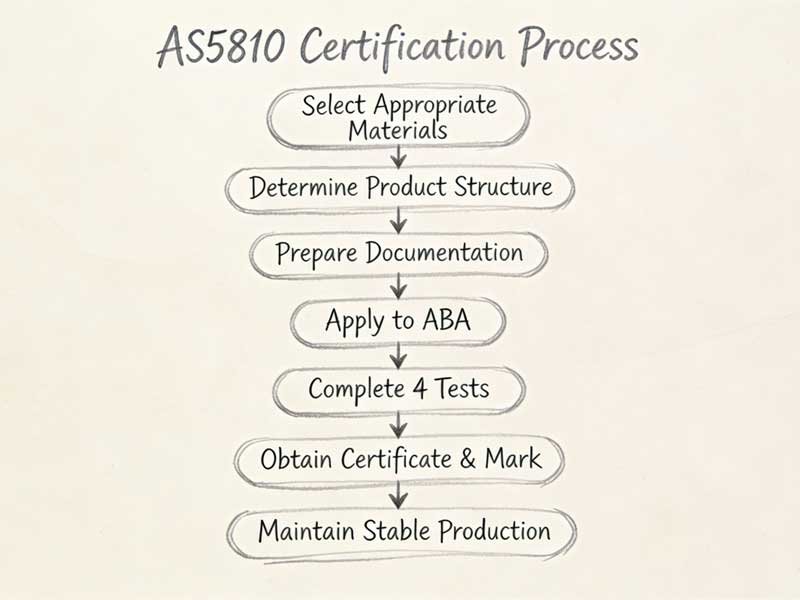
If you want your compostable bags, mailers, or packaging to be legally sold and certified as home compostable products in Australia, you must comply with the AS5810 home compostable certification standard.
Choose suitable material
↓
Finalize product structure
↓
Prepare documents
↓
Apply to ABA
↓
Complete 4 tests
↓
Get certificate + logo
↓
Maintain consistent production
1.Check Your Materials for Compliance
AS5810 is best suited for the following materials:
- PLA
- PBAT
- Starch-based materials
Avoid:
- PE, PP, PET (these materials cannot be certified)
- Dark or metallic inks
- Unknown additives
If the formulation is unstable, the product may fail subsequent tests.
2.Determine Product Specifications Before Testing
AS5810 certification applies to finished products, not raw materials.
You must determine:
- Thickness
- Final printing effect
- Bag shape and sealing method
- Material ratio
- Design and dimensions
Any changes after certification require retesting.
3.Prepare Application Documents
You will need to prepare:
- Product description
- Material information
- Material Safety Data Sheet (MSDS)
- Ink and adhesive details
- Drawings or product photos
4.Apply Through the Australian Bioplastics Association (ABA)
ABA handles AS5810 certification.
The steps include:
- Completing the application form
- Submitting product samples
- Paying testing fees (typically USD 6,000 to USD 10,000)
- Waiting for approval and testing arrangements
- Testing typically takes 10 to 16 weeks.
5.What does the AS5810 standard test?
Biodegradation:
Measures the degree to which a material is converted into carbon dioxide, water, and biomass.
The product must reach a certain biodegradation rate within a specified time. That is, if a compostable bag remains almost intact after several months in the compost pile, it is considered substandard.
Decomposition:
Tests whether the material physically decomposes.
A qualified product must decompose to a certain extent so that no large residue remains after sieving the compost. Thicker bags will fail this test.
Hazardous Chemical Detection
The final compost must not contain heavy metals or toxic substances. This includes checking inks, dyes, adhesives, and additives. If a brand uses inferior inks, the product may be substandard even if the material is compostable.
No Impact on the Composting Process
The product should not slow down the composting process.
It should not harm earthworms. It should not harm plants. It should not prevent the compost pile from heating up. Verified by plant growth and earthworm survival tests.
Key Technical Requirements of the AS5810 Home Compostable Standard
6.AS5810 Certification Process
Once a product passes all tests, the certification body (usually the ABA, the Australian Bioplastics Association) will issue a certificate.
- ABA issues a formal certificate.
- Products receive an independent certification number.
- The Home Compostable Logo can be legally used.
- The brand name will be listed in the ABA public database (searchable as: Shandong Orizon Biomaterials Co., Ltd.).
The certification is typically valid for 3 years, during which time the formula and structure cannot be changed.
This means your product can be sold on the market, and it can then use:
- The official “Home Compostable” label
- Certification number
- The brand name associated with the certificate
Without this certificate, a brand cannot legally claim its products are home compostable in Australia. Australia has strict regulations against false environmental claims.
The Australian Competition and Consumer Commission (ACCC) has warned It is crucial to understand this if you sell or plan to sell products in Australia.
7.Comply with Labelling and Usage Rules
ABA Requirements:
- Correct label size
- Display certification number
- No color alteration
- No labeling on untested products
- Violation of these rules may result in loss of certification.
8.Maintain Production Consistency
Certification remains valid only if the product remains unchanged.
Avoid:
- Changing raw materials
- Changing molds or thickness
- Changing ink systems
- Changing production lines
Any major changes require retesting.
Why Some Products Fail AS5810 Testing
Here are some common problems I’ve encountered in practice:
- Packaging bags are too thick, hindering rapid degradation.
- Heavy metal content in the ink exceeds limits.
- High PBAT content in the blend can slow disintegration if the film is too thick. PBAT stands for polybutylene adipate terephthalate, a flexible biodegradable polyester often used together with PLA and starch.
- Additives are unsuitable for composting.
- Sample products do not match mass-produced products.
- Products were not fully dried before testing.
- Colors are too dark, affecting oxygen flow.
These errors are not uncommon. Even experienced suppliers frequently make these mistakes.
In many of these cases, the product fails not because compostable technology is impossible, but because the supplier did not fully understand or follow the AS5810 home compostable certification requirements.
Key Technical Requirements of the AS5810 Home Compostable Standard
Unlike general claims such as “biodegradable” or “eco-friendly,” AS5810 is a strict scientific certification with measurable pass/fail criteria. A product must meet all of the following numeric requirements to be certified as home compostable in Australia.
1. Biodegradation Requirement
To pass the AS5810 biodegradation test, the material must:
- Reach ≥ 90% biodegradation within 12 months
- Break down at ambient home compost temperatures (20–30°C)
- Convert into carbon dioxide, water, and biomass without leaving persistent residues
This proves that the product will decompose effectively in backyard compost bins without needing industrial heat.
2. Disintegration Requirement
To pass the disintegration test:
- The material must break into small pieces
- After 6 months, at least 90% of the material must be able to pass through a 2 mm sieve
This ensures no large visible plastic-like fragments remain in the compost.
3. Ecotoxicity and Plant Growth Safety
The compost created from the material must:
- Support healthy plant growth
- Show no toxicity
- Show no reduction in germination rate
- Be safe for earthworms and soil organisms
This ensures the compost is safe for gardens, agriculture, and soil ecosystems.
4. Heavy Metal and Chemical Limits
AS5810 certification requires:
- Strict limits on lead, cadmium, chromium, mercury, copper, nickel, zinc
- No harmful additives
- No toxic inks or coatings
- No PFAS or fluorinated chemicals (increasingly enforced by certification bodies)
These rules prevent long-term contamination of compost and soil.
5. No Negative Impact on Composting Process
The product must not:
- Slow the composting process
- Prevent microbial activity
- Reduce compost pile temperature
- Interfere with the compost’s carbon–nitrogen balance
These requirements ensure that AS5810-certified packaging behaves like natural organic matter inside a home compost system.
New Compliance Trend: PFAS-Free Requirements for Compostable Packaging
As global regulations tighten, certification bodies are increasing scrutiny on chemical additives within compostable materials.
Why PFAS Matters
-
PFAS (“forever chemicals”) do not break down in compost
-
They can contaminate soil and groundwater
-
Many countries are moving toward PFAS-free mandates
AS5810 Implications
While AS5810 traditionally focuses on biodegradation, disintegration, and ecotoxicity, many certifying bodies and councils now also expect:
-
No PFAS-based coatings
-
No fluorinated grease-resistant treatments
-
No persistent harmful additives
Future-Proofing Your Packaging
Suppliers aiming for long-term compliance should ensure:
-
Materials are PFAS-free
-
Inks and adhesives use non-fluorinated formulations
-
No chemicals with long-term environmental persistence are used
AS5810 Home Compostable Certification vs AS4736 vs EN13432: Which Standard Is Best for You?
When customers inquire about AS5810, they often also ask about two other standards: AS4736 and EN13432. These standards sound similar, and their rules overlap. However, these differences are crucial when choosing packaging for Australia.
Simply put:
- AS5810 = Household compostable standard (Australian standard)
- AS4736 = Industrial compostable standard (Australian standard)
- EN13432 = Industrial compostable standard (European standard)
AS5810: For Home Composting
Effective at lower temperatures, as home backyard compost piles don’t reach very high temperatures. This standard is often relevant if you’re selling to Australian families, small shops, or e-commerce platforms.
AS4736: For Industrial Composting
AS4736 is also an Australian standard applicable to industrial composting facilities.
In these facilities, composting temperatures are higher, and the compost is machine-turned. The material decomposes faster.
Some people believe:
“If my product meets EN13432 or AS4736, then it must also meet AS5810.” This is not true.
A product that works well at high temperatures may not decompose in a home backyard compost pile. The Australian Biotechnology Association (ABA) warns companies not to confuse these standards in their advertising.
EN13432: European Industrial Composting Standard
This is the most widely used compostable standard globally.
Many companies in China, Europe, and the United States use this standard. However, it is designed for industrial environments, not home use. A product cannot claim to be “home compostable” if it only meets the EN13432 standard.
In Australia, consumers typically need home compostable products, not industrial compostable products.
| Feature / Parameter | AS5810 (Home Compostable) | AS4736 (Industrial Compostable) | EN13432 (Industrial – EU) |
|---|---|---|---|
| Composting environment | Home / backyard compost | Industrial facility | Industrial facility |
| Temperature | Low (20–30°C) | High (50–60°C) | High (50–60°C) |
| Biodegradation | ≥ 90% within 12 months | ≥ 90% within 180 days | ≥ 90% within 180 days |
| Disintegration | 90% < 2 mm in 6 months | 90% < 2 mm in 12 weeks | Similar to AS4736 |
| Ecotoxicity | Required | Required | Required |
| Worm toxicity | Required | Optional | Optional |
| Typical applications | Caddy liners, retail mailers, home-use bags | Food service, bin liners, councils | European packaging |
| Accepted in Australia? | Widely accepted for home compost | Only where industrial composting exists | Not accepted for home compost |
Which standard is right for you?
- If your customers are Australian households: AS5810
- If your customers are Australian municipalities: AS4736
- If your customers are European customers: EN13432
Different markets, different standards. If you are selling products online to Australian consumers, AS5810 is usually the safest and most flexible option.
How to Tell if AS5810 Home Compostable Certification Is Real
Many products on the market claim to be “compostable” but are not actually professionally certified. Some products use misleading language, some use counterfeit labels, and some are completely unaware of the relevant regulations.
When I check a product that claims to be AS5810 certified, I always verify the AS5810 home compostable certification number against the ABA database.
Look for the official ABA “Home Compostable” label
This label should include:
- The label itself
- Certification number
- Company name
If any of these are missing, be cautious.
Obtain a certificate
A genuine certificate should include:
- Certificate number
- Product name
- Company name
- Expiration date
- Testing laboratory
- Materials used
If the information on the certificate does not match the actual product, be wary.
Check the ABA database: a reliable step
The Australian Bioplastics Association maintains a publicly available list of certified products. If a brand is not listed, regardless of how it is labeled on the packaging, the product is not certified.
Beware of “Green Whitewashing” Terminology
If you see the following terms:
“eco-friendly plastic,” “biodegradable,” “earth-friendly,” “environmentally safe”… without a standard number, the claim is unreliable.
In 2023, the Australian Competition and Consumer Commission (ACCC) warned companies to avoid using vague “green” claims without evidence.
Brands should not claim their products are compostable if they cannot provide AS5810, AS4736, or EN13432 certification.
Why Do Home Compost Bags Sometimes Decompose Slowly?
Sometimes buyers report to our factory, “I’ve left the bag in the compost bin for months, and it hasn’t decomposed.”
My answer is: Home composting isn’t a controlled laboratory.
- Laboratory testing conditions are stable: stable temperature, regular turning, stable humidity, and a balanced carbon-to-nitrogen ratio.
- Home composting is different: it might be too dry, too cold, or not turned at all.
Therefore, if your bag decomposes slowly at home, it doesn’t mean it doesn’t meet standards. It means the composting conditions might not be ideal. This is normal. Even the American Composting Association (ABA) points out that actual composting conditions vary greatly.
How to Compost AS5810 Certified Bags at Home (Best Practices)
Even when a product passes AS5810 certification, real home composting conditions vary greatly. To ensure faster and more complete decomposition, here are practical steps users can follow.
1.Maintain Proper Moisture
- Compost should feel like a wrung-out sponge
- Too dry → decomposition slows
- Too wet → low oxygen, bad odor
Add dry carbon material (leaves, cardboard) if the pile becomes too wet.
2. Improve Oxygen Flow
- Turn the compost every 2–3 weeks
- Aeration encourages microbial activity
- Ensures better breakdown of compostable bags
3. Place Bags in the Warmest Area of the Compost
The center of the compost pile is the warmest area.
- Bury AS5810 bags beneath food scraps
- Avoid placing bags on the surface
4. Tear Bags Into Smaller Pieces Before Composting
More surface area = faster biodegradation.
A simple step that reduces decomposition time significantly.
5. Balance Carbon and Nitrogen
To maintain a healthy compost ecosystem:
-
Nitrogen: food scraps, grass, kitchen waste
-
Carbon: leaves, paper, cardboard, dried plants
Ideal C:N ratio ≈ 25–30:1
6. Maintain Temperature
Even household compost works better with some warmth.
- Use a compost bin lid
- Keep compost out of direct wind
- Store in a sunny location during winter months
These practices ensure the bag breaks down as intended under home compost conditions.
Can As5810 Garbage Bags Be Used in Fogo Bins?
This is one of the most easily misunderstood questions. And the answer isn’t the same everywhere. In Australia, some local governments accept AS5810 garbage bags, while others don’t. Why?
- Some areas are concerned about pollution from counterfeit compostable garbage bags.
- Some areas are concerned about pet feces, as it contains bacteria that could contaminate the soil.
- Some areas want to avoid confusion between different types of garbage bags.
Here are some general guidelines:
- South Australia: More open to AS5810 garbage bags.
- Queensland & Victoria: Depends on local government regulations.
- New South Wales: Generally restricts the use of dog feces bags, even compostable ones.
If you sell compostable garbage bags, it’s best to guide your buyers by saying, “Please check your local government’s FOGO bin regulations.” This can avoid many misunderstandings.
Why Dog Poop Bags Are Disposed Of Differently
Even if dog poop bags meet AS5810 standards, many municipalities do not allow pet feces to be put into composting.
Pet feces may contain pathogens, and the temperature in composting facilities may not be sufficient to kill these pathogens.
Municipalities are unwilling to take the risk, so the problem isn’t the bag itself, but the feces inside.
This is why some municipalities prohibit dog poop bags from being put in FOGO bins, even if the bags are certified. This may confuse consumers, but the regulation is for safety reasons.
Why Compost Bags Sometimes Feel Fragile or Tear Easily
If you’ve ever used a compost bag and felt it was “not sturdy enough,” this is indeed a current drawback, but compostable materials are different from petroleum-based plastics.
- PLA and PBAT soften when heated.
- Starch blends absorb moisture.
- Home compostable products are designed to decompose, not last forever.
It’s impossible for a product to be both “as sturdy as plastic” and “decomposes quickly.” Manufacturers are constantly striving to balance durability and compostability. Perfection is not yet possible, but the technology is improving every year.
Can As5810 Garbage Bags Be Used in Fogo Bins?
How to Buy AS5810 Compostable Bags From a Supplier
I’ve worked with many buyers who hesitate when purchasing compostable bags.
Some worry about getting fake certificates. Some don’t know what questions to ask. Some pay too much because they don’t understand the materials. If you want to avoid these problems, here’s what I usually tell you: You don’t need to be an expert. You just need to ask clear and specific questions.
Ask the supplier about their certifications
A reputable supplier should provide the following information:
- AS5810 certification certificate
- Certificate number
- Product name and thickness
- Company name on the certificate
- Validity period
If this information doesn’t match the product, there may be a problem. A trustworthy supplier will provide this information without hesitation.
Ask about the material formulation
Most household compostable bags use a mixture of the following materials: PLA (polylactic acid), PBAT (polybutylene terephthalate), and starch. The proportions of these ingredients affect: strength, flexibility, cost, and compostability.
If a supplier cannot explain their formulation in simple terms, you need to be cautious. You don’t need to know every detail, but a basic explanation shows they have a good understanding of their product.
Request Samples
Test samples yourself before placing an order.
Does the bag stretch or tear easily?
- Is the seal even?
- Is the printing clear?
- Does the bag feel sticky or too soft in warm weather?
A real sample is more convincing than any brochure.
Inquire about Thickness Control
Many AS5810 certification failures are due to products being too thick. Even small variations are crucial.
For example:
- Garbage bags of 17-20 microns might pass certification.
- Mail bags of 30 microns might struggle to pass certification.
Certification may fail if the supplier fails to effectively control thickness during mass production.
Common Supply Chain Risks ( How to Avoid Them)
I’d like to share some of the most common problems I encounter. These are based on real-world examples, not theory.
Counterfeit Certificates
This is the biggest risk.
Some suppliers use:
- Expired certificates
- Certificates belonging to other companies
- Certificates for other products
- Test reports only, no certificate
- Test reports are different from certifications.
- ABA has clear regulations on this.
The safest approach: Always check the ABA-approved list.
Inconsistent Material Quality
Some factories change materials when prices fluctuate. They might use cheaper starch or more PBAT (potassium dihydrogen phosphate).
This affects:
- Bag strength
- Sealing performance
If the materials change, the certificate will become invalid. This is why stable suppliers are crucial.
Ink and Printing Issues
The ink must also be compostable. Some suppliers overlook this. If ordinary ink is used, the bags may fail chemical tests.
A reliable supplier will inform you:
The types of inks they use
- Whether the inks meet composting requirements
- Which colors work best
- Dark black and dark colors often cause problems.
Thickness Variation
Producing compostable film of consistent thickness is much more difficult than you might think. If the film thickness deviation is ±3-5 microns, a 20-micron bag could end up with a 25-micron thickness on one side.
This will affect its compostability.
I’ve seen some buyers focus only on price and ignore thickness control. Later, they ran into problems with certification.
Packaging and Storage Issues
Compostable bags absorb moisture. They also soften at high temperatures.
To avoid problems:
- Store the bags in a cool, dry place
- Avoid direct sunlight
- Use within 8-12 months
The supplier should warn you about this. If they don’t, it’s worrying.
What Affects the AS5810 Bags Price?
Buyers sometimes ask why compostable bags are more expensive than plastic bags.
Factors affecting compostable bag prices:
- Raw materials (PLA, PBAT, starch): Prices fluctuate with global supply.
- Certification costs: AS5810 certification is time-consuming and expensive.
- Printing and colors: Compostable inks are more expensive.
- Thickness: Greater thickness → more material used → higher cost.
- Bag size and design: Drawstring bags, wavy bags, and mailer bags require different molds or sealing tools.
- Order quantity: Generally, the larger the order quantity, the lower the price.
There is no “one-size-fits-all” price.
However, understanding the price structure allows you to compare different suppliers more fairly.
How to Store AS5810 Garbage Bags
- Store in a cool, dry place.
- Avoid high temperatures (>35°C).
- For best performance, use within one year.
- Do not allow garbage bags to come into contact with sharp objects.
- Do not overload.
Please inform the end user to check local composting regulations. These small steps will greatly improve the user experience.
How to Source As5810 Compostable Bags from China
Most AS5810 home compostable bags used in Australia are manufactured in China, but not all factories fully meet the certification requirements. When sourcing, buyers should verify the supplier’s genuine AS5810 certificate, check material stability (PLA/PBAT/Starch ratios), confirm ink and adhesive compliance, and review film thickness control.
If you plan to source S5810 bags from China, we wrote a full China-focused guide here. 《 How to Source AS5810 Bags from China (Choosing a Reliable Compostable Bags Supplier) 》
FAQ
Are AS5810 garbage bags suitable for all composting machines?
No. Some home compost heaps are too cold or too dry.
Can I put AS5810 dog poop bags in FOGO bins?
This depends on municipal regulations. Regulations vary by area.
Can EN13432 replace AS5810?
No. EN13432 is for industrial composting. AS5810 is for home composting.
Why are my compostable garbage bags decomposing during storage?
High temperatures and humidity weaken the material’s properties. This is normal for compostable plastics.
Can I print any design on AS5810 garbage bags?
Yes, but biodegradable ink must be used. Note that excessive ink can cause testing failure.
Limitations of AS5810: What the Standard Does Not Guarantee
AS5810 is one of the strictest home composting standards in the world, but it is important to understand its boundaries. Certification proves compostability under test conditions, but does not guarantee performance everywhere.
1. AS5810 Does Not Guarantee Breakdown in Landfill
Home compostable plastics require oxygen and microbial activity.
Landfills lack both.
Therefore, even certified AS5810 bags may not degrade in landfill conditions.
2. Does Not Guarantee Breakdown in Marine or Natural Environments
AS5810 certification does not mean:
- biodegradable in the ocean
- biodegradable in soil
- biodegradable in freshwater
It only applies to home composting systems.
3. Does Not Mean Every Council Accepts It
Even if a bag is AS5810-certified:
- Some councils do not allow compostable bags in FOGO bins
- Some restrict pet waste or certain materials
- Acceptance varies by region and waste contractor
Users must always check local guidelines.
4. Does Not Mean All Home Composting Conditions Are Suitable
Backyard compost conditions vary dramatically:
- Too cold
- Too dry
- Not turned
- Unbalanced carbon/nitrogen ratio
A certified bag may decompose slowly if the compost system is not well-maintained.
5. Does Not Guarantee Extreme Strength
Home compostable materials are designed to degrade.
This means:
- They may soften in heat
- They may absorb moisture
- They cannot be as strong or durable as petroleum-based plastic
This is normal and expected.
Conclusion
If you are already familiar with the AS5810 home compostable certification standard and now want to evaluate which types of home compostable bags are suitable for your business, you may find our detailed guide on home compostable bags helpful.
AS5810 is more than just a technical standard; it’s a practical guide to help people make honest and safe choices. It protects the environment, homes, municipalities, and consumers by providing clear and reliable information.
For anyone working with compostable products, understanding the AS5810 home compostable certification standard can reduce confusion, prevent costly mistakes, and lead to more informed decisions when choosing materials and suppliers.
Related Articles