ASTM D6400 Explained: Certification Requirements for Compostable Plastics
- Andrea Chen
- Compostable Packaging Compliance Specialist
Table of Contents
When people see the words “compostable” on a bag or package, many wonder what it really means. Many buyers ask this question often comes up in stores, online, and even in Reddit discussions. One term that appears again and again is ASTM D6400.
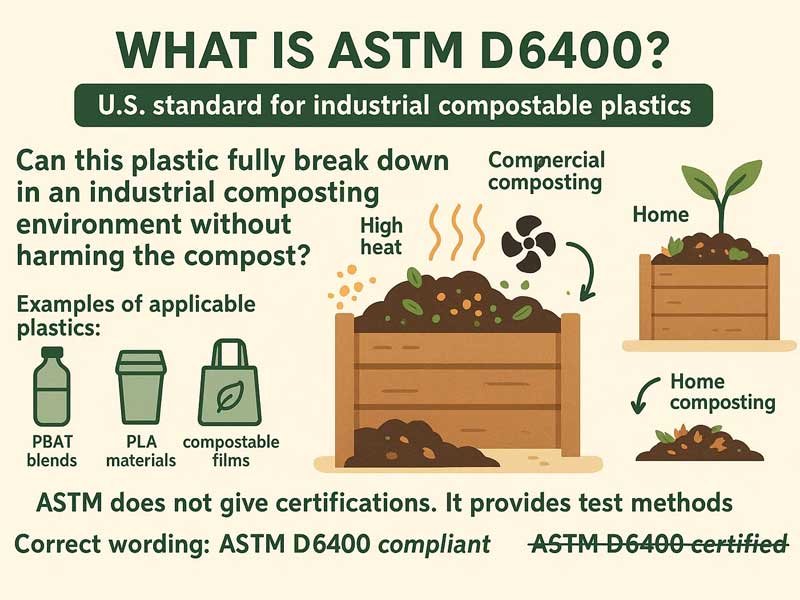
ASTM D6400 is a U.S. standard that defines how compostable plastics must break down in industrial composting facilities without leaving harmful residues.
If you work with compostable bags, packaging films, or materials like PLA and PBAT, you will see this standard often. But what does it truly mean? And how does it connect to certifications like BPI Certification?
This guide explains ASTM D6400 in a simple and clear way. I want you to understand what it tests, how products meet it, and why businesses rely on it today.
Why Do People Search for ASTM D6400?
People search for ASTM D6400 because the term appears on many compostable products. But these same people are unsure about:
- Whether it means “biodegradable”
- Whether it is the same as BPI Certification
- How long something takes to break down
- Whether the product is safe for soil
Many buyers on social media mix up the meanings. Some think it is a certification. Some think it guarantees home composting. Neither is correct. This article clears up these misunderstandings.
What Is ASTM D6400?
ASTM D6400 is a technical specification issued by ASTM International.
Its full title is:
Standard Specification for Labeling of Plastics Designed to be Aerobically Composted in Municipal or Industrial Facilities.
The standard applies to plastic products intended for industrial composting systems.
It does not apply to landfill degradation.
It does not automatically apply to home composting.
The official specification is published by ASTM International and can be accessed through the ASTM standards database.
ASTM D6400 Requirements Summary (Quick Overview)
ASTM D6400 requires compostable plastics to meet the following measurable criteria:
- 90% biodegradation within 180 days
- Physical disintegration during composting
- No harmful residue affecting plant growth
- Compliance with heavy metal limits
- Industrial composting temperature (55–60°C)
This standard applies only to industrial composting environments.
What Does ASTM D6400 Certify?
Many buyers ask this confusion everywhere—especially on Reddit and LinkedIn.
Here is the truth:
- ASTM D6400 = test standard
- BPI Certification = official approval
BPI uses ASTM D6400 (and ASTM D6868) to check whether a product qualifies as industrial compostable. Only BPI can issue a certification mark for the U.S. market.
So if you want a product that is officially recognized, you look for BPI Certified Compostable, not “ASTM certified.”
Core Requirements of ASTM D6400
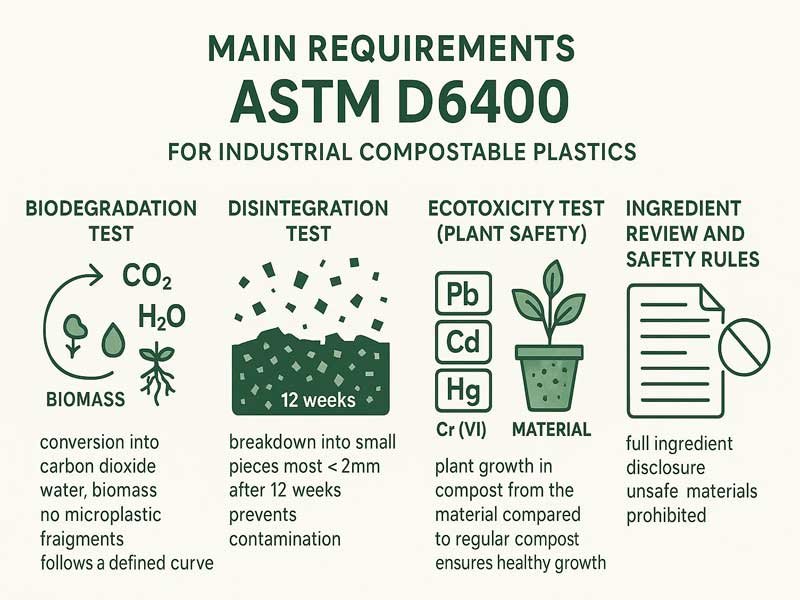
To comply with ASTM D6400, a product must meet four major criteria:
1. Biodegradation Requirement
At least 90% conversion of organic carbon to carbon dioxide (CO₂) within 180 days under controlled industrial composting conditions.
2. Disintegration Requirement
Material must physically break down and not be visually distinguishable in compost after processing (typically 84 days).
3. Ecotoxicity Requirement
Compost resulting from degradation must not negatively affect plant growth.
4. Heavy Metal Limits
Products must remain within defined heavy metal concentration thresholds.
These requirements are tested in laboratory conditions designed to simulate industrial composting facilities.
Industrial Composting Conditions
ASTM D6400 compliance assumes:
• Controlled temperature (typically 55–60°C)
• Aerobic microbial activity
• Regulated moisture
• Managed composting cycles
Without these conditions, degradation may not occur within the defined timeline.
ASTM D6400 is therefore an industrial composting standard, not a landfill or marine degradation standard.
Which Products Must Meet ASTM D6400?
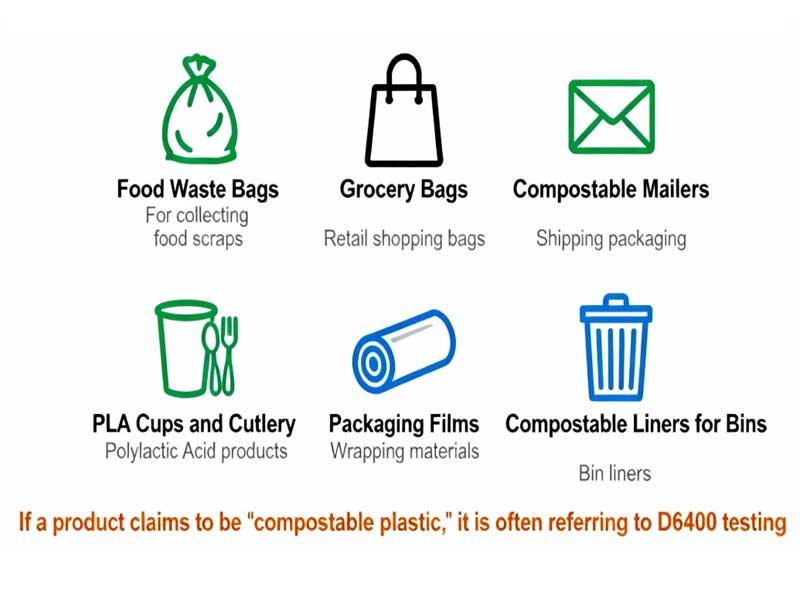
You will find ASTM D6400 mentioned on many compostable products, including:
- food waste bags
- grocery bags
- compostable mailers
- PLA cups and cutlery
- packaging films
- compostable liners for bins
If a product claims to be “compostable plastic,” it is often referring to D6400 testing. ASTM D6400 applies to compostable plastic products intended for industrial composting, including commercial compostable trash bags used in food service and commercial waste management.
How ASTM D6400 Certification Works
ASTM writes the standard.
Certification bodies verify compliance.
In North America, ASTM D6400 compliance is often verified through BPI certification
Certification typically requires:
• Independent laboratory testing
• Technical data review
• Ingredient disclosure
• Labeling verification
• Ongoing renewal
Products approved under certification programs are listed in public databases.
ASTM D6400 vs ASTM D6868
These two standards are often paired, but they apply to different things.
| Standard | Applies To | Notes |
|---|---|---|
| ASTM D6400 | Compostable plastics | Used for bags, films, resins |
| ASTM D6868 | Paper + compostable coating | Used for cups, paper trays, packaging |
ASTM D6868 is for fiber-based items with a compostable coating.
ASTM D6400 is for the plastic components themselves.
ASTM D6400 vs EN 13432
For global comparison:
| Standard | Region | Compost Type |
|---|---|---|
| ASTM D6400 | USA & Canada | Industrial |
| EN 13432 | European Union | Industrial |
Both standards require biodegradation, disintegration, and ecotoxicity testing.
However, regional documentation and labeling requirements differ.
If exporting to Europe, EN 13432 certification may also be required.
ASTM D6400 vs BPI Certification
Here is the simplest answer:
- ASTM D6400 is the test method.
- BPI Certification is the proof that a finished product meets the test.
BPI checks:
- ingredient safety
- labeling
- product-level performance
- updated PFAS rules
So, ASTM D6400 is only one part of the full process.
How ASTM D6400 Testing Works (Step-by-Step)
Here is a simplified view of the testing process:
- A company sends product samples to an accredited lab.
- The lab runs a biodegradation test.
- The product goes through a disintegration trial for 12 weeks.
- Heavy metals and chemical safety tests follow.
- The lab issues a report.
- The company uses this report to apply for BPI Certification.
This entire process typically takes several months.
Common Misunderstandings About ASTM D6400
These are the key points that are most easily misunderstood:
ASTM D6400 does not mean biodegradable in landfill.
Landfills lack oxygen and proper composting conditions.
ASTM D6400 does not automatically mean home compostable.
Home composting requires separate testing under lower temperature conditions.
Certification applies to specific products, not entire brands.
Always verify the certified product listing.
How to Know If Something Meets ASTM D6400
Here are simple steps you can use:
1. Check the BPI Database
If a product meets ASTM D6400, it often becomes BPI certified.
Search the product or company name.
2. Ask for the ASTM D6400 compliance report
Manufacturers can request this from testing labs.
3. Look for accurate labeling
Products should say “meets ASTM D6400” or “BPI Certified Compostable.”
4. Avoid vague claims
Terms like “eco-friendly” or “biodegradable” do not mean D6400 compliant.
Simple Examples of ASTM D6400-Compliant Products
Here are common items that follow this standard:
- food scrap bags
- compostable shopping bags
- PLA cup lids
- bio-based films
- paper cups with compostable coatings (D6868)
These items help reduce landfill waste when used in the right systems.
Who Uses ASTM D6400 Standards?
ASTM D6400 compliance is commonly required in:
• US municipal organics programs
• Hospitality waste diversion systems
• Food service operations
• Institutional composting frameworks
• Sustainability procurement policies
In regulated environments, certification clarity protects waste stream integrity and reduces contamination risk.
For structured bulk supply aligned with certified compostable programs, see Compostable Trash Bags Manufacturer
For distribution or private-label programs, visit Compostable Trash Bags Wholesale
Why ASTM D6400 Matters in Regulated Waste Systems
In compliance-driven waste systems, compostable materials are not interchangeable commodities.
They are part of waste diversion infrastructure.
When materials lack verified certification:
- Loads may be rejected
- Facilities may impose penalties
- Contamination risk increases
- Diversion targets may fail
ASTM D6400 provides defined, measurable compostability criteria that reduce these risks.
FAQ About ASTM D6400
ASTM D6400 is a U.S. test standard for industrially compostable plastics. It explains how a plastic product should break down in a commercial composting facility.
ASTM D6400 requires 90% biodegradation within 180 days, disintegration under composting conditions, ecotoxicity compliance, and heavy metal limits.
ASTM D6400 requires 90% biodegradation within 180 days under industrial composting conditions, material disintegration, ecotoxicity safety, and heavy metal limits.
No. ASTM D6400 is a testing standard. It shows how compostability is tested, but it does not certify a product by itself.
Yes. BPI certification relies on recognized ASTM test methods, including ASTM D6400 (and ASTM D6868 for some coated or fiber-based products), to evaluate compostable items.
Not in the general sense. It means the product is designed to biodegrade under industrial composting conditions, not in soil, oceans, or landfills.
No. ASTM publishes standards and test methods. Certification is done by third-party certification programs (such as BPI), not by ASTM.
No. Home composting requires separate testing under lower temperature conditions.
No. Compostable coated paper products are typically tested under ASTM D6868.
Conclusion
ASTM D6400 is one of the most important standards for compostable plastics in the United States. It tells us how to test plastics for safe industrial composting. It protects soil, supports composting facilities, and helps businesses make honest claims.
If you use compostable bags or packaging, understanding this standard helps you choose products that truly break down—not just those with green labels.