EN 13432 Standard Explained
Table of Contents
Requirements, Testing, Disintegration & Certification Overview
EN 13432 is the official European standard used to evaluate whether packaging materials are suitable for industrial composting.
It defines clear, testable criteria for biodegradation, physical disintegration, chemical safety, and compost quality.
Any packaging product marketed as “compostable” in the European Union is expected to comply with EN 13432.
This page explains:
- What the EN 13432 standard actually requires
- How EN 13432 testing works in practice
- Disintegration and biodegradation thresholds
- Certification, logos, and verification
- Common compliance mistakes brands make
EN 13432 at a Glance
The EN 13432 standard defines whether packaging is suitable for industrial composting.
To comply, a product must achieve at least 90% biodegradation within 180 days,
physically disintegrate within 12 weeks with less than 10% residue remaining (all fragments under 2 mm),
meet heavy metal limits, and pass ecotoxicity and plant growth tests.
Only products that pass all required tests may be considered EN 13432 compliant.
Quick Summary: EN 13432 Key Requirements
To comply with EN 13432, a packaging product must meet all of the following:
Biodegradation:
At least 90% biodegradation within 180 days under industrial composting conditionsDisintegration:
After 12 weeks, no more than 10% of material remains, and all fragments must be smaller than 2 mmChemical Safety:
Heavy metals must stay below strict EU limitsEcotoxicity:
Final compost must support normal plant growth
Failure in any single test means the product does not meet EN 13432.
What Is the EN 13432 Standard?
EN 13432 is a harmonized European standard titled:
“Packaging — Requirements for packaging recoverable through composting and biodegradation.”
It applies to packaging products, including:
- Films and bags
- Food-contact packaging
- Shopping and carrier bags
- Labels, tapes, and flexible packaging
- Multi-layer compostable structures
EN 13432 evaluates the finished product, not just the raw material.
In short, this certification proves that the product meets the technical requirements of the EN 13432 standard. If you want a simple explanation of how the EN 13432 standard defines compostable packaging, you can read our article on the EN 13432 standard and its key requirements.
EN 13432 Standard vs EN 13432 Certification
EN 13432 is a technical standard that defines compostability requirements.
Certification is the process used to demonstrate compliance with that standard through laboratory testing and third-party verification.
In practice, companies must meet the EN 13432 standard first, and then obtain certification from an accredited body to prove compliance.
EN 13432 vs “Biodegradable” Claims
A common misunderstanding is equating biodegradable with EN 13432 compliant.
Key differences:
EN 13432 requires third-party laboratory testing
“Biodegradable” claims often lack defined conditions or timelines
EN 13432 is legally recognized across the EU for compostability claims
For brands and importers, EN 13432 is the compliance baseline, not an optional label.
EN 13432 Testing Requirements Explained
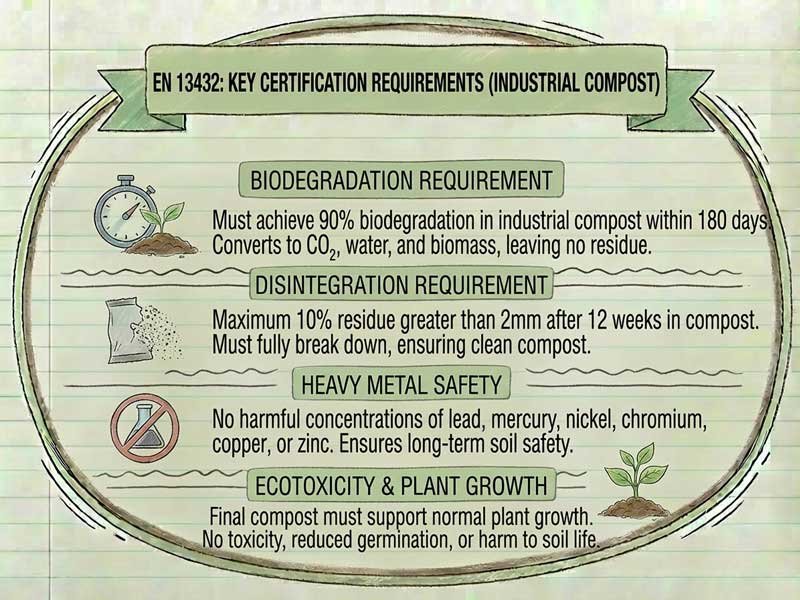
EN 13432 certification testing consists of four mandatory components.
1. Biodegradation Test (180 Days)
The material must reach ≥90% biodegradation within 180 days under controlled industrial composting conditions.
Biodegradation is measured by:
CO₂ evolution
Comparison against reference materials
This confirms the material truly breaks down at a molecular level.
2. Disintegration Test (12 Weeks)
After 12 weeks of composting:
- No more than 10% of the original mass may remain
- All residues must be smaller than 2 mm
This test ensures the material does not leave visible fragments in compost.
Many products fail EN 13432 at this stage due to excessive thickness or incompatible layers.
3. Heavy Metal & Chemical Limits
EN 13432 sets strict limits for elements such as:
- Lead
- Mercury
- Cadmium
- Chromium
- Copper
- Zinc
These limits protect soil health and prevent long-term contamination.
4. Ecotoxicity & Plant Growth Test
Final compost containing the test material must show:
- No toxicity
- Normal seed germination
- Healthy plant growth
This confirms the compost is safe for agricultural use.

EN 13432 Disintegration vs Biodegradation (Why Both Matter)
A product may biodegrade chemically but still fail disintegration.
Common failure reasons include:
- Film thickness too high
- Non-compostable inks or adhesives
- Multi-layer structures with incompatible layers
EN 13432 requires both processes to succeed.
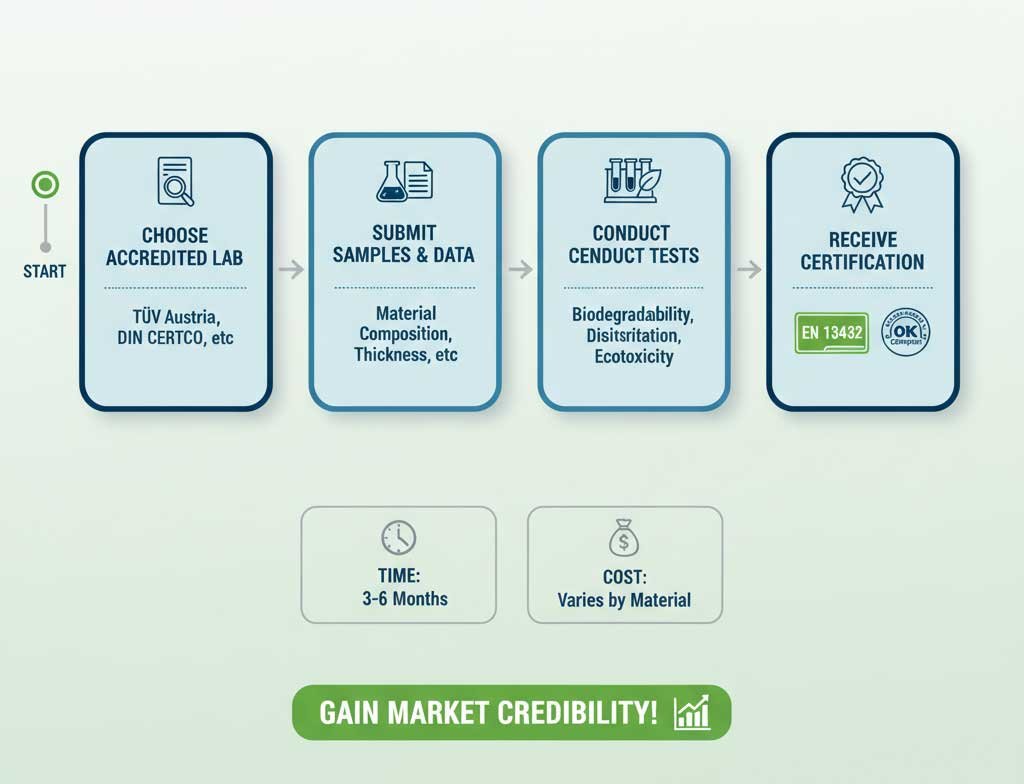
EN 13432 Certification Process (Step by Step)
While EN 13432 is a standard, compliance is proven through certification.
Typical process:
Product formulation review
Sample submission to accredited lab
Laboratory testing (180 days + 12 weeks)
Audit and assessment
Certificate issuance
Only after passing all steps can a product be marketed as EN 13432 compliant.
EN 13432 Testing Timeline
| Test Item | Typical Duration |
|---|---|
| Biodegradation | Up to 180 days |
| Disintegration | 12 weeks |
| Heavy metals | Days to weeks |
| Ecotoxicity | Several weeks |
Total time often ranges from 6 to 12 months, depending on product complexity.
What Increases the Risk of EN 13432 Test Failure?
- Excessive film thickness
- Multi-layer structures with non-compostable barriers
- Non-certified inks or pigments
- Adhesives not evaluated for composting
- Product modifications after certification
EN 13432 Certification Marks & Logos
Commonly recognized marks include:
Seedling Logo (DIN CERTCO)
OK Compost INDUSTRIAL (TÜV Austria)
These logos indicate that the product has passed EN 13432 requirements under industrial composting conditions.
Logos may only be used within the certified scope.
Certification logos may only be used within the approved product scope.
Misuse of EN 13432-related marks may result in certificate suspension or regulatory penalties under EU Green Claims rules.
How to Verify EN 13432 Compliance
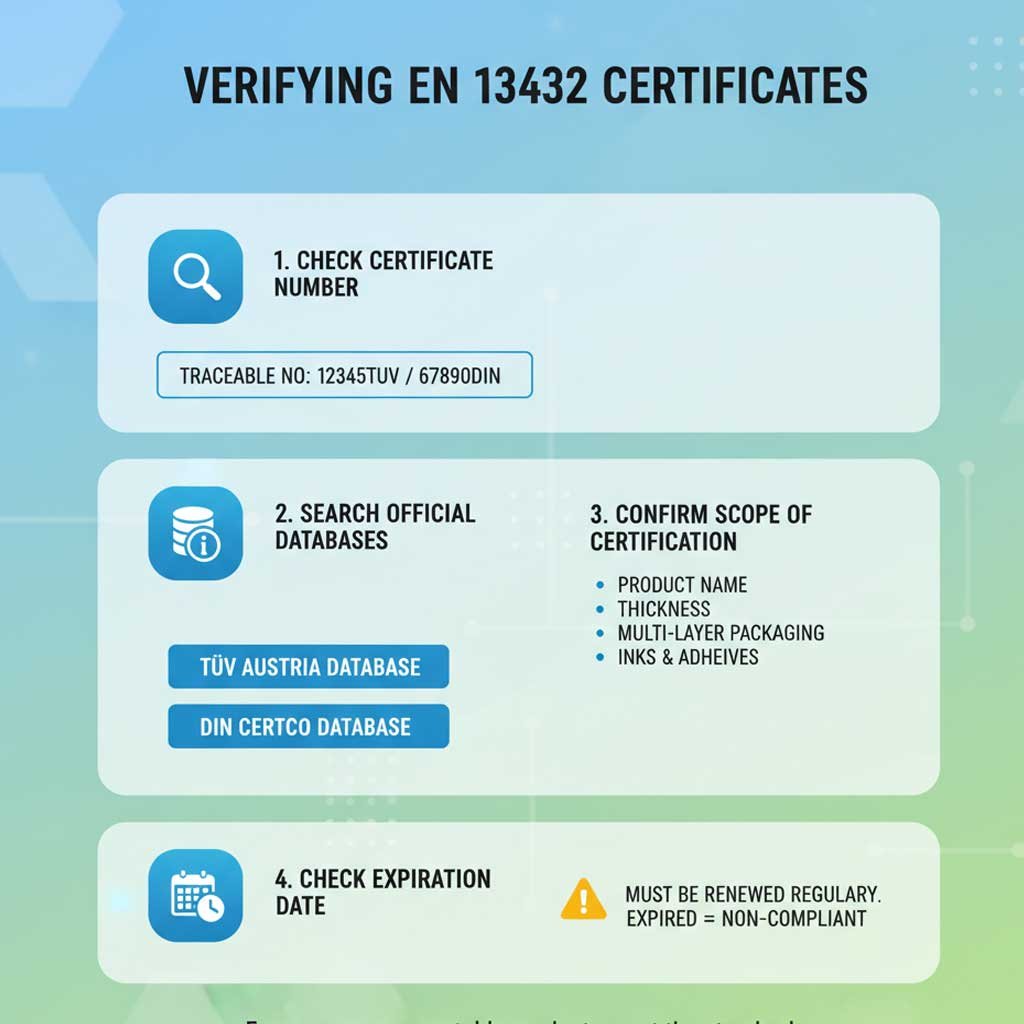
Buyers should verify:
Certificate number
Issuing body (DIN CERTCO, TÜV Austria, etc.)
Product scope (final product vs raw material)
Validity period
Verification databases are maintained by certification bodies.
Common EN 13432 Compliance Mistakes
- Assuming certified resin = certified product
- Changing thickness without re-testing
- Using non-compliant inks or adhesives
- Applying logos outside certified scope
These issues frequently lead to test failure or certificate suspension.
Limits of EN 13432 Compliance
EN 13432 does not guarantee:
Home compostability
Soil or marine biodegradation
Landfill degradation
It applies only to industrial composting systems.
What EN 13432 Covers — and What It Does Not
| Covered by EN 13432 | Not Covered by EN 13432 |
|---|---|
| Industrial composting | Home composting |
| Packaging materials | Products in soil or ocean |
| Controlled composting | Landfill degradation |
| Certified final products | Raw materials only |
When EN 13432 Is the Right Choice
EN 13432 is most appropriate when:
Packaging is contaminated with food waste
Industrial composting infrastructure exists
Compostability claims are required by law or retailers
In other cases, recyclable or reusable packaging may be more suitable.
Who Should Use This Guide
This page is intended for packaging buyers, brand owners, importers, and compliance teams
who need a clear understanding of the EN 13432 standard, testing requirements, and compostability claims in the European Union.
Related Compliance Resources
- EN 13432 vs ASTM D6400 vs AS 4736
- Can One Compostable Bag Meet AU, EU, and US Standards?
- Compostable Packaging Compliance Checklist
Looking for EN 13432-Certified Packaging?
If you need EN 13432-certified compostable packaging,
you can verify our certification details here:
EN 13432 Certification (Company Verification Page)