EN 13432 Certification for Compostable Packaging
A complete guide to EN 13432 certification requirements, testing, and compliance for compostable packaging entering the European market.
Table of Contents
EN 13432 certification is the most widely used packaging compostability certification in Europe. It indicates that a product can be safely decomposed in an industrial composting system and complies with stringent environmental regulations.
This page explains the meaning of EN 13432 certification, the testing content, and how companies can use this certification when selling compostable packaging.
What EN 13432 Certification Means
EN 13432 certification confirms that packaged products comply with the European compostable standard EN 13432.
This standard applies to a wide range of compostable packaging types, including:
- films and bags
- food containers and cups
- coffee capsules
- labels and tapes
- multi-layer compostable packaging
To obtain certification, products must pass tests demonstrating their biodegradability, breaking down into small fragments and safely returning to compost without harming soil or plants.
EN 13432 certification is typically required in the following situations:
- products sold in the EU
- packaging using the term “compostable”
- retailers requiring the use of certified compostable materials
- brands seeking compliance with environmental regulations
In short, this certification proves that the product meets the technical requirements of the EN 13432 standard.
If you want a simple explanation of how the EN 13432 standard defines compostable packaging, you can read our article on the EN 13432 standard and its key requirements.
Who Needs Certification? From Suppliers to Brand Owners
- Packaging Manufacturers: If you produce paper cups, films, tableware, etc., and want them to be considered compostable, certification is essential.
- Raw Material Suppliers: If you supply bio-based plastics (such as PLA, PBAT, PHA) used to manufacture compostable packaging, your materials themselves need to be certified to help your downstream customers obtain certification.
- Brand Owners: Even if you are only sourcing packaging, if your brand wants to claim that its product packaging is compostable, you must ensure that the packaging materials supplied by your suppliers are EN 13432 certified. This is a commitment to product compliance.
How EN 13432 Fits Into EU Packaging Laws and EPR Compliance
Understanding EN 13432 is not only important from a technical perspective—it is also essential for meeting the legal and compliance requirements within the European Union. In the EU market, compostability claims are tightly regulated, and companies must ensure that their packaging meets the correct standards before using terms such as “compostable” or “biodegradable.”
EN 13432 and the EU Packaging and Packaging Waste Directive
The EU Packaging and Packaging Waste Directive (PPWD) establishes rules for sustainable packaging design and waste management. Under this directive, any product claiming compostability must comply with EN 13432, the official harmonized standard used to evaluate industrial compostability.
This means:
- You cannot market packaging as “compostable” in the EU unless it passes EN 13432 testing.
- Retailers and distributors may reject packaging that lacks recognized certification marks.
- Environmental claims without certification risk violating EU Green Claims rules.
In short, EN 13432 is not optional when entering the EU compostable packaging market—it is the legal baseline for compliance.
EN 13432 and Green Claims Regulation
The European Commission has tightened its rules against misleading environmental claims. Terms such as:
- “eco-friendly,”
- “biodegradable,”
- “environmentally safe,”
must be supported by verifiable standards, and EN 13432 is the accepted evidence for compostable packaging.
Failing to comply may lead to:
-
product recalls,
-
fines issued by local authorities,
-
negative retailer audits,
-
reputational damage due to “greenwashing.”
For brands selling across multiple EU countries, EN 13432 certification ensures alignment with all national interpretations of sustainability claims.
Role of EN 13432 in EPR (Extended Producer Responsibility)
Under EPR programs, producers are financially responsible for the end-of-life management of their packaging. Some EU member states impose lower eco-modulation fees on certified compostable materials when they meet EN 13432 requirements.
Benefits include:
- reduced producer fees under certain national EPR schemes,
- easier acceptance by local composting infrastructures,
- proof of conformity for retailer sustainability audits,
- simplified documentation during supplier verification.
Therefore, EN 13432 certification is not only a technical standard—it is also a cornerstone for regulatory compliance and EPR cost optimization in the EU packaging market.
EN 13432 Certification Requirements
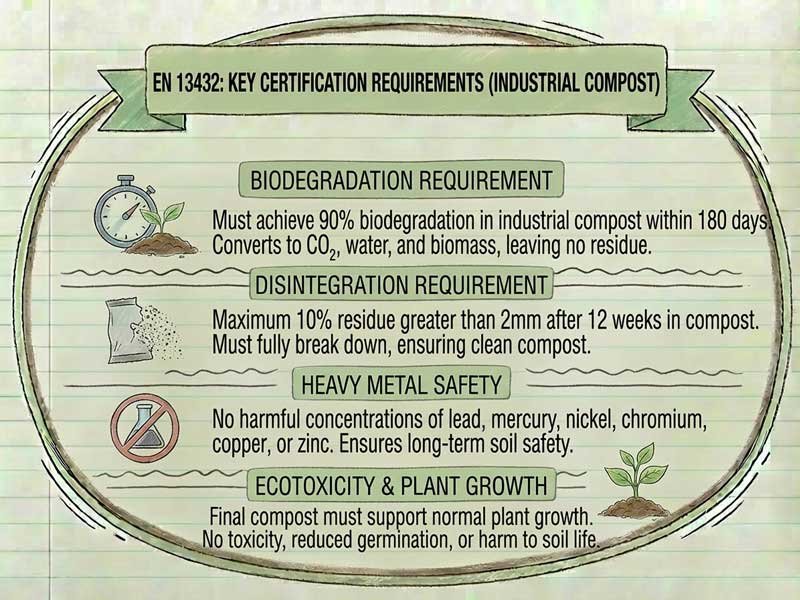
EN 13432 certification has four key technical requirements. All certified products must pass all of these tests.
1. Biodegradation Requirements
The material must be at least 90% biodegraded within 180 days in an industrial composting environment.
This means that microorganisms must convert the material into:
- Carbon dioxide
- Water
- Biomass
This requirement ensures that the material truly decomposes and leaves no residue in the compost.
2. Disintegration Requirements
The product must physically disintegrate during composting. After 12 weeks, no more than 10% of the original product should remain, and all debris must be less than 2 mm. This helps ensure a clean compost appearance with no visible debris.
3. Heavy Metal and Chemical Safety
The material must not contain harmful concentrations of the following metals: lead, mercury, nickel, chromium, copper, and zinc. These restrictions ensure that the compost is safe for soil and will not cause long-term pollution.
4. Ecotoxicity and Plant Growth Testing
The final compost containing the degradable material must be able to support normal plant growth.
The following conditions must be met:
- No toxicity
- No reduction in germination rate
- No harm to soil organisms
This test confirms that the certified packaging can safely return to nature.
Industries and Applications Where EN 13432 Is Expected or Required
EN 13432-certified packaging plays a critical role in industries that rely on organic waste collection or handle food-related materials. Because these sectors often integrate composting into their waste management systems, certified compostable packaging helps improve efficiency and reduce contamination.
Below are the industries where EN 13432 compliance is strongly preferred—or even required.
1. Food Service & Quick-Service Restaurants (QSR)
Restaurants, cafes, bakeries, and large food chains increasingly adopt compostable packaging to support their sustainability goals.
Common EN 13432-certified items include:
- coffee cups and lids
- takeaway containers
- cutlery
- food scrap collection liners
Many food service programs in Europe only accept compostable packaging when it carries EN 13432 certification.
2. Supermarkets & Grocery Retailers
Supermarkets use certified compostable packaging for:
- produce bags
- biobased checkout bags
- bakery packaging
- fresh food containers
Large retail groups often require EN 13432 as part of their supplier packaging guidelines to avoid misleading environmental claims.
3. Municipal Organics & Industrial Composting Programs
Municipalities that operate large-scale composting facilities typically set strict contamination rules.
These programs often require:
- EN 13432-certified bin liners
- certified food scrap bags
- certified product labels
Composting facilities rely on certification because it helps them keep the compost stream clean and reduces sorting challenges.
4. Catering and Large Events (Festivals, Conferences, Stadiums)
Zero-waste events commonly adopt EN 13432-certified products to ensure that all packaging entering the compost bin can be processed together.
Examples:
- beverage cups
- serveware
- food containers
- compostable wrappers
Without certification, the entire waste stream may be rejected.
5. E-Commerce and Sustainable Brands
Some e-commerce companies in Europe are shifting to compostable mailers and labels.
EN 13432 certification provides:
-
credibility for sustainability claims
-
legal protection against greenwashing
-
better acceptance in retailer compliance checks
6. Agriculture, Landscaping, and Professional Horticulture
Certified compostable films and bags are used for:
- collecting plant waste
- organic waste transport
- biodegradable films that integrate into compost operations
These industries rely on certification to avoid contamination in soil and compost.
Why This Matters for Your Customers
Buyers in these sectors want certainty that compostable packaging:
- will be accepted by their composting partners,
- complies with EU sustainability rules,
- meets safety and performance standards.
Adding this section greatly increases the commercial relevance of your EN 13432 page and helps you capture more B2B industry keywords.
EN 13432 Certification Process and Marking
If your company produces compostable packaging or materials and you want them to stand out in the market and gain consumer trust, then EN 13432 certification is the way to go. It allows your products to legally use the environmental labels that consumers trust.
Authoritative Certification Bodies:
- Packaging Manufacturers: If you produce paper cups, films, tableware, etc., and want them to be considered compostable, certification is essential.
- Raw Material Suppliers: If you supply bio-based plastics (such as PLA, PBAT, PHA) used to manufacture compostable packaging, your materials themselves need to be certified to help your downstream customers obtain certification.
- Brand Owners: Even if you are only sourcing packaging, if your brand wants to claim that its product packaging is compostable, you must ensure that the packaging materials supplied by your suppliers are EN 13432 certified. This is a commitment to product compliance.
How the EN 13432 Certification Process Works
The EN 13432 certification process follows a clear structure. It verifies whether a product meets all the requirements of EN 13432 certification under controlled testing conditions.
Most companies will go through the following main stages.
Step 1: Product and Material Audit
Before commencing EN 13432 testing, the laboratory will audit the following:
- Material composition
- Product thickness
- Number of layers
- Inks, coatings, and adhesives
- Any additives used in the formulation
This step helps the laboratory understand the material’s performance in industrial composting. It also ensures that the entire product (not just the raw resin) complies with the EN 13432 standard.
Step 2: Laboratory Testing
Accredited laboratories follow the official EN 13432 compostability certification methodology.
This testing phase includes:
- Biodegradation test (180 days)
- Disintegration test (12 weeks)
- Heavy metal analysis
- Ecotoxicity and plant growth test
These tests confirm that the product meets the technical requirements for European industrial compost certification. Testing time may vary, especially for thicker or multi-layered packaging.
Step 3: Audit and Assessment
After testing, the laboratory will audit all results.
They will check whether the product complies with all the requirements of EN 13432 certification. The assessment includes:
- Checking the biodegradation curve
- Checking the decomposition rate
- Checking the composting quality results
Proof of phytosafety
Only when all results show full compliance with the standards can the product proceed to the final step.
Step 4: Issuance of EN 13432 Certificate
Upon successful testing, the company will receive an EN 13432 certification document. This certificate confirms that the product complies with European compostable packaging certification standards. A valid certificate typically includes:
- Product Name
- Company Name
- Certificate Number
- Test Result Summary
- Scope of Certification
Brand owners and retailers use this document to confirm that the packaging has obtained EN 13432 certification.
EN 13432 Certification Laboratories
To ensure accurate results, EN 13432 testing must be conducted in a certified laboratory. Common EN 13432 certification laboratories include:
- TÜV Austria – known for its OK Compost Industrial logo
- DIN CERTCO – known for its Seedling logo
Other laboratories accredited by European compostability certification bodies adhere to stringent standards and provide reliable EN 13432 compliance test results.
How to Verify an EN 13432 Certificate
One of the most important aspects of EN 13432 certification is understanding how to verify the certificate. Many buyers are unaware that certificates may be expired, incomplete, or only apply to raw materials, not the final product.
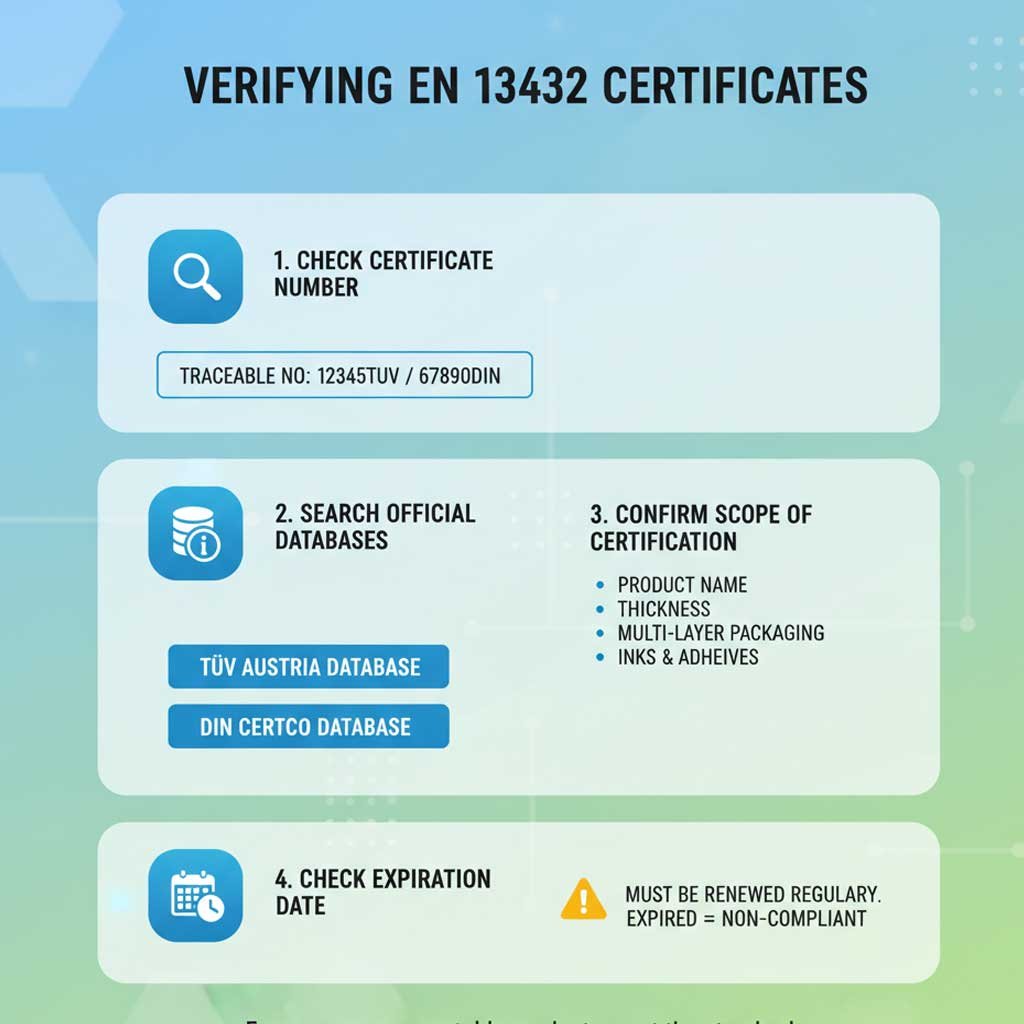
Here are methods to verify the authenticity of a certificate:
1. Check the certificate number: Genuine EN 13432 certificates always have a traceable number.
2. Search official databases: You can search the certificate number in the following databases:
- TÜV Austria Database
- DIN CERTCO Database
3. Confirm the scope of certification: A common problem is that only the raw materials are certified, not the final product.
Please ensure the certificate lists:
- Accurate product name
- Correct thickness
- Each layer in multi-layer packaging
- Inks and adhesives (if any)
4. Check the expiration date
EN 13432 certificates must be renewed regularly; expired certificates do not comply with the EN 13432 standard.
Why Material-Level Certification Is Not Enough
Many suppliers claim their packaging is compostable “because the raw material is certified.”
But this is not true.
EN 13432 certification applies to finished products, not just materials.
Here’s why:
The resin may meet EN 13432, but other ingredients may not.
Thickness changes biodegradation and disintegration rates.
Coatings or inks may prevent proper composting.
Multi-layer structures behave differently from single-layer films.
For true EN 13432 compliance, the final product must pass all EN 13432 testing procedures.
Common Mistakes Companies Make
These issues often cause certification delays or testing failures:
Using certified resin but non-certified additives
Adding inks or adhesives that are not compostable
Exceeding recommended film thickness
Designing packaging with incompatible multi-layer structures
Addressing these early reduces risk and improves chances of achieving EN 13432 compostability certification.
Typical Failure Scenarios and What We Learned
Even well-designed compostable packaging can fail EN 13432 certification due to small issues that are often overlooked. Below are real-world scenarios that illustrate common causes of failure and how to avoid them.
Scenario 1: The Film Was Too Thick to Disintegrate in 12 Weeks
A packaging company submitted a multilayer compostable mailer that passed biodegradation tests but failed the 12-week disintegration requirement. The film’s increased thickness slowed down fragmentation.
What happened:
-
More than 10% of the material remained after 12 weeks.
-
Additional fragmentation testing was required, delaying approval.
What we learned:
-
Even compostable resins behave differently at greater thicknesses.
-
Reducing material thickness by 15–20% enabled the product to pass in the second test.
Scenario 2: Ink Formulation Contained Non-Compliant Pigments
A brand modified the printing inks on its compostable bags without checking whether the pigment chemicals met EN 13432 limits.
What happened:
-
Heavy metal levels exceeded allowed thresholds.
-
The entire packaging failed the heavy metal and ecotoxicity tests.
What we learned:
-
All components—including inks, coatings, and adhesives—must be pre-verified.
-
Switching to EN 13432-compatible inks allowed the packaging to pass tests without retesting other layers.
Scenario 3: Multi-Layer Packaging Contained a Non-Compostable Barrier Layer
Some companies design packaging with a barrier layer for moisture or oxygen control that is not compostable.
What happened:
- Disintegration tests showed that the barrier layer remained intact after composting.
- Entire structure failed EN 13432 compliance.
What we learned:
- Every layer must be compostable—not only the outer film.
- The company replaced the barrier with a certified compostable coating and passed the subsequent test.
How to Get EN 13432 Certified
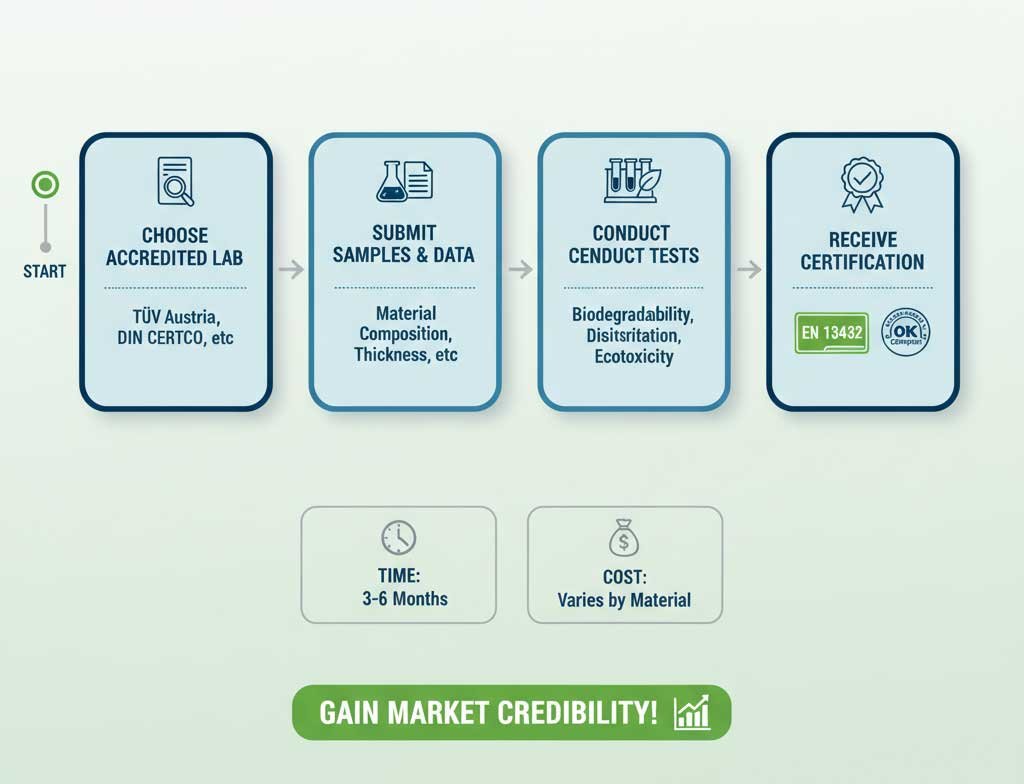
If you’re developing compostable packaging or film, here’s how certification works:
-
- Choose an accredited testing body – TÜV Austria, DIN CERTCO, or another recognized lab.
-
- Submit samples and technical data – material composition, thickness, etc.
-
- Undergo testing – biodegradation, disintegration, and eco-toxicity tests.
-
- Get certified – once your product passes, you can legally print “EN 13432” or the OK Compost logo.
Most tests take 3–6 months, and the cost depends on the material type.
Once certified, your product gains instant credibility in eco packaging markets.
EN13432 Certification Costs and Time:
The cost and time of certification vary depending on the product type, complexity, and the chosen certification body. Generally:
- Time: The entire process can take 6 to 12 months, as the testing itself takes several months to complete (e.g., biodegradability testing takes 180 days). Therefore, advance planning is crucial.
- Cost: Fees typically include application fees, testing fees, and annual fees. These can range from several thousand to tens of thousands of euros, depending on the scope of the testing and the number of repeat tests required. While this is an investment for businesses, it is usually worthwhile considering the competitive advantage and consumer trust it brings.
EN 13432 Certification Costs: What You Should Budget For
The total cost of obtaining EN 13432 certification varies depending on the product design, material composition, and the number of tests required. Understanding how these costs are structured helps companies plan their certification budget more accurately.
Typical Cost Breakdown
| Cost Component | What It Covers | Typical Range |
|---|---|---|
| Application Fee | Administrative review of documentation, product scope definition | €300 – €1,000 |
| Laboratory Testing Fee | Biodegradation, disintegration, heavy metals, and ecotoxicity tests | €5,000 – €12,000+ |
| Additional Retesting Fee | Required when samples fail or when product structure changes | €1,500 – €5,000 |
| Annual Licensing Fee | Use of certification mark (Seedling or OK Compost Industrial) | €1,000 – €3,000 per year |
| Renewal Fee (every 3–5 years) | Certificate extension and verification of formulation | Similar to initial testing |
Factors That Increase Certification Cost
Several product characteristics may raise the total cost:
-
Film thickness: Thicker materials typically degrade more slowly and may require multiple test rounds.
-
Multi-layer structures: Each layer must be tested and verified, increasing complexity.
-
Non-standard additives: Inks, coatings, and adhesives can significantly impact test results.
-
Large SKU ranges: Different sizes or structures may require separate certifications.
Why Costs Vary So Widely
Because EN 13432 certification is performance-based, real-world behavior matters more than theoretical material properties. As a result:
-
Two products made from similar materials may still require different test methods.
-
Products with multiple functional layers may require extensive biodegradation and disintegration testing.
-
Retesting is common, especially for barrier-coated films or thicker molded packaging.
Correct planning and pre-testing can reduce overall costs and shorten lead time.
Limits of EN 13432 Compliance
Understanding the limits of EN 13432 certified packaging is important for both brands and consumers.
EN 13432 certification does not guarantee that a product will:
- break down in home composting
- biodegrade in soil
- biodegrade in landfill
- biodegrade in marine environments
- break down in low temperatures
- be accepted by every industrial composting facility
EN 13432 only shows that the product meets the technical requirements for industrial composting certification under controlled lab conditions.
Real composting systems vary.
Some facilities run short composting cycles, meaning not all certified materials will fully disintegrate.
EN 13432 Certified vs Non-Certified Compostable Packaging
Not all products marketed as “compostable” meet rigorous scientific and regulatory requirements. EN 13432 certification provides verified proof that packaging will break down safely in an industrial composting environment. Non-certified products, even if labeled “biodegradable,” often fail to meet these expectations.
Key Differences at a Glance
| Aspect | EN 13432 Certified Packaging | Non-Certified “Compostable” Claims |
|---|---|---|
| Scientific Testing | Verified under EN 13432 test methods | No standardized testing required |
| Industrial Compostability | Proven through biodegradation & disintegration tests | Performance not guaranteed |
| Accepted by Composting Facilities | Widely accepted | Often rejected due to contamination risk |
| Legal Protection for Environmental Claims | Complies with EU regulations | High risk of being considered greenwashing |
| Supplier Audits & Retailer Requirements | Supported by certification | May fail retailer compliance checks |
| Traceability | Certificate number and database listing | No formal traceability |
Commercial Risks of Non-Certified Packaging
Using packaging that is not certified under EN 13432 may expose companies to:
- Retailer rejections during sustainability audits
- Penalties under EU Green Claims rules
- Product removal from environmentally sensitive channels
- Reputational damage related to misleading environmental claims
- Waste management complications, where composting partners refuse to accept uncertified materials
For brands that sell into European markets, EN 13432 certification reduces regulatory risk and ensures compatibility with existing waste systems.
EN 13432 vs Other Compostability Certifications
Many companies sell to more than one region.
So they often ask how EN 13432 certification compares with standards in the U.S., Australia, and other markets.
EN 13432 vs ASTM D6400 (United States)
Both standards are used for industrial composting certification, but they are not identical.
- EN 13432 applies to packaging.
- ASTM D6400 applies to plastics and films.
- Both require biodegradation and disintegration.
- EN 13432 requires mandatory eco-toxicity testing, while ASTM treats it as optional.
Because of this, EN 13432 is often viewed as the more complete compostability certification for packaging.
EN 13432 vs EN 14995 (Europe)
Both standards follow similar testing rules.
- EN 13432 is for packaging.
- EN 14995 is for plastics in general.
If a product is certified under one, it often meets the technical conditions for the other, but the certificate scope is different.
EN 13432 vs AS 4736 (Australia & New Zealand)
AS 4736 is based on EN 13432 requirements but includes an extra test:
worm toxicity test
Both are industrial composting certification standards, but AS 4736 reflects regional expectations for organics recovery in Australia and New Zealand.
EN 13432 vs AS 5810 (Home Composting Standard)
AS 5810 is very different.
- EN 13432 is for industrial composting.
- AS 5810 is for home composting, which has lower and unstable temperatures.
A product that meets EN 13432 certification cannot be assumed to meet AS 5810.
These comparisons help companies plan for multi-market compostability compliance.
EN 13432 Testing Timeline
The total time for EN 13432 certification depends on the product and testing conditions.
Typical timelines:
- Biodegradation test: up to 180 days
- Disintegration test: 12 weeks
- Heavy metal and chemical testing: a few days
- Ecotoxicity and plant growth tests: several weeksWith preparation and evaluation, EN 13432 compliance often takes several months.
- Products with multiple layers or coatings may require more testing time.
What Affects EN 13432 Compliance Time
A few factors can change how long the certification process takes:
- product thickness
- type of resin or polymer blend
- additives, inks, or adhesives
- composting behavior of each layer
- need for retesting
These factors make each industrial composting certification path slightly different.
Identifying Compostable Products: EN 13432 Certification Marks
Showcasing Key Certification Marks:
When looking for compostable packaging that complies with EN 13432, remember these important marks:
- Din Certco’s “Seedling Logo”: This is one of the most widely recognized compost certification marks. It’s usually a small green leaf with “EN 13432 Compostable” or similar wording below.
- TÜV AUSTRIA’s “OK Compost Industrial” Mark: This mark also indicates that the product complies with EN 13432 requirements and can be processed in industrial composting facilities. It’s usually a circular mark with the words “OK Compost Industrial”.
These marks are like the product’s “identity card,” proving its true compostability in an industrial composting environment.
Practical Tips to Improve Testing Success
Companies often face delays during EN 13432 testing because small details are overlooked.
Here are helpful steps to prepare your product for EN 13432 compliance.
1. Carefully Inspect All Components
Each layer must meet compostability requirements:
- Base resin
- Fillers and additives
- Inks
- Binders
- Coatings
If any one layer fails, the entire product will fail.
2. Check Product Thickness
Thicker materials take longer to decompose.
Adjusting the thickness helps ensure better decomposition.
3. Avoid Using Non-Compostable Components
Common defects include:
- Metallic inks
- Toxic pigments
- Moisture-barrier coatings
- Non-biodegradable adhesives
Keeping the structure simple helps improve performance in EN 13432 testing.
4. Conduct Internal Testing Before Submission
Even simple in-plant decomposition or composting behavior tests reduce risk. These tests help identify problems early, avoiding sending samples to an accredited laboratory.
These steps save you time and reduce the chances of retesting.
When EN 13432 Certification Is the Right Choice
EN 13432 certification is highly effective for certain applications, but not all packaging formats or markets benefit equally from industrial compostability. Below is a practical decision guide to help companies choose when EN 13432 is appropriate.
When EN 13432 Is the Best Option
Choose EN 13432-certified packaging when:
- Your products are sold in Europe and must comply with EU compostability claims.
- Packaging is contaminated with food waste, making recycling impractical.
- Industrial composting facilities exist in your target market.
- Retailers or tenders require certified compostable packaging as part of sustainability initiatives.
- You want legal protection against misleading environmental claims in the EU.
- Your brand participates in a closed-loop composting system, such as food scrap collection programs.
In these scenarios, certified compostable packaging simplifies compliance and increases acceptance.
When Other Packaging Strategies May Be Better
EN 13432 may not be the optimal choice when:
- Your target markets lack access to industrial composting facilities.
- The packaging is typically clean and easily recyclable, such as paperboard.
- You aim to optimize material circularity through recycling rather than composting.
- The product requires high barrier performance that compostable materials cannot yet provide.
- Packaging is intended for regions where compostability claims are not recognized.
In such cases, recyclable or reusable alternatives may offer better environmental and commercial outcomes.
A Balanced Approach to Sustainable Packaging
EN 13432 certification is a powerful tool—but only when used in the right context. Many brands benefit from a hybrid strategy that combines:
- compostable packaging for food-contact and contaminated materials,
- recyclable packaging for clean dry goods,
- reusable packaging where feasible.
Understanding when to use EN 13432 helps companies create a more effective, compliant, and credible sustainability strategy.
FAQ
Is EN 13432 certification mandatory in Europe?
If a product claims to be compostable, then yes.The claim must follow the EN 13432 standard.
Is EN 13432 the same as “industrial compostable”?
Yes.The EN 13432 standard is built around industrial composting conditions.
Does EN 13432 certification mean a product is biodegradable?
Yes, but only in industrial composting systems.It does not mean biodegradable in soil, ocean, or landfill.
Can EN 13432 packaging break down in home compost?
No.The temperatures in home compost are too low.
How can I verify an EN 13432 certificate?
Check the certificate number in:DIN CERTCO database,
TÜV Austria database, Always confirm the certificate matches the final product.
Who issues EN 13432 certificates?
Only EN 13432 accredited labs and certification bodies such as:
- TÜV Austria
- DIN CERTCO
Conclusion
The EN 13432 certification is more than a label.
It is a clear and technical way to show that compostable packaging can break down safely in an industrial composting system.
By meeting the EN 13432 certification requirements and using accredited labs, companies can ensure their packaging meets European compostability rules and supports a more responsible supply chain.