OK Compost Certification: Home & Industrial Guide for Brands and Buyers
Table of Contents
When I first started working with compostable packaging years ago, I realized one thing very quickly:
Many people see the OK Compost logo, but very few understand what it really means.
This page is my clear, simple, and practical guide to OK Compost Certification—written from the viewpoint of a manufacturer who works with TÜV Austria standards every day and helps global brands source certified compostable bags.
If you buy compostable packaging, sell it, or need it for your brand, this guide is for you.
Who This OK Compost Guide Is For
I wrote this guide with real users in mind:
Buyers and procurement managers
Retail and private-label brands in Europe
Distributors and importers of compostable bags
Municipal and FOGO program managers
Manufacturers planning to apply for certification
If you make decisions about sustainable packaging, you will find what you need here.
What Is OK Compost Certification?
OK Compost Certification is a compostability label issued by TÜV Austria, one of the most trusted certification bodies in Europe.
The goal of this certification is to confirm that a product can safely break down in a composting system.
There are two types:
OK Compost INDUSTRIAL
For products that break down in industrial composting facilities with high temperatures.
OK Compost HOME
For products that break down in a home compost system, which runs at lower temperatures.
Both labels test:
Biodegradation
Disintegration
Ecotoxicity
Heavy metal limits
But OK Compost HOME has stricter requirements because home composting is slower and less controlled.
OK Compost HOME vs INDUSTRIAL: The Real Differences
| Feature | OK Compost HOME | OK Compost INDUSTRIAL |
|---|---|---|
| Composting environment | Backyard | Industrial facility |
| Temperature | 20–30°C | 55–60°C |
| Time to break down | 3–12 months | ~12 weeks |
| Related standard | AS 5810, home compost logos | EN 13432 |
| Suitable for | Thin bags, small films | Retail packaging, food service items |
Important:
OK Compost Industrial does not guarantee home compostability.
I still see this mistake on product listings and supplier websites.
OK Compost in the Global Compostable Certification Landscape
Europe
EN 13432 (standard)
OK Compost HOME / INDUSTRIAL (certification marks)
USA / Canada
BPI Certification
ASTM D6400 / ASTM D6868
Australia / New Zealand
AS 4736 (industrial)
AS 5810 (home)
How global brands combine these
A simple example:
Selling in EU → OK Compost + EN 13432
Selling in the US → BPI + ASTM D6400
Selling in AU/NZ → AS 4736 + AS 5810
As a manufacturer exporting worldwide, I often advise buyers to map certifications to markets like this.
Why OK Compost Certification Matters for EU Compliance
While OK Compost certification is a voluntary label, it plays an increasingly important role in helping brands comply with European environmental regulations. In the EU, sustainability claims such as “compostable,” “biodegradable,” or “environmentally friendly” must be supported by verifiable scientific evidence — and OK Compost certification is one of the most widely recognized ways to demonstrate that proof.
Below is a clear explanation of how OK Compost fits into the European regulatory landscape and why brands rely on it to avoid compliance risks.
1. Link to the EU Packaging and Packaging Waste Directive (PPWD)
The EU Packaging and Packaging Waste Directive defines the legal framework for packaging placed on the European market. When a product is marketed as “compostable,” the Directive requires that:
- The packaging must comply with EN 13432, the harmonized standard for industrial compostability.
- The claim must be supported by third-party certification or test reports.
- Retailers and importers must be able to verify that environmental claims are accurate.
OK Compost Industrial certification is directly aligned with EN 13432.
This makes OK Compost one of the most accepted labels within the EU for demonstrating compliance with industrial compostability requirements.
2. EU Green Claims Regulation (Avoiding Greenwashing)
Europe is tightening rules against misleading environmental claims (“greenwashing”). Under the upcoming EU Green Claims Regulation:
Brands must provide scientific proof for terms such as:
- “compostable”
- “biodegradable”
- “eco-friendly”
- “plastic-free”
Without third-party certification like OK Compost, brands risk:
Fines from local consumer authorities
Product removal from retail chains
Negative audit results in supplier evaluations
Legal challenges from consumer protection agencies
OK Compost certification protects brands by providing verified, test-based evidence that a product can compost safely and completely.
3. Why Retailers in Europe Prefer OK Compost Certified Packaging
Large European retailers — especially supermarket chains and private-label brands — often require suppliers to use recognized compostability logos for packaging placed in compostable waste streams.
Reasons retailers prefer OK Compost certification include:
Ensures product compliance across all EU markets
Simplifies supplier verification
Reduces risk of incorrect environmental claims
Aligns with their sustainability commitments (ESG reporting)
Improves consumer trust and sorting accuracy
Without visible certification, packaging may be rejected during audits.
4. Role of OK Compost in FOGO Programs and Municipal Composting Requirements
Across Europe, more cities are adopting FOGO (Food Organics & Garden Organics) programs.
Many municipal composting facilities only accept packaging that:
carries the OK Compost Industrial logo, or
passes EN 13432 certification
This is because uncertified packaging increases contamination and reduces compost quality.
Examples of acceptance rules:
- Some municipalities accept only OK Compost Industrial / EN 13432 certified liners
- Some accept no packaging at all
- Very few accept home-compostable packaging due to lower processing temperatures
Brands targeting FOGO or circular-waste markets must use recognized certification marks.
5. Why OK Compost HOME Is Becoming More Important in EU Markets
Although industrial composting is more common, home composting is rising in popularity, especially in:
- France
- Italy
- Belgium
- The Netherlands
As home garden composting becomes a household trend, buyers increasingly prefer packaging labeled:
OK Compost HOME
because it provides:
- true low-temperature biodegradation
- safety in backyard compost systems
- a more consumer-friendly sustainability message
Many eco-focused brands use OK Compost HOME to add value to premium product lines.
6. How OK Compost Supports EPR (Extended Producer Responsibility) Compliance
Under EPR systems, producers pay fees based on the environmental impact of their packaging.
In some EU countries:
- Certified compostable packaging may receive lower eco-modulation fees,
- Non-certified “biodegradable” packaging may receive penalties due to contamination risks.
OK Compost certification provides:
- clear documentation for EPR submissions
- compliance evidence for product stewardship schemes
- traceability required for environmental audits
This makes OK Compost useful not only for marketing, but also for regulatory reporting.
Why OK Compost Matters for Compliance
For brands:
- Prevents greenwashing
- Simplifies EU-wide legal compliance
- Improves audit success with retailers
For distributors:
- Ensures product claims match certification
- Reduces liability
- Supports transparent communication with customers
For manufacturers:
- Proves technical capability
- Increases acceptance in global markets
- Aligns with international compostability systems
OK Compost certification is more than a logo — it is a trusted indicator of regulatory compliance, product safety, and environmental responsibility.
What Does OK Compost Certification Test?
TÜV Austria follows strict rules that match EN 13432 and additional requirements for home compost.
1. Biodegradation
The material must turn into CO₂, water, and biomass.
2. Disintegration
After composting, no visible fragments should remain.
3. Ecotoxicity
The resulting compost must support healthy plant growth.
4. Chemical limits
Heavy metals such as lead, cadmium, and mercury must stay below strict limits.
5. Extra requirements for HOME
The product must break down at low temperatures, which is hard for many bioplastics.
This is why not every “biodegradable” bag is OK Compost certified.
OK Compost Certification Costs: What You Should Budget For
Many brands and manufacturers underestimate the cost and time required for OK Compost certification. TÜV Austria follows strict test procedures for both OK Compost INDUSTRIAL and OK Compost HOME, and the total cost varies depending on product complexity, material formulation, and the number of SKUs being certified.
Below is a practical breakdown of the expenses you should expect when planning OK Compost certification.
Typical Certification Cost Breakdown
| Cost Component | What It Covers | Typical Range |
|---|---|---|
| Application Fee | Document review, formulation assessment, initial preparation | €300 – €1,200 |
| Laboratory Testing Fee | Biodegradation, disintegration, ecotoxicity, chemical tests | €6,000 – €14,000+ |
| Additional Retesting Fee | Required when samples fail or need repeats | €1,500 – €5,000 |
| License / Logo Usage Fee | Permission to use OK Compost INDUSTRIAL or HOME logo | €1,000 – €3,000 per year |
| Certificate Renewal Fee | Renewal every 3–5 years depending on certification scope | Similar to initial test cost |
Important:
OK Compost HOME is always more expensive and more difficult to achieve than INDUSTRIAL, due to lower-temperature testing and more stringent disintegration requirements.
Why Certification Costs Vary So Much
The final cost depends heavily on the product type:
Thickness
Thicker products take longer to degrade and may require repeated tests.
Multi-Layer Structures
Every layer must be compostable.
If one layer fails → the entire product fails.
Additives, Inks, Colorants
Non-compliant pigments or coatings often cause ecotoxicity failures.
Different SKUs or Sizes
If multiple product sizes use different thicknesses or materials, they may need separate certifications.
HOME Certification Complexity
Home composting requires breakdown at 20–30°C, making it much harder for PLA/PBAT blends.
Only certain grades (e.g., high-PHA content) typically pass.
Typical Cost Examples (Based on Real Projects)
| Product Type | OK Compost Industrial | OK Compost Home |
|---|---|---|
| Thin produce bags | €7,000 – €10,000 | €12,000 – €18,000 |
| Dog waste bags | €6,000 – €9,000 | Rarely suitable unless very thin |
| Shopping bags | €8,000 – €12,000 | Difficult due to thickness |
| Multi-layer mailer bags | €10,000 – €15,000 | Usually not eligible |
| Compostable resin | €5,000 – €8,000 | Not applicable (HOME rarely granted) |
Why Certification Costs Should Be Seen as an Investment
For brands selling in Europe:
OK Compost logos increase consumer trust
Retailers prefer certified packaging
It reduces risk of greenwashing allegations
Waste facilities can accept certified products more easily
Enhances ESG documentation & transparency
For manufacturers:
Certification allows you to expand into new markets
Simplifies compliance for buyers
Helps avoid costly retesting later
When used correctly, certification can significantly increase the value of your product line and open up new retail channels.
How to Reduce the Cost of OK Compost Certification
Use certified base materials when possible
This reduces risk but does not guarantee final product approval.
Standardize product thickness
Multiple thicknesses = multiple test samples = higher cost.
Avoid complex multi-layer structures
Simple mono-layer films perform better in disintegration tests.
Pre-test materials internally
A small-scale compost test can save thousands of euros by identifying obvious issues early.
If you are unsure whether your product is a good candidate for OK Compost certification, we can help you review materials, thickness, and design to estimate cost and feasibility before applying.
Which Products and Materials Can Be OK Compost Certified?
Finished products
TÜV Austria certifies finished items, such as:
Compostable trash bags
Shopping bags
Produce bags
Mailer bags
Dog waste bags
Food service packaging
Raw materials
Sometimes suppliers only certify the resin or film.
This can be misleading for buyers if they think the final bag is certified too.
Common materials that pass
PLA + PBAT blends
Starch-based films
PHA (often used for home compostable grades)
Materials that struggle
Pure PLA (needs high heat → usually industrial only)
If you buy compostable packaging, always check whether the bag itself is certified, not only the raw material.
Industries and Applications That Commonly Require OK Compost Certification
OK Compost certification is widely used across industries that rely on organic waste collection, sustainable packaging programs, or consumer-facing eco-labeling. Different sectors prefer either OK Compost INDUSTRIAL or OK Compost HOME, depending on their waste streams, customer expectations, and composting infrastructure.
Below is a comprehensive industry overview that reflects real buyer behavior and procurement requirements in Europe and global markets.
Here is a concise, simplified version of your content, keeping all key points and use cases clear and easy to understand:
1. Supermarkets & Grocery Retailers
European grocery chains prefer certified compostable packaging to meet sustainability goals and improve waste sorting.
Common uses: produce bags, biobased shopping bags, bakery packs, compostable pouches, labels.
Preferred certification:
Industrial for most operations
Home for premium organic/zero-waste products
Retailers often require visible OK Compost logos for audits.
2. Food Service, Restaurants & Coffee Chains
Cafés, QSRs, and delivery brands use compostable items to reduce plastic waste and meet ESG goals.
Products: compostable liners, takeaway boxes, cutlery, cups, wrappers.
Certification: Mostly Industrial; Home for small eco-friendly product lines.
3. Municipal FOGO Programs
Cities running industrial composting require certified bags to avoid contamination.
Uses: food waste liners, household bin liners, compostable labels.
Certification: Industrial only (strict requirement in many EU regions).
4. E-Commerce & Mailing Industry
Brands replace poly mailers with compostable alternatives.
Products: compostable mailers, envelopes, protective films.
Certification:
Industrial for durability
Home only for thin specialty films
OK Compost logos support eco-branding.
5. Pet Industry (Dog Waste Bags)
A major category for compostable film products.
Why certification matters: proof of no microplastics, retailer approval, some municipal acceptance.
Certification: Mainly Industrial; Home for niche eco-markets.
6. Household & Consumer Goods
Home composting drives demand for backyard-friendly packaging.
Products: cling film, small liners, caddy bags, organic product packaging.
Certification:
Home for zero-waste consumers
Industrial for general use
7. Agriculture, Landscaping & Horticulture
Used for plant waste and organic farming materials.
Applications: plant bags, mulch bags, harvest bags.
Certification: Mostly Industrial, with some Home for small consumer items.
8. Zero-Waste Stores & Sustainable Brands
Depend on certification for transparency and consumer trust.
Uses: refill bags, organic food packaging, customer bags.
Certification:
Home as a strong marketing advantage
Industrial for broader packaging needs
9. Events, Festivals & Public Venues
Compostable products support large-scale waste management.
Uses: cups, cutlery, wrappers, food scrap bags.
Certification: Industrial, due to bulk waste collection.
OK Compost logos improve sorting accuracy.
How to Verify OK Compost Certification (For Buyers)
Many buyers have asked me how to avoid “fake” certificates or misleading claims.
Here is the method I teach distributors and brand owners.
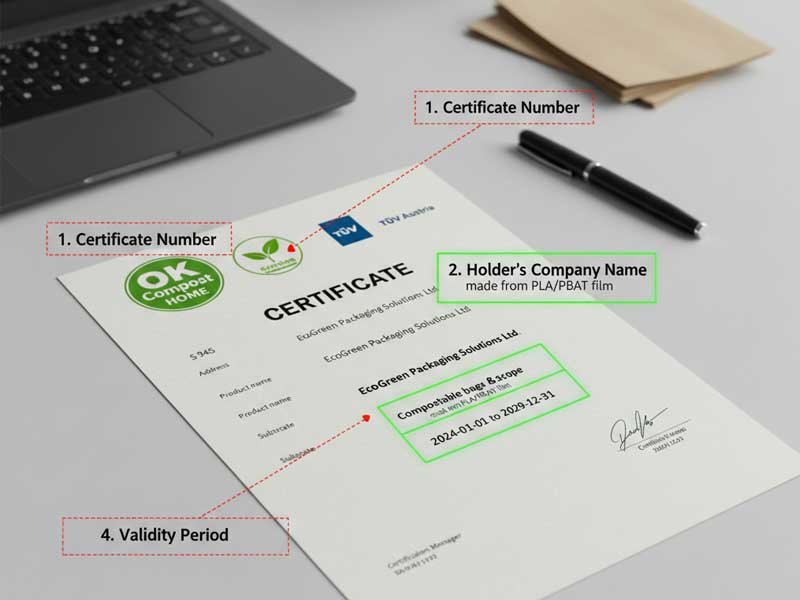
Step 1 — Ask for the certificate PDF
It must include:
- Certificate number
- Holder’s company name
- Product type
- Scope (e.g., “compostable bags made from PLA/PBAT film”)
- Validity period
Step 2 — Check TÜV Austria’s online database
If the product is not in the database, it is not certified.
Step 3 — Confirm it is a product-level certificate
A common red flag:
The resin is certified, but the finished bag is not.
This is one of the simplest ways buyers are misled.
Step 4 — Match the certificate with the exact product you are buying
Check:
Bag thickness
Color
Application
Material type
Step 5 — Warning signs (red flags)
Supplier shares logo but no certificate
Expired certificate
Certificate issued to another company
Certificate for pellets, but supplier sells finished bags
This section alone can save buyers from costly mistakes.
As a manufacturer, I always encourage buyers to verify any OK Compost logo they see. A real certificate stands up to scrutiny.
When Should You Choose OK Compost HOME vs INDUSTRIAL?
For grocery & retail brands
- Produce bags : HOME or INDUSTRIAL
- Shopping bags : INDUSTRIAL is usually enough
- If your brand targets eco-focused consumers: HOME can add value
For pet brands (dog waste bags)
Most users will throw the bag in the regular trash.
So:
- INDUSTRIAL = more realistic
- HOME = for zero-waste markets or premium lines
For e-commerce mailers
Shipping conditions can be rough: humidity, pressure, time in transit.
- INDUSTRIAL is generally safer
- HOME requires very specific material blends and careful storage
For municipal FOGO programs
This depends on local rules.
Some EU cities only accept OK Compost Industrial / EN 13432 packaging.
Others accept no packaging at all.
OK Compost vs EN 13432 vs “Biodegradable” Logos
OK Compost vs EN 13432
- EN 13432 = the test standard
- OK Compost = the recognized logo
OK Compost vs “biodegradable”
“Biodegradable” has no clear time frame or conditions.
A biodegradable product can take years to break down and may leave microplastic.
Certified compostable products must pass strict tests.
Why brands prefer certified logos
- Avoid greenwashing
- Meet retailer requirements
- Support waste stream sorting
- Give buyers honest information
Our Experience as an OK Compost Certified Manufacturer
As a producer of compostable bags, I work with global buyers who need reliable documents and consistent quality. Here is what we provide:
Products we offer under OK Compost standards
- Trash bags
- Shopping bags
- Produce bags
- Dog waste bags
- Compostable films for packaging
How we support distributors and brand owners
- Provide certificate copies
- Provide technical data sheets
- Support printing and packaging design
- Help avoid incorrect claims on packaging
Documents you receive
- Certificate PDF
- Declaration of compliance
- Material information
- Logo usage guidance
Our goal is simple: make certification clear and honest.
How to Get OK Compost Certification (For Manufacturers or Brand Owners)
If you are a manufacturer or planning your own branded product, here is the basic process.
- Define the product (type, thickness, use)
- Submit samples to a TÜV-approved lab
- Biodegradation, disintegration, and toxicity tests
- Document review
- Certificate issue and logo approval
The full process takes several months.
Working with a manufacturer that already has certified products can save time.
If you work with a manufacturer that already holds OK Compost certified products, you can often avoid repeating the certification process from zero.
Common Misunderstandings About OK Compost
“OK Compost means it will break down anywhere.”
Not true. Composting needs oxygen and the right microbes.
“Industrial = Home compostable.”
No. Home composting requires lower temperatures.
“Resin certification = finished bag certification.”
Not correct. The final product must be tested.
“Plant-based always means compostable.”
Some plant-based plastics behave like regular plastics.
“OK Compost is mandatory in the EU.”
Not always. But many retailers prefer it.
OK Compost Certified vs Non-Certified Compostable Packaging
Not all “compostable” or “biodegradable” products behave the same way in real composting conditions. A product with OK Compost certification has been scientifically tested and verified, while many non-certified products rely on vague or unregulated environmental claims.
Below is a clear comparison to help brands, buyers, and distributors understand the difference — and why certification matters.
Certified vs Non-Certified: The Key Differences
| Feature | OK Compost Certified | Non-Certified “Compostable” Claims |
|---|---|---|
| Scientific Testing | ✔ Fully tested (biodegradation, disintegration, toxicity, chemicals) | ✖ No standardized testing required |
| Independent Verification | ✔ TÜV Austria approved laboratories | ✖ Supplier or manufacturer self-claims |
| Compliance with EN 13432 / EN 14995 | ✔ Meets EU legal compostability standards | ✖ No compliance proof |
| Guaranteed Breakdown Performance | ✔ Industrial or home composting verified | ✖ No guarantee; may take years to break down |
| Microplastic Safety | ✔ Must fully disintegrate with no residue | ✖ May leave microplastic fragments |
| Accepted by Composting Facilities | ✔ Widely accepted | ✖ Often rejected due to contamination risk |
| Retailer / Importer Approval | ✔ Supports audit & supplier verification | ✖ Poses compliance risks |
| Legal Protection for Eco-Claims | ✔ Complies with EU Green Claims Regulation | ✖ High risk of being considered greenwashing |
Why Non-Certified Compostable Products Create Problems
Problem 1 — They may not break down as claimed
Many products labeled “biodegradable” only break down under very specific conditions or over extremely long periods. Without OK Compost certification, buyers cannot be sure that the product will:
disintegrate within the required time
achieve full biodegradation
leave no harmful residue
This leads to contamination in compost and landfill streams.
Problem 2 — Composting facilities may reject them
Industrial composters must maintain strict quality controls.
Non-certified “compostable” bags are often banned because:
they slow down composting cycles
they leave visible fragments
they contaminate finished compost
they are visually indistinguishable from non-compostable plastics
Certified products help composters sort and process waste more efficiently.
Problem 3 — Retailers increasingly require certification
European retailers, especially supermarkets and private-label brands, are tightening requirements. Most now expect:
OK Compost Industrial
EN 13432 compliance
or equivalent third-party certificates
Non-certified products may fail supplier audits and risk being removed from shelves.
Problem 4 — High greenwashing risk
In the EU, misleading environmental claims can lead to:
regulatory fines
forced product relabeling
removal from the market
damage to brand credibility
Without certification, words like “compostable” or “biodegradable” are not legally defensible.
Problem 5 — Resin-level certification is not enough
Some suppliers show certifications for materials, not finished bags.
This is misleading because:
- thickness affects performance
- coatings and inks may not be compostable
- multi-layer structure changes degradation behavior
Only final products can be certified — not just raw materials.
Why OK Compost Certification Protects Your Business
Ensures transparency and trust
End users, retailers, and distributors can instantly verify certification online.
Helps pass retailer & importer audits
Certification supports compliance with European packaging and sustainability programs.
Reduces contamination in composting programs
Certified products match the processing requirements of industrial composting facilities.
Reduces legal and reputational risk
Brands are protected from greenwashing accusations and regulatory penalties.
Improves customer satisfaction
Consumers increasingly expect credible eco-labels, not vague claims.
Certified Products Support the Circular Economy
OK Compost certification ensures that products:
- break down under real composting conditions
- contribute to high-quality finished compost
- support food-waste collection systems
- minimize plastic pollution
This aligns with Europe’s circular economy goals and municipal waste strategies.
Why You Should Choose Certified Over Non-Certified
| Reason | Why It Matters |
|---|---|
| Proof of compostability | Scientific testing + independent verification |
| Reduced risk | Avoid greenwashing, audit failures, consumer complaints |
| Better performance | Tested to fully disintegrate without microplastics |
| Market acceptance | Required by many retailers, municipalities, and waste programs |
| Brand protection | Ensures accurate and defensible sustainability claims |
Typical Failure Scenarios and How to Avoid Them
Even well-designed compostable products can fail OK Compost certification for reasons that are easy to overlook. OK Compost INDUSTRIAL and especially OK Compost HOME follow strict test protocols, and small issues in material selection, formulation, or production design can lead to test failure or costly retesting.
Below are real-world scenarios we commonly see during certification projects — and how manufacturers and brands can avoid them.
These examples are simplified but reflect the typical challenges faced in TÜV Austria’s certification process.
Scenario 1 — Film Is Too Thick to Disintegrate Properly (Industrial or Home)
What happened:
A brand submitted compostable shopping bags for OK Compost INDUSTRIAL certification.
Although the material biodegraded well, the film thickness was too high, and after 12 weeks:
more than 10% of material remained,
visible pieces larger than 2 mm failed the disintegration criteria.
Why it failed:
Thicker films slow down fragmentation and microbial access.
How to avoid it:
Reduce film thickness by 10–25% depending on resin type.
Pre-test disintegration using small-scale composting before sending samples.
Keep bag sizes and thicknesses consistent across SKUs (each thickness may require separate testing).
Scenario 2 — Printing Ink Contains Non-Compostable Components (Very Common)
What happened:
A supplier used regular flexo inks on compostable bags.
During certification, heavy metal limits (e.g., zinc or chromium) exceeded OK Compost requirements.
Why it failed:
Non-certified pigments, metallic inks, and certain dyes do not break down safely in compost.
How to avoid it:
Use only TÜV-approved compostable ink systems.
Request “ink compliance statements” from ink manufacturers.
Avoid metallic, neon, and specialty-effect inks.
Ink-related failures are one of the most common causes of certification delays.
Scenario 3 — Resin Is Certified, but Finished Product Fails
(This is the #1 misunderstanding among buyers)
What happened:
A brand used a resin that was OK Compost Industrial certified.
However, after converting it into a mailer bag:
the final structure included an adhesive and a coating,
the finished product failed disintegration testing.
Why it failed:
Certification applies to finished products, not just the base resin.
Any added layer or component affects compostability.
How to avoid it:
Ensure every layer (coating, adhesive, seal strip, colorant) is compostable.
Avoid complex multi-layer structures for Industrial tests; for Home, they are rarely suitable.
Verify additives and masterbatches before production.
Scenario 4 — Seal Strip or Adhesive is Not Compostable (Mailer Bags)
What happened:
Compostable mailer bags passed biodegradation and disintegration,
but the sealing strip adhesive did not break down at industrial composting temperatures.
Why it failed:
Adhesives often contain non-compostable polymers.
How to avoid it:
Use compostable hot-melt adhesives verified for TÜV Austria certification.
Ask suppliers for documented compostability of adhesives.
Pre-test seal performance under composting conditions.
Mailer bags frequently fail because of adhesives — not the film.
Scenario 5 — Product Deforms or Clumps Together During Testing
What happened:
A compostable produce bag passed biodegradation but failed disintegration because it:
- melted slightly,
- clumped together,
- slowed down fragmentation.
Why it failed:
Some PLA/PBAT blends behave differently at 55–60°C (industrial compost temperatures).
If bags stick together, the composting process cannot access the inner layers.
How to avoid it:
- Use materials with lower melting points balanced for industrial compost setups.
- Reduce thickness or modify resin ratios.
- Add perforations to allow airflow and reduce clumping.
Scenario 6 — Material Passes Industrial, Fails Home Compost Testing
What happened:
A brand wanted OK Compost HOME for dog waste bags.
Material biodegraded at high temperatures, but at 20–30°C (home compost), it degraded far too slowly.
Why it failed:
PLA and many PBAT-heavy blends require high heat → not suitable for Home.
How to avoid it:
- Use compostable materials with PHA or starch blends designed for low-temperature breakdown.
- Perform internal pilot tests at 25°C before applying.
- Avoid thick films — Home compost requires significantly thinner structures.
Key takeaway:
OK Compost HOME is much harder to obtain than Industrial.
Scenario 7 — Non-Compostable Labels or Stickers Cause Failure
What happened:
A compostable produce bag passed testing, but the printed label applied to the final product did not.
Why it failed:
Labels sometimes use non-compostable adhesives or films.
How to avoid it:
- Ensure labels, adhesives, and inks are all certified compostable.
- Request supplier documentation for label components.
- Avoid glossy barriers or laminated labels.
FAQ
Is OK Compost based on EN 13432?
Yes. Industrial certification follows EN 13432 requirements.
Is OK Compost Home the same as home compostable?
Yes, it is a recognized home compost label.
Do compostable bags need OK Compost to be sold in the EU?
Not always, but it helps with compliance and retailer acceptance.
How do I check if a product is certified?
Search the certificate number in the TÜV Austria database.
Does OK Compost guarantee no microplastics?
Yes. Certified items must fully disintegrate and leave no harmful residue.
Can OK Compost items go in my green bin?
Only if your local waste program accepts them.
Conclusion
OK Compost Certification is more than a label.
It is a clear, trusted way to show that a product will break down in the right composting system without harming soil, plants, or the environment.
For brands and buyers, it brings transparency.
For distributors, it reduces risk.
For composting programs, it helps keep contamination low.
If you need OK Compost certified bags or want to understand how this certification affects your packaging plans, you’re welcome to contact us for more details and documentation.