Australia Compostable Bags Requirements (2025 Compliance & Procurement Guide)
FOGO, AS 4736 & AS 5810 Compliance Guide for Procurement
Australia does not have a single national law governing compostable bags.
Instead, compostable bag compliance is determined by a combination of Australian Standards, state plastic bag bans, and council-level waste system rules. As a result, a compostable bag may be legally sold in one state but rejected by a council or composting facility in another.
This page explains how Australia council compostable bag requirements work in practice, with a focus on compliance, correct use, and procurement decisions for councils, waste contractors, importers, distributors, and other B2B buyers.
Legal Framework for Compostable Bags in Australia
Australia regulates compostable bags through standards and state legislation, not through a single federal ban.
At a high level, the regulatory framework includes:
- Australian Standards (AS 4736 and AS 5810)
- State and territory plastic bag bans
- Organics and FOGO waste systems
- Local council and composting facility acceptance rules
National bodies provide guidance on waste reduction and packaging, but states determine what is banned, and councils determine what is accepted in collection systems.
For compliance purposes, compostable bags must be assessed at three levels:
- Standard certification
- State or territory regulations
- Council and waste system acceptance
How Compostable Bag Compliance Is Decided in Australia
In Australia, compostable bag acceptance is not decided by one authority.
Instead, compliance is determined through a layered process:
1. Australian Standards
Does the bag meet AS 4736 (industrial composting) or AS 5810 (home composting)?
2. State & Territory Regulations
Is this type of bag restricted or banned under state plastic bag laws (e.g. lightweight shopping bags)?
3. Council & Waste System Rules
Does the local council or composting facility accept compostable liners in its collection system?
A bag may be certified and legally sold, yet still be rejected by a council.
For this reason, council-level requirements are critical for compliant procurement.
Who Must Comply With Australia’s Compostable Bag Requirements
Compliance is not only the responsibility of consumers.
In practice, responsibility often falls on:
- Importers and overseas manufacturers
- Brand owners and private-label suppliers
- Packaging wholesalers and distributors
- Supermarkets and retail chains
- Hospitality and food service groups
- Councils and waste contractors
If a bag is mislabelled or supplied for the wrong use, the supplier or importer may carry the risk.
Claims such as “eco-friendly” or “biodegradable” do not protect against non-compliance.
For B2B buyers, compostable bags are a procurement and risk issue, not just a sustainability choice.
Australian Compostable Standards Explained (AS 4736 & AS 5810)
AS 4736 – Industrial / Commercial Composting
AS 4736 applies to products designed for industrial or commercial composting facilities.
This standard is commonly required for:
- Compostable bin liners
- Compostable caddy liners
- FOGO and organics programs
Where councils allow compostable liners, AS 4736 is usually the minimum requirement.
Read more: FOGO Compostable Bags – AS 4736 & AS 5810 Explained
AS 5810 – Home Composting
AS 5810 applies to home composting conditions.
These products:
- Break down more slowly
- Are not designed for commercial facilities
- Are accepted in limited situations
AS 5810 certification does not guarantee acceptance in FOGO or council waste systems.
An Important Clarification
Meeting AS 4736 or AS 5810 does not override state plastic bag bans.
For example, a compostable shopping bag may still be banned if it meets the legal definition of a prohibited lightweight plastic bag.
Compostable Bag Types Commonly Restricted or Controlled
Restrictions are based on use and design, not just material claims.
Lightweight Compostable Shopping Bags
Many states ban lightweight shopping bags regardless of whether they are compostable. Thickness, handles, and durability are key factors.
Compostable Produce Bags
Often restricted or closely controlled due to contamination risks.
Compostable Caddy Liners
Sometimes allowed in FOGO systems, but only when councils accept them and certification matches the processing facility.
Compostable Bin Liners
Common in commercial settings, but acceptance depends on waste contracts and processing rules.
Compostable Food Service Packaging
Some items are restricted due to poor breakdown or contamination issues.
State-Level Differences in Compostable Bag Regulations
Australia does not apply compostable bag rules uniformly.
Each state sets its own plastic bag bans and waste policies, while councils determine actual acceptance in collection systems.
Below is a high-level overview of how compostable bag requirements differ by state.
For procurement and compliance, local council guidance should always be checked.
New South Wales
Compostable liners may be accepted in some FOGO systems, depending on council and composting facility policy.
Acceptance varies significantly between councils.
Victoria
Victoria enforces some of the strictest plastic bag bans in Australia and tightly controls FOGO acceptance.
Many councils restrict or prohibit liners in organics systems.
Queensland
Queensland regulations focus on shopping bag durability, thickness, and reuse, rather than material claims alone.
Compostable certification does not automatically ensure acceptance.
South Australia
South Australia places strong emphasis on correct labelling and certified compostable claims.
Misleading “biodegradable” or non-certified claims are a key compliance risk.
Western Australia
Western Australia enforces broad plastic bag bans with limited exemptions.
Compostable bags are assessed primarily by bag type and intended use.
Compostable Bags in FOGO & Organics Programs
FOGO acceptance is a common source of confusion.
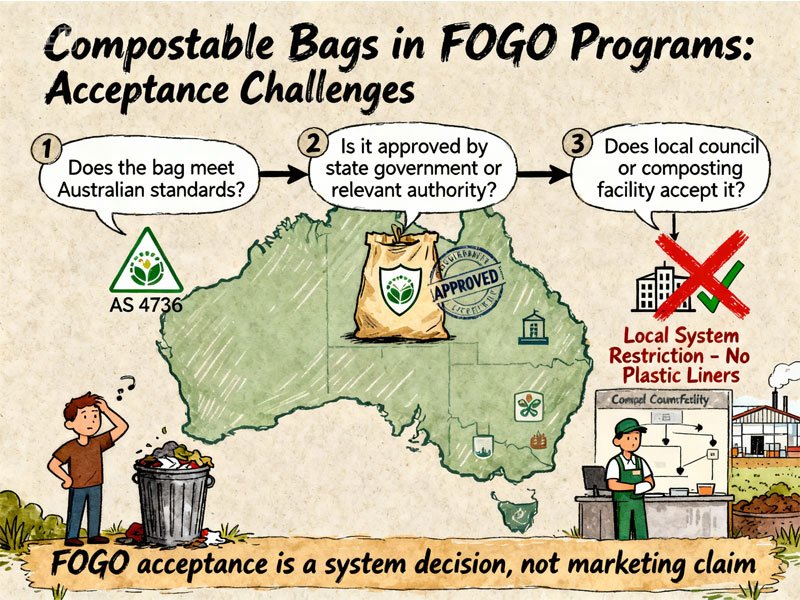
In practice, acceptance depends on three checks:
- Is the bag certified to the correct Australian Standard?
- Does the state or agency allow this type of product?
- Does the local council or composting facility accept it?
A compostable bag can meet AS 4736 and still be rejected if the local system does not allow plastic liners.
FOGO acceptance is a system decision, not a marketing claim.
Compliance Risks for Importers, Suppliers, and B2B Buyers
Common risks include:
- Overseas certification that does not meet Australian Standards
- Using “biodegradable” claims without recognised benchmarks
- Supplying compostable liners to councils that prohibit them
- Inconsistent quality in bulk production
These issues can lead to:
- Rejected waste collections
- Contract disputes
- Reputational damage
For many organisations, compliance failures cost more than the bags themselves.
Sourcing Compliance-Ready Compostable Bags for Australia
If you are sourcing compostable bags for Australia, especially for regulated or bulk use, provide your requirements clearly.
Support may include:
- AS 4736 or AS 5810 certified products
- Use-specific bag design
- Bulk manufacturing and stable supply
- Documentation for procurement and audits
FAQ
There is no single national rule. Legality depends on bag type, state bans, and intended use.
Most biodegradable bags do not meet recognised standards and are often treated as non-compliant.
In most council-run FOGO systems, AS 4736 is the required standard where liners are allowed.
Only if the council and processing facility accept them.
No. They are designed for composting conditions, not landfill.
Australia council compostable bag requirements are shaped by standards, state bans, and local waste systems.
Compliance is not about choosing a “green” product.
It is about using the right bag, for the right purpose, in the right system.
For councils, contractors, and suppliers, understanding this structure helps reduce risk and support compliant waste outcomes across Australia.