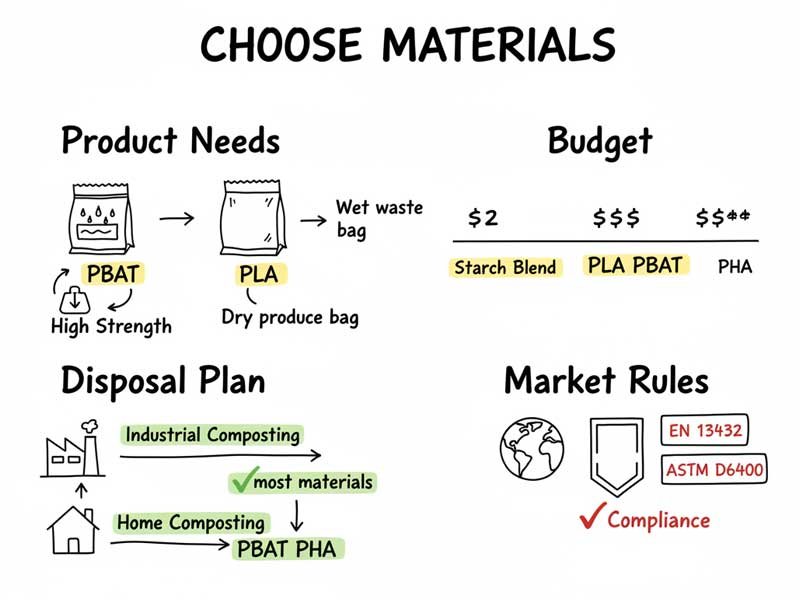
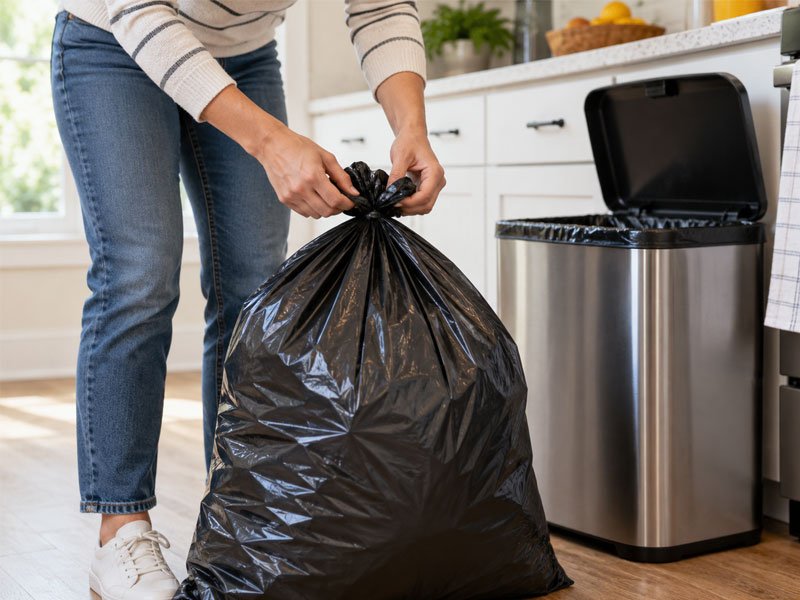
Private label compostable nappy bags are not only about adding your logo to a bag.
A real private label project includes the bag, the packaging, the claim, the barcode, the carton, the sample, and the repeat order plan.
If you are a baby-care brand, retailer, importer, or distributor, it is better to confirm these details before artwork starts.
That saves time.
It also helps avoid wrong box sizes, unclear claims, and costly sample changes.
In this guide, I will explain how to plan private label compostable nappy bags from specification to quotation.
If you already know your required product, you can also start from our compostable nappy bags wholesale.
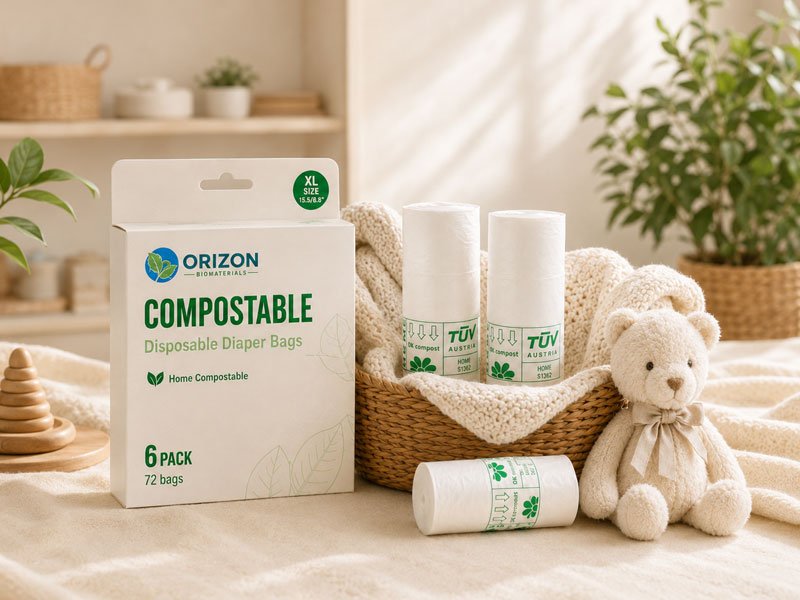
What Private Label Compostable Nappy Bags Mean
Private label means the product is made for your brand.
For nappy bags, this can include:
- Your brand name
- Your bag size
- Your colour
- Your logo printing
- Your retail box
- Your barcode
- Your packaging copy
- Your carton marking
- Your target market claim
The factory produces the bags based on the agreed specification.
Your brand sells the finished product.
Private label compostable nappy bags are often used by:
- Baby-care brands
- Sustainable hygiene brands
- Supermarkets and pharmacies
- Online baby product sellers
- Childcare product suppliers
- Importers and distributors
- Retail private label teams
The product may also be called private label nappy bags, biodegradable nappy bags, compostable nappy sacks, diaper disposal bags, or biodegradable diaper sacks.
For this article, “nappy bags” means disposal bags for used nappies or diapers. It does not mean baby changing bags or diaper backpacks.
What Buyers Should Confirm Before Artwork
Do not start with the box design.
Start with the bag.
I usually suggest confirming these details first:
- Bag format
- Bag size
- Thickness
- Colour
- Printing
- Bags per roll or pack
- Retail packaging type
- Certification claim
- Target market
- Shipping term
Artwork depends on these details.
For example, a roll nappy bag needs the roll diameter checked before the box dieline is final. A tie-handle nappy bag may need a different folded size and packaging structure.
If the bag changes, the box may need to change too.
That is why the specification should come before the final artwork.
MOQ by kg/spec
MOQ is one of the first questions buyers ask.
For custom compostable nappy bags, MOQ is usually calculated by material weight, not only by bag count.
For ORIZON custom projects, MOQ usually starts from about 500 kg per specification.
The final bag quantity depends on:
- Bag size
- Thickness
- Bag format
- Material
- Colour
- Printing
- Bags per roll or pack
- Packaging type
This means 500 kg does not always equal the same number of bags.
A small, thin nappy disposal bag may produce more pieces.
A larger or thicker bag may produce fewer pieces.
If one project has two different sizes, two different colours, or two different bag formats, each one may need to be reviewed as a separate specification.
Retail boxes and printed packaging may also have their own MOQ.
So when you ask for a quote, it is better to share the full project plan.
Not only the bag size.
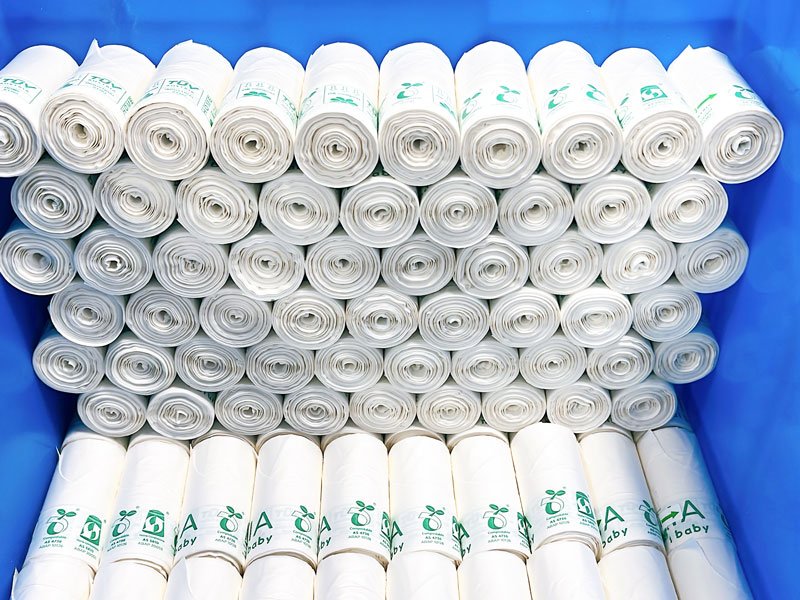
Bag Format Options for Private Label Projects
Private label nappy bags can be made in several formats.
The right choice depends on your selling channel and user experience.
Tie-Handle Nappy Bags
Tie-handle nappy bags are easy to close after use.
They are suitable for:
- Daily diaper disposal
- Childcare use
- Travel packs
- Baby-care retail products
- Pouch or box packaging
This format is useful when fast closure matters.
Roll Nappy Bags
Roll nappy bags are packed on a roll.
They are often used for:
- Retail boxes
- Sleeve packs
- Dispenser boxes
- Online retail
- Refill-style packaging
For roll bags, you should check the tear-off line, roll height, roll diameter, and box fit before bulk production.
Booklet-Bound Nappy Sacks
Booklet-bound nappy sacks are stacked and bound together.
They can work well for:
- Travel packs
- Small consumer packs
- Baby-care starter kits
- Compact shelf packaging
If you are still choosing between formats, read our tie-handle vs roll nappy bags.
Retail Box and Packaging Options
Private label buyers usually need more than bags.
They need finished retail packaging.
Common options include:
- Retail box
- Hanging box
- Pouch
- Sleeve
- Dispenser box
- Booklet pack
- Bulk carton
- Shelf-ready carton
Each option affects cost, packing, shipping volume, and shelf display.
A retail box gives more space for brand story, barcode, product count, instructions, and certification information.
A pouch may feel lighter and easier for travel products.
A dispenser box can work well for roll nappy bags.
A bulk carton may be better for childcare suppliers or institutional buyers.
One simple rule:
Confirm the bag size and pack count before finalising the box.
The box should fit the product, not the other way around.
Custom Printed Nappy Bags
Custom printed nappy bags can help a private label product look more complete.
Common printing options include:
- One-colour logo printing
- Repeated logo pattern
- Simple text printing
- Custom bag colour
- Pantone colour matching
- Full-colour retail box printing
For many nappy bag projects, a simple printed bag and a stronger retail box work better than heavy ink coverage on the bag.
The bag is used quickly.
The box sells the product.
Before printing, please prepare:
- Logo file
- AI or editable PDF artwork
- Pantone colour reference
- Print position
- Box dieline, if available
- Barcode, if needed
- Certification logo request, if applicable
Printing should be reviewed together with the compostable claim.
Ink coverage, colour, fragrance, and additives may affect the final product review or certification scope.
For wider printing options, see our custom printing for compostable bags.
Barcode, SKU and Retail Details
Barcode planning is easy to forget.
But it matters for retail.
The buyer usually provides the barcode. The factory or designer places it on the retail box, pouch, or label.
Before printing, check:
- Barcode number
- Barcode size
- Barcode position
- Scanning area
- SKU or item code
- Product name
- Bag count
- Bag size
- Warning text
- Disposal instruction
- Importer or distributor information
The barcode should not fight with the certification logo, warning text, or product instructions.
Leave enough clean space around it.
If the product is for supermarkets, pharmacies, Amazon, or retail chains, barcode placement should be checked before artwork approval.
Carton Marking for Export Orders
Outer cartons are not exciting.
But they matter.
Good carton marking helps warehouse teams, freight forwarders, retailers, and importers handle the order correctly.
A private label nappy bag carton may include:
- Product name
- Item number
- Customer SKU
- Bags per carton
- Packs per carton
- Net weight
- Gross weight
- Carton size
- Country of origin
- Batch number
- Shipping mark
- Carton number
- Handling marks, if needed
For larger orders, carton marking should match the packing list and commercial invoice.
If the product is going to a warehouse, retailer, or fulfilment centre, ask whether they have carton label requirements.
It is better to confirm this before carton production.
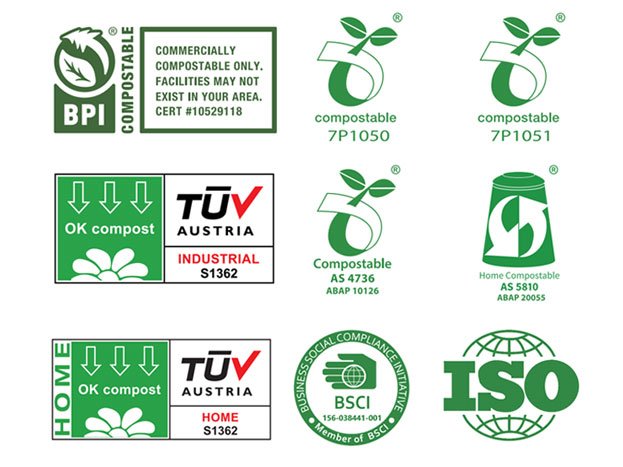
Certification Logo Use and Claim Review
Many private label buyers want to place certification logos on retail packaging.
This needs care.
Common standards and certifications may include:
- EN 13432
- ASTM D6400
- BPI
- OK compost
- AS 4736
- AS 5810
But logo use depends on the certificate, product scope, licensing rules, and target market.
A material certificate is not always the same as a finished product certificate.
The final claim may depend on:
- Material
- Thickness
- Bag size
- Printing
- Ink coverage
- Colour
- Fragrance
- Additives
- Packaging wording
- Target market
- Certification logo permission
The UK Green Claims Code says environmental claims should be truthful, clear, not hide important information, and be supported by evidence. It also says manufacturers, wholesalers, distributors, and retailers may all be involved in making or relying on such claims.
So I do not suggest placing a logo or strong environmental claim on the box before review.
Check the product first.
Check the document next.
Then approve the artwork.
For claim wording, read our biodegradable vs compostable nappy bags.
For standards, see our compostable nappy bag certifications guide.
Sample Process Before Bulk Production
Samples reduce risk.
For private label compostable nappy bags, there are several sample options.
1. Existing Stock Sample
This helps you check material feel, opening, thickness, and general bag quality.
It may not match your exact size or printing.
2. Similar Material Sample
This helps when you want to check film softness, colour, smell, strength, or transparency.
3. Printed Reference Sample
This shows previous printing quality or box printing quality.
It is useful before custom artwork starts.
4. Digital Artwork Proof
This is used to check layout, logo position, barcode, text, and certification information.
It is not a physical product test.
5. Custom Physical Sample
This is closer to the final product.
It may be needed when you have a new size, new colour, special packaging, or important retail launch.
6. Pre-Production Approval
Before bulk production, confirm:
- Bag size
- Thickness
- Colour
- Printing
- Bag count
- Roll size or folded size
- Retail packaging
- Carton packing
- Claim wording
A sample cannot solve every problem.
But it can find many problems early.
Performance Checks Before Bulk Production
Private label products should be tested like real products.
Not only photographed.
For nappy bags, I suggest checking:
- Easy opening
- Tear-off line
- Tie-handle strength
- Seal strength
- Leak resistance
- Bag thickness
- Roll diameter
- Folded size
- Box fit
- Carton packing
If the product is roll packed, test whether one bag tears off cleanly.
If it is tie-handle, test whether the handles close smoothly.
If it is a retail box, check whether users can take the bags out easily.
Small problems become customer complaints after launch.
If thickness is still under review, this compostable nappy bag thickness may help.
Common Mistakes in Private Label Nappy Bag Projects
I see the same mistakes often.
Mistake 1: Designing the box before confirming the bag
This can lead to the wrong box size.
Roll diameter and folded bag size should be confirmed first.
Mistake 2: Only comparing unit price
A lower unit price may come from thinner film, smaller size, simpler packaging, or weaker printing.
Always compare the full specification.
Mistake 3: Using certification logos too early
Do not place EN 13432, BPI, OK compost, AS 4736, or AS 5810 logos on packaging before checking the document scope and usage rules.
Mistake 4: Using vague green claims
Words like “eco-friendly,” “green,” or “fully biodegradable” may be too broad if they are not explained.
The claim should be clear and supported.
Mistake 5: Ignoring barcode and carton labels
Retail and warehouse requirements should be checked before printing.
Mistake 6: Skipping sample review
A sample can help check opening, strength, colour, printing, box fit, and carton packing.
Skipping this step may save a few days, but it can create bigger issues later.
Quotation Checklist
A good quote starts with clear information.
To quote private label compostable nappy bags, please share:
- Bag size
- Bag thickness
- Bag format
- Bag colour
- Pantone colour, if needed
- Printing requirement
- Bags per roll or pack
- Retail packaging type
- Barcode requirement
- Certification requirement
- Destination country
- Shipping term
- Target order quantity
- Target launch date
- Current product photo or reference sample
If you are not sure about the exact specification, send a product photo.
That is often the fastest way to start.
Source Private Label Compostable Nappy Bags
Private label nappy bag projects work best when the bag, box, claim, and carton are planned together.
ORIZON supports private label compostable nappy bags for baby-care brands, retailers, distributors, and importers.
We can help review:
- Bag specification
- MOQ by kg/spec
- Retail packaging
- Custom printing
- Barcode position
- Carton marking
- Sample options
- Certification document needs
- FOB, CIF, or DDP shipping
You can start from our compostable nappy bags wholesale product page, or send your current sample for a specification review.
FAQ
What are private label compostable nappy bags?
Private label compostable nappy bags are disposal bags made for your own brand. They can include custom size, colour, printing, retail packaging, barcode, carton marking, and packaging copy.
What is the MOQ for private label nappy bags?
Custom MOQ usually starts from about 500 kg per specification. The final bag quantity depends on size, thickness, bag format, colour, printing, and packaging.
Can you print my logo on nappy bags?
Yes. Logo printing and repeated logo pattern printing can be made on nappy bags. Retail boxes can also be printed with full brand artwork.
Can you make retail boxes for nappy bags?
Yes. Retail box, hanging box, pouch, sleeve, dispenser box, booklet pack, and shelf-ready carton options can be reviewed based on the bag format and pack count.
Can I use EN 13432 or BPI logos on my packaging?
Logo use depends on the certificate scope, product specification, licensing rules, and target market. Buyers should review documents before placing certification logos on artwork.
Can I order samples before bulk production?
Yes. Sample options may include existing samples, similar material samples, printed reference samples, digital artwork proof, custom physical samples, or pre-production samples.
Does custom printing affect compostability claims?
It may. Printing, ink coverage, colour, fragrance, and additives can affect claim review or certification scope. These details should be checked before final artwork.
What information is needed for a quote?
Please send bag size, thickness, format, colour, printing needs, bags per roll or pack, packaging type, quantity, certification requirement, destination country, and shipping term.