We deal with waste every day, making the choice of the right trash bags crucial, as it relates to environmental changes. We’re all searching for more environmentally friendly solutions, especially with the emergence of compostable trash bags. A core question arises: Are compostable trash bags better? Are they truly better than traditional plastic bags? Can they really help us reduce our environmental burden?
Today, we’ll take you on a deep dive into the world of compostable trash bags. From what compostable bags are, their advantages, challenges, and some decomposition tests, we’ll provide a comprehensive guide. Hopefully, this will help you make informed and truly better-for-the-environment choices when purchasing and using these products. Let’s explore the true value of these eco-friendly waste solutions together.

Are Compostable Trash Bags Better for the Environment
Yes, under the right conditions, compostable trash bags are indeed better for the environment than traditional plastic bags. But these “right conditions” are key.
Traditional plastic trash bags are typically made from petroleum, and they take hundreds or even thousands of years to decompose in the natural environment, producing large amounts of microplastics during this process, causing long-term pollution to soil, water sources, and ecosystems. Most of these bags end up in landfills, consuming valuable land resources and slowly releasing greenhouse gases.
Compostable trash bags offer a different path. If they are processed in industrial composting facilities or in certified home composting environments, they decompose completely into harmless organic matter, water, and carbon dioxide in a shorter time (usually weeks to months). This process doesn’t leave the harmful residues of traditional plastics; instead, it transforms organic waste into beneficial compost, nourishing the soil. This is the core reason why compostable trash bags are better for the environment.
Will Compostable Trash Bags Break down in a Landfill
Most compostable trash bags are not designed to break down effectively in a conventional landfill. Landfills are typically anaerobic (lacking oxygen) and sealed, which inhibits the microbial activity needed for compostable materials to decompose. While they might eventually break down over a much longer period than in a compost pile, it’s often at a rate similar to or only slightly faster than traditional plastic, and without contributing to nutrient cycling. For them to truly serve their purpose, they need to go into an industrial or home composting system.
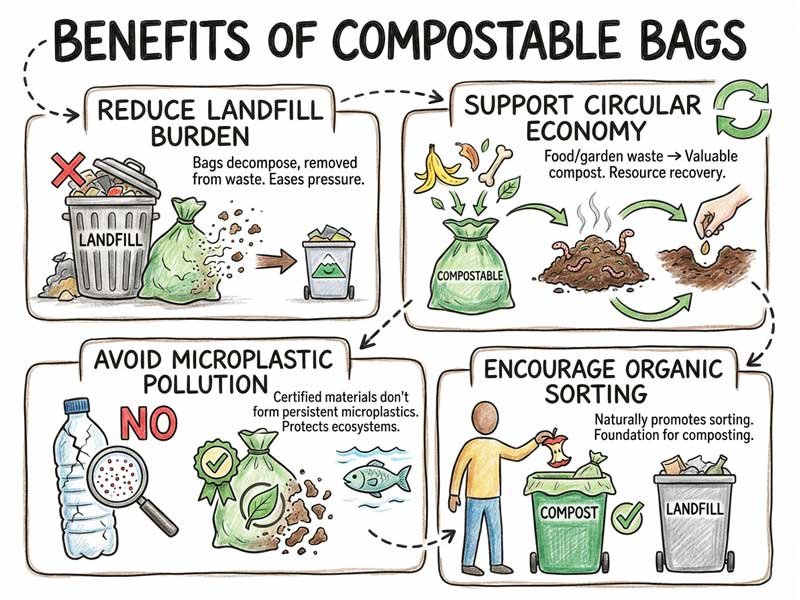
Benefits of Compostable Trash Bags
- Reduced Landfill Burden: Compostable bags are completely removed from the waste stream after decomposition, easing pressure on landfills.
- Support for a Circular Economy: They transform food waste and gardening waste into valuable compost, achieving resource recycling rather than simple disposal.
- Avoid Microplastic Pollution: Strictly certified compostable materials do not break down into persistent microplastics, thus protecting ecosystems.
- Encourage Organic Waste Sorting: Using compostable bags naturally encourages us to more actively sort organic waste, laying the foundation for subsequent composting.
If compostable trash bags end up in traditional landfills or incinerators, their environmental benefits are significantly diminished. In the oxygen-deprived environment of a landfill, some compostable materials may not decompose effectively, potentially even producing greenhouse gases like methane; incineration, on the other hand, fails to differentiate between ordinary plastics and compostable materials.
To maximize the environmental benefits of compostable trash bags, the key lies in our actions as consumers: choosing them correctly (look for BPI or TÜV Austria OK Compost certification) and disposing of them properly according to local waste management facilities. Only when we actively participate in this cycle can their environmental potential be truly realized.
Problems with Compostable Trash Bags:
Strength and durability.
Compared to traditional plastic bags, compostable trash bags are generally less durable. When they come into contact with damp food waste, the decomposition process may start prematurely, causing the bags to soften or even break.
They require us not to overload them and to empty them as promptly as possible to avoid prolonged immersion in liquid. Many Reddit users have complained about bags breaking before even reaching the compost bin, which is indeed a real problem.
Strict decomposition conditions.
Many people ask: Do compostable trash bags break down? The answer is yes, but they often require very specific conditions.
Most compostable trash bags are designed for industrial composting facilities. In these facilities, temperature, humidity, and microbial species are strictly controlled to ensure that the bags decompose completely within weeks to months.
If you’re planning home composting in your backyard, how long do compostable trash bags take to decompose? This can take much longer, and some bags simply won’t decompose completely in the relatively cold and unstable environment of home composting. This is a crucial point regarding the pros and cons of compostable trash bags.
Are compostable trash bags expensive?
Yes, compostable trash bags are generally more expensive than traditional plastic bags. This is mainly due to their more complex raw material costs and manufacturing processes. This makes many consumers hesitate when choosing, wondering if compostable trash bags are worth it.
Storage requirements.
Compostable trash bags are sensitive to humidity and temperature, and we can’t store them as casually as we would ordinary plastic bags. They need to be stored in a dry, cool environment, otherwise they may show signs of decomposition before use.
All of this shows that compostable trash bags are not perfect magic. Understanding these limitations helps us view them more rationally and avoid disappointment in actual use.
How Do Compostable Trash Bags Work
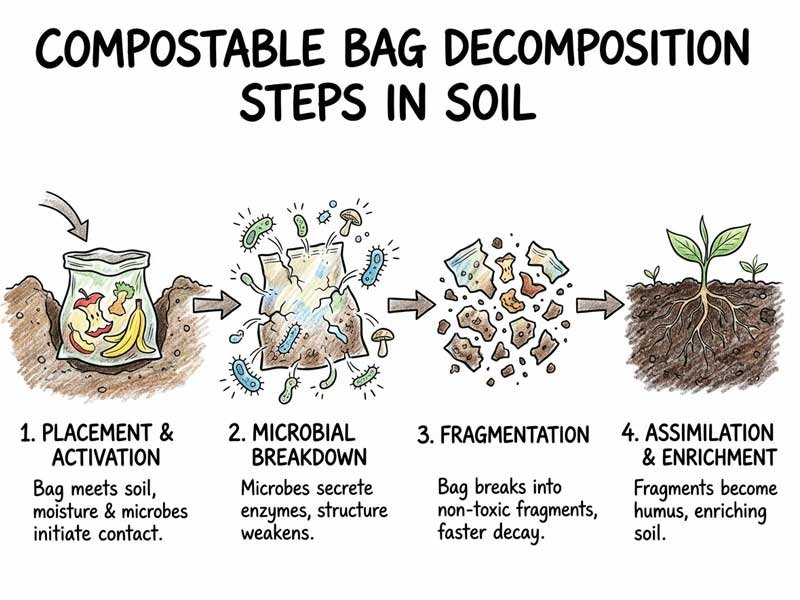
Compostable bags decompose in the soil through a natural, controlled biological process. When the bag is placed in the soil and has sufficient temperature, moisture, and oxygen, microorganisms begin to break it down. These microorganisms include bacteria, fungi, and other tiny organisms commonly found in compost and the natural environment.
The bag absorbs moisture from the soil. This softens the material, making it easier for microorganisms to break down polymer chains such as PLA, PBAT, and plant starches. As the microorganisms decompose the material, the bag’s strength and structure gradually decrease.
The material breaks down into increasingly smaller fragments. At this stage, the microorganisms convert the carbon in the bag into carbon dioxide, water, and organic biomass. Because certified compostable bags are designed to decompose completely into natural elements, no toxic residues are left behind.
After weeks or months (depending on temperature, humidity, and the thickness of the bag), the compostable bag eventually integrates into the soil. What remains is nutrient-rich material that improves soil quality and promotes plant growth.
In short, compostable bags decompose in the soil because microorganisms use them as nutrients. Under the right conditions, the bag will disappear completely, returning to nature as clean and harmless organic matter.
Where Can I Buy Compostable Trash Bags?
You can find compostable trash bags in many places:
- Supermarkets and Grocery Stores: Many larger stores now carry them in the cleaning or refuse aisle.
- Online Retailers: Websites like Amazon, Grove Collaborative, or directly from brands specializing in eco-friendly products are good sources.
- Home Improvement Stores: Stores like Lowe’s or Home Depot might have them, especially larger sizes.
- Specialty Eco-Friendly Stores: Dedicated environmental product shops often stock a variety of options.
How to Choose Truly Good Compostable Garbage Bags
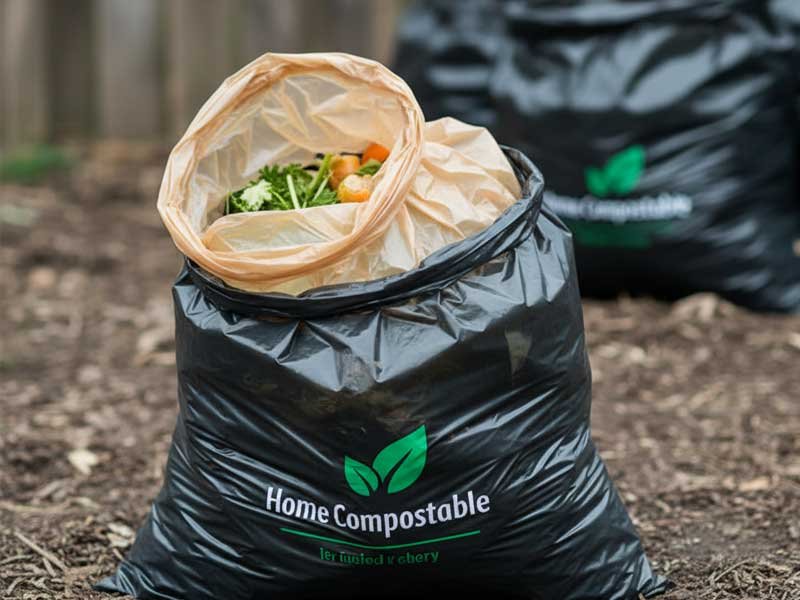
Through the preceding analysis and testing, you should now have a deeper understanding of the question of whether compostable trash bags are better. If you decide to use them, then choosing the right compostable trash bags becomes crucial. Here’s a buying guide to help you select the best compostable trash bags.
Look for authoritative certifications.
This is key to identifying genuine compostable trash bags.
- BPI (Biodegradable Products Institute) Certification: The most common certification for industrial composting products in North America. If your local industrial composting facilities accept compostable garbage bags, products with BPI certification are generally reliable.
- TÜV Austria (OK Compost Industrial / OK Compost Home) Certification: European certification is more detailed, clearly distinguishing between “industrial compost (OK Compost Industrial)” and “home compost (OK Compost Home).” If you plan to compost at home, be sure to look for products with the “OK Compost Home” label, as this means it can decompose in the lower temperatures and unstable environment of your home.
Avoidance Tips: Be wary of products that only use vague terms like “eco-friendly,” “natural,” or “plant-based.” Without clear third-party compostable certifications, they are likely just “green marketing.”
You can read this article: What Is BPI Compostable Certification? The Complete 2025 Guide
Use Cases
Do you need compostable trash bags for food waste? Or compostable kitchen bags?
If you mainly use them for food waste, choose small, moderately thick bags and empty them promptly to prevent breakage.
For general waste, if you don’t need to compost, then using compostable bags offers little environmental benefit.
For compostable trash bags for composting, be sure to check if they are certified for “home composting.”
For more detailed information, you can read my article: How to Check Compostable Bag Quality : Comprehensive Guide
Material Analysis
Common compostable materials on the market include PLA (polylactic acid) and PBAT. They each have their own characteristics, but ultimately, they must meet certification standards.
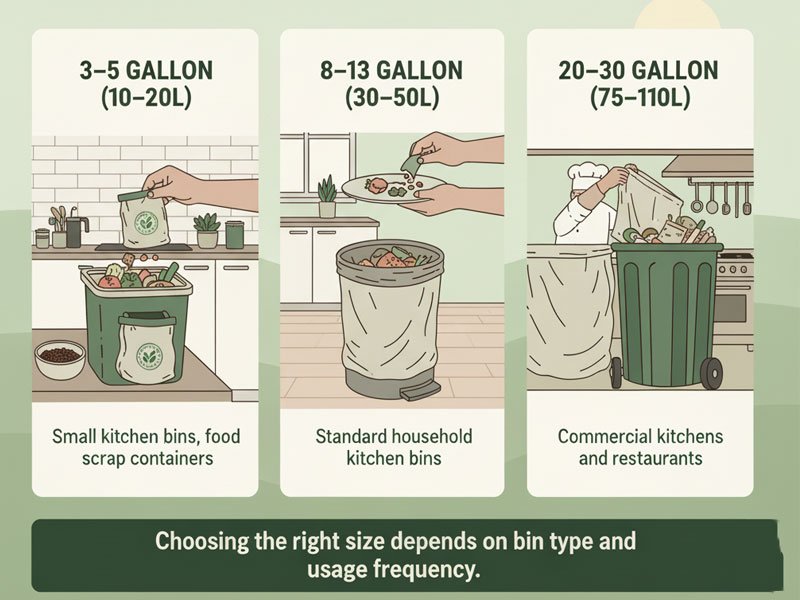
Choosing Size and Capacity
Choose according to the size of your trash can and your family’s needs to avoid waste.
As for where to buy compostable trash bags, you can find them in large supermarkets, e-commerce platforms (such as Amazon), or specialized eco-friendly product stores. Remember, always prioritize brands with clear certification marks.
How to Properly Use and Dispose of Compostable Garbage Bags
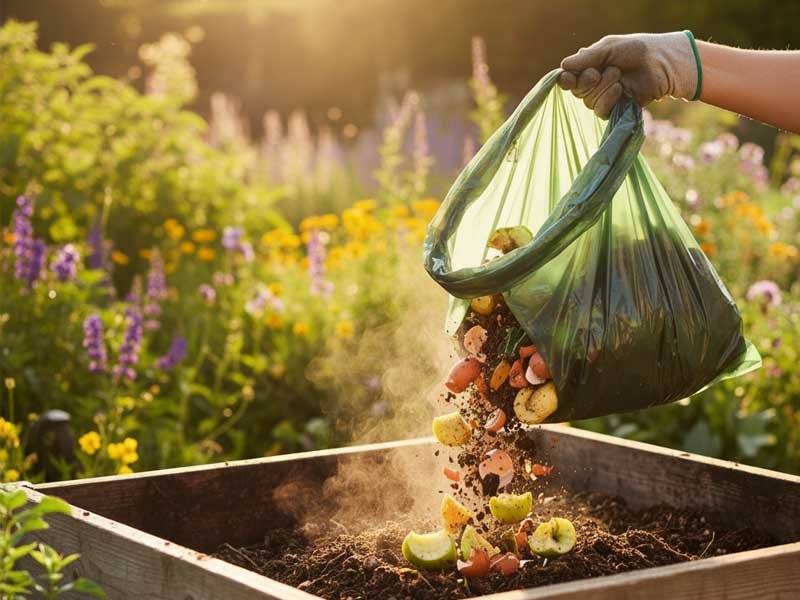
Now that you’ve chosen suitable compostable trash bags, how do you use and dispose of them correctly to maximize their environmental benefits? This directly relates to what compostable trash bags you can put in and how to dispose of them.
When to Use?
Compostable trash bags are best suited for collecting organic waste, primarily food waste such as kitchen scraps (fruit peels, vegetable leaves, coffee grounds, eggshells, etc.) and some gardening waste. If used to hold non-compostable general waste, the bags will eventually end up in landfills, negating their compostable nature.
Avoid Overloading.
These bags are designed to decompose, but you certainly don’t want them to break before they reach composting facilities. Therefore, avoid putting sharp objects in them and don’t make the bags too heavy. In my experience, they are indeed less resistant to weight and sharp objects than traditional plastic bags.
Timely Disposal is Crucial.
They are designed to decompose; storing wet waste for extended periods can cause the bags to soften prematurely, leak, and even develop odors. I recommend emptying your food waste bin daily or every other day, especially in hot and humid weather. If you ask, “Do compostable trash bags smell?” the answer is that any bag will develop an odor if trash is left inside for a long time. Compostable bags may have a slightly milder smell due to their better breathability, but they will still produce a natural odor during decomposition.
Disposal Methods
- Preferred Option: Take compostable trash bags filled with organic waste to an industrial composting facility that accepts compostable waste. This is the best way to ensure the bags decompose completely and quickly. Check your city’s or region’s waste management policy to see if such a service is available.
- Home Composting: If you are using bags with “OK Compost Home” certification and your home composting system is working well (ideal temperature, humidity, and microbial conditions), you can put them directly into the compost bin. However, please refer to my test results in Section 5 and be prepared for a slower decomposition rate; it may not be as quick and thorough as industrial composting.
- Do Not Throw Them in the Recycling Bin: This is very important! Compostable trash bags should not be thrown into plastic recycling bins. Their composition differs from that of ordinary plastics, and if they are mixed into the recycling stream, they will contaminate the entire recycling batch.
For more detailed information, you can read my article: How to Dispose of Compostable Bags: Your Ultimate Guide
The Future and Sustainable Development of Compostable Materials
Previously, we mainly focused on whether compostable garbage bags better meet consumer needs. However, as someone who manufactures biodegradable compostable bags, I’m more concerned about the future of compostable material innovation. On platforms like LinkedIn, many companies and policymakers are considering how to create truly sustainable waste management solutions, which largely depends on advancements in materials science.
The research and development of compostable materials is progressing rapidly. Besides PLA, which everyone is familiar with, new materials such as PHA are also attracting attention. PHA is a natural polymer produced by microorganisms that can biodegrade in various environments, such as soil, water, and industrial or household composting. These innovations are helping to improve the performance of compostable garbage bags, aiming to reduce costs and expand their applications.
Global plastic bans are also accelerating the growth of the compostable product market. As more and more countries restrict the use of single-use plastics, companies are actively seeking alternatives. This means that the environmental impact of compostable garbage bags is being scrutinized more rigorously, and companies must provide truly sustainable products.
For B2B buyers, choosing sustainable waste management solutions is becoming a strategic decision. This is not just a matter of price, but also about corporate social responsibility and brand reputation. I recommend that companies, when choosing a solution, should not only focus on price and performance, but also examine the source of raw materials, the environmental friendliness of the production process, and whether the product has reliable compostable certification. Investing in compostable waste bags is undoubtedly an important step for companies that want to lead the way in sustainability and meet the growing demand for green sourcing.
FAQ
Should i use compostable trash bags
Using compostable trash bags is a great choice if you actively compost your food scraps and other organic waste. They are designed to break down in composting environments, returning nutrients to the soil. If you don’t compost, their benefits are less pronounced, as they may not break down effectively in a typical landfill
Can i use compostable bags for regular trash
You can use them for regular trash, but it’s generally not recommended if your goal is environmental benefit. Compostable bags are designed to break down in specific conditions found in composting facilities (presence of microorganisms, moisture, and oxygen). When mixed with general waste in a typical landfill, these conditions are usually absent, meaning the bags may not decompose much faster than conventional plastic bags
Do compostable garbage bags really decompose 100%?
Yes, under ideal composting conditions (whether industrial or compliant home composting), certified compostable garbage bags can decompose 100% and eventually return to nature.
Do they produce microplastics?
Certified compostable garbage bags do not produce traditional, harmful microplastics during decomposition. They break down into natural organic matter. In the initial stages of decomposition, there may be visible fragments, but these will continue to decompose and eventually disappear completely.
Can I throw them in the recycling bin?
No, please do not throw compostable garbage bags into plastic recycling bins. Their composition differs from conventional plastics, and mixing them into the recycling stream can contaminate the recycling process, potentially causing the entire batch to fail. Please dispose of them according to local regulations, ideally by sending them to a composting facility.
Can I use compostable garbage bags for regular garbage?
Yes, you can use compostable trash bags in a regular bin. However, if these bags end up in a landfill with regular garbage, their compostable properties are lost, significantly diminishing their environmental benefits. They are primarily recommended for organic waste.
Is it still worthwhile to use compostable trash bags if I don’t have a composting facility at home?
If your city has industrial composting facilities that specifically accept food waste or compostable trash bags, then using them is still worthwhile. Otherwise, if they ultimately end up in a landfill as regular garbage, their environmental benefits are indeed limited. You can check with your local municipal services for relevant recycling policies.
What is the shelf life of compostable trash bags?
Compostable trash bags typically have a “shelf life” due to their material properties. They should be used within one year of purchase. They need to be stored in a cool, dry place, away from direct sunlight and high humidity, otherwise they may begin to degrade before use.
Are compostable trash bags waterproof?
They are waterproof for a short time, but prolonged soaking or exposure to moisture may accelerate decomposition. As for whether all green trash bags are compostable? No, color has nothing to do with compostability. Many green bags are just regular plastic; be sure to check for certification marks.
Conclusion
Are Compostable Trash Bags Better? When used and disposed of correctly, compostable trash bags are indeed a more environmentally friendly and sustainable option than traditional plastic bags. They bring tangible benefits to our planet by reducing landfill waste, supporting the circular economy, and mitigating microplastic pollution.
Therefore, I encourage everyone to make more sustainable waste management choices based on their own circumstances. Understand your local waste management policies, choose appropriate compostable trash bags, and ensure they are truly effective. Small choices, when combined, can create a transformative force. Let’s work together for a cleaner planet!