Our company has been specializing in compostable bags for 16 years, and I handle compostable plastic bags daily. I’ve also read many municipal waste management guides.
One thing is clear by 2026: waste management will no longer be just a service, but an operational system.
This guide is aimed at municipal departments, waste management contractors, property managers, and commercial operators, and aims to provide practical solutions, not empty slogans. I will focus on truly effective practices, hoping it will be helpful to you.
What Councils Mean by “Waste Management” in 2026
When councils talk about waste management, they are not only talking about bins and trucks.
In practice, it means:
- Reducing landfill
- Recovering resources
- Controlling contamination
- Managing costs
- Educating residents
- Reporting outcomes
In Australia, food and organic waste is now one of the biggest priorities. That’s why FOGO and FO programs keep expanding.
FOGO means Food Organics and Garden Organics. It combines food scraps and garden waste into one collection stream.

2025 Snapshot: Where Council Waste Management Is Heading
By 2025, most Australian states have moved from “trial” to mandatory rollout of organics collection.
For example, NSW has committed to providing FOGO services to households with red-lid bins by 2030. Other states are moving in the same direction.
This matters because once FOGO is in place:
- Collection systems change
- Education needs increase
- Contamination costs rise if controls are weak
- External source:
- NSW EPA – FOGO rollout commitments
The Contamination Problem (And Why It Gets Expensive Fast)
If you work in waste, you already know this. One wrong item can affect an entire load.
Contamination happens when non-accepted materials enter recycling or organics streams. Plastic bags, non-certified liners, and pet waste are common examples.
On Reddit and local forums, residents often complain that “one neighbour ruins it for everyone.” They are not wrong.
Once contamination exceeds facility thresholds:
- Loads may be rejected
- Extra sorting is required
- Processing costs increase
- Councils pay more per tonne
External source: Australian Government – Managing contamination in organics
Practical Ways Councils Reduce Contamination
From what I’ve seen, education alone is not enough.
The councils that perform best combine several tools:
- Clear bin lid colours and labels
- Simple “accepted / not accepted” signage
- Bin tagging and feedback notices
- Targeted education in high-risk areas
- Seasonal messaging (summer matters)
Short messages work better than long brochures.
One sentence is often enough:
“Only food and garden waste. No plastic bags.”
Service Design Levers That Actually Improve Results
Small design decisions make a big difference.
The most effective levers are:
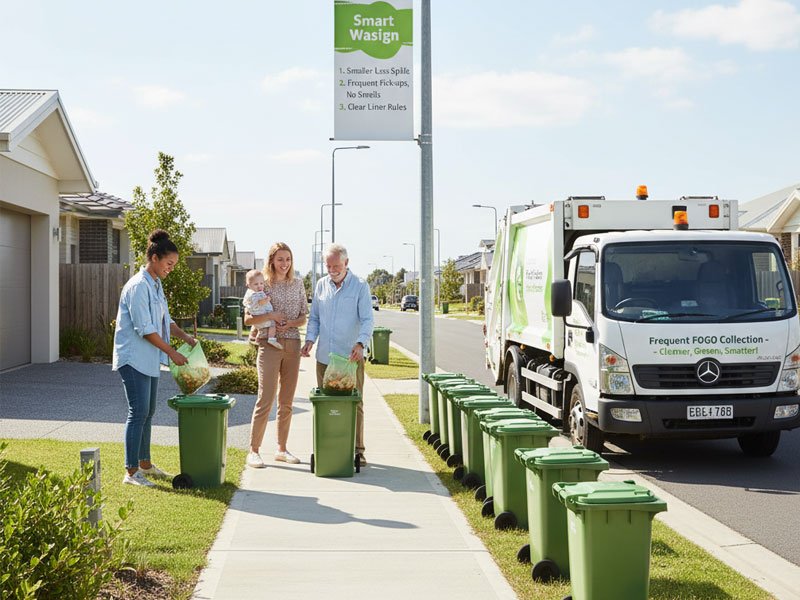
- Bin size – smaller organics bins reduce overfilling
- Collection frequency – more frequent pickup reduces odour complaints
- Liner policy – clear rules on what liners are allowed
When these three are aligned, participation goes up and complaints go down.
Multi-Unit Developments Need a Different Playbook
Apartments are not houses.
Shared bin rooms create shared problems.
Common challenges include:
- Poor signage
- High tenant turnover
- No clear responsibility
- Contamination without accountability
Councils that succeed in multi-unit developments usually:
- Standardise bin room layouts
- Use large, visual signage
- Train caretakers or building managers
- Provide regular feedback, not one-time education
External source: NSW EPA – Better waste management in apartments
Procurement Checklist: Liners and Bin Liners (B2B Focus)
This is where many programs quietly fail. If procurement specs are unclear, operations suffer.
For organics and FOGO programs, councils and contractors should define:
- Required composting standard (e.g. AS 4736)
- Approved liner types and sizes
- Thickness range suitable for food waste
- Packaging format (rolls or flat packs)
- Compliance documentation requirements
Using non-certified liners increases contamination risk. Compostable bin liners for council and organics programs
What Councils Should Measure in 2025
If you don’t measure it, you can’t manage it.
Key indicators I see councils tracking include:
- Contamination rate
- Capture rate (organics recovered)
- Missed collections
- Resident complaints
- Education reach
These numbers don’t need to be perfect. They just need to be consistent.
FAQ: Council Waste Management in Practice
Are compostable liners always allowed in FOGO bins?
No. Acceptance depends on council rules and required certification.
What happens to contaminated FOGO loads?
They may be rejected or require additional processing, which increases costs.
Why do odour complaints spike in summer?
Heat accelerates decomposition. Collection frequency and liner choice matter.
Final Thoughts
Council waste management in 2026 is no longer about adding more bins.
It’s about system design.
Clear rules.
Simple education.
Practical procurement.
Measurable outcomes.
When these pieces align, waste diversion improves—and so does public trust.