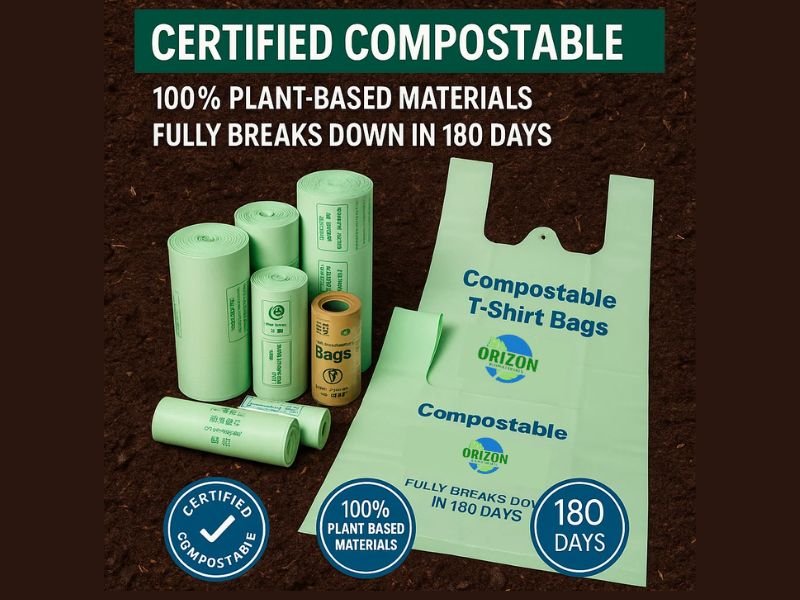
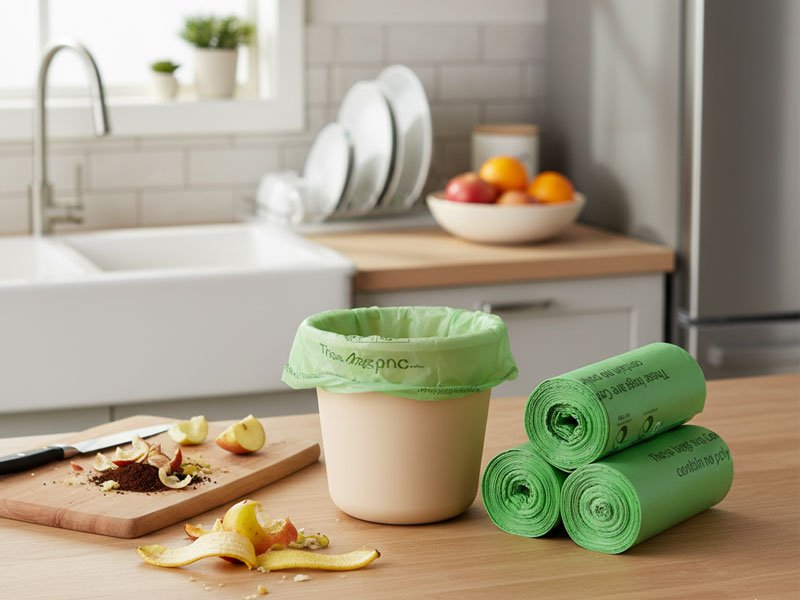
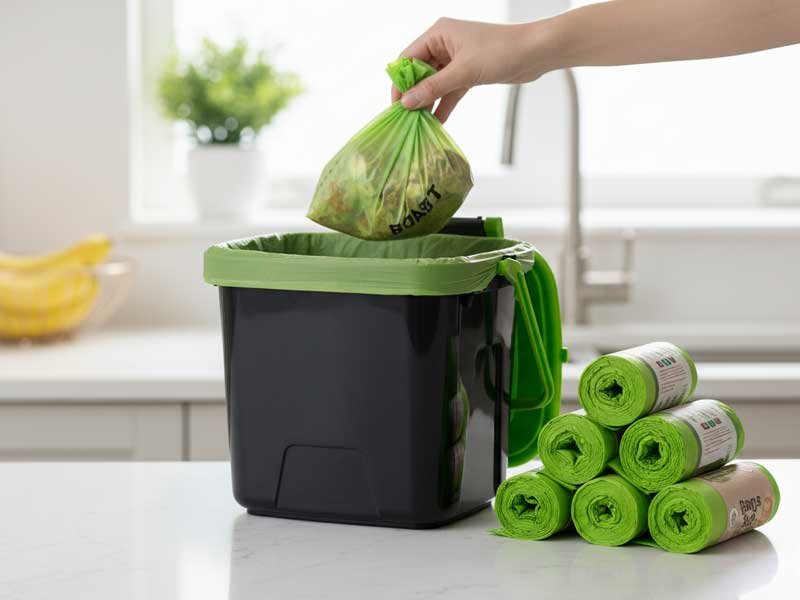
Biodegradable bags and regular plastic bags are commonplace in our daily lives. Which is more environmentally friendly? What’s the difference between biodegradable bags vs plastic bags ? How do they impact our lives?
I’ve read a lot of information online, but the introduction to biodegradable bags is quite vague. As a manufacturer with 16 years of experience in biodegradable and compostable bags, I’ll provide a detailed explanation of biodegradable bags vs plastic bags, including the raw materials, prices, and how to dispose of used bags. I hope this will help you make an informed choice.
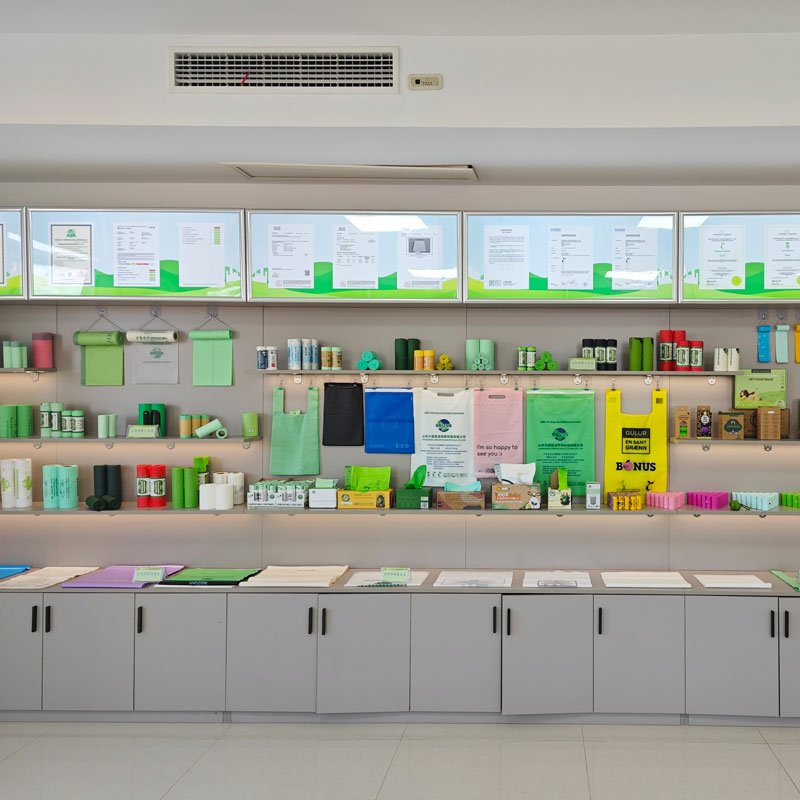
What Are Biodegradable Plastic Bags and Regular Plastic Bags?
Everyone is familiar with plastic bags, but many vendors in the market confuse the terms “biodegradable” and “compostable.” I’m sure you’re confused. When I first started working in the compostable bag industry, I was also confused. Let me clarify things for you.
Traditional plastic bags
They are typically made of HDPE or LDPE, which are derived from petroleum. They are waterproof and durable, can last for hundreds of years, and rarely degrade naturally.
Biodegradable bags
The concept of biodegradable bags is a bit vague. Do you think that packaging labeled “biodegradable” is environmentally friendly? That’s a complete mistake; it’s just a marketing gimmick. Read on.
Biodegradable
Bags can be decomposed by microorganisms, but there are no specific timeframes or environmental requirements. In natural environments, they may not decompose at all. This is a common problem for “greenwashing.”
Compostable
Biodegradable within a specified timeframe (90-180 days). This requires a specific temperature, humidity, and oxygen level to decompose the bag in an industrial composting facility, ultimately transforming it into harmless materials. This is the truly eco-friendly bag worth buying.
Source: Compiled from oceanwatch, chicobag.
| Aspect | Biodegradable Bags | Traditional Plastic Bags |
|---|---|---|
| Material | Plastic-based with additives that attract degrading microbes | Petroleum-based plastic |
| Degradation Method | Microbial breakdown in specific conditions | Extremely difficult to degrade naturally |
| Degradation Speed | Several months to years, depending on environmental conditions | Hundreds to thousands of years |
| Environmental Impact | May leave microplastics but less pollution than traditional plastic | Long-term environmental pollution, very hard to degrade |
| Cost | More expensive than plastic bags | Low cost |
| Use Range | Suitable for light packaging and general trash | Suitable for various purposes, including carrying heavy items |
Data Source :BPI (Biodegradable Products Institute),European Bioplastics,UNEP (United Nations Environment Programme),EPA (U.S. Environmental Protection Agency)
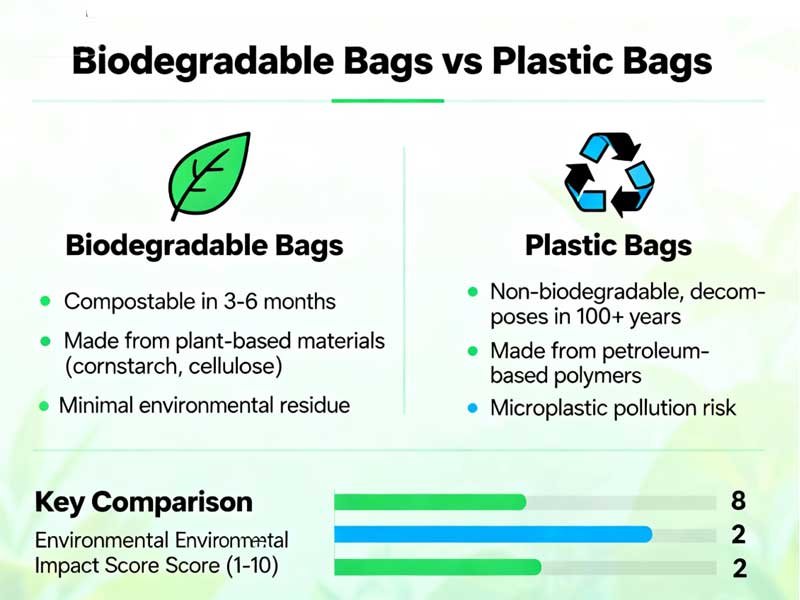
Pros and Cons : Biodegradable Bags Vs Plastic Bags
Biodegradable Bags
Advantages:
- Under the right conditions, they can be decomposed by microorganisms. This reduces the long-term accumulation of plastic waste and is better for the environment.
- They decompose more easily than regular plastic bags, reducing plastic pollution.
- They are increasingly favored by companies and consumers for supporting sustainable development, contributing to a green economy.
- Some biodegradable bags can even be composted in industrial composting plants, which facilitates material recycling.
Disadvantages:
- They are more expensive to manufacture and purchase than regular plastic bags.
- They require special conditions (suitable temperature, humidity, and oxygen) to decompose. If these conditions are not met, they degrade very slowly.
- They are weak, easily torn, and unable to carry heavy loads.
- In some cases, they cannot completely decompose, resulting in tiny plastic fragments (microplastics).
- If biodegradable bags are not properly collected and handled, their environmental benefits are significantly reduced.
Traditional Plastic Bags
Advantages:
- They are inexpensive and well-suited for large-scale use.
- They are durable, waterproof, tear-resistant, and can also carry heavy loads.
- The mature production process allows for rapid mass production.
Disadvantages:
- Non-biodegradable, may take hundreds of years to decompose, and causes significant pollution.
- It can damage marine and terrestrial ecosystems.
- It creates waste problems and is difficult to recycle, ultimately ending up in landfills or as garbage.
Limitations and Risks You Should Know
While biodegradable and compostable bags offer real environmental benefits, they are not a silver bullet:
In landfills, where oxygen is limited, biodegradable bags may release methane, a potent greenhouse gas.
Compostable bags require access to industrial composting facilities, which are not available in all regions.
Mislabeling or vague claims (“biodegradable” without certification) can mislead consumers and harm brand trust.
To avoid greenwashing, always look for third-party certifications and check whether local waste systems support compostable disposal.
Cost Difference Between Biodegradable and Plastic Bags
The raw materials used for biodegradable bags, such as cornstarch and bioplastics, are more expensive. The production process is also more complex, which raises the overall cost.
According to market data from industry reports (European Bioplastics, BPI, and UNEP), the unit price of biodegradable bags is usually several times higher than that of regular plastic bags — often 3 to 10 times more expensive, depending on quality, certification, and order quantity.
Traditional plastic bags have extremely low production costs, averaging only $0.01 to $0.05 per bag (Data from Amazon, Alibaba, etc.) , with bulk purchases driving the price even lower.
Although biodegradable bags are more expensive today, their prices show a downward trend due to advances in manufacturing technology and growing market demand.
On the other hand, traditional plastic bags appear cheap, but the long-term environmental cleanup costs and ecological damage they cause are not reflected in their market prices.
In some regions, government regulations and environmental policies — such as plastic bag taxes, bans, or mandatory biodegradable alternatives — have indirectly increased the usage cost of traditional plastic bags, encouraging more consumers and businesses to choose biodegradable options.
How Long Do Biodegradable Bags Take to Decompose?
I always thought biodegradable plastic bags degraded quickly everywhere. It wasn’t until I started working in the biodegradable and compostable bag manufacturing industry that I learned more about the process. I discovered that biodegradable plastic bags don’t actually degrade quickly, even within a few months.
Biodegradable plastic bags don’t disappear on their own, and the term “biodegradable” can be widely misunderstood. They require specific environmental conditions, such as temperature, humidity, and oxygen levels. These conditions are ideal in industrial composting facilities, where these factors can be manually controlled.
Buying biodegradable bags doesn’t mean you’ll immediately reduce environmental pressures. We need to understand more about how these bags are handled and shouldn’t blindly trust the term “biodegradable.”
In reality, biodegradable plastic bags require strictly controlled conditions—including specific temperatures (50-60°C), humidity, and oxygen levels—to decompose within the expected timeframe. These conditions can only be reliably achieved in industrial composting facilities. According to Forbes (2023), over 80% of commercially certified compostable packaging relies on industrial composting systems to fully decompose within 180 days.
If these bags are discarded in landfills or end up in oxygen-deficient marine environments, their anaerobic degradation can take decades—making them essentially no better than conventional plastic bags. Worse still, the U.S. Environmental Protection Agency reports that landfills are the third-largest source of methane emissions from human activities, and the anaerobic degradation of organic matter (including some biodegradable plastics) produces methane, a greenhouse gas 28 times more potent than carbon dioxide (EPA, 2023).
As Dr. Laura Simmons, Senior Environmental Scientist at the Ellen MacArthur Foundation, emphasizes, “Biodegradability is not a magical property—it only works if the proper waste management processes are followed. Otherwise, these materials may actually become part of the problem.”
Buying biodegradable bags doesn’t mean you’ll instantly reduce environmental pressures. Consumers and businesses should understand how these bags are handled by local waste systems, whether they’re collected for industrial composting or potentially sent to landfills, before considering them an environmentally friendly solution.
You can read this article to learn more about the decomposition time of biodegradable bags: 2025 Gudie : How Long Does It Take for Biodegradable Plastic to Decompose
What Experts Say
“Biodegradable plastics are not a free pass to litter. They need the right conditions to break down properly.” — Ellen MacArthur Foundation, 2024 Report
“Switching from conventional plastic to certified compostable alternatives can cut microplastic leakage by up to 80%.” — UNEP Plastic Pollution Study, 2023
By combining certified solutions with proper waste management, the environmental benefits of biodegradable bags can be fully realized.
Different Composting Methods for Biodegradable Bags
I used to think that biodegradable bags worked the same in both industrial and home composting facilities. However, after conducting some experiments myself, those in the industry and others have discovered that simply placing a biodegradable bag in a home compost bin and expecting it to quickly turn into soil is merely an idealistic concept, as home composting is limited by temperature and humidity control.
Some materials in biodegradable bags require the high temperatures and specific humidity levels of industrial composting facilities to decompose, which are difficult to achieve in home composting. This is a common misconception. If they become useless, they can clog the composting system or the bags may end up as garbage.
The Environmental Impact of Plastic and Biodegradable Bags
Researchers at the Life Cycle Assessment (LCA) Lab analyzed the lifecycle of a single shopping bag, from raw material extraction, processing, use, disposal, and final decomposition. The overall impact of biodegradable plastic bags is not always lower than that of conventional plastic bags.
Conventional plastic bags are typically made from petroleum-based polymers, a process that releases significant amounts of greenhouse gases and consumes significant amounts of water. According to the World Bank (2022), producing one kilogram of conventional plastic emits approximately 6 kilograms of carbon dioxide and consumes significant amounts of water and energy.
Although biodegradable plastic bags are typically made from renewable feedstocks such as corn starch or polylactic acid (PLA), they are not completely impact-free. Forbes (2023) reported that growing corn used to produce bioplastics consumes 2.5 times more water per kilogram than petroleum-based plastics and often requires the use of fertilizers and pesticides, which can lead to soil degradation and water pollution.
The compostable end-of-life stage of a bag is crucial. Due to a lack of industrial composting facilities, many biodegradable plastic bags fail to break down as expected and may remain in landfills for years. In contrast, while traditional plastic bags are non-biodegradable, recycling them through closed-loop systems can reduce their carbon footprint by up to 40% (Ellen MacArthur Foundation, 2023).
Thus, to evaluate whether a bag is environmentally friendly, we need to examine its entire life cycle, not just a single stage. Only then can we truly understand its impact on the environment.
Lifecycle Assessment: Beyond End-of-Life
When comparing biodegradable bags and traditional plastic bags, it’s important to look at their full lifecycle rather than only the disposal stage.
According to the European Environment Agency (EEA), a lifecycle assessment (LCA) measures environmental impact from raw material extraction through production, use, and disposal. For example:
- Biodegradable bags may require more energy in production but often offset this by breaking down faster at the end of life.
- Conventional plastic bags usually have a lower production footprint but persist in landfills and oceans for centuries.
According to the United Nations Environment Programme (UNEP) (2023), compostable alternatives can reduce lifecycle emissions by 32% under industrial composting conditions. These results will vary depending on infrastructure and disposal conditions.
Do Biodegradable Bags Produce Microplastics?
You still think that “biodegradable” means microplastics won’t be produced. Initially, I took that for granted, too.
After working in the biodegradable and compostable bag industry for a long time, I’ve discovered that when biodegradable bags aren’t fully degraded or when conditions aren’t ideal, tiny plastic particles can remain. These microplastics can enter the soil and water, posing a threat to the ecological environment.
This is something we must pay close attention to. Blindly promoting biodegradable bags can easily overlook their potential risks. Understanding these risks will allow us to choose and use them more rationally.
Policy Development and Authoritative Certification
There are many bags on the market claiming to be “biodegradable” or “compostable.” I once bought a cheap biodegradable bag, but it didn’t work very well. Later, I learned that not all bags claiming to be biodegradable are certified.
Biodegradable and compostable claims must be backed by rigorous certifications.
- United States: ASTM D6400 and BPI certification ensure that bags meet strict compostability criteria.
- European Union: EN 13432 and TÜV OK Compost guarantee industrial composting compliance.
- Australia: Standards AS 4736 and AS 5810 apply to industrial and home composting.
- Governments are also enforcing change: the EU’s Single-Use Plastics Directive and California’s Plastic Bag Ban both restrict conventional plastic bags, pushing businesses toward certified alternatives.
- Our factory holds BPI, OK Compost, and EN13432 certifications, and we supply to major retailers in Europe and North America — ensuring that our clients meet both legal and sustainability requirements.
When buying biodegradable bags, it’s recommended to check for authoritative certification marks. This reduces the risk of purchasing substandard products and promotes healthy market development.
Are there other environmentally friendly alternatives?
I’ve found that the best way to reduce plastic pollution is actually to change our lifestyle habits. There are many alternatives on the market, such as cloth bags and reusable shopping bags.
Carry a reusable bag with you when you go out and reduce your use of disposable bags. While this may be less convenient, the benefits to the environment far outweigh any additional reusable bags.
Each of us participating in green living and promoting policy support are crucial. The choice of a reusable bag reflects the public’s growing environmental awareness and the improvement of social systems.
Durability Issues with Biodegradable Bags
Because our company specializes in the production of biodegradable and compostable bags, some customers have reported that the bags’ durability isn’t as good as traditional plastic bags. Sometimes, they break after just a few kilograms. This is because our biodegradable and compostable bags are made from plant-based materials, PLA and PBAT, and contain no petroleum-based ingredients. Therefore, they can’t be as durable as traditional plastic bags.
We’ve conducted experiments and found that compostable shopping bags can hold 7 bottles of mineral water. Furthermore, care should be taken in the storage environment to avoid high temperatures and humidity, as this can prematurely deteriorate the bags and reduce their performance.
This has made me realize that when using biodegradable bags, we should have reasonable expectations. We shouldn’t assume they are as durable as regular plastic bags. Understanding the specific characteristics of bags can help us better utilize them and reduce waste.
FAQ
Are biodegradable bags the same as compostable bags?
No. Compostable bags must meet strict certifications (ASTM D6400, EN13432) to fully break down in composting conditions, while “biodegradable” is a broader, less regulated term.
Can biodegradable bags go into home compost bins?
Only if labeled “home compostable” (AS 5810 standard). Industrial-only bags need higher temperatures to decompose.
What if my city has no composting facility?
Compostable bags may end up in landfills, where they degrade slowly. In this case, reusable bags remain the best option.
How to Dispose of Biodegradable Bags
- Home Compostable Bags: Some biodegradable bags are claimed to degrade in home composting systems, but this requires specific conditions, such as the right temperature and humidity. Most home composting systems struggle to meet these conditions, resulting in slow degradation.
- Industrial Compostable Bags: Commercial biodegradable bags must be sent to industrial composting facilities, where temperature, humidity, and ventilation are controlled, allowing the bags to decompose over several months.
- Landfill Disposal: If biodegradable bags are discarded with regular garbage and landfilled, they will struggle to degrade effectively due to a lack of oxygen, sunlight, and suitable temperatures, and will still cause pollution.
- Recycling Note: Biodegradable bags generally cannot be mixed with regular plastics for recycling, as this will contaminate the recycling chain. Therefore, avoid placing them in recycling bins.
The correct approach is to send industrial compostable bags to a professional composting center, as indicated on the bag label. Homeowners can choose products that meet home composting standards. If these conditions are unavailable, they can be disposed of as landfill, which has limited environmental benefits.
What Are Biodegradable Bags Made Of?
- Plant-based raw materials: such as corn starch, potato starch, sugarcane, and other natural polymers. These materials can be degraded by microorganisms under specific conditions.
- Bioplastics: Made from plant-derived materials such as polylactic acid (PLA), they mimic the properties of traditional plastics but are more easily degradable.
- Traditional plastic additives: Some biodegradable bags are made from ordinary plastics (such as polyethylene) with oxidative degradation agents added to promote their breakdown under the influence of light and oxygen, allowing further microbial degradation.
- Mixed materials: Some products use a blend of bio-based and chemical plastics to maintain performance while attempting to enhance degradation.
Although labeled as biodegradable, the composition and degradation properties of different products vary significantly. Consumers should pay attention to authoritative product certifications.
Are Biodegradable Bags Better Than Plastic Bags?
If there are well-established industrial composting facilities, biodegradable bags are a more environmentally friendly option.
If simply discarded, biodegradable bags fail to fully realize their benefits, and the pollution they cause is not much different from that of plastic bags.
Consumers should make their choices based on local disposal facilities and their lifestyle habits. More importantly, they should reduce their use of disposable bags and switch to reusable, eco-friendly ones.
Conclusion
Although biodegradable bags and plastic bags may look similar, they differ significantly in their materials, environmental impact, and performance. Biodegradable bags are more environmentally friendly, but they require a proper handling environment to function effectively. Traditional plastic bags, while inexpensive and durable, are also severely damaging to the environment.
By understanding the differences, you can make a more informed choice based on your needs and environmental awareness. Ultimately, protecting the environment requires the efforts of everyone involved, and it starts with choosing the right bag.
If you’d like to learn more about compostable bags or other eco-friendly alternatives, please let me know and I can provide a more detailed introduction.
Data Sources
- BPI (Biodegradable Products Institute) – Certification data for compostable and biodegradable materials
- UNEP (United Nations Environment Programme) – Reports on plastic waste management and biodegradable alternatives
- European Bioplastics Association – Industry data and biodegradation standards
- U.S. Environmental Protection Agency (EPA) – Studies on traditional plastic pollution and waste management