If you work with compostable packaging, you will eventually face this question: Should I use BPI or EN 13432?
I see this confusion often. Many people assume all compostable certifications work everywhere. They don’t.
In this guide, I compare BPI vs EN 13432, explain where OK Compost fits in, and help you choose the right certification based on real composting systems, not marketing claims.
Quick Comparison Summary
Here is the short answer.
- BPI certification: United States & Canada
- EN 13432 : European Union
- OK Compost : Home or industrial composting, depending on the label
A certification only matters if the local system accepts it. If your product goes into the wrong system, it may be rejected — even if it is “certified.”
What Is BPI Certification?
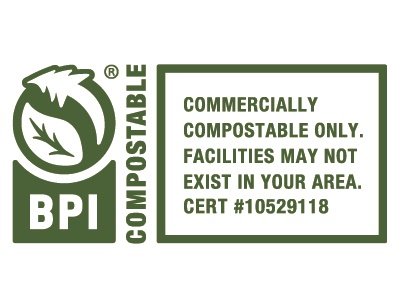
BPI certification is a third-party compostability certification used in the United States and Canada.
It confirms that finished products meet ASTM D6400 or ASTM D6868 requirements and are designed for industrial composting facilities.
Most North American composting systems rely on BPI certified compostable products listed in the public database as their acceptance rule.
This verification step matters more than test results alone.
That is why BPI certification plays such a central role in the U.S. and Canadian markets.
You can verify a product by checking the BPI public listing.
What Is EN 13432?
EN 13432 is the European standard for compostable packaging. EN 13432 defines what “compostable packaging” must prove under industrial composting conditions.
It applies to industrial composting in the EU and defines:
- Biodegradation speed
- Disintegration requirements
- Compost quality and toxicity limits
EN 13432 works well inside Europe.
Outside the EU, acceptance depends on local composting and procurement rules.
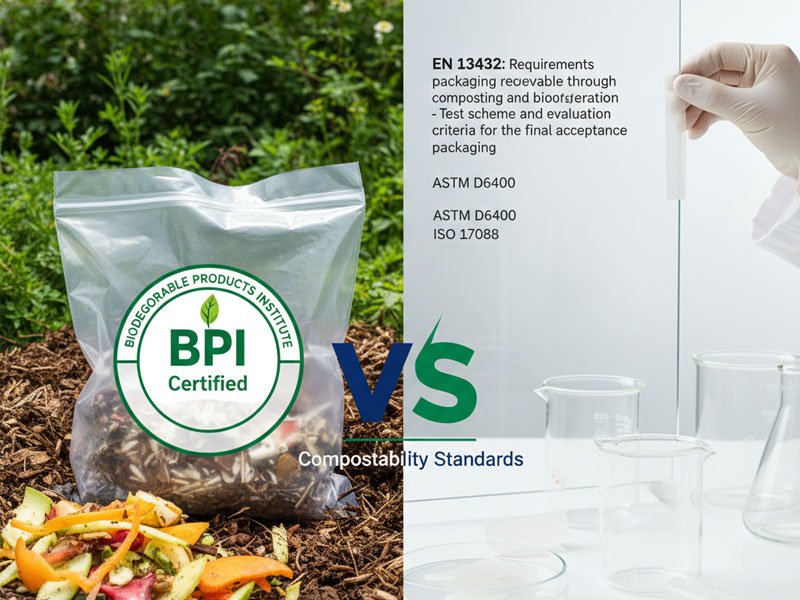
BPI vs EN 13432: Side-by-Side Comparison
| Factor | BPI Certification | EN 13432 |
|---|---|---|
| Main region | United States & Canada | European Union |
| Composting type | Industrial | Industrial |
| Governing body | BPI (USA) | CEN (EU) |
| Test standards | ASTM D6400 / D6868 | EN 13432 |
| Facility acceptance | Very high in North America | Limited outside EU |
| Public product database | Yes | Varies by country |
Key takeaway:
Standards are technical. Acceptance is regional.
For products sold or used in the United States and Canada (North America), BPI certification is the most widely recognized requirement for industrial composting systems.
Where Does OK Compost Fit In?
OK Compost is a certification issued by TÜV Austria.
It comes in two forms:
- OK Compost INDUSTRIAL
- OK Compost HOME
Home composting is lower temperature and slower than industrial composting. OK Compost HOME is designed for low-temperature home composting, which BPI does not cover.
However, many North American composting facilities do not accept OK Compost alone.
They often ask specifically for BPI certification when products enter industrial composting streams.

Why Certification Acceptance Matters More Than the Standard Itself
This is where many mistakes happen. A product can be:
- EN 13432 certified
- OK Compost certified
And still be rejected by a U.S. composting program.
Why? Because composting facilities operate under local acceptance rules, not global theory. For example, a city food waste program may list BPI as the required proof for compostable items.
Waste haulers, municipalities, and processors need a fast, trusted signal. In North America, that signal is usually BPI certification.
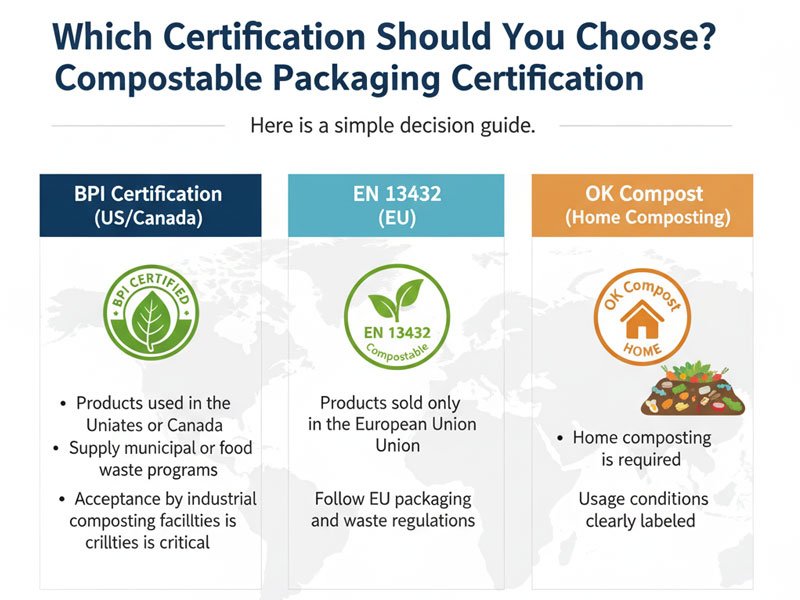
Which Certification Should You Choose?
Here is a simple decision guide.
Choose BPI certification if (US/Canada):
- Your products are used in the United States or Canada
- You supply municipal or food waste programs
- Acceptance by industrial composting facilities is critical
Choose EN 13432 if (EU):
- Your products are sold only in the European Union
- You follow EU packaging and waste regulations
Consider OK Compost if (home composting):
- Home composting is required
- Usage conditions are clearly labeled
If your products are used in U.S. municipal or food waste programs, understanding BPI certification requirements is essential.
Common Misunderstandings
“EN 13432 is stricter, so it should work everywhere.”
Not true. Stricter does not mean accepted.
“Compostable resin is enough.”
It is not. Certification applies to the finished product, not the raw material.
“Multiple certifications solve everything.”
Only if local systems accept them.
FAQ
Can a product be certified for both markets?
Yes, but each market may require its own recognized certification and verification method.
What is the difference between BPI and EN 13432?
BPI is a North American certification program. EN 13432 is a European compostability standard.
Is EN 13432 accepted in the US?
Not always. Many US composting facilities rely on BPI listings instead.
Is BPI accepted in Europe?
BPI is not commonly used as a compliance reference in EU procurement.
BPI vs OK Compost: which one do I need?
It depends on your market. OK Compost is commonly used in Europe, BPI in North America.
Does BPI mean home compostable?
No. BPI applies only to industrial composting systems.
Does EN 13432 mean home compostable?
No. EN 13432 is also focused on industrial composting conditions.
Conclusion
BPI and EN 13432 are not competing standards. They are regional tools. The real question is not which certification sounds better.
The real question is:
Which certification does the composting system actually accept where my product is used?
If your products are used in U.S. municipal or food waste programs, understanding BPI certification requirements is essential.
For a plain-language explanation of how BPI works in practice, see our full guide on BPI certification.
External Reference
- BPI Certification Overview https://bpiworld.org/Certification
- EN 13432 Standard Overview (EU) https://single-market-economy.ec.europa.eu
- TÜV Austria OK Compost https://www.tuv-at.be