Choosing the wrong compostable packaging certification can lead to real problems. Products may be rejected, claims challenged, or brands accused of greenwashing.
I often see confusion around EN 13432 vs ASTM D6400, especially among apparel brands sourcing compostable packaging for different markets.
This page explains what each certification means, how they differ, and which one you actually need—without marketing language or legal jargon.

What Is EN 13432 Certification?
EN 13432 is the European standard for compostable packaging.
It defines whether a material can be called industrially compostable under controlled composting conditions. To comply, packaging must meet requirements in four areas:
- Biodegradation (conversion to CO₂ within a defined time)
- Disintegration (breakdown during industrial composting)
- No harmful residues (no toxic effects on compost quality)
- Heavy metal limits (strict thresholds)
EN 13432 is widely required in the EU and UK for products making compostable claims.
Source: European Committee for Standardization (CEN)
What Is ASTM D6400 Certification?
ASTM D6400 is the primary compostable packaging standard used in North America, especially the United States.
Like EN 13432, it focuses on industrial compostability, not home composting.
ASTM D6400 evaluates:
- Biodegradation rate under industrial composting
- Physical disintegration
- Compost quality and plant toxicity
- Residual material limits
In the U.S. market, ASTM D6400 is often paired with BPI certification, which verifies compliance through third-party testing.
Source: ASTM International / Biodegradable Products Institute (BPI)
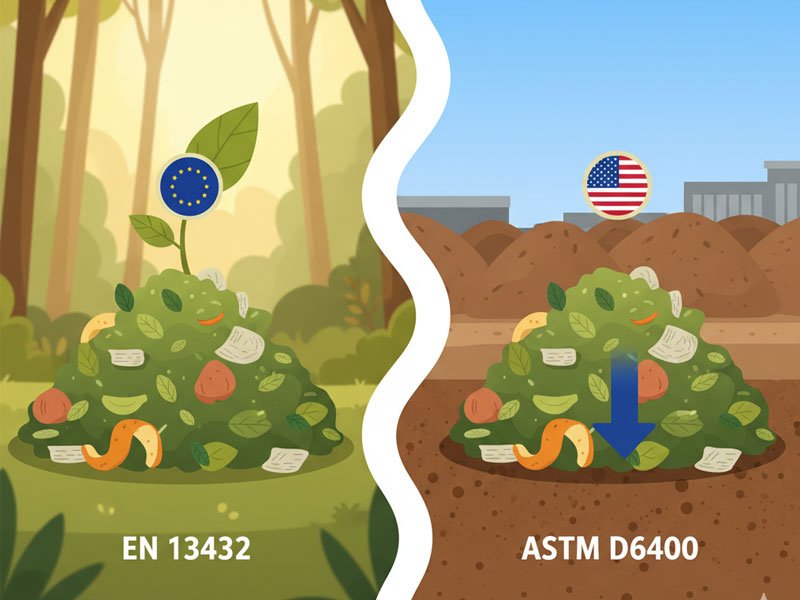
EN 13432 vs ASTM D6400: Key Differences
At a technical level, the two standards are very similar.
The real differences are regional acceptance and enforcement.
| Aspect | EN 13432 | ASTM D6400 |
|---|---|---|
| Primary market | Europe / UK | United States |
| Composting type | Industrial | Industrial |
| Legal recognition | High in EU | High in US |
| Certification bodies | TÜV, DIN CERTCO | BPI |
| Common misuse | Used incorrectly outside EU | Used without BPI listing |
If you sell across multiple regions, one certification alone may not be enough.
Certification Applies to Products, Not Factories
One common misunderstanding among buyers is assuming that compostable certification applies to an entire factory.
In practice, EN 13432 and ASTM D6400 certifications apply to specific products, not manufacturing sites.
Each certified product is defined by its material formulation, thickness, structure, and printing coverage.
From a manufacturing perspective, this means a compostable trash bag, a mailer bag, and a garment bag cannot automatically share the same certification—even if they are produced in the same facility.
This is also why parameters such as garment bag size and thickness must be clearly defined and controlled when certification is applied in real production.
Which Certification Is Required for Apparel Packaging?
For apparel packaging, the correct certification depends on where the product is sold, not where it is manufactured.
From my experience:
- EU market → EN 13432 is expected
- US market → ASTM D6400 + BPI listing is safest
- Global distribution → Dual compliance is often required
Packaging used as inner garment bags is still subject to compostable claims regulations if logos or wording appear on the bag.
If claims are visible, regulators treat the packaging as a consumer-facing product.
How Certification Requirements Vary by Bag Type
Certification requirements can vary significantly depending on bag type and real-world application.
For example:
- Compostable mailer bags must account for adhesive layers and multi-material structures
- Compostable garment bags are sensitive to thickness, transparency, and printing coverage
- Compostable trash bags are often tested at higher thickness levels due to load requirements
- Dog waste bags may pass certification tests but still fail customer expectations if thickness is not properly specified
This is why certification should always be evaluated together with product design and usage conditions, not in isolation.
Common Mistakes Brands Make with Compostable Claims
These are issues I see repeatedly:
- Using “biodegradable” instead of certified compostable
- Having ASTM D6400 test reports but no BPI listing
- Applying EN 13432 logos on products sold only in the US
- Assuming certification applies globally without verification
These mistakes create legal risk and damage brand trust.
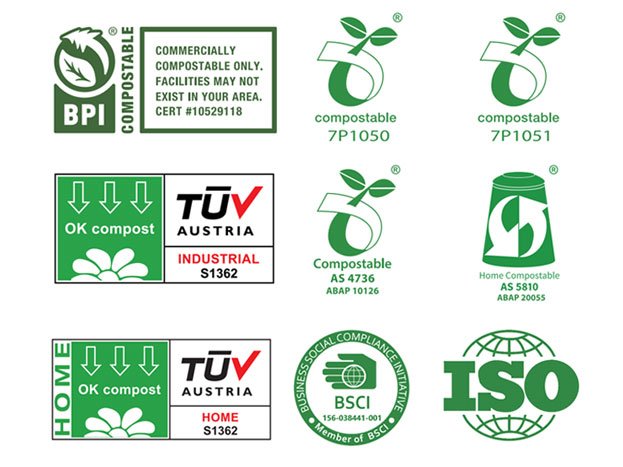
EN 13432, ASTM D6400, BPI, OK Compost: How They Relate
These standards are related but not interchangeable.
- EN 13432 : European compostability standard
- ASTM D6400 : US compostability standard
- BPI : Confirms ASTM D6400 compliance in the US
- OK Compost : Separate certification (Industrial or Home)
Understanding how these systems connect helps avoid incorrect labeling.
Common Compliance Risks & Greenwashing Red Flags
| Risk Area | Common Mistake | Why It’s a Problem |
|---|---|---|
| Certification scope | Using one certificate for all bag types | Certification applies only to tested products |
| Market mismatch | EN 13432 used for US-only sales | May fail local compliance checks |
| Missing listing | ASTM D6400 without BPI listing | Claims may be challenged |
| Thickness change | Altering thickness after certification | Invalidates test results |
| Labeling | Using “home compostable” without proof | High greenwashing risk |
A Manufacturer’s View: Supporting Compliance for Global B2B Buyers
From a manufacturer’s point of view, certification alone does not guarantee compliance.
For global B2B buyers, what matters more is whether a supplier can:
- Match the correct certification to each bag type
- Provide traceable certification numbers and test reports
- Adjust thickness or formulation to meet different market requirements
- Support audits, documentation reviews, and private-label compliance checks
This level of support is especially important for buyers supplying multiple regions under different regulatory frameworks.
Compliance Decision Checklist for B2B Buyers
Before choosing EN 13432 or ASTM D6400, B2B buyers should confirm:
- Target sales markets (EU, US, or both)
- Whether compostable claims appear on the packaging itself
- Bag type (trash, garment, mailer, produce, dog waste, etc.)
- Material formulation and thickness range
- Printing coverage and ink type
- Whether third-party listings (BPI / OK Compost) are required
If any of these points are unclear, certification risk increases significantly.
FAQ: Compostable Packaging Certifications
Is EN 13432 the same as ASTM D6400?
No. They test similar performance but apply to different markets.
Can one certification cover all regions?
Usually not. Regional standards still matter.
Is ASTM D6400 enough without BPI?
In most US cases, no. BPI listing is strongly recommended.
Do compostable garment bags require certification?
If compostable claims are made, certification is essential.
Does thickness affect certification?
Yes. Material structure and thickness influence test results.
Conclusion
Certifications do not replace good packaging design. They work best when combined with correct specifications.
Certification is only one part of the decision.
For apparel brands, compostable standards should always be considered within a broader sustainable clothing packaging strategy, including material choice, packaging design, and end-of-life disposal.
Related Guides
- Learn how bag specifications affect performance and compliance in our garment bag size and thickness guide
External Reference Sources
- European Committee for Standardization (EN 13432)
- ASTM International (ASTM D6400)
- Biodegradable Products Institute (BPI)