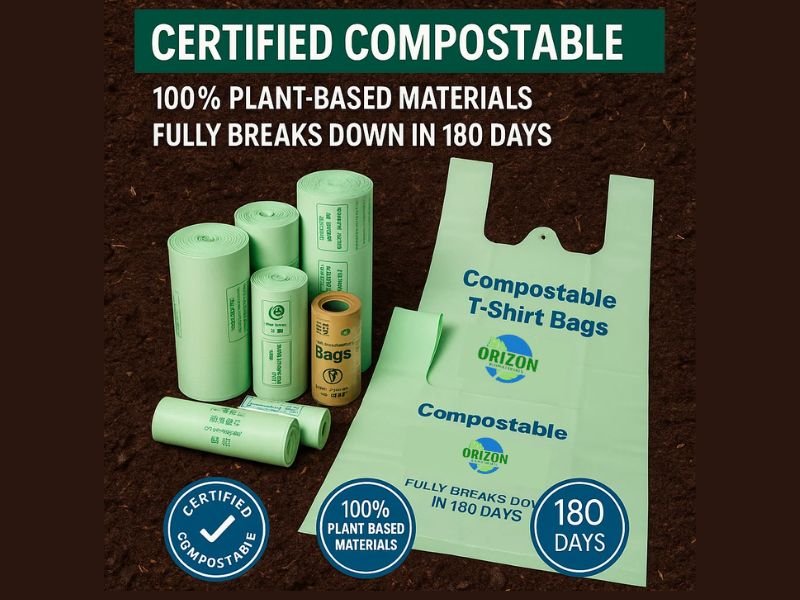
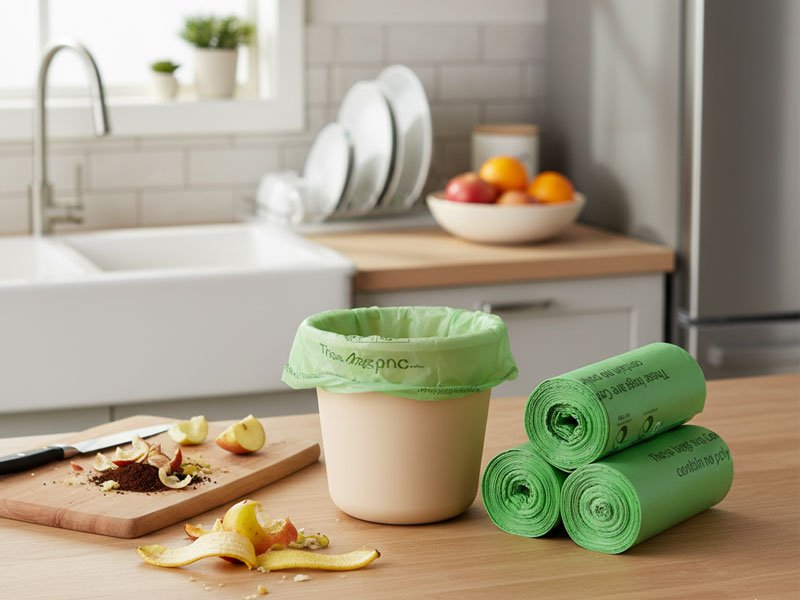
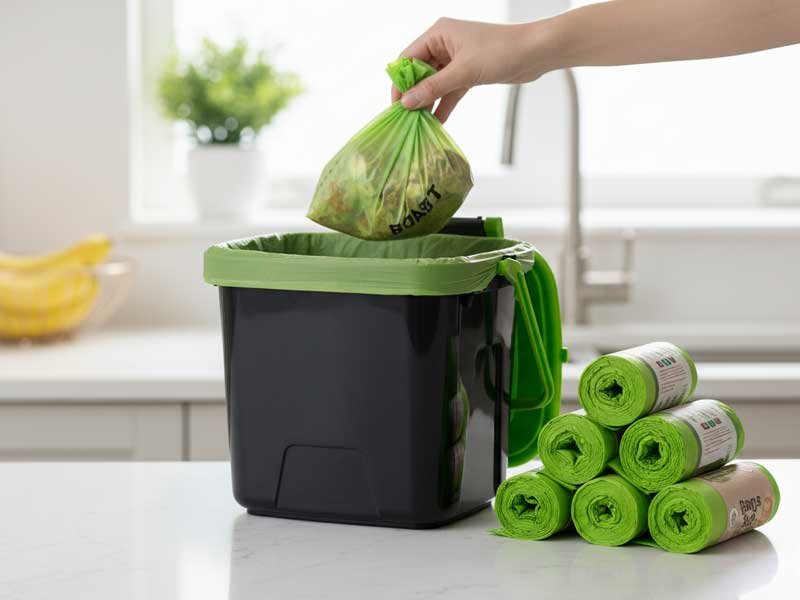
If you’re buying produce packaging for a grocery store, supermarket chain, or retail program, you’ve probably seen the term compostable vest bags. Some suppliers also call them compostable t-shirt bags or vest carrier bags. The names are messy, but the buying decision doesn’t have to be.
I work with a compostable bag factory in China. In this guide, I’ll help you understand what vest bags are, how to position them correctly for produce use, and what specs you should confirm before placing a bulk order.
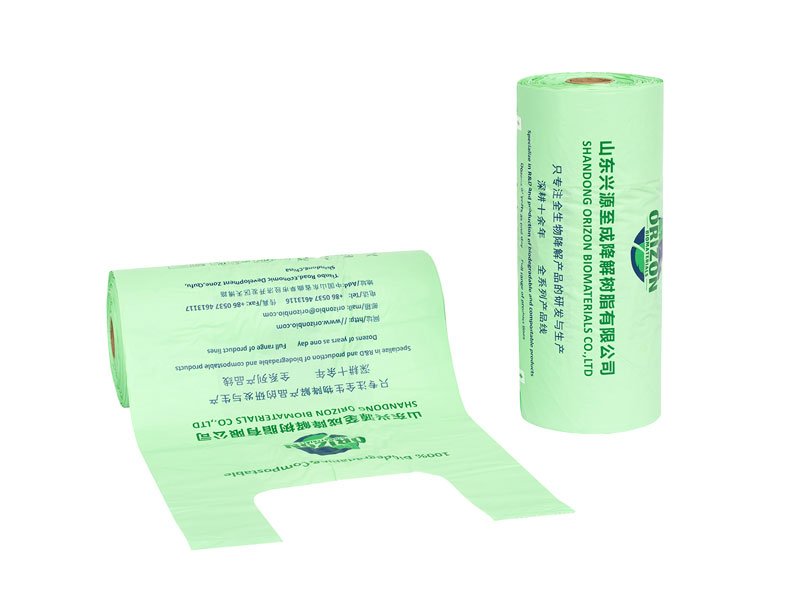
What Are Compostable Vest Bags?
Compostable vest bags are produce bags with two handles and a wide opening. The shape looks like a T-shirt, so many buyers call them compostable t-shirt bags.
In grocery and retail, vest bags are used mainly for fresh fruit and vegetable packaging, because:
- the opening is wide (easy for customers to load produce)
- the handles make heavier items easier to carry
- they work well in self-service produce areas
If you’re sourcing for store produce sections, you’ll often see these described as:
- compostable produce bags with handles
- compostable grocery produce bags
- produce section compostable bags
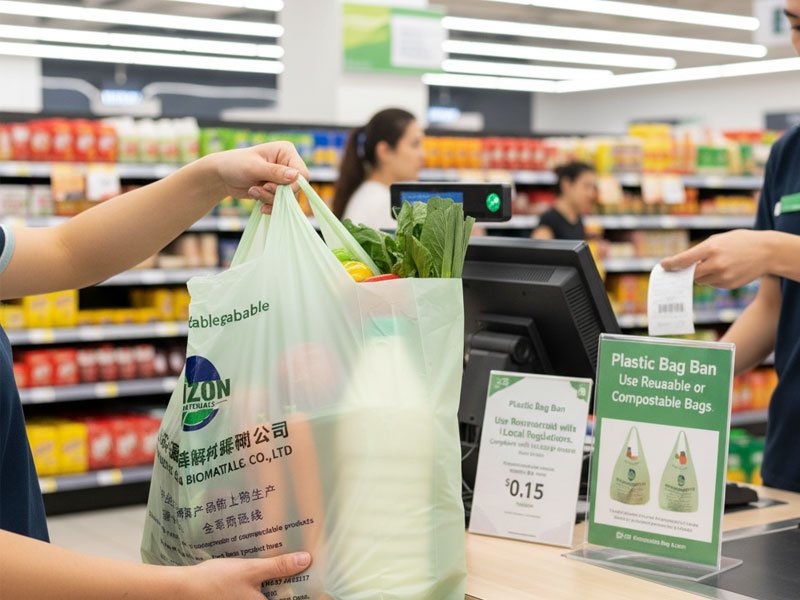
Vest Bags vs Checkout Bags: Why Positioning Matters
This is the part most pages fail to explain.
In some countries or channels, handle bags may be regulated as “shopping/carry-out bags”. That can create compliance risk if you position a vest produce bag like a checkout bag.
A safe B2B positioning is:
Produce-use only notice (copy-ready):
“These compostable vest bags are designed for fresh produce packaging inside retail produce sections. They are not intended for checkout or carry-out shopping bag use and should be positioned according to local regulations.”
If your project is truly for checkout/carry-out, then it belongs on your Compostable Shopping Bags Wholesale page. If it’s produce section only, keep the message consistent across product page, cartons, and artwork.
Where Grocery & Retail Buyers Use Vest Bags
Typical B2B use cases include:
- Supermarkets & grocery stores: produce sections and self-service fruit & veg areas
- Organic food retailers: lightweight carry from produce area to basket
- Fresh food programs: bagging mixed produce items quickly
- Wholesale produce markets: short-term produce packing workflows
If your workflow is not customer self-service (for example, backroom packing or processing lines), you may also want to compare:
- flat open-top produce bags (simple, fast packing)
- pre-open produce bags (high-speed packing tables)
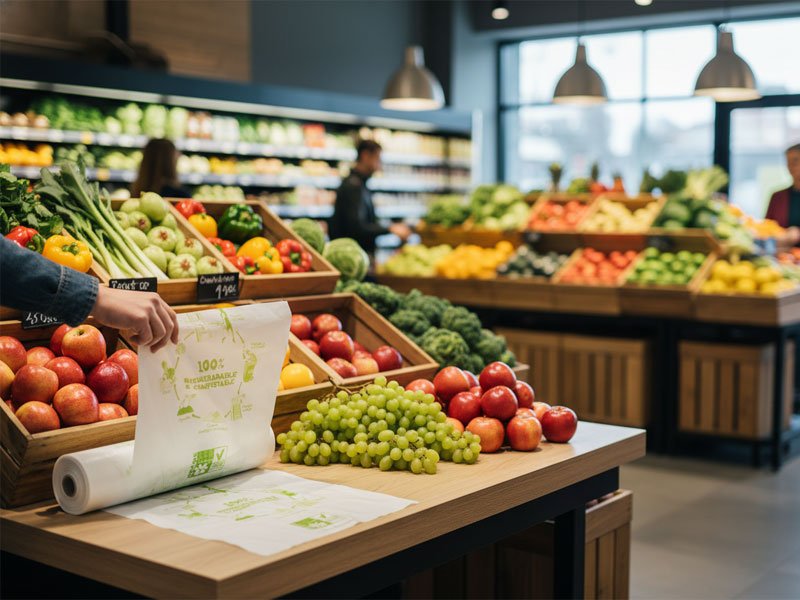
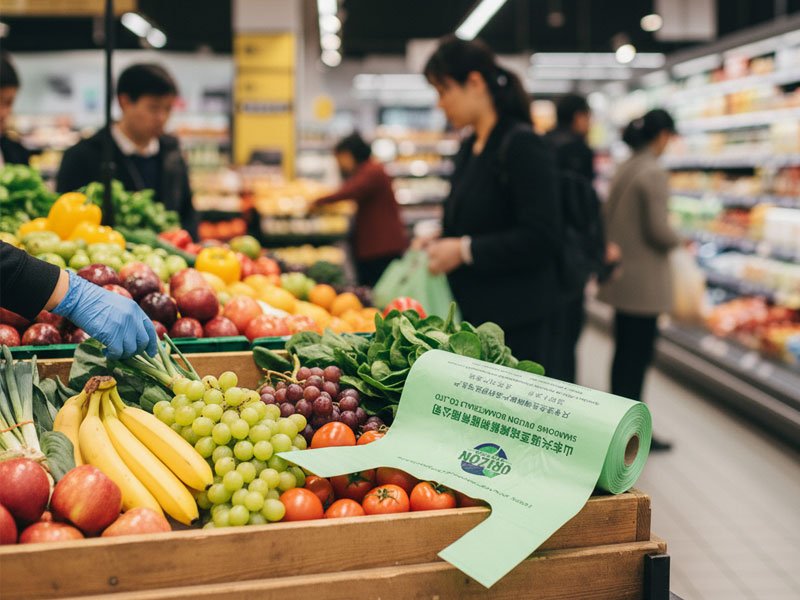
Key Specs Buyers Should Confirm (Before You Request a Quote)
Most “bad orders” happen because specs were not confirmed early. Here’s the checklist I recommend:
1) Bag size (W × L)
Confirm the width and length your produce section needs. Bigger produce items often need more width, not just length.
2) Thickness (microns / μm)
For produce section use, buyers usually care about two things:
- Will it tear during loading?
- Will the handle hold heavier items?
A supplier should suggest a micron range based on your typical items (heavy citrus vs light vegetables).
3) Supply format: roll vs loose pack
- Roll-fed bags are common for produce dispensers and high-traffic stores
- Loose packed stacks may work for backroom operations
4) Roll specs (if you use dispensers)
Ask for:
- bags per roll
- core diameter
- perforation strength
- roll outer diameter
These affect whether bags dispense smoothly during peak hours.
5) Food contact requirements
If you need food-contact compliance, confirm it in writing (especially for EU/US import workflows).
Certifications Buyers Ask For (EU / US / AU)
Buyers usually request certification based on market.
- EU: EN 13432 is commonly referenced for industrial compostability claims
- US: many buyers ask for ASTM D6400 and BPI alignment
- Australia: buyers may request AS standards depending on end-of-life system
One key point to keep your procurement clean:
Certification applies to specific product specifications (material formulation, thickness, printing coverage), not to “the factory” as a whole.
Also, BPI certification is tied to ASTM compostability standards (ASTM D6400/D6868), so if a customer asks “is it real compostable?”, this is the compliance language they’re usually pointing to.
How to Choose: 3 Common Buying Scenarios
Scenario A: Standard supermarket produce section (self-service)
- roll-fed format
- easy-tear perforation
- stable thickness for daily use
- clear positioning as produce-use packaging
Scenario B: Heavier produce items (handles matter more)
- reinforced handle area
- slightly higher thickness
- tear resistance as priority
Scenario C: Distributor/private label program
- stable case pack and carton labels
- SKU consistency across batches
- optional printing (logo/barcode/compliance text)
- clear MOQ/lead-time rules
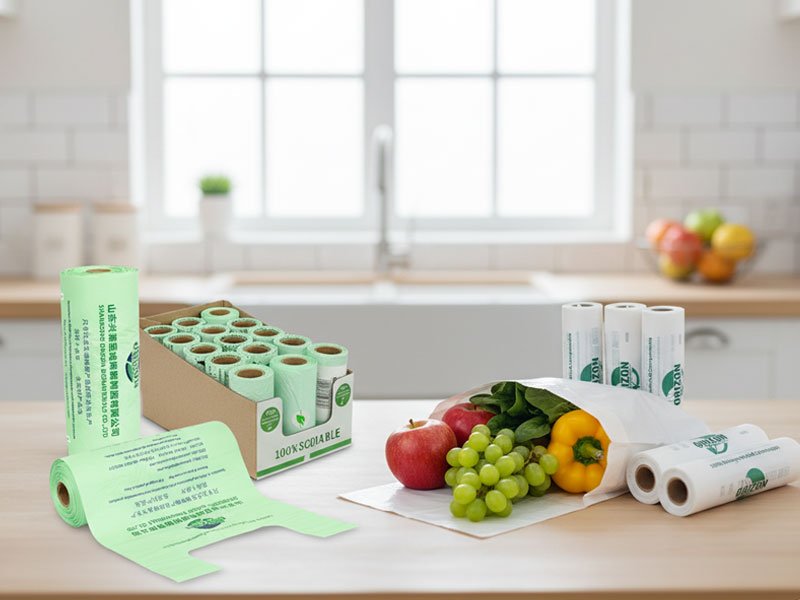
OEM Checklist for Bulk Orders (Copy This to Your RFQ)
When you request pricing, include:
- bag type: compostable vest / t-shirt produce bags
- size (W×L), thickness (μm)
- roll specs: bags/roll, core diameter, perforation
- material & target market compliance (EU/US/AU)
- printing needs (logo/barcode/compliance text)
- annual volume estimate + trial order volume
Internal link suggestions:
- Learn more about Compostable Produce Bags Wholesale
- Explore Custom Printing Capabilities
- Review OEM FAQ & MOQ Guidelines
FAQ
Are compostable vest bags the same as compostable t-shirt bags?
Yes. In packaging, “vest bag” and “t-shirt bag” usually describe the same handle structure.
How do I avoid positioning them as checkout bags?
Use a produce-use only notice, and keep the same message on product page, cartons, and artwork.
What roll specs matter for produce dispensers?
Core diameter, bags per roll, perforation strength, and roll outer diameter. These decide whether dispensing is smooth at peak times.
What micron range is common for produce section use?
It depends on produce weight and handling. Your supplier should recommend a range based on your use case, not a one-size-fits-all number.
Conclusion
If you’re building a compliant produce packaging program, compostable vest bags can work well—when the specs and positioning are correct.
If you want, you can compare: