If you buy grocery carry bags for a supermarket chain, a distributor program, or a high-volume retail store, “eco-friendly” is not enough. You need bags that work at checkout, meet local compliance rules, and stay consistent across thousands of daily transactions.
In this guide, I’ll walk you through how B2B buyers choose compostable grocery carry bags (also called compostable carrier bags, checkout bags, or carryout bags) for high-volume retail—based on workflow, specs, and procurement realities like MOQ and lead time.

What “Grocery Carry Bags” Means in Different Markets
One reason buyers get confused is naming. In different countries and retail channels, the same “carry bag” may be called:
- compostable grocery bags
- compostable shopping bags
- compostable retail bags
- compostable carry bags / carrier bags
- compostable checkout or carryout bags
They all describe bags used for retail distribution—but the use case matters more than the name. A bag designed for produce sections is not always suitable (or allowed) as a checkout carryout bag.
Learn how we group bag formats for bulk retail supply: Compostable Shopping Bags Wholesale

Start With the Workflow (Checkout vs Produce vs Fulfillment)
Before you compare materials or pricing, lock the workflow. High-volume retail usually has three different bag moments:
Checkout / Carryout (front-of-store)
This is where speed matters: fast opening, stable handles, and consistent thickness. Many buyers choose vest / T-shirt style bags for checkout because they’re easy to grab and load.
Produce section (self-service)
These are typically produce bags on a roll (dispenser bags). They are often regulated differently, and in some regions they must be positioned as “produce-use only,” not as checkout bags.
If your program includes produce dispensers, start here::Compostable Produce Bags Wholesale
Backroom packing & distribution
For backroom workflows (fresh prep, repacking, distribution), buyers may use flat bags, pre-open bags, or roll formats depending on speed and handling.
Vest (T-Shirt) vs Die-Cut vs Flat Bags: Which Fits High Volume?
Here’s the simple way to think about it:
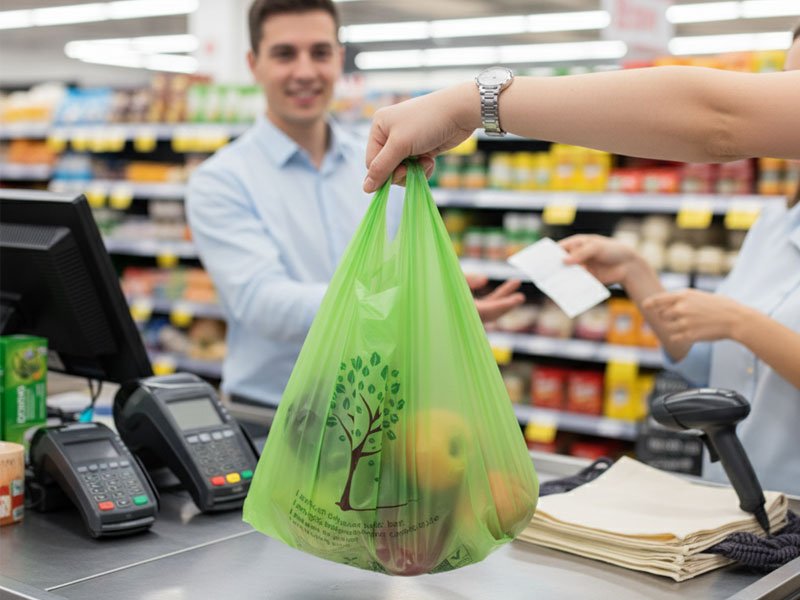
Vest / T-Shirt bags (high-speed checkout)
Best when you need:
- fast loading at checkout
- stronger carry comfort (handles)
- stable performance across stores
Also called: compostable vest bags, T-shirt carrier bags, grocery carryout bags.

Die-cut handle bags (branding + presentation)
Best when:
- your bag is part of brand presentation
- you sell lighter items or boutique-style grocery programs
- you need cleaner printing surface
Also called: die-cut compostable shopping bags, retail handle bags.
Flat bags (packing, inner use, non-carry focus)
Best when:
- you pack items, not carry them by hand
- you use secondary outer packaging
- you prioritize cost control for bulk inner packaging
5 Specs Buyers Should Lock Before Asking Price
High-volume retail buyers get better quotes when specs are clear. These are the “must confirm” fields:
- Bag size (width × length + gusset if any)
- Thickness (microns) matched to load and store routine
- Handle structure (vest / die-cut / no handle)
- Seal & bag-making style (bottom seal, side seal—affects strength)
- Packing format (loose, stacked, roll, cartons, private label outer)
If you want to standardize across multiple store locations, define these once and keep them consistent—then pricing becomes stable.
Compliance & Claims: Don’t Let “Biodegradable” Dilute “Compostable”
Many buyers search “biodegradable grocery bags wholesale,” but for compliance and procurement, the word compostable is usually the tighter requirement—because it points to a defined end-of-life standard and third-party certification.
A practical rule for B2B pages:
If you sell into regulated markets, make sure your labeling and claims match the certification rules. For example, BPI provides guidance on how certified compostable products should be represented and labeled.
Compostability Certifications & Documents
MOQ, Lead Time, and Private Label for Bulk Retail
For high-volume retail, compostable bags are usually sourced as bulk supply, not small batches. A realistic procurement discussion should include:
- MOQ: defined by bag type, size, thickness, and printing coverage
- Lead time: depends on printing, packing format, and production schedule
- Private label: outer carton labels, barcodes, compliance text, and batching info
If you run a distributor program, private label carton packing often matters as much as the bag itself.
For MOQ + lead time rules, keep it on one page: OEM FAQ & MOQ Guidelines