This page is a practical reference for Australian distributors, wholesalers, and procurement teams evaluating AS4736 compostable produce bags. For a broader overview of Australia compostable bags requirements, please refer to our dedicated regulatory guide.
This is not a product listing. It is a sourcing and compliance guide.
Who This Page Is For (And Why It Exists)
This guide is designed for:
- Produce bag distributors and importers in Australia
- Supermarket and retail packaging buyers
- Fresh food supply and food service procurement teams
- Sustainability, quality, and compliance managers
Many buyers already understand why compostable produce bags are needed.
The real challenge is answering internal questions such as:
- Is this bag truly AS4736 certified?
- How do we verify the certification?
- Will councils or FOGO systems accept it?
- Are the claims and labels compliant in Australia?
This page exists to answer those questions clearly.
What AS4736 Means for Compostable Produce Bags
What AS4736 Actually Certifies
AS 4736 is the Australian Standard for industrial (commercial) compostability.
For compostable produce bags, this means:
- The bag is designed to break down in commercial composting facilities
- It meets strict requirements for disintegration, biodegradation, and toxicity
- It is suitable for FOGO and organics processing systems, where accepted
AS4736 does not mean the bag is home compostable.
AS4736 vs AS5810: Why Produce Bags Use AS4736
For buyers comparing industrial and home composting standards, understanding the differences between AS4736 vs AS5810 compostability standards can help avoid misapplication and compliance issues. In Australia, two compostability standards are often mentioned:
- AS 4736 – Industrial / commercial composting
- AS 5810 – Home composting
Most compostable produce bags are certified to AS4736, not AS5810, because:
- Produce bags are thin, lightweight, and used in high-volume retail systems
- They are designed for commercial waste streams, not backyard compost
- Most councils and FOGO programs reference AS4736-certified products
This is normal and expected for produce roll bags in Australia.
How to Verify a Real AS4736 Compostable Produce Bag
This is the most important step for buyers.
Not all bags described as “compostable” meet AS4736 requirements.
Mandatory Certification Elements You Should See
A genuine AS4736 compostable produce bag should include:
- Seedling logo (Australian or European)
- A valid ABA / ABAP sublicence number
- Clear reference to AS 4736 on documentation or packaging
- Certification that applies to the finished bag, not just the raw material
If any of these elements are missing, further verification is required. Procurement teams often request supporting documents during internal review.
You may refer to our AS4736 certification verification resources or request AS4736 certification documents for audit and approval purposes.
Common Red Flags Buyers Should Avoid
Procurement teams should be cautious if a supplier uses:
- “Biodegradable” without AS4736 reference
- “Degradable” or “oxo-degradable” language
- Certificates that only cover resin pellets, not the final produce bag
- Vague claims such as “eco-friendly” without certification proof
These issues often lead to FOGO contamination risks and internal compliance concerns.
FOGO & Council Acceptance: What Distributors Need to Know
Are AS4736 Compostable Produce Bags Accepted in FOGO Systems?
In many Australian regions, AS4736-certified compostable bags are accepted in FOGO and organics systems.
However, acceptance depends on:
- Local council guidelines
- The composting facility operator
- Clear and correct labelling on the bag
No single supplier can guarantee acceptance by all councils.
Acceptance of compostable produce bags may vary by region.
Buyers are encouraged to review local council FOGO acceptance guidelines to confirm whether compostable bags are permitted in their organics collection systems.
A Practical Reality Check for Procurement Teams
To reduce risk, buyers should:
- Confirm local council or processor guidance
- Ensure the Seedling logo is clearly visible
- Avoid mixed or confusing claims on packaging
Clear certification and labelling reduce contamination concerns and simplify approvals.
Labelling & Claims: Staying Compliant in Australia
Correct labelling is as important as the material itself.
Recommended Compliant Claim Language
The following claim styles are commonly accepted in Australia:
- “Industrially compostable to AS 4736”
- “Certified compostable – Seedling logo displayed”
- “Suitable for commercial composting facilities where accepted”
These claims are clear, accurate, and easy for compliance teams to approve.
Proper labelling plays a critical role in regulatory compliance.
For additional reference, buyers may review compliant compostable bag labelling in Australia to ensure claims align with local guidelines.
Claims to Avoid
Buyers should avoid bags that claim:
- “100% biodegradable”
- “Breaks down anywhere”
- “Home compostable” (unless AS5810 certified)
Incorrect claims can create regulatory and reputational risk.
Produce Bag Specifications That Usually Pass Procurement Faster
Beyond certification, procurement teams often look for practical details.
Common Formats for Australian Produce Programs
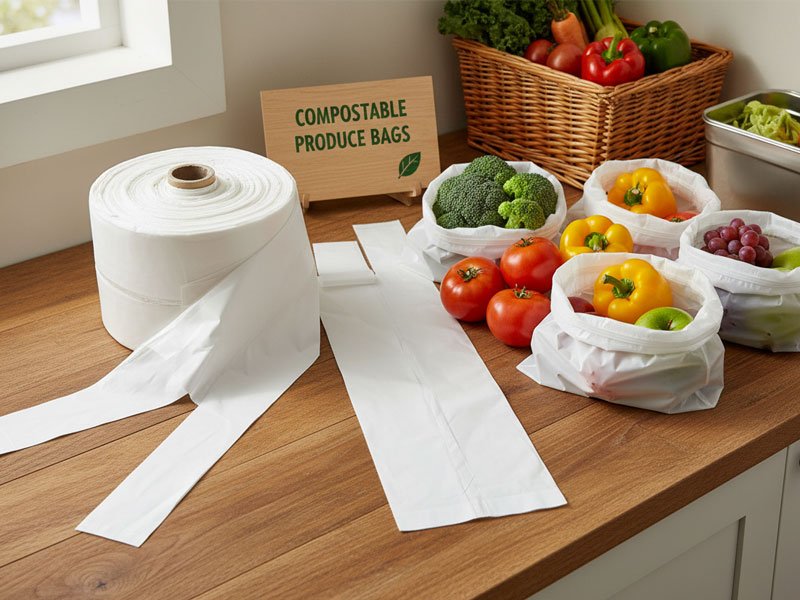
- Produce bags on rolls
- Flat or micro-perforated designs
- Standard retail carton packing
These formats align with supermarket and fresh food workflows.
These formats are widely used in retail and fresh food supply chains.
Buyers sourcing compostable produce bags wholesale in Australia typically focus on certified, standardised specifications that support high-volume distribution.
Typical Procurement Checklist
Before approval, buyers often confirm:
- Bag size and thickness range
- Roll length and core size
- Shelf life and storage conditions
- Food-contact compliance statements
- Outer carton and roll labelling
Providing this information early helps reduce back-and-forth emails.
Documents Australian Buyers Commonly Request
For internal review and audits, buyers often ask for:
- AS4736 certificate for the finished product
- ABA / ABAP sublicence confirmation
- Test summary (upon request)
- Material declaration (PLA / PBAT based)
- Food-contact compliance statement
- Printing and ink declaration (if applicable)
Having a complete document pack simplifies approval.
To support internal approval, buyers may request an AS4736 certification pack or discuss AS4736 produce bag documentation requirements directly with the manufacturer.
How Distributors Typically Source AS4736 Produce Bags
Australian buyers usually source compostable produce bags through:
- Bulk wholesale supply
- Private label retail programs
- Long-term supply agreements
- Ongoing batch and certification control
Consistency and documentation matter more than short-term pricing.
Final Notes for Procurement & Compliance Teams
For Australian produce bag sourcing:
- AS4736 is about system compatibility, not marketing language
- Certification verification is more important than claims
- Clear labelling reduces FOGO contamination risk
- The right supplier simplifies audits and internal approval
Well-documented products reduce friction across procurement, sustainability, and operations teams.
Talk to a Manufacturer Familiar with AS4736 Compliance
If you are reviewing AS4736 compostable produce bags for the Australian market, working with a manufacturer who understands certification, labelling, and distributor requirements can save time.
You may wish to request:
- A full AS4736 certification pack
- Clarification on produce bag specifications
- Wholesale or private label supply details
If you are evaluating AS4736 compostable produce bags for Australia, working with a manufacturer familiar with certification and compliance can simplify procurement and approval.