If you work in the baby care products industry, you’ve likely encountered the terms biodegradable and compostable nappy bags.
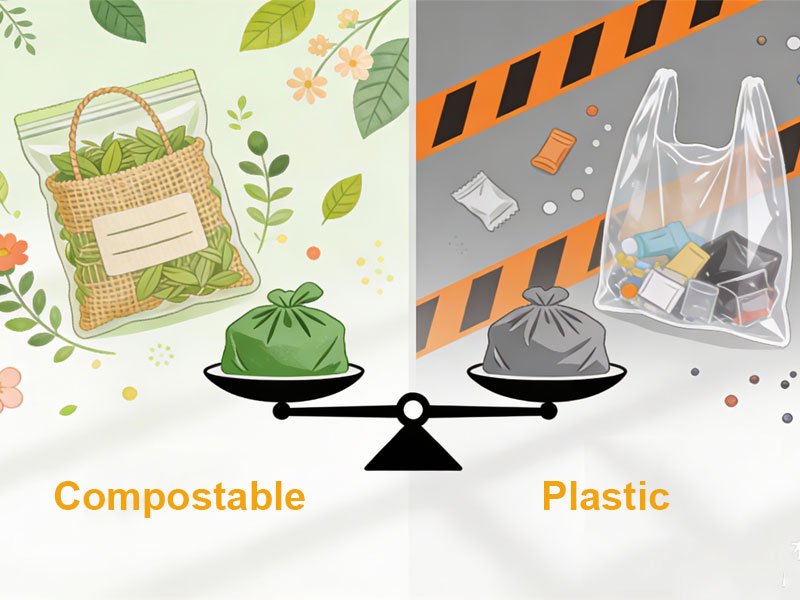
These terms are often used interchangeably, but the key differences between biodegradable vs compostable nappy bags have important implications for compliance, product claims, and long-term business risk.
I frequently see this confusion among brand owners and distributors when sourcing nappy disposal bags for new markets. Choosing the right type of nappy bag involves more than environmental intent—it directly affects regulatory acceptance, certification requirements, and buyer trust.
As a manufacturer with 16 years of experience producing certified compostable bags, this article explains the real differences and why compostable options are generally the safer choice for professional buyers.
Why the Terms “Biodegradable” and “Compostable” Are Often Confused
Most of the confusion stems from marketing. “Biodegradable” sounds positive, implying the product will naturally disappear. However, in most countries, “biodegradable” is not a strictly regulated claim.
Different brands use “biodegradable” in different ways. Different environments produce different results.
Because consumers don’t research the specific regulations in every country when buying compostable diaper disposal bags, many mistakenly believe they are making a sustainable choice, when the actual results are unpredictable.
What Are Biodegradable Nappy Bags?
How Biodegradable Bags Are Designed to Break Down
Biodegradable diaper bags are designed to decompose over time after exposure to factors such as heat, moisture, and microorganisms.
This sounds reassuring. However, the specific decomposition time isn’t mentioned, yet the most crucial aspect of biodegradability lies in where and how the decomposition occurs.
Why “Biodegradable” Is Not a Regulated Claim
In many regions, there is no single global standard that defines how fast a biodegradable bag must break down, or what residues it can leave behind.
This means two biodegradable bags can behave very differently. Some products may fragment rather than fully decompose.
Common Risks: Microplastics and Landfill Reality
This is where reality matters.
Most nappy waste ends up in landfill, not in controlled composting systems. Landfills are low-oxygen environments.
In these conditions, many biodegradable plastics do not fully break down. They can leave behind microplastic fragments instead.
This concern is widely discussed in environmental research and waste management studies (Source: European Commission, Australian Bioplastics Association).
What Are Compostable Nappy Bags?
How Compostable Bags Break Down Under Controlled Conditions
Compostable nappy bags are different by design.
They are tested to break down fully under controlled composting conditions, turning into water, carbon dioxide, and organic matter.
No plastic fragments.
No toxic residues.
But only when the right conditions are met.
Compostable Certifications and What They Verify
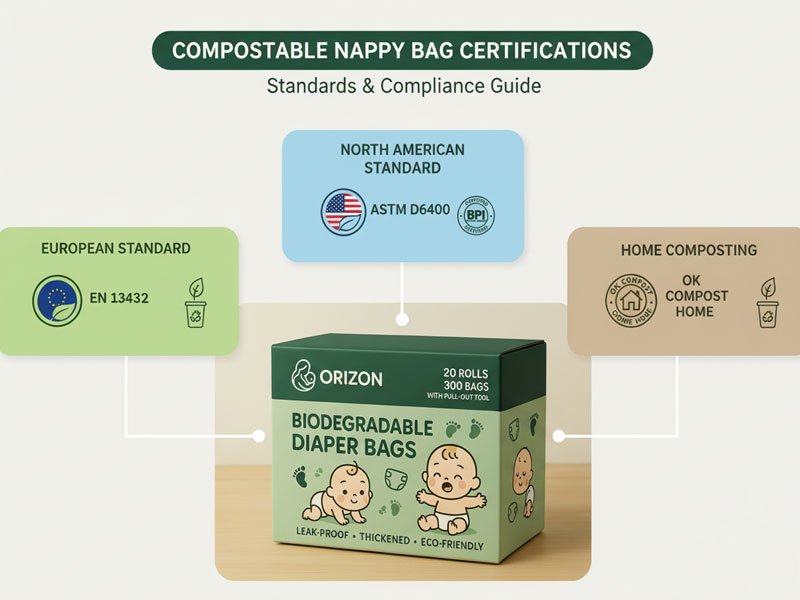
Standards such as EN 13432 compostable certification, ASTM D6400 compostable standard, and OK Compost certification provide third-party verification for compostable claims. This is where certification matters.
Recognized standards include:
Our company’s identification number can be found on the BPI website: 10529118 https://products.bpiworld.org/companies/shandong-orizon-biomaterials-co-ltd,
OK Compost Certificate Inquiry : https://m.dincertco.tuv.com/registrations/60152087?locale=en, https://www.dincertco.tuv.com/registrations/60152088?locale=en
These standards test:
- Disintegration speed
- Heavy metal limits
- Ecotoxicity (impact on plant growth)
This makes compostable claims verifiable, not just descriptive.
Materials Used in Certified Compostable Nappy Bags
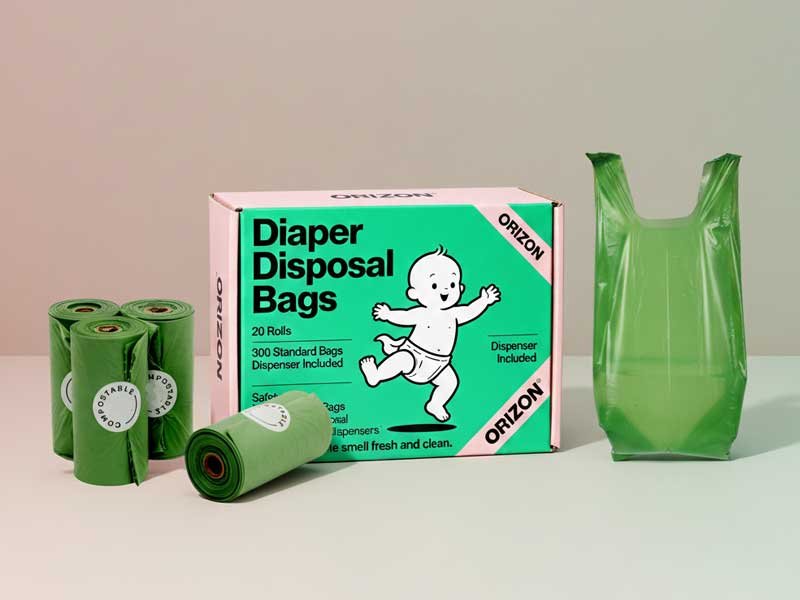
Certified compostable nappy bags are typically made from plant-based polymers, such as:
- PLA (polylactic acid)
- PBAT
- Starch-based materials
Material transparency is one of the biggest advantages for professional buyers.
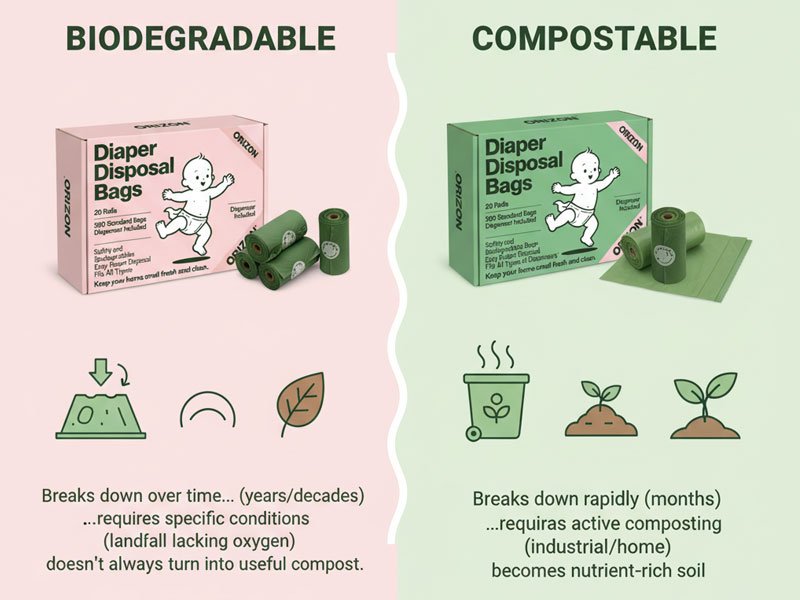
Biodegradable vs Compostable Nappy Bags — Key Differences
Breakdown Conditions
- Biodegradable: Breakdown depends on environment. Results vary.
- Compostable: Breakdown occurs under defined composting conditions.
Certification and Verification
- Biodegradable: Often no third-party certification.
- Compostable: Certified under recognized standards.
Environmental and Compliance Impact
- Biodegradable: Higher greenwashing risk.
- Compostable: Clearer compliance path for regulated markets.
This difference matters when claims are reviewed by regulators or retail partners.
Why Compostable Nappy Bags Are a Better Choice for Businesses
Compliance and Greenwashing Risk
Regulators are paying closer attention to environmental claims.
Using vague language like “100% biodegradable” can raise questions.
Using certified compostable language is easier to defend.
This is why many brands move toward certified compostable nappy disposal bags.
Supply Chain Transparency and Buyer Trust
Certification numbers can be checked.
Test reports can be reviewed.
That transparency builds trust across the supply chain.
Suitability for Childcare and Institutional Use
In childcare and institutional settings, bags are used frequently.
Odor control, strength, and compliance all matter.
This is why compostable nappy disposal bags are often selected for childcare and institutional environments.
Many brands therefore choose certified compostable nappy bags to reduce compliance risk and ensure consistent performance across regulated markets.
Important Limitations Buyers Should Understand
For buyers operating across multiple regions, understanding whether one product can meet multiple standards is critical. Learn more in Can One Compostable Bag Meet AU, EU, and US Standards?
Compostable Does Not Mean “Disappears Anywhere”
This point is often misunderstood.
Compostable does not mean the bag will disappear in any environment.
It means it will break down when composted correctly.
Clear communication avoids false expectations.
Local Disposal Systems Still Matter
Not all regions accept compostable plastics in their waste systems.
Buyers should align product claims with local disposal infrastructure.
Oxo-degradable and “Degradable” Claims Explained
Some products use terms like oxo-degradable or degradable.
These materials often fragment into smaller plastic pieces and are not accepted under compostable standards such as EN 13432 or ASTM D6400
(Source: Australian Bioplastics Association).
This is an important distinction for risk management.
How to Choose Between Biodegradable and Compostable Nappy Bags
Market-Based Standards
A simple rule helps:
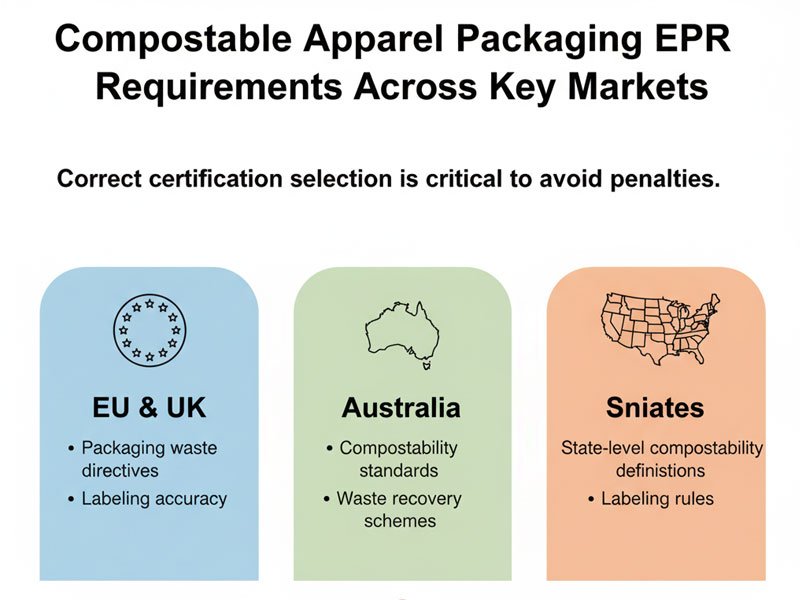
- EU : EN 13432
- US : ASTM D6400
- AU : AS 4736 / AS 5810 (where applicable)
Certification Checklist for Buyers
Before making a decision, I recommend checking:
- Which standard is claimed?
- Is the certificate number available?
- Is the end-of-life scenario clearly stated?
- Are claims written in verifiable language?
This approach reduces long-term compliance risk.
FAQ
Is biodegradable the same as compostable?
No. All compostable materials are biodegradable, but not all biodegradable materials are compostable.
Do biodegradable nappy bags break down in landfill?
In most cases, no. Landfills lack oxygen and the conditions needed for proper biodegradation, which can result in incomplete breakdown or microplastic residues.
Are compostable nappy bags always accepted?
Acceptance depends on local waste systems and certifications. Some regions only accept certified compostable bags that meet specific standards.
How can buyers verify compostable claims?
Buyers should check recognized certification standards, verify certificate numbers, and ensure the end-of-life conditions are clearly stated.
Conclusion
Choosing between biodegradable and compostable nappy bags is not just a sustainability decision. It is a compliance and risk decision.
Biodegradable claims are often vague. Certified compostable bags provide clearer definitions, testing, and accountability.
For businesses supplying baby care products, clarity matters.
Final Thoughts
If you are evaluating compostable nappy disposal bags for your brand or distribution network, focus on verifiable standards, transparent materials, and realistic disposal paths.
That approach protects both your customers and your business.
Related Resources
- Biodegradable vs Compostable Nappy Bags
- Compostable Nappy Disposal Bags for Childcare
- Compostable Nappy Bag Certifications
Rource:
- European Commission – Biodegradable & compostable plastics guidance
- Australian Bioplastics Association (ABA) – Compostable standards & oxo-degradable warnings
- ASTM International – ASTM D6400 Standard
- TÜV Austria – OK Compost certification overview