When people see the phrase “BPI compostable”, they often assume it simply means “eco-friendly” or “biodegradable.”
That assumption is incorrect.
As someone who works with certified compostable products and industrial composting requirements every day, I want to clearly explain what BPI compostable means, what it does not mean, and why this certification matters in real-world composting systems.
This article focuses on clarity, not marketing language.
In practice, the term BPI compostable only has meaning when it refers to a finished product that has passed official BPI compostable certification and appears in the public listing.
Quick Answer
What does “BPI compostable” mean?
BPI compostable means that a finished product has passed ASTM compostability testing and is officially approved and listed as one of the BPI certified compostable products for industrial composting in the United States and Canada.
This certification is issued by the Biodegradable Products Institute (BPI) and applies only to products accepted by commercial composting systems.
Certification status can only be confirmed through the official BPI certified product listing.
Common follow-up questions
- Is BPI compostable the same as compostable resin?
No. Resin certification alone is not sufficient. Only finished products can receive BPI certification. - Is BPI compostable home compostable?
No. BPI compostable products are designed for industrial composting facilities, not backyard or home compost bins. - How do I verify a BPI certified product?
By checking the public BPI certified products database and confirming the product details.

What “BPI Compostable” Actually Refers To
The phrase “BPI compostable” has a very specific meaning.
It refers to a finished product certification, not a raw material, resin, or general compostable claim.
For a product to qualify as BPI compostable, it must:
- Meet the ASTM D6400 compostable standard or ASTM D6868 compostability requirements
- Pass independent laboratory testing
- Undergo ingredient disclosure and labeling review
- Receive formal approval and appear in the BPI certified product listing
If a product is not listed in the public database, it is not BPI certified.
This is why the term BPI compostable definition only has value when it applies to BPI certified compostable products, not uncertified packaging or materials.
What BPI Compostable Does Not Mean
The term BPI compostable refers specifically to BPI certified compostable products, not raw materials or general compostable claims.
BPI compostable does not mean:
- It will break down in landfills
- It will degrade in oceans or soil
- It is suitable for backyard compost bins
- The resin alone is certified
- The product can be recycled
In simple terms:
No BPI listing = no BPI compostable certification.
Understanding the difference between compostable vs biodegradable is critical.
“Biodegradable” has no defined timeframe, while certified compostable packaging must meet strict standards under controlled composting conditions.
Why Composting Systems Care About BPI Compostable Certification
Industrial composting facilities operate under carefully controlled conditions, including:
- Temperature
- Oxygen levels
- Moisture
- Processing time
These commercial composting systems cannot tolerate contamination.
From experience working with municipal programs and waste operators, most facilities rely on industrial composting certification because it provides a clear acceptance rule:
Only products proven to break down cleanly are allowed.
This protects compost quality, prevents compost contamination, and keeps non-compostable plastics out of the system.
As a result, composting facilities acceptance is often tied directly to BPI certification status.
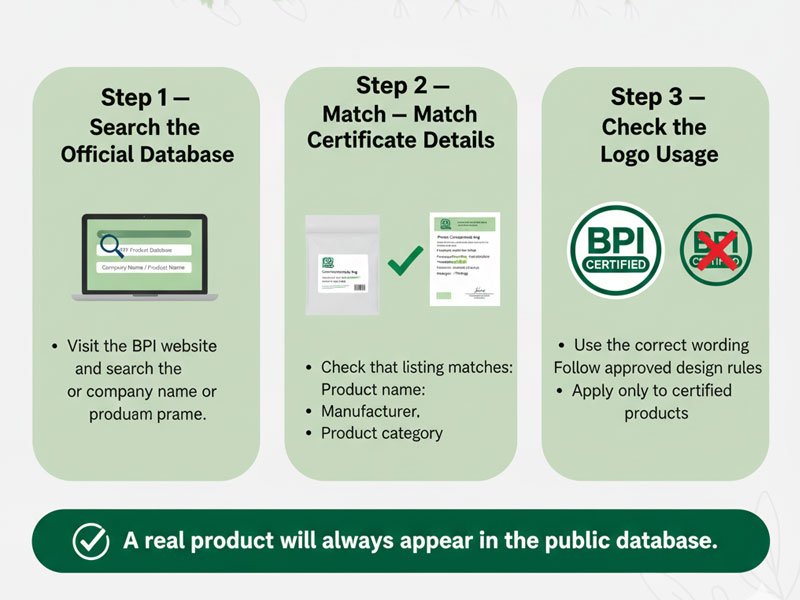
How to Verify a BPI Compostable Product
Verifying a BPI compostable product is straightforward.
Step 1 — Search the Official Database
Visit the BPI website and search the company name or product name.
Step 2 — Match Certificate Details
Check that the listing matches:
- Product name
- Manufacturer
- Product category
Step 3 — Check the Logo Usage
The BPI logo must:
- Use the correct wording
- Follow approved design rules
- Apply only to certified products
A real product will always appear in the public database.
External reference: BPI Certified Products Database – https://bpiworld.org/products
BPI Compostable vs Other “Green” Labels
Many sustainability terms sound similar but have very different meanings.
- BPI compostable → Certified for industrial composting (US & Canada)
- Biodegradable → No defined timeframe or system requirements
- Uncertified compostable → High risk of greenwashing
This distinction explains why biodegradable does not automatically mean compostable, and why third-party certification matters in regulated waste systems.
When Does “BPI Compostable” Really Matter?
The label matters most when waste must meet strict rules.
Common examples include:
- Municipal food waste programs
- Restaurants and food service operations
- Commercial kitchens
- Waste haulers and composting facilities
In these settings, BPI compostable certification is often required rather than optional.
FAQ
What does BPI compostable mean?
It means the finished product is certified by BPI for industrial composting and listed in the official database.
Is BPI compostable home compostable?
No. BPI applies only to industrial composting systems.
How do I verify a BPI certified product?
Search the public BPI certified products database and confirm certificate details.
Is compostable resin enough for BPI certification?
No. Only finished products can receive BPI certification.