Every day, we throw things away—food scraps, packaging, paper, plastic. Most of it ends up in plastic trash bags that take hundreds of years to break down. It’s a quiet problem, but a serious one. The world produces over 300 million tons of plastic each year, and only a fraction is recycled (UNEP, 2024). The rest lingers in landfills and oceans.
That’s why many people, myself included, are looking for sustainable waste solutions. One option getting attention is the plant based trash bag—a type of garbage bag made from renewable materials like cornstarch, PLA (polylactic acid), or PBAT instead of fossil fuels.
In this article, I’ll explain what are plant based trash bags, what they’re made of, and how they differ from regular plastic ones. You’ll also learn whether they’re compostable or biodegradable, and how they can help your home or business cut waste without giving up convenience.
It’s a small change that might make a big difference—for your trash bin and for the planet.
What Are Plant Based Trash Bags?
A plant-based trash bag is a type of eco-friendly garbage bag made from renewable materials instead of petroleum-based plastics. In simple terms, it’s a bag designed to hold waste just like a normal trash bag—but the difference lies in what it’s made of.
Traditional plastic bags come from crude oil or natural gas. They’re cheap to make but take hundreds of years to break down. Plant-based trash bags, on the other hand, are made from renewable resources such as cornstarch, sugarcane, or special plant-derived polymers like PLA (polylactic acid) and PBAT (polybutylene adipate terephthalate). These materials can be renewed every year instead of extracted from the earth, which helps reduce our reliance on fossil fuels.
You can think of it this way: a plant-based bag begins its life in a field, not an oil well.
That doesn’t mean all of them are fully compostable, though. Some “plant-based” products only replace part of the plastic with bio-based material, while others are certified compostable and can safely break down in composting systems. So, when you see the label plant-based, it’s worth checking whether the bag is compostable, biodegradable, or simply made with some renewable material.

How Plant Based Trash Bags Are Made
Plant-based trash bags are made from bioplastic materials—plastics derived partly or fully from plants instead of fossil fuels. The most common ingredients include PLA, PBAT, and cornstarch blends. Each plays a unique role in making the bag strong, flexible, and environmentally friendly.
PLA (Polylactic Acid)
PLA comes from corn or sugarcane. The plant sugars are fermented into lactic acid and then turned into polymer pellets. It’s a renewable polymer known for its smooth texture and light weight. PLA gives the bag structure and helps it maintain shape.
PBAT (Polybutylene Adipate Terephthalate)
PBAT is a flexible biopolymer that improves durability and stretch. While it’s partly petroleum-based, it biodegrades more easily than regular plastic. When blended with PLA, it creates PLA PBAT trash bags—a strong, flexible, and compostable combination that’s popular in today’s market.
Cornstarch Blends and Other Biopolymers
Cornstarch garbage bags use starch as the main ingredient. The starch is processed with biodegradable resins to form a film that looks and feels like plastic but decomposes faster. Other materials, such as cassava starch or sugarcane fiber, may also be added to enhance performance.
How They’re Made
The process starts with grinding and fermenting the plant material, then polymerizing it into pellets. These pellets are melted and extruded into thin films, which are cut and sealed into bags. Compared with petroleum-based plastics, this process uses less fossil fuel and releases fewer greenhouse gases.
Lifecycle Benefits
Because these renewable polymers come from crops, they absorb CO₂ while growing. The result? A lower carbon footprint, less dependence on oil, and a cleaner end-of-life cycle when properly composted.
Benefits of Using Plant-Based Trash Bags
Choosing plant-based trash bags isn’t just a trend—it’s a step toward smarter waste management. Here’s why they make sense:
- Made from renewable resources — corn, sugarcane, or starch instead of petroleum.
- Lower carbon footprint — plants absorb CO₂ while growing, offsetting emissions.
- Reduce plastic pollution — decompose naturally without leaving microplastics.
- Compatible with organic waste collection — ideal for food scraps and compost bins.
- Non-toxic and safe — no harmful residues or additives. Good brand image — shows commitment to sustainability, great for eco-brands and retailers.
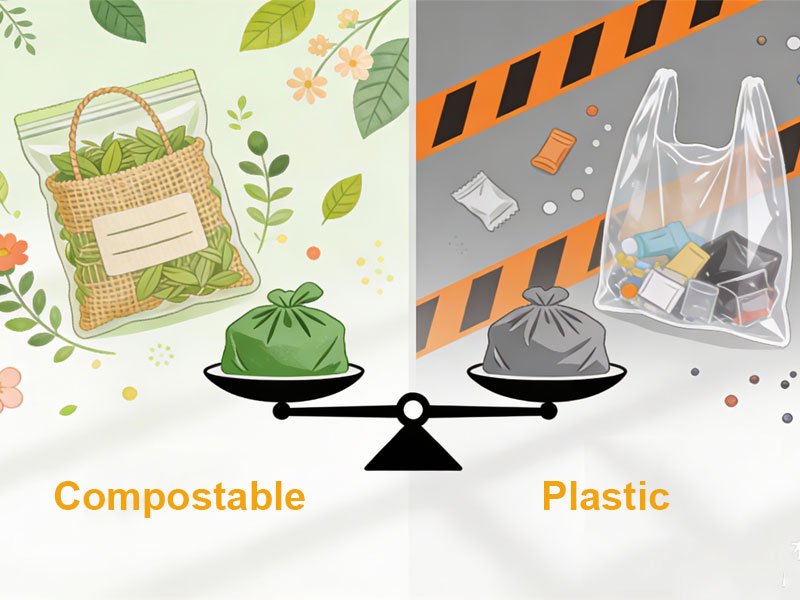
Plant Based vs Traditional Plastic
Composition Comparison
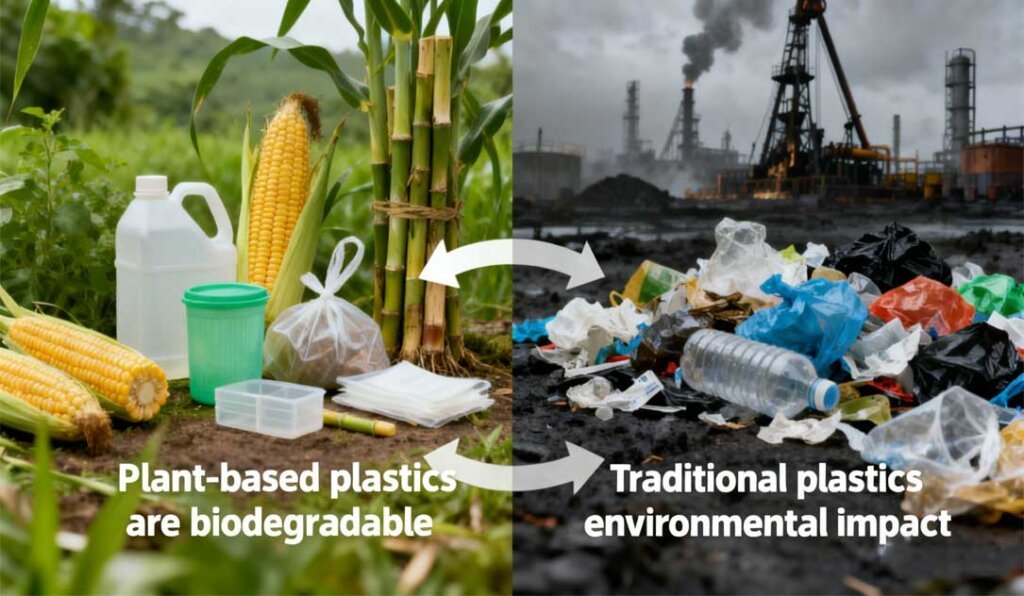
Traditional plastic bags are made from polyethylene, a fossil-fuel-derived polymer. They’re durable but persist in landfills and oceans for centuries.
Plant-based bags, in contrast, come from renewable sources like corn, sugarcane, or starch. They don’t contain polyethylene and can often decompose under composting conditions.
Simply put:
- Plastic bags = fossil fuels + permanence
- Plant-based bags = plants + renewability
Environmental Impact
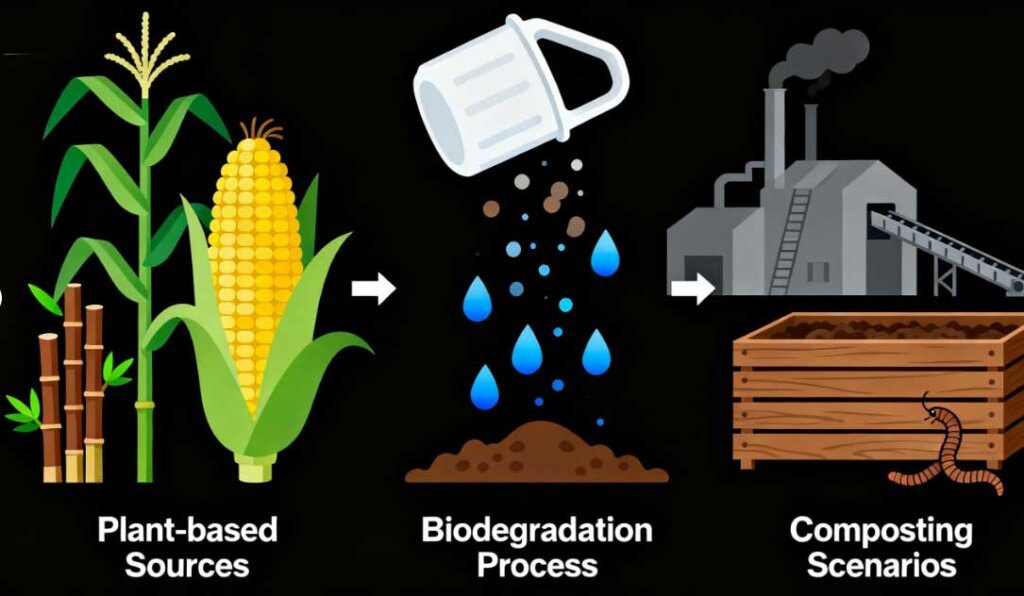
When conventional plastic bags break down, they fragment into microplastics that pollute water and soil. Plant-based bags are designed to decompose naturally into water, CO₂, and biomass under the right conditions.
They also produce less CO₂ during manufacturing since the feedstocks are plant-based. This makes them a more eco-friendly garbage bag option for homes and businesses looking to reduce emissions.
Functional Comparison
In terms of performance, the gap between plant-based and plastic bags is closing. Modern PLA PBAT blends are strong, flexible, and moisture-resistant.
Still, there are times when you might choose one over the other:
- Plant-based bags: best for kitchen waste, compost collection, retail packaging
- Plastic bags: suitable for long-term storage or heavy industrial use
In everyday waste management, eco vs plastic garbage bags now feels less like a trade-off and more like a practical switch.
Are Plant-Based Trash Bags Compostable or Biodegradable?
| Category | Core Definition/Explanation | Key Supplementary Information |
|---|---|---|
| Plant-Based | Refers to products partially or fully made from renewable resources such as corn starch and sugarcane, or produced using plant-based polymers like polylactic acid (PLA) and polybutylene adipate terephthalate (PBAT) | Only indicates the source attribute of raw materials, and there is no necessary equivalent relationship with biodegradability or compostability |
| Biodegradable | Refers to substances that can decompose into natural elements such as water and carbon dioxide in the natural environment | The decomposition process may take a long time, and there is no guarantee of no toxic residues after decomposition; environmental friendliness needs to be judged based on actual conditions |
| Compostable | Refers to the ability to completely decompose under specific controlled composting conditions without leaving any toxic residues | Has clear requirements for the decomposition environment, and professional certification is required to ensure its composting performance |
| Relevant Characteristics of Plant-Based Garbage Bags | Not all plant-based garbage bags are compostable: some are certified as compostable, while others can only achieve partial biodegradation | The actual environmental attributes need to be distinguished through product certification marks to avoid confusion |
| Key Certification Standards (Compostability) | 1. BPI-Certified Garbage Bags: Applicable in North America 2. EN13432: Applicable in Europe 3. ASTM D6400: Internationally recognized compostability standard | Products certified by the above standards have undergone strict laboratory tests to ensure effective decomposition in industrial composting facilities |
| Notes on Composting Scenarios | 1. Industrial Composting: Higher temperature, suitable for products certified by the above standards 2. Home Composting: Lower temperature than industrial composting, requiring more specific product requirements | When planning to compost at home, it is necessary to check whether the product is marked with the “Home Compostable” label to avoid using products only suitable for industrial composting |
Some plant-based trash bags are certified compostable, while others are only partially biodegradable. To know the difference, look for certifications such as:
- BPI Certified Trash Bags (North America)
- EN13432 (Europe)
- ASTM D6400 (international compostability standard)
These marks prove the bag has passed strict lab tests to ensure it breaks down in an industrial composting facility.
If you plan to compost at home, check for “home compostable” labels—industrial composting requires higher temperatures than backyard setups.
In short: all compostable bags are biodegradable, but not all plant-based bags are compostable.
Common Misunderstandings
All plant-based bags are compostable” – False
Some contain only a small percentage of bio-materials and can’t fully break down. Always check for BPI or EN13432 certifications.
“They are weaker than plastic” – False
Thanks to PBAT and new polymer blends, modern plant-based bags match or even exceed the strength of traditional plastics.
“They decompose anywhere” – Not quite
Composting requires the right mix of heat, oxygen, and microbes. In a landfill, decomposition slows dramatically.
“They’re too expensive” – Short-term yes, long-term no
Plant-based bags can cost more upfront. But for businesses, they bring long-term value — fewer pollution fees, better brand image, and compliance with green procurement standards.
How to Choose a Good Plant-Based Trash Bag Supplier
Before you buy, consider what you’ll use it for:
- Kitchen waste: look for certified compostable bags that handle wet organic matter.
- Retail checkout: cornstarch-based T-shirt bags with good stretch.
- Industrial or yard waste: thicker PLA/PBAT blends with higher load capacity.
Also check:
- Certifications (BPI, EN13432, ASTM D6400) Our company’s identification number can be found on the BPI website: 10529118
- Local composting facility requirements
- Bag thickness, size, and strength
- Custom options for brands — OEM or private labeling
Who Should Use Plant-Based Trash Bags?
- Retailers and grocery chains replacing single-use plastic
- Hotels, cafes, and restaurants seeking greener disposal
- Waste management companies working with composting programs
- Eco brands and startups building sustainable supply chains
- Municipal composting and zero-waste programs
- These bags are no longer niche — they’re becoming standard in responsible waste systems
Where to Buy or Source Plant-Based Trash Bags
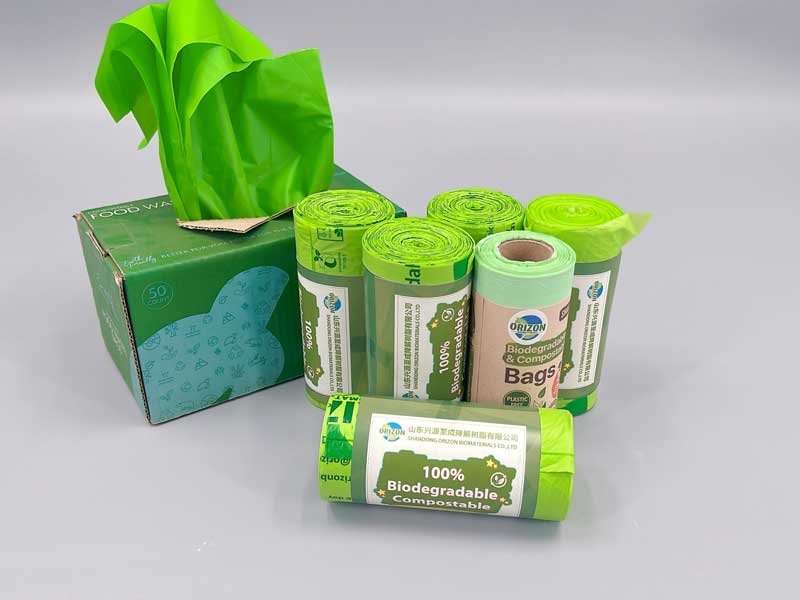
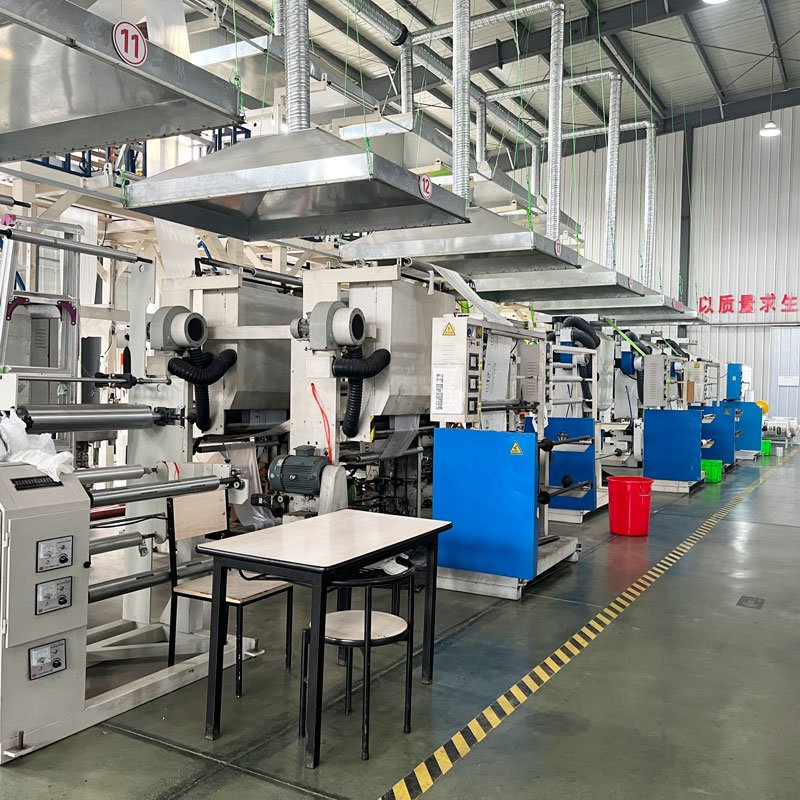
If you’re looking for a reliable supplier, consider working with a certified manufacturer like Orizon Biomaterials.
We specialize in:
- OEM and wholesale services
- Custom printing and private labeling
- Certified materials (BPI, EN13432, ASTM D6400, AS4736)
👉 Contact Orizon Biomaterials for OEM & wholesale plant-based trash bag solutions.
FAQs
Are plant-based trash bags better than biodegradable bags?
In many ways, yes. They use renewable materials and are often certified compostable, while “biodegradable” can mean almost anything.
Can I compost plant-based trash bags at home?
Only if they’re labeled “home compostable.” Most need industrial composting conditions.
How long do they take to decompose?
Typically 90–180 days in industrial composting facilities.
Are they suitable for wet waste?
Yes, many are moisture-resistant, but choose the right thickness for your use.
Do they meet local composting regulations?
Check certifications like BPI or EN13432 — most facilities accept these.
Conclusion
Plant-based trash bags aren’t a perfect solution — but they’re a meaningful step forward.
By switching from petroleum to renewable materials, we reduce pollution, save energy, and move closer to a cleaner future.
If you’re a business looking to make that change, partnering with a certified manufacturer like Orizon Biomaterials can make the transition easy and reliable.