When you see the words “compostable” on a supermarket shelf or coffee cup, have you ever wondered what “biodegradable” and “compostable” mean? Don’t worry, this feeling is normal. I’ve found that many people have the same confusion.
Today, the market is flooded with various “environmentally friendly,” “biodegradable,” and “green” slogans, making it difficult to distinguish which products can truly degrade and which are just marketing gimmicks.
That’s why BPI certification is particularly important. It’s not just a marketing slogan, but proof that a product has been tested and verified to be safe for composting under real industrial conditions.
Today, I want to talk to you about BPI compostability certification. According to a 2023 report by the U.S. Environmental Protection Agency (EPA), millions of tons of plastic waste are sent to landfills every year, which is a huge problem for the planet. Choosing materials that can truly return to nature is crucial to reducing this waste.
So what exactly is BPI compostability certification? Why is it so important for green products? In this article, I will explain the meaning of BPI certification, how products obtain certification, and why it is so important for brands and consumers.
What Is BPI Compostable Certification Mean ?
BPI stands for Biodegradable Products Institute. Headquartered in the United States, it is a leading certification body in North America, primarily responsible for certifying whether products can truly decompose in industrial composting facilities.
To obtain certification, products must meet the requirements of ASTM D6400 (plastics) or ASTM D6868 (coatings and packaging). These stringent scientific standards test a product’s decomposition in industrial composting facilities—where temperature, oxygen, and microorganisms are strictly controlled.
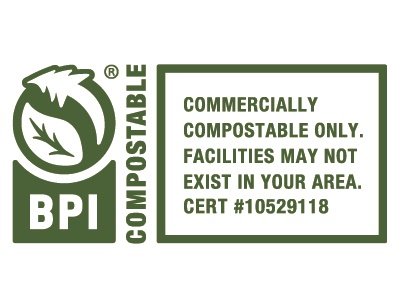
Once a product passes the test, it receives the BPI Certified Compostable Mark. This small mark tells composting facilities that the product can be safely converted into compost without contaminating the composting system like some counterfeit “biodegradable” plastics.
All compostable items are biodegradable, but not all biodegradable items are compostable. However, biodegradation can occur anywhere, and the time it takes and what it leaves behind are uncertain. It might take hundreds of years to decompose, or it might leave harmful substances in the process.
BPI’s certification is based on rigorous scientific standards. They refer to international standards like ASTM D6400 (the American Society for Testing and Materials) and EN 13432 (the European standard). These standards are like “exam rules” for products, ensuring that the products in the industrial composting plant actually turn into useful soil, rather than polluting the environment.
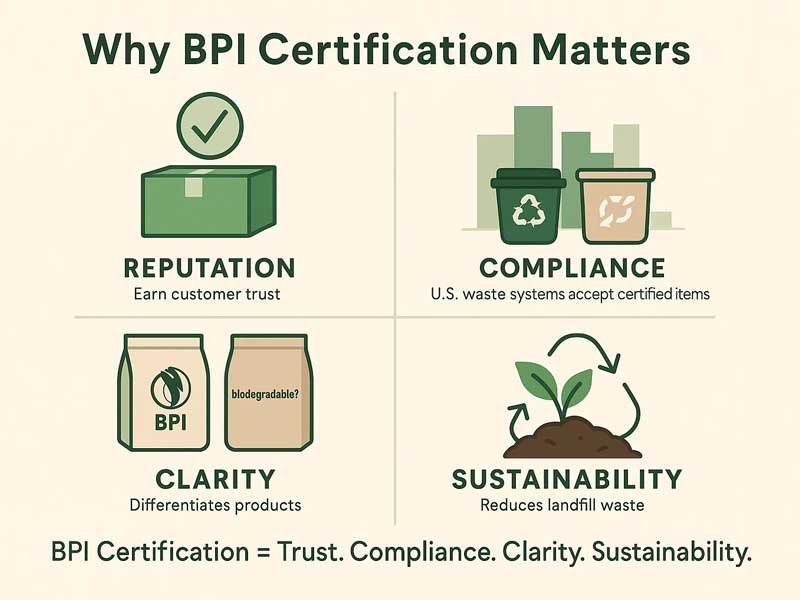
Why BPI Certification Matters for Businesse
BPI certification helps avoid “greenwashing” in the market. It builds customer trust, ensures products are truly compostable, and aligns the brand with U.S. environmental standards.
- Reputation: Customers, retailers, and composting facilities trust the BPI mark.
- Compliance: Many U.S. city waste collection systems only accept BPI-certified compostable products.
- Clarity: It distinguishes truly compostable materials from misleadingly labeled biodegradable plastics that may never decompose.
- Sustainability Goals: Certified products reduce landfill waste and improve compost quality.
If your business manufactures or sells compostable bags, tableware, or packaging, BPI certification is not just a bonus, it’s essential.
Benefits of Using BPI Certified Products
As someone working in sustainable packaging, I’ve witnessed firsthand the transformative impact of BPI certification.
Choosing certified compostable products offers the following benefits:
- Environmental Protection
These products decompose completely, leaving no toxic residues or microplastics. The result is cleaner compost and healthier soil.
- Reduced Waste
Certified products help move organic waste from landfills to composting facilities, reducing methane emissions.
- Trust and Brand Building
Consumers perceive your company’s commitment to transparency. The BPI logo on packaging is a subtle yet powerful signal of integrity.
- Facility Compliance
Composting centers prefer to use, or even require, BPI-certified materials because they know these materials decompose properly.
- Business Advantages
Many retailers now require BPI-certified packaging suppliers to meet their own sustainability goals. Certification opens up new markets and partnerships.
When brands choose validated materials such as PLA compostable film, PBAT compostable mailing bags, or BPI-certified garbage bags, everyone wins.
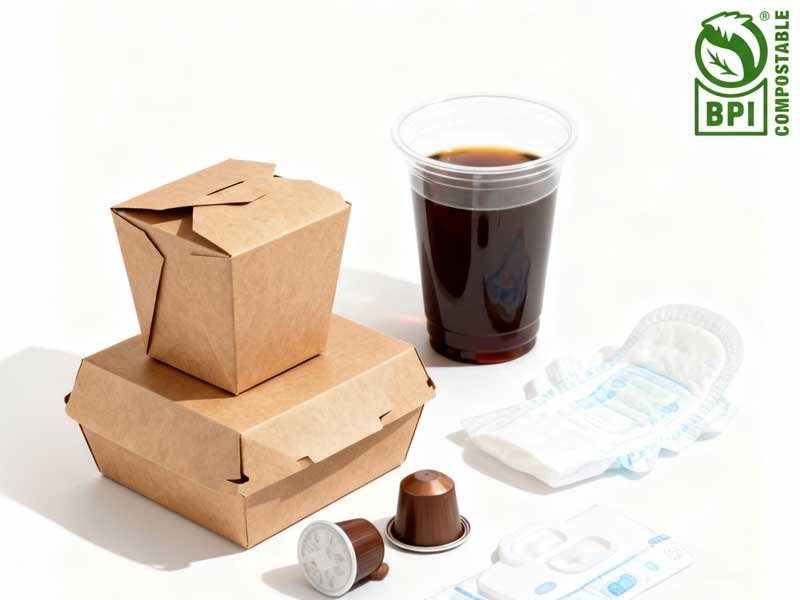
BPI Compostable Product Types and Application Scenarios
Food Packaging: Takeout containers, beverage cups, cutlery (knives, forks, spoons), and straws used when ordering takeout. Some brands, like World Centric, produce a lot of BPI-certified cutlery.
Garbage Bags: Bags for food waste and garden waste. Brands like BioBag offer BPI-certified food waste bags that can be directly disposed of with food waste in compost bins.
Agricultural Film: Biodegradable mulch film allows farmers to simply plow it into the soil after planting without needing to recycle it, reducing the environmental burden.
Other Innovative Products: Some coffee capsules, wipes, and even components of some baby diapers are beginning to receive BPI certification.
Application Cases Across Industries:
- Food Service Industry: Many restaurants and cafes have begun using BPI-certified takeout tableware and packaging. For example, some university cafeterias have fully adopted BPI-certified tableware, significantly reducing plastic waste.
- Households: I personally use BPI-certified food waste bags, so my food waste can be directly sent to the community composting center, which is great.
- Agriculture: Farmers using BPI-certified mulch film not only reduce plastic pollution but also improve soil health.
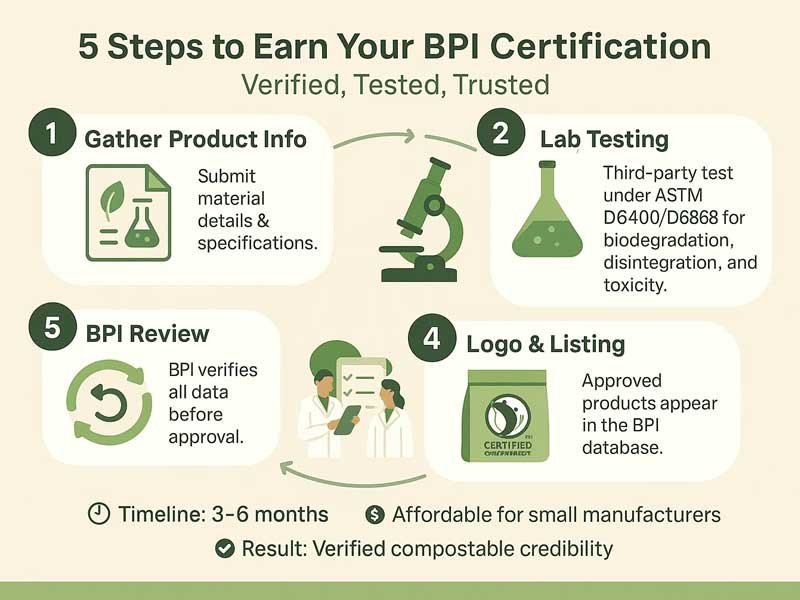
How to Get BPI Certification
1. Gather product information
Manufacturers first submit detailed data about the product—its materials, thickness, additives, and intended use.
2. Send samples for testing
BPI only accepts third-party lab tests that follow ASTM D6400 or ASTM D6868 methods.
These tests measure:
- How completely the material biodegrades
- Whether it disintegrates within 84 days
- If it leaves any toxic residue in the finished compost
3. Review by BPI
Once test results are complete, BPI’s scientific team reviews everything. If the product meets all criteria, it earns certification.
4. Use of logo and listing
Approved items get listed in the official BPI certification database, and brands may display the BPI compostable logo on packaging—following strict labeling rules.
5. Renewal
Certification must be renewed every few years to ensure consistency with updated standards and materials.
On average, the process takes 3–6 months, depending on testing time. Costs vary, but for most small manufacturers, it’s an affordable investment in transparency.

BPI Logo and Labeling Guidelines
Once a product is certified, companies must follow specific labeling rules. This avoids confusion for composting facilities and consumers alike.
The BPI logo should be:
- Clearly visible on the product or packaging
- Used only for certified items (never as a general brand mark)
- Printed in the proper shape and color approved by BPI
Products that misuse the logo can lose certification.
For example, I’ve seen brands label their bags “BPI approved” when only part of the product—like the resin—was certified. That’s misleading. BPI checks for this and enforces its policy to protect the integrity of the program.
Proper labeling matters because composting facilities rely on it to identify accepted materials quickly. The right logo keeps contamination low and compost clean.
BPI Certification vs. Other Compostability Standards
BPI isn’t the only certification in the world, but it’s the main one for North America.
Here’s how it compares:
- BPI uses ASTM D6400/D6868 and focuses on industrial composting in the U.S.
- OK Compost and TÜV Austria use EN 13432, which is the European Union standard.
- Home compostable certifications (like OK Compost HOME) test at lower temperatures, suitable for backyard compost bins.
If you sell internationally, you might need both BPI and EN 13432 certification to cover different regions.
- BPI = for U.S. industrial composting.
- EN 13432 = for European composting systems.
- Home compost = for domestic use at lower heat.
Understanding these differences helps global brands meet all requirements and avoid costly rejections.
How to Verify if a Product Is BPI Certified
The certification process may sound technical, but it’s fairly clear once you understand the steps.
1. Gather product information
Manufacturers first submit detailed data about the product—its materials, thickness, additives, and intended use.
2. Send samples for testing
BPI only accepts third-party lab tests that follow ASTM D6400 or ASTM D6868 methods.
These tests measure:
- How completely the material biodegrades
- Whether it disintegrates within 84 days
- If it leaves any toxic residue in the finished compost
3. Review by BPI
Once test results are complete, BPI’s scientific team reviews everything. If the product meets all criteria, it earns certification.
4. Use of logo and listing
Approved items get listed in the official BPI certification database, and brands may display the BPI compostable logo on packaging—following strict labeling rules.
5. Renewal
Certification must be renewed every few years to ensure consistency with updated standards and materials.
On average, the process takes 3–6 months, depending on testing time. Costs vary, but for most small manufacturers, it’s an affordable investment in transparency.

How to Properly Dispose of BPI Compostable Products
The Importance of Industrial Composting Facilities:
BPI-certified products are designed for industrial composting facilities. This is crucial. Industrial composting facilities provide specific high temperatures, humidity levels, and microbial environments that ensure complete decomposition of the product within a short timeframe. Your home compost bin may not meet these conditions.
Why Home Composting May Be Ineffective?
Your backyard compost bin is typically not hot enough and decomposes slowly. If you throw BPI products in, it may take a very long time to decompose, or it may not decompose completely at all. Ultimately, it may become a pile of “plastic residue” instead of nutrient-rich compost.
Avoid Cross-Contamination:
If you throw BPI products in with regular garbage, they will end up in a landfill or incinerator. There, it loses its compostable value. It may even contaminate the recycling system, as recycling plants cannot process this material.
How to Find Local Industrial Composting Facilities:
- Check your local government website: Many cities and regions offer organic waste or food waste collection services and send it to industrial composting plants.
- Use composting search tools: Some websites or apps specifically provide maps or lists of local composting facilities.
- Ask your waste disposal company: Your waste disposal service provider may have relevant information.
Many users purchase our BPI products but don’t know the correct disposal methods, and as a result, these products end up in landfills. This is truly a pity. Therefore, please be sure to understand the composting options in your area.
Common Misconceptions About BPI Certification
All biodegradable products are BPI certified.
False. Many “biodegradable” plastics don’t meet composting standards. “Biodegradable” just means something can break down—eventually. But it doesn’t say where or how long it takes. BPI certification proves compostability under real facility conditions.
Compostable means it breaks down anywhere
Also false. Compostable items need specific industrial composting conditions—heat, moisture, and microbes. If you toss a compostable bag in a landfill, it won’t break down the same way.
BPI is only for bags.
Nope. It covers a wide range—compostable cutlery, food containers, cups, PLA films, PBAT blends, and more.
It’s the same as home compostable.
Not quite. BPI-certified products are meant for industrial facilities, not backyard compost piles.
Future of BPI Certification
BPI continues to evolve too. In 2025, the organization is focusing on:
- Testing new biopolymers like PHA that decompose faster and use less energy.
- Updating ASTM D6400 standards to reflect modern materials.
- Working with government and waste facilities to expand industrial composting infrastructure.
- Increasing public awareness of compostable packaging certification and how to dispose of products correctly.
I believe the next few years will see tighter regulations on green claims and stronger demand for certified compostable packaging. BPI will stay at the center of that progress.
Conclusion
BPI certification is more than a label; it’s real proof.
It demonstrates that a product truly meets the scientific standards for compostability. For businesses, this means compliance, reputation, and consumer trust. For consumers, it means that what they throw into the green bin will eventually return to the earth.
If your brand wants to be part of the circular economy, start by validating your materials. Visit the BPI certification database, contact testing laboratories, and begin your BPI certification journey.
It’s a small step, but it can make a huge difference—significant for both your business and the planet.
Related Articles