In Australia, compostable products are regulated under two different standards: AS 4736 for industrial composting and AS 5810 for home composting.
These standards are not interchangeable. Choosing the wrong certification can lead to product rejection, compliance issues, and financial loss for importers.
If you are in the business of compostable bags or packaging for the Australian market, you may have encountered two standards: AS5810 and AS4736.
Many importers assume they are the same. However, this is not the case. Choosing the wrong standard can lead to product rejection, customer complaints, or failed audits.
In this guide, I will explain the differences between AS5810 and AS4736 in simple terms to help you understand them.
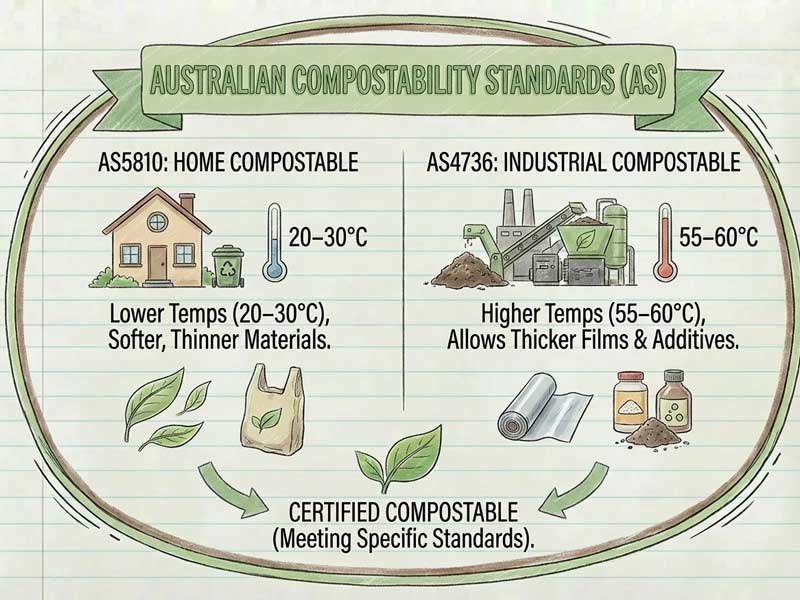
What Are AS5810 and AS4736?
Australia uses two compostability standards because its composting systems are quite different.
AS5810 Home Compostability Standard:
This standard applies to home composting systems, where the temperature in the compost bins is lower, typically around 20–30°C. Due to the milder environment, materials must be softer, thinner, and decompose more easily.
AS4736 Industrial Compostability Standard:
This standard applies to commercial composting facilities. Temperatures can reach 55–60°C. Materials decompose much faster in this environment, so this standard allows for the use of thicker films and more additives.
Why Australia Uses Both Standards
Most countries only adopt the European industrial composting standard EN13432.
Australia also encourages home composting, and the Australian Bioplastics Association (ABA) has established:
- AS4736: Industrial composting standard
- AS5810: Home composting standard
However, home composting involves lower temperatures and less control. This is why producing compostable garbage bags for home use is more difficult. They must pass additional tests for decomposability, biodegradability, and ecotoxicity. If the product labeling is incorrect, municipal councils and retailers may refuse to sell it.
I have seen some importers suffer losses because their garbage bags were not certified.
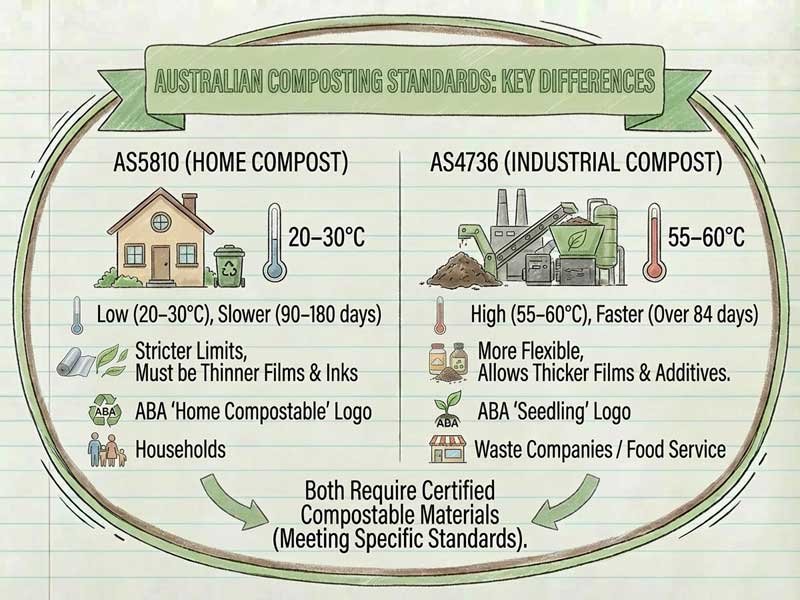
Differences Between AS5810 and AS4736
| Feature | AS5810 (Home Compost) | AS4736 (Industrial Compost) |
|---|---|---|
| Composting system | Backyard/home | Commercial facility |
| Temperature | Low (20–30°C) | High (55–60°C) |
| Breakdown speed | Slower | Faster |
| Material limits | Stricter | More flexible |
| Ink rules | Stricter | Less strict |
| Film thickness | Must be thin | Can be thicker |
| Logo | “Home Compostable” ABA logo | “Seedling” ABA logo |
| User environment | Households | Waste companies / food service |
A product that meets AS4736 may not break down at home. This is one of the biggest misunderstandings in the market.
Which Products Typically Need AS5810 vs AS4736
| Comparison Item | AS5810 (Home Compostable) | AS4736 (Industrial Compostable) |
|---|---|---|
| Typical Product Types | Household compostable products | Commercial & food service compostable products |
| Example Products | Compostable bin liners Food scrap bags Small roll bags Supermarket shopping bags Dog waste bags |
Compostable coffee cups Takeaway containers Food service packaging Thick commercial waste bags |
| Where They Are Used | Homes, backyards, personal compost bins | Restaurants, cafés, food service areas, industrial composting facilities |
| Composting Environment | Low-temperature, inconsistent home compost conditions | High-temperature (55–60°C), controlled industrial composting conditions |
| Why This Standard Applies | Products will likely enter home compost systems and must break down safely under variable natural conditions | Products enter commercial organics waste streams requiring faster, controlled composting processes; often paired with EN13432 |
The Science Behind the Difference (Why AS5810 Is Harder)
Many people may not realize that AS5810 bags are more difficult to manufacture than AS4736 bags.
The reasons are as follows:
Low temperatures slow down degradation:
At home, composting environments are cold, requiring materials to decompose even under less demanding conditions. Therefore, AS5810 requires more stringent decomposition and biodegradation testing.
Thinner film:
If the bag is too thick, it will fail home composting tests. Even a difference of a few micrometers is crucial.
More stable formulation:
Factory factories typically use PLA/PBAT blends with added starch. If the formulation changes, the bag may pass the AS4736 test but fail the AS5810 test.
Ink restrictions:
AS5810 requires the use of compostable inks, and these inks must meet very stringent ecotoxicity standards.
More sensitive to batch variations:
If the extruder is not properly calibrated, the film thickness can vary. This is one of the most common causes of AS5810 bag failure.
Most competitors never mention these actual production details online, but these details are crucial for importers.
How to Identify if a Bag is AS5810 or AS4736 Certified
Many suppliers—even those from China—use incorrect labels or only provide test reports.
Here’s what you should check:
- Look for the ABA certification number
Every genuine certification has a number that you can look up.
- Look for the correct logo
AS5810 = “Home Compost”
AS4736 = “Seedling Mark”
- Search the ABA database
If the company name or product name doesn’t appear in the database, the product is not certified.
- Test Report ≠ Certificate
This is a common scam. In Australia, only ABA certification is recognized.
- Request a Certificate PDF File
You should be able to see the product type, thickness, and certification date.
This step helps avoid purchasing counterfeit documents—a topic frequently discussed by Reddit users.
What Happens If You Choose the Wrong Standard?
Here are the real consequences importers face:
- Supermarkets refuse to accept the product.
- Municipal departments refuse to accept the packaging bags during waste audits.
- The packaging bags cannot decompose in home composting, leading to customer complaints.
- The product must be relabeled, repackaged, or destroyed.
- Legal risks associated with misleading advertising.
Using AS4736 compliant packaging bags for home composting poses significant problems. Using AS5810 compliant packaging bags for industrial packaging may result in premature breakage. Choosing the wrong standard is costly.
A Simple Guide to Choosing the Right Standard
Please select AS5810 if the following conditions are met:
- This item will be used at home.
- It will be placed in a compost bin in the backyard.
- It is a shopping bag, pet bag, garbage bag, or roll bag.
Please select AS4736 if the following conditions are met:
- This product is intended for use in a cafe, food service establishment, or restaurant.
- It will be placed in a commercial composting facility.
- It is food packaging or a thicker product.
Uncertainty: Consider the final destination of the waste, not the origin of the product.
What Importers Should Know When Buying From China
I’ve seen many importers confused by suppliers using different standards.
Here are a few things you must check:
- The factory only has the AS4736 standard but claims it’s “suitable for home composting.”
- The factory provides test reports, not certification certificates.
- The factory changes its formula due to fluctuations in raw material prices.
- The ink must be compostable, not ordinary ink.
- Batch variations have a much greater impact on the AS5810 standard than on the AS4736 standard.
- China has stricter resin control requirements for packaging bags that have obtained AS5810 certification.
If you require packaging bags made in China that comply with AS5810 or AS4736 certification, be sure to ask: “Can you provide the ABA certification number for this product?” This simple question can help you avoid costly mistakes.
FAQ
Is AS5810 better than AS4736?
Neither is “better.” They are designed for different environments.
Can a product be certified for both AS5810 and AS4736?
Yes, but it is rare. Most materials optimized for home compost are too weak for industrial packaging.
Do AS4736 bags break down at home?
Usually not. Home compost systems lack the heat needed.
Are AS5810 bags more expensive?
Often yes, because formulas and inks are stricter.
Why do bags fail home compost tests?
Thickness, ink, or unstable PLA/PBAT formula.
Which should I choose: AS5810 or AS4736?
Choose based on the final composting environment, not the product type.
Conclusion
For importers selling products to Australia, understanding the differences between AS5810 and AS4736 is crucial. While these two standards may seem similar, their composting requirements are drastically different.
Choosing the right certification protects your brand, ensures compliance with Australian regulations, and avoids costly mistakes. Even high-quality products can fail to meet standards if the wrong certification is chosen.
Related Articles