When sourcing compostable packaging, certification is one of the first things buyers should review.
Many products use the word “compostable.” Not all follow recognized standards.
Understanding the required certifications helps buyers reduce compliance risk and protect long-term supply programs.
This guide explains the key certifications for a compostable bags manufacturer and how to verify them.
Why Certification Matters
Certification confirms that compostable products have been tested by an independent organization.
Testing usually includes:
- Breakdown under composting conditions
- Biodegradation rate
- Heavy metal limits
- Environmental safety
A professional compostable bags manufacturer should clearly present valid certification documents and explain which standards apply.
Certification protects:
- Retail compliance
- Municipal acceptance
- Brand credibility
- Import documentation
Without proper certification, products may be rejected by composting facilities or retailers.
EN 13432 (Europe)
EN 13432 is widely used in the European Union. It applies to industrial composting systems.
This standard verifies that packaging materials:
- Disintegrate within a defined period
- Biodegrade under controlled conditions
- Meet strict environmental limits
If your market includes the EU, EN 13432 is often required.
When comparing EN 13432 vs ASTM D6400, both focus on industrial composting but apply in different regulatory regions.
ASTM D6400 and BPI (United States)
ASTM D6400 is commonly used in the United States.
It defines performance requirements for compostable plastics in industrial composting systems.
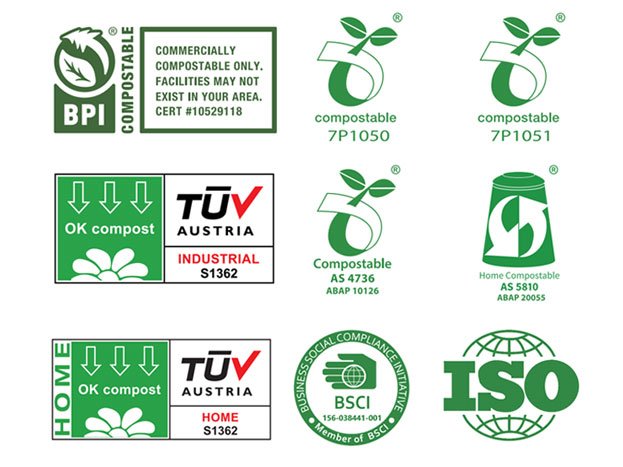
BPI (Biodegradable Products Institute) provides third-party certification aligned with ASTM standards.
A certified compostable bags manufacturer serving the U.S. market should clarify whether products are ASTM compliant and whether they are BPI certified.
Buyers should confirm:
- Certificate number
- Validity period
- Product scope
OK Compost (Industrial and Home)
OK Compost is issued by TÜV Austria.
There are two main categories:
- OK Compost INDUSTRIAL
- OK Compost HOME
Industrial composting requires controlled temperature and humidity.
Home composting operates under lower temperatures.
Industrial vs home compostable is an important distinction. Buyers must confirm which certification matches their intended use.
AS 4736 and AS 5810 (Australia)
For the Australian market:
- AS 4736 applies to industrial composting
- AS 5810 applies to home composting
These standards are often required in FOGO programs and retail environments.
A compostable bag factory supplying Australia should clearly state which Australian standard applies.
Clear labeling reduces the risk of incorrect environmental claims.
Certification Scope and Common Pitfalls
Not all certificates apply to finished bags.
Common mistakes include:
- Certification only for raw materials, not final products
- Scope that does not include bags or liners
- Expired certificates
- Home compost claims without home certification
Before placing an order, buyers should:
- Check the certificate number
- Confirm the issuing body
- Review the product category
- Verify the expiration date
- Confirm industrial or home classification
Certification by Market: Quick Reference
Different regions require different standards.
EU Market
EN 13432 (industrial composting)
US Market
ASTM D6400 + BPI certification
Australia
AS 4736 (industrial)
AS 5810 (home)
Understanding compostable certification standards by region supports smoother import and retail approval.
How to Verify Certification
A practical verification process includes:
- Request official certificate copy
- Check certificate number in the issuing body database
- Confirm product description matches your order
- Review validity date
- Confirm the certificate holder
When evaluating a supplier, transparency in documentation often indicates structured internal processes.
Final Buyer Checklist
Before selecting a supplier, confirm:
- Recognized certification standard
- Valid certificate number
- Matching product scope
- Clear industrial or home classification
- Up-to-date documentation
Certification is not a marketing tool. It is a compliance requirement.
Conclusion
Understanding certifications for a compostable bags manufacturer helps buyers make informed decisions.
Standards such as EN 13432, ASTM D6400, OK Compost, AS 4736, and AS 5810 define clear testing frameworks.
Clear documentation and scope verification reduce regulatory and supply risk.
When reviewing long-term partners, working with a verified compostable bags manufacturer with transparent certification management supports stable and compliant supply programs.