Compostable Bags for Green Bin
Food waste collection is growing fast in Canada, Australia, and many parts of Europe.
More cities now use Green Bin or FOGO programs to collect kitchen waste and organic materials separately from regular trash.
This change also creates a problem.
Many bags marked as “biodegradable” are not accepted in municipal composting systems. Some bags break too early. Some do not break down at all. Others leave plastic contamination behind.
That is why certified compostable bags for green bin programs have become important for distributors, supermarkets, and municipal suppliers.
At Orizon, we work with compostable film and OEM compostable bag production every day. I have also seen how confusing this market can be for importers. Different cities have different rules. Different compostable certifications also mean different things for municipal waste systems.
This page explains how compostable green bin liner swork, what certifications matter, and how distributors can choose reliable compostable bag manufacturers for green bin programs, what certifications matter, and how distributors can choose reliable compostable bag manufacturers for green bin programs.
What Are Compostable Bags for Green Bin?
Compostable bags for green bin programs are liners used for collecting food scraps and organic waste.
People often use them for:
- kitchen food waste
- fruit and vegetable scraps
- coffee grounds
- tea bags
- small compost bins
- municipal organic waste collection
You may also hear these products called:
- green bin compost bags
- compostable green bin liners
- organic waste liners
- food waste compost bags
Most compostable green bin bags are designed for industrial composting systems.
Industrial composting means the bags break down under controlled heat, moisture, oxygen, and microbial activity inside commercial compost facilities. According to the U.S. EPA composting guide, compostable products require specific composting conditions to properly break down.
This is different from regular landfill conditions.
According to the U.S. EPA Composting Basics, compostable products need specific conditions to properly decompose.
That is why certification matters.
Why Green Bin Programs Require Certified Compostable Bags
Compostable bags for green bin programs are liners used for collecting food scraps and organic waste.
One of the biggest problems in municipal composting is contamination.
Many bags look environmentally friendly, but they are not truly compostable.
Some are only oxo-degradable plastics. Some contain traditional PE materials mixed with additives. These materials may break into smaller pieces instead of fully composting.
For municipal compost facilities, this creates risk.
Plastic contamination can damage finished compost quality and increase sorting costs.
Because of this, many cities only accept certified compostable bags for green bin programs.
For North American markets, ASTM D6400 compostable bags and BPI certified compostable bags are commonly required for municipal organic waste programs.
| Certification | Region | Purpose |
|---|---|---|
| ASTM D6400 | United States & Canada | Industrial compostability |
| BPI Certified | North America | Third-party compost certification |
| EN13432 | Europe | Industrial compostability |
Different regions may use different compostability standards for municipal waste systems.
In Australia, AS4736 is one of the key industrial compostability standards used for certified compostable plastics, as referenced by the Australasian Bioplastics Association.
EN13432 is widely used in Europe for industrial compostable packaging and bioplastics, according to European Bioplastics.
Many distributors still confuse biodegradable and compostable materials.
They are not the same thing.
A biodegradable bag may break down slowly or incompletely. A compostable bag is tested under composting standards. The BPI Certification Program explains how certified compostable products are tested for industrial composting systems. The BPI Certification Program explains how certified compostable products are tested for industrial composting systems.
The BPI Certification Program explains this clearly.
This difference matters for green bin compost bags.
Especially in municipal waste programs.
Compostable vs Biodegradable Bags for Green Bin Programs
This is one of the most common questions buyers ask. I hear it often from distributors.
“Can biodegradable bags be used in green bins?” Sometimes the answer is no.
Many municipal composting systems only allow certified compostable liners.
Here is the simple difference:
| Compostable Bags | Biodegradable Bags |
|---|---|
| Tested under compost standards | Often not certified |
| Break down in industrial composting | May leave residue |
| Accepted by many green bin programs | Often rejected |
| Designed for organic waste collection | Broad and unclear term |
The word “biodegradable” is not enough anymore.
Many councils and compost facilities now focus on certified compostable products instead.
This trend is becoming stronger in Canada and Australia.
Common Problems with Low-Quality Compostable Bags
Not all compostable bags perform the same way. This is another major pain point for importers.
I have seen buyers receive products that:
- leak food waste liquid
- tear during use
- stick together on rolls
- break during dispensing
- have unstable thickness
- develop sealing problems
Green bin waste is usually wet.
Food scraps create moisture, odor, and pressure inside the bag.
That means compostable kitchen waste bags need balanced film formulation and stable production quality.
Film thickness alone is not enough.
The resin blend also matters.
For example, PLA alone is usually too brittle for compostable film production.
That is why many compostable bag manufacturers use PLA + PBAT blends instead.
Best Compostable Bag Types for Green Bin Waste
Different green bin programs use different bag styles. The most common products include:
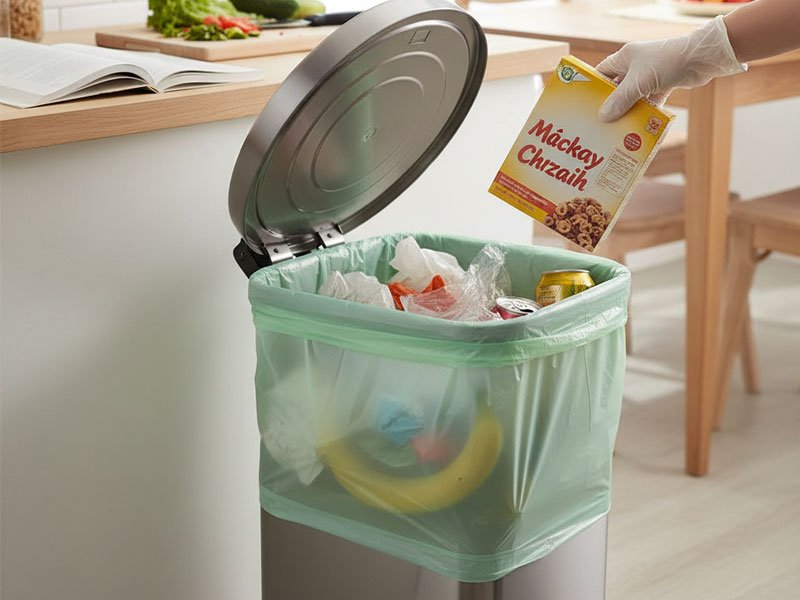
Kitchen Food Waste Bags
Usually used inside small kitchen compost bins.
Popular sizes:
- 3 gallon
- 6 liter
- 8 liter
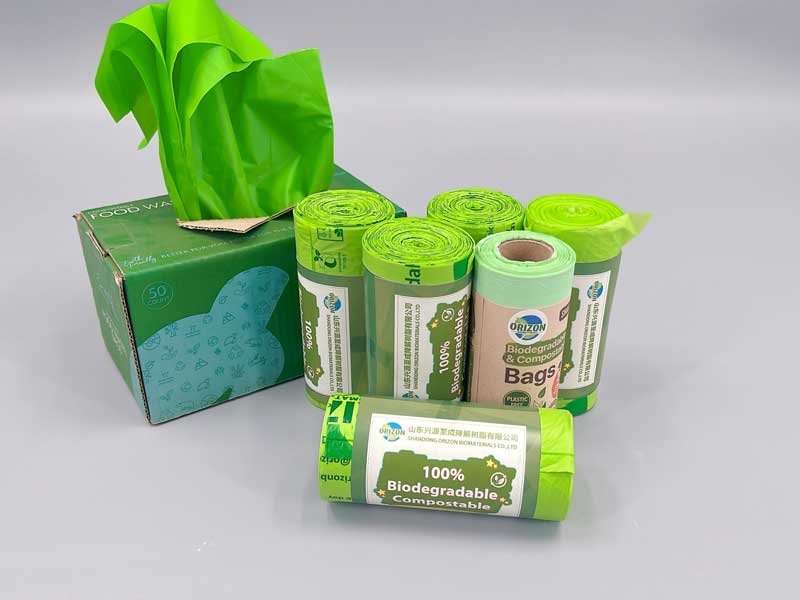
Compostable Roll Bags
These are common in supermarkets and retail stores.
They are easy to dispense and pack efficiently.
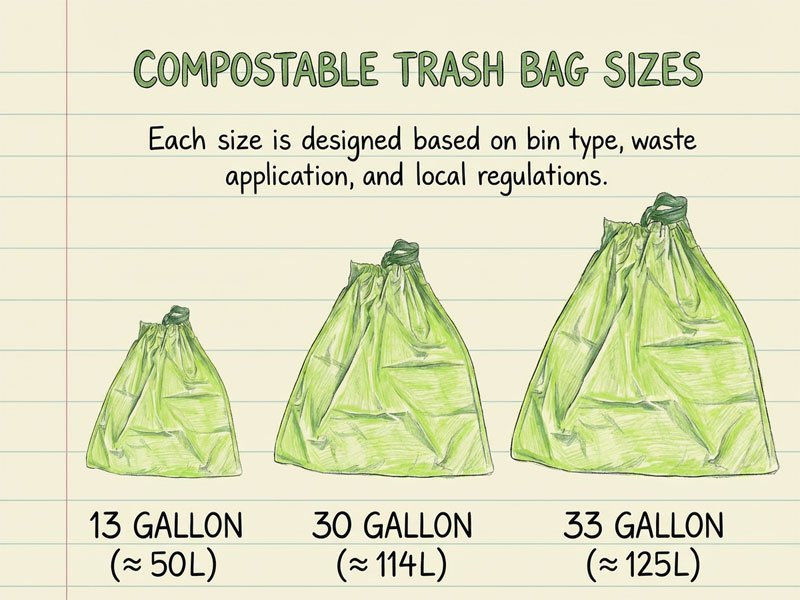
Drawstring Compost Bags
Often used for larger kitchen waste collection.
They offer better carrying convenience.
However, drawstring compost bags usually require thicker film.
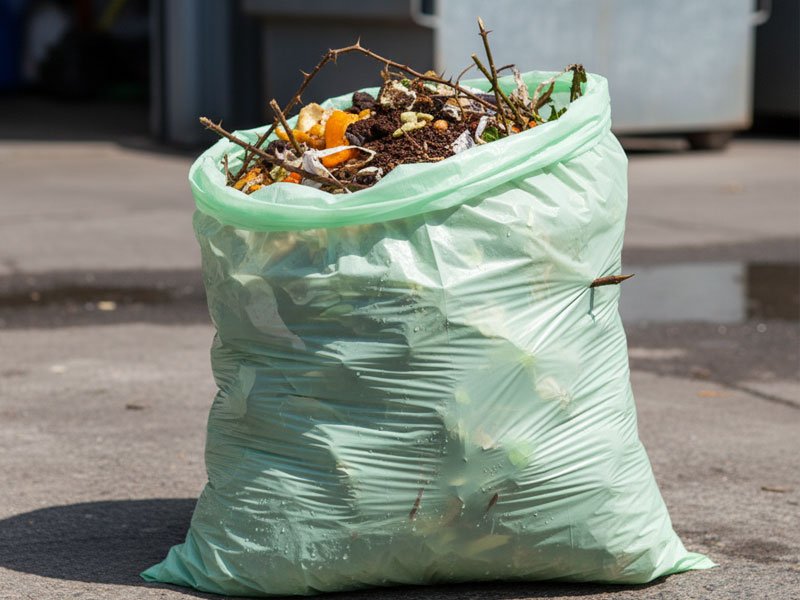
Heavy-Duty Organic Waste Bags
Used for municipal or commercial organic waste collection.
Common applications include:
- restaurants
- hotels
- food processing
- municipal waste programs
Recommended Thickness for Green Bin Compost Bags
Thickness depends on bag size and application.
Many buyers try to reduce cost by using thinner film.
But if the bag becomes too weak, customer complaints increase quickly.
Below are common thickness recommendations used in the compostable bag industry.
| Bag Type | Recommended Thickness |
|---|---|
| 3 Gallon Compost Bags | 12–15 μm |
| 13 Gallon Compost Bags | 15–18 μm |
| Drawstring Compost Bags | 18–22 μm |
| 33–55 Gallon Compost Bags | 22–25 μm |
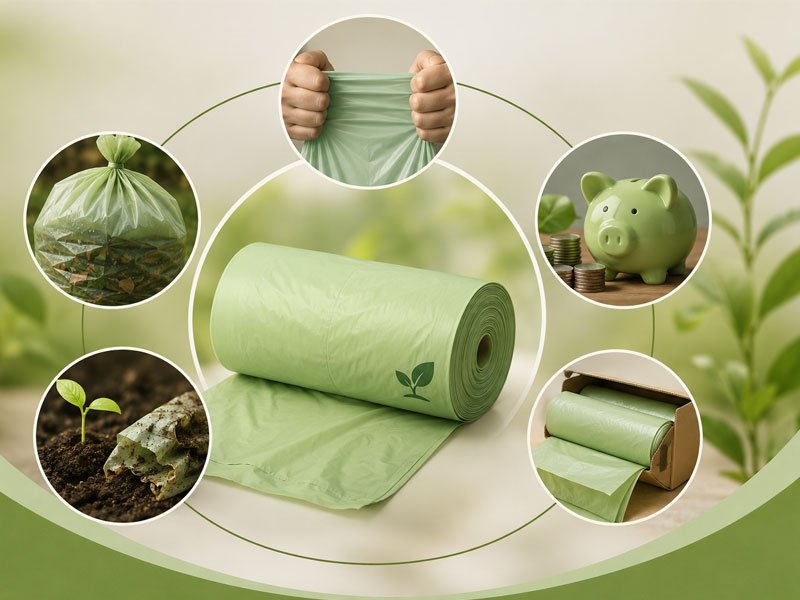
The right thickness should balance:
- strength
- sealing performance
- cost
- compostability
- dispensing stability
For OEM compostable green bin bags, thickness consistency is very important.
Especially for private label distributors.
OEM Compostable Bags for Green Bin Programs
Many distributors now want more than plain compost bags.
They want products designed for their local market.
At Orizon, most of our compostable bags are produced as OEM and private label orders.
Common OEM options include:
- custom printing
- retail box packaging
- roll label packaging
- custom thickness
- custom bag size
- private label branding
Different markets also require different certifications.
For example:
- Canada often focuses on ASTM D6400 and BPI
- Europe mainly uses EN13432
- Australia commonly requires AS4736
For importers, choosing the right certification before production is important.
Incorrect labeling can create problems during customs clearance or retail sales.
Compostable Bags for Municipal Waste Programs
Municipal organic waste collection is growing quickly. Canada continues to expand waste reduction and organics diversion programs as part of its broader plastic waste reduction strategy, according to the Government of Canada.
Especially in:
- Canada
- Australia, where many cities now use FOGO systems for organic waste collection.
- Europe
Many cities now separate:
- food waste
- organic waste
- garden waste
from regular trash.
This creates long-term demand for compostable green bin liners.
But municipal programs also require stable quality.
A bag that fails during waste collection creates operational problems very quickly.
That is why municipal buyers usually focus on:
- certification compliance
- stable thickness
- sealing strength
- leak resistance
- reliable supply chain
Not just price.
Why Choose a Professional Compostable Bag Manufacturer
Compostable bags are more complex than traditional PE bags. Film processing is less forgiving. Production stability matters more.
For distributors and importers, For distributors and importers, a reliable compostable bag manufacturer should understand:
- compostability standards
- municipal waste applications
- film formulation
- sealing performance
- export compliance
- OEM packaging requirements
At Orizon, we focus on OEM compostable bag manufacturing for distributors, wholesalers, and private label brands.
Our products are exported to multiple countries and produced using certified compostable raw materials.
We also understand that real-world use matters.
Not just lab testing.
FAQs About Compostable Bags for Green Bin
This depends on local municipal rules. Many cities allow certified compostable bags, while some restrict certain materials.
Common certifications include ASTM D6400, BPI Certified, EN13432, and AS4736.
Not always. Many municipal composting programs only accept certified compostable bags.
This depends on bag size and waste type. Kitchen waste bags usually use 12–18 μm film, while larger bags require thicker material.
Yes, if the film formulation and sealing quality are properly controlled.
Conclusion
Green bin programs are changing the compostable bag industry.
Today, buyers need more than “eco-friendly” claims.
They need certified compostable bags that work in real municipal waste systems.
For distributors and private label brands, choosing the right compostable bag manufacturer means balancing:
- compliance
- product performance
- stable quality
- OEM flexibility
- long-term supply reliability
That is where practical manufacturing experience matters.