What Does BPI Compostable Mean?
Table of Contents
BPI Certified Compostable means that an eligible finished product has been independently evaluated under BPI’s certification program for defined composting conditions.
For commercial compostability, ASTM D6400 is the base assessment standard used by BPI. ASTM D6868 may also apply as an additional assessment for eligible products that incorporate plastics or polymers with paper or other substrates.
This guide explains what BPI certification means, how ASTM D6400 and ASTM D6868 differ, and what product developers and buyers should understand about testing and certification.
What Is BPI Certification?
BPI is a third-party certification organization for compostable products and packaging.
Its Commercial Compostability Certification evaluates eligible products intended for commercial composting conditions, with ASTM D6400 used as the base assessment standard.
BPI also offers Home Compostability Certification for eligible products. Home certification is a separate program built on top of BPI commercial certification.
Importantly, BPI certification applies to specific products and approved configurations—not automatically to every product made by a certified company or from a compostable raw material.
For buyers who need to verify a supplier, certificate or exact SKU, see our BPI certification verification page.
What Does “BPI Compostable” Mean?
When a product is described as BPI compostable, it generally means that the finished product has been evaluated and approved under the applicable BPI compostability certification scheme.
BPI certification looks beyond a simple “biodegradable” material claim.
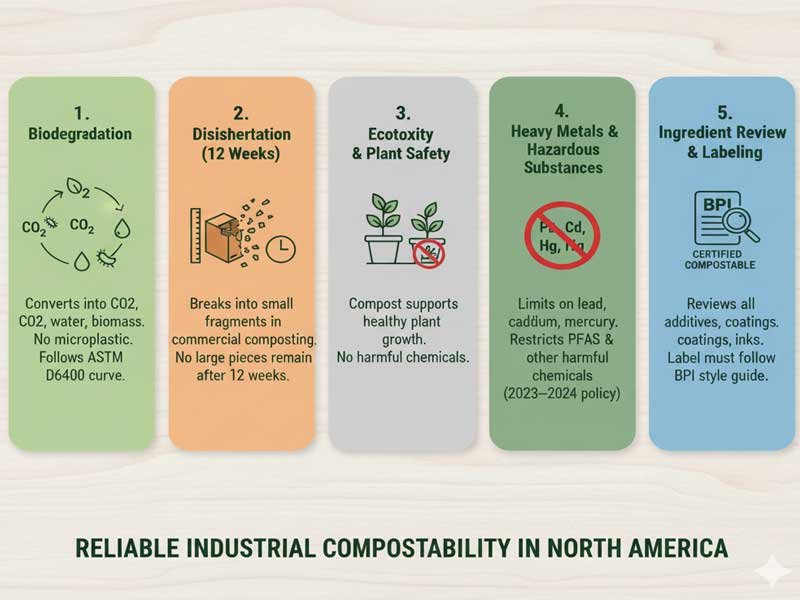
Depending on the product and certification route, the assessment may consider:
- finished-product formulation
- biodegradation
- disintegration
- compost quality
- regulated substances
- thickness or grammage
- labeling and Certification Mark requirements
This is why buyers and product developers should verify the finished product rather than relying only on a compostable resin certificate or a BPI logo shown by a supplier.
BPI vs ASTM D6400: What’s the Difference?
BPI certification and ASTM D6400 are closely related, but they are not the same thing.
| ASTM D6400 | BPI Certification | |
|---|---|---|
| What it is | Technical compostability specification | Third-party certification program |
| Main role | Defines commercial compostability requirements | Evaluates and certifies eligible products |
| Role in BPI | Base assessment standard | Uses ASTM D6400 plus BPI program requirements |
| Public product listing | No ASTM certified-product catalog | BPI Online Product Catalog |
| Certification Mark | No ASTM product certification mark | BPI Certification Mark |
ASTM D6400 provides technical requirements for plastics intended for aerobic composting in municipal or industrial facilities.
BPI uses ASTM D6400 as the base standard for its Commercial Compostability Certification, but passing relevant ASTM testing does not automatically make a product BPI certified.
BPI also applies its own product-eligibility, formulation, labeling and certification-program requirements.
For detailed ASTM requirements, testing and terminology, see our ASTM D6400 compostable standard guide.
What Is ASTM D6868?
ASTM D6868 is a compostability specification for certain end items that incorporate plastics or polymers as coatings or additives with paper and other substrates.
Typical applications may include:
- polymer-coated paper packaging
- fiber-based food-service items with compostable coatings
- certain laminated paper or fiber products
- other eligible paper/polymer composite constructions
Like ASTM D6400, ASTM D6868 relates to products designed for aerobic composting in municipal or industrial facilities.
However, ASTM D6868 should not simply be treated as an alternative name for ASTM D6400.
Within BPI’s Commercial Compostability Certification program, ASTM D6400 is the base assessment standard for all items. ASTM D6868 is an optional additional assessment used for eligible product constructions.
ASTM D6400 vs ASTM D6868: Which One Applies?
The easiest way to understand the difference is to look at the finished product construction.
| Question | ASTM D6400 | ASTM D6868 |
| Main focus | Compostable plastics and plastic products | End items combining polymers with paper or other substrates |
| Typical example | Compostable plastic bag | Polymer-coated paper or fiber packaging |
| Composting environment | Municipal / industrial aerobic composting | Municipal / industrial aerobic composting |
| Role in BPI Commercial Certification | Base assessment standard | Additional assessment for eligible items |
| Does it equal BPI certification? | No | No |
For a compostable plastic bag, ASTM D6400 is normally the key technical standard.
For an eligible paper or fiber item that includes a polymer coating, laminate or additive, ASTM D6868 may also become relevant.
The exact assessment route is determined by the product construction and BPI’s technical review.
Commercial vs Home Compostability in BPI Certification
BPI now offers both Commercial and Home Compostability Certification.
Commercial certification evaluates eligible products for commercial composting conditions and uses ASTM D6400 as its base assessment standard.
BPI Home Compostability Certification is a separate program based on NF T 51-800 and requires commercial certification as a prerequisite.
Therefore:
A product that is BPI commercially certified should not automatically be described as home compostable.
Buyers should check the exact product listing and certification type before making a home-compostability claim.
What Does BPI Review Before Certification?
BPI certification involves more than submitting a single ASTM test report.
Depending on the product, BPI may review:
- product eligibility
- complete formulation information
- applicable ASTM assessment
- thickness or grammage
- regulated metals and fluorine
- disintegration and biodegradation testing
- compost-quality requirements
- finished-product samples
- labeling and Certification Mark requirements
The exact testing program is determined through a product-specific test scheme.
This is one reason two visually similar compostable products may not require exactly the same certification pathway.
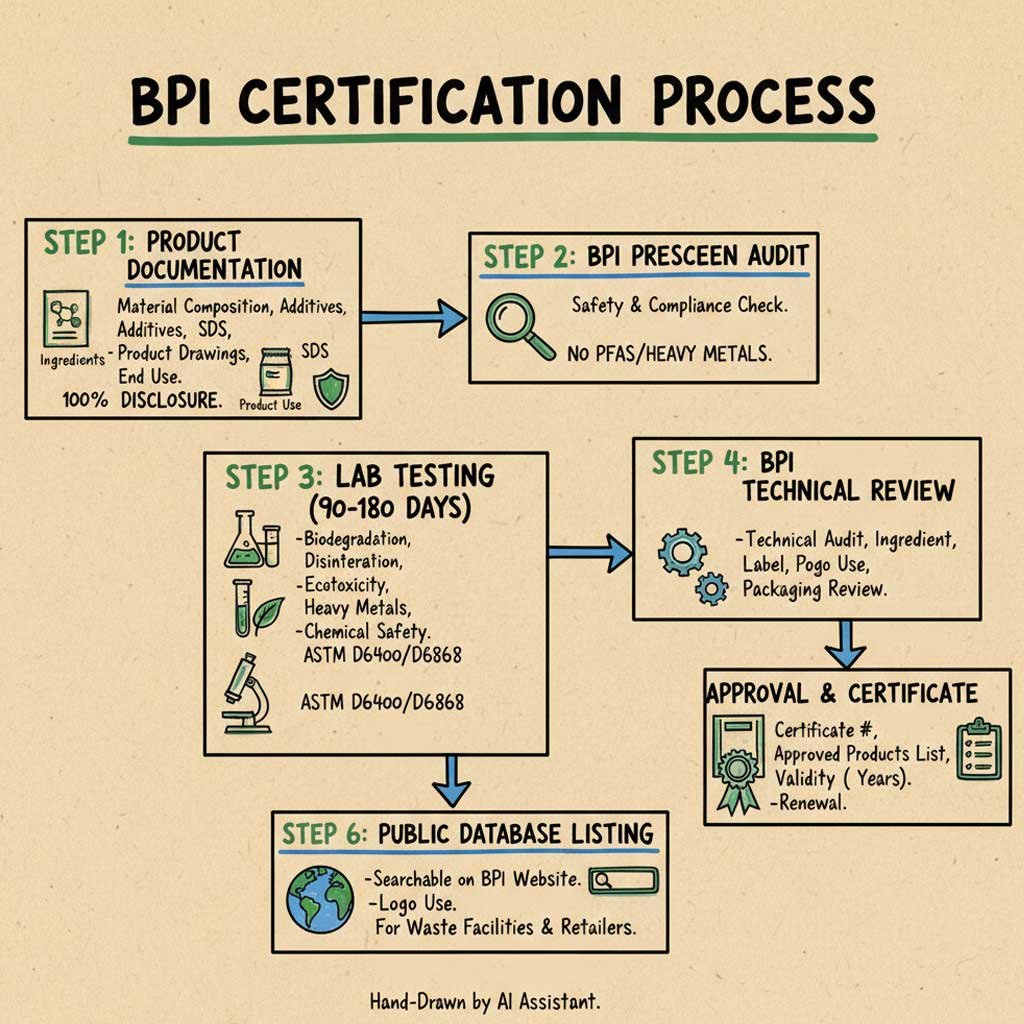
How Does the BPI Certification Process Work?
The certification process depends on the product, formulation and existing test data.
Step 1 — Confirm Product Eligibility
The applicant first determines whether the product is eligible for BPI certification and whether the project requires new certification, modification, recertification or another route.
Step 2 — Submit Product Information
The applicant provides the required product, formulation, manufacturing and supporting documentation.
Step 3 — Receive a Test Scheme
BPI’s technical reviewer evaluates the submitted information and determines which laboratory tests are required for the product.
Step 4 — Complete Required Testing
Required testing is performed by BPI-approved independent laboratories.
Depending on the test scheme, this may include biodegradation, disintegration, compost quality, regulated-substance and other product-specific assessments.
Step 5 — Technical Review
BPI reviews the laboratory results, formulation, verification samples and other required information.
Step 6 — Licensing & Product Listing
After successful technical review and completion of the applicable licensing requirements, certified products can be listed in BPI’s public Online Product Catalog and use the applicable BPI Certification Mark.
The complete certification process can take up to 12 months or longer depending on the required testing, laboratory capacity and applicant readiness.
For companies developing a new compostable product, certification should therefore be considered early in the product-development process rather than after packaging and artwork are already finalized.
How Can Buyers Verify BPI Certification?
BPI maintains a public Online Product Catalog where buyers can search certified companies, products, SKUs and item numbers.
Do not rely only on a supplier-uploaded certificate or logo.
For a detailed verification process—including how to check the company, exact product, SKU and certified scope—see our BPI certification verification page.
Common Misunderstandings About BPI Certification
“BPI certified” means the product biodegrades anywhere.
No.
Certified compostability relates to defined composting environments and conditions. It should not be interpreted as a claim that the product rapidly breaks down in landfills, soil, water or the natural environment.
Commercial BPI certification means home compostable.
Not necessarily.
BPI Commercial and Home Compostability Certifications are separate. Only products carrying the applicable home certification should make the corresponding home-compostability claim.
A company with BPI certification can call all of its products BPI certified.
No.
Certification applies to approved products and configurations. Buyers should check the exact product or SKU.
An ASTM D6400 test report is the same as BPI certification.
No.
ASTM D6400 is a technical standard. BPI certification is a third-party certification program with additional product, testing, eligibility and licensing requirements.
FAQ
BPI compostable generally means that an eligible finished product has been independently evaluated and certified through BPI’s compostability certification program.
Buyers should verify the exact product rather than relying only on a general material claim or supplier logo.
ASTM D6400 focuses on compostable plastics and plastic products.
ASTM D6868 applies to certain end items that incorporate plastics or polymers as coatings or additives with paper and other substrates.
Within BPI commercial certification, ASTM D6400 is the base standard, while ASTM D6868 may be used as an additional assessment for eligible products.
No.
ASTM D6400 compliance and BPI certification are different claims.
BPI certification requires the product to complete BPI’s applicable certification process, including technical review and program requirements.
Start with the finished-product construction.
A compostable plastic product generally falls under ASTM D6400, while an eligible paper or fiber-based product incorporating polymer coatings or additives may also require assessment under ASTM D6868.
The final testing route should be confirmed according to the actual product construction and certification program.
The complete process can take up to 12 months or longer depending on the required test scheme, available laboratory capacity and how quickly the applicant provides the required information.
Testing is often the longest stage.
BPI has a separate Home Compostability Certification program.
Its home certification is based on NF T 51-800 and requires BPI Commercial Certification as a prerequisite.
A commercial BPI certification alone should not automatically be interpreted as home-compostable certification.
Looking for BPI-Certified Compostable Bags?
If your goal is product sourcing rather than certification research, see our BPI certified compostable bags page for available bag formats, customization, private-label development and B2B supply.
For supplier certificate verification, visit our BPI certification verification page.