The word “compostable” is used worldwide, but compostable standards are not the same in every country.
A product that is accepted as compostable in Europe may not be accepted in the United States or Australia. This often causes confusion for buyers sourcing compostable packaging across multiple markets.
This article provides a high-level explanation of how compostable standards work in the EU, US, and Australia—and where to find a detailed comparison when making sourcing decisions.
Why There Is No Single Global Compostable Standard
Compostable standards are designed around local waste systems, not global definitions.
Each region has its own:
- Composting infrastructure
- Regulatory framework
- Acceptance rules for compostable materials
Because of this, the term “compostable” must always be linked to a specific standard, not just a material or marketing claim.
This is why certification logos and standards play a critical role in compostable packaging compliance.
How Compostable Standards Differ by Region
While the goal of composting is similar everywhere, the rules and requirements differ by market.
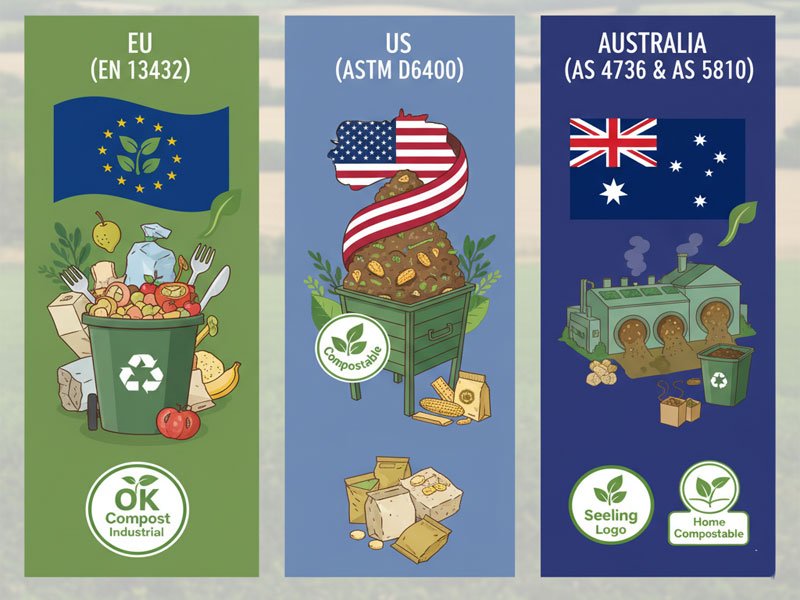
European Union (EU)
In the EU, compostable packaging is typically evaluated under an industrial composting framework. Products must meet defined requirements for biodegradation, disintegration, and compost quality.
United States (US)
In the US, compostable packaging is also linked to industrial composting systems, with standards commonly referenced by certification programs and composting facilities.
Australia (AU)
In Australia, compostable packaging used in organics systems must align with industrial composting requirements, especially in council-led food and garden organics (FOGO) programs.
Because these systems are not identical, standards are not interchangeable.
A Common Buyer Question: Are These Standards Equivalent?
Many buyers ask whether a single compostable product can meet all regional standards.
The short answer is: sometimes—but not always.
Each standard has its own test methods, scope, and acceptance criteria. In some cases, products may carry multiple certifications, but this depends on design, testing, and intended markets.
For this reason, buyers should always evaluate compostable packaging based on the target market, not assumptions about global equivalence.
Where to Find a Detailed Standards Comparison
This blog is intended as a starting point, not a technical reference.
For a side-by-side comparison of the three major compostable standards—covering:
- Market scope
- Composting environment
- Key differences
- Common buyer mistakes
- Guidance on choosing the right standard
See the full comparison here: EN 13432 vs ASTM D6400 vs AS 4736 compostable standards
This page is designed as a long-term reference for buyers sourcing compostable packaging for EU, US, and Australian markets.
Key Takeaways
- Compostable standards are market-specific
- “Compostable” is not a global, universal definition
- Certification standards must match local waste systems
- Buyers should rely on verified standards, not material claims
Understanding these differences early helps avoid compliance issues, rejected products, and re-labeling costs.