Compostable Packaging Compliance Guide for Buyers
Compostable packaging compliance is no longer just about materials — it is about labeling, certification, and real-world application.
Many buyers assume that “compostable” means compliant.
In reality, compliance failures often happen due to:
- incorrect labeling claims
- misunderstanding certification scope
- lack of documentation
- mismatch with local waste systems
For importers, distributors, and brands, these issues can lead to:
- shipment rejection
- regulatory penalties
- product recalls
This guide explains why buyers get into trouble, what risks to avoid, and how to verify compostable packaging before buying.
Why Buyers Get into Trouble with Compostable Packaging
Even experienced buyers face compliance issues when sourcing compostable products.
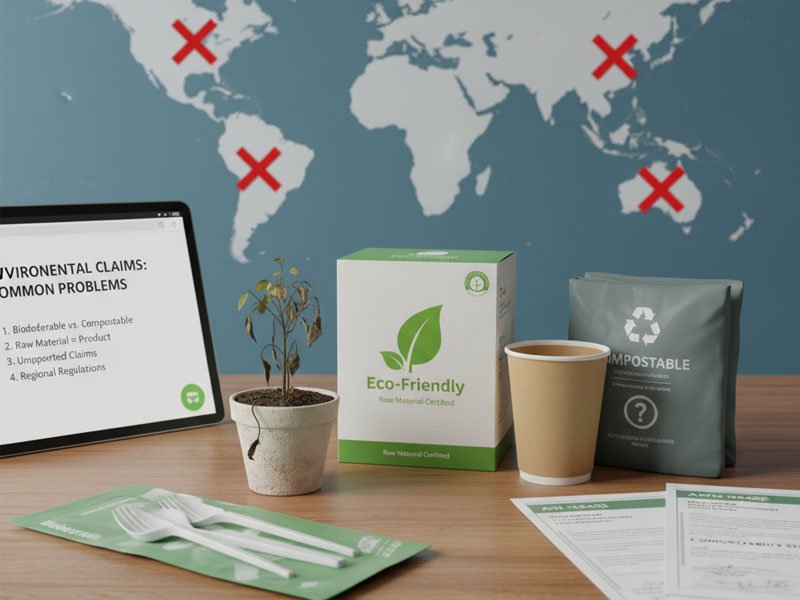
Common problems include:
- Confusing biodegradable vs compostable
- Assuming raw material certification equals product compliance
- Using unsupported environmental claims
- Ignoring country-specific regulations
In regulated markets like the U.S., EU, and Australia, these mistakes can quickly become costly.
Learn more about standards:
3 Common Mistakes Brands Make with Compostable Claims
1. Using unsupported claims
Terms like “eco-friendly” or “biodegradable” are often restricted without proper certification.
2. Misunderstanding certification scope
Some suppliers provide certification for materials only — not the finished product.
This creates serious compliance risks during import or resale.
3. Ignoring local waste systems
Even certified compostable packaging may not be accepted in all regions.
Examples include:
- Industrial vs home composting differences
- Municipal acceptance requirements
How to Verify Compostable Certification Before Buying
Before placing an order, buyers should verify the following:
Certification type
- EN 13432 (EU)
- ASTM D6400 / BPI (USA)
- AS4736 / AS5810 (Australia)
Certification scope
Check whether the certification applies to:
- the final product
- or only raw materials
Supporting documents
Request:
- certification copies
- test reports
- declaration of compliance
Supply consistency
Ensure the supplier can provide:
- stable material supply
- consistent production quality
- traceability for batches
Download full checklist: Compostable Packaging Compliance Checklist (AU, EU, US)
How Regulations Affect Packaging Decisions (US, EU, AU)
United States
- Increasing regulation on compostable labeling
- ASTM D6400 and BPI certification required
- State-level laws (e.g., California, Washington)
Europe
- EN 13432 widely required
- Strong connection to EPR and packaging regulations
Australia
- AS4736 (industrial compostable)
- AS5810 (home compostable)
- Linked with FOGO waste collection programs
Related resources:
Choosing a Reliable Compostable Packaging Supplier
Compliance depends not only on certification, but also on execution.
A reliable supplier should offer:
- verified product-level certification
- consistent thickness and performance
- stable supply capacity
- complete documentation
At ORIZON, we support global buyers with:
- certified compostable materials (PLA + PBAT)
- strict quality control
- documentation for international compliance
Conclusion
Compostable packaging is becoming a global requirement — but compliance is becoming more complex.
Buyers who succeed focus on:
- understanding certification beyond labels
- verifying suppliers carefully
- aligning packaging with local regulations
Making the right decision early helps reduce risk and ensures long-term supply stability.
FAQ
Compostable packaging compliance means meeting certification standards, labeling regulations, and local waste system requirements.
Check certification type, confirm it applies to the final product, and request supporting documents.
EN13432 (EU), ASTM D6400 (USA), and AS4736 / AS5810 (Australia).
Because claims may not match certification scope or local regulations.