Compostable plastics are designed to reduce waste, but only when they are disposed of correctly.
Many people assume that compostable plastics can be thrown into any bin or will naturally break down if discarded. In reality, incorrect disposal can cancel out their environmental benefits and even cause contamination in recycling and waste systems.
This guide explains how to dispose of compostable plastics properly, based on certification rules, real waste infrastructure, and common mistakes—without assumptions.
The 10-Second Rule (Quick Answer)
- Compostable plastics do not belong in recycling bins.
- Most compostable plastics require industrial composting, not home composting.
- If your area has no composting option, follow local guidance—general waste may be the fallback.
To understand why, it helps to first know what compostable actually means.
Quick Disposal Comparison Table
| Disposal Option | Compostable Plastics | Recyclable Plastics | Biodegradable Plastics |
|---|---|---|---|
| Recycling Bin | ❌ No | ✅ Yes | ❌ No |
| Industrial Composting | ✅ Yes (if certified) | ❌ No | ❌ Not defined |
| Home Composting | ⚠️ Only if certified | ❌ No | ❌ Usually no |
| Landfill | ⚠️ Last resort | ⚠️ Sometimes | ⚠️ Often ends here |
| Natural Environment | ❌ Never | ❌ Never | ❌ Never |
Compostable plastics must follow composting rules.
They should not be treated as recyclable or biodegradable by default.
What Does “Compostable” Mean for Disposal?
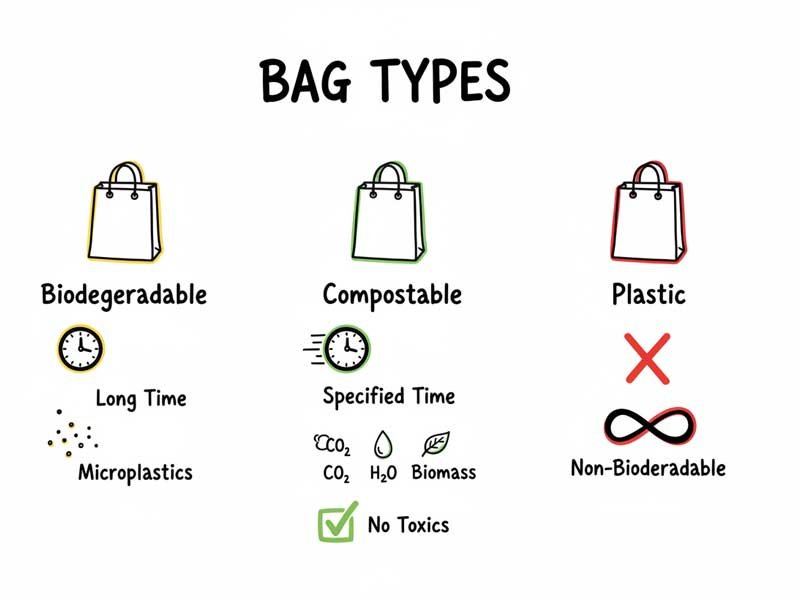
Compostable plastics are materials designed to break down under controlled composting conditions within a defined timeframe, leaving no toxic residue.
For a clear explanation, see our compostable definition.
Most compostable plastics are not designed to break down in landfills, oceans, soil, or recycling systems. Their environmental benefit depends entirely on whether they enter a suitable composting process.
Step-by-Step: How to Dispose of Compostable Plastics
Step 1: Check the Label or Certification
Look for recognized compostable certifications and wording:
- Is the product certified for industrial composting or home composting?
- Avoid vague claims like “eco-friendly” or “biodegradable” without proof.
If a product is only labeled biodegradable, disposal rules may be different. See biodegradable vs compostable for clarification.
Step 2: Check Local Waste Acceptance
Disposal rules depend on local waste infrastructure.
Before disposing:
- Check your local council or municipal waste website
- Confirm whether compostable plastics are accepted in organics or food waste streams
- Look for composting programs or drop-off locations
A compostable product is only effective if your local system can process it.
Step 3: Use the Correct Disposal Stream
Choose the correct option based on certification and local availability:
- Industrial composting (best option, when available)
- Home composting (only if explicitly certified)
- General waste (fallback when composting is not available)
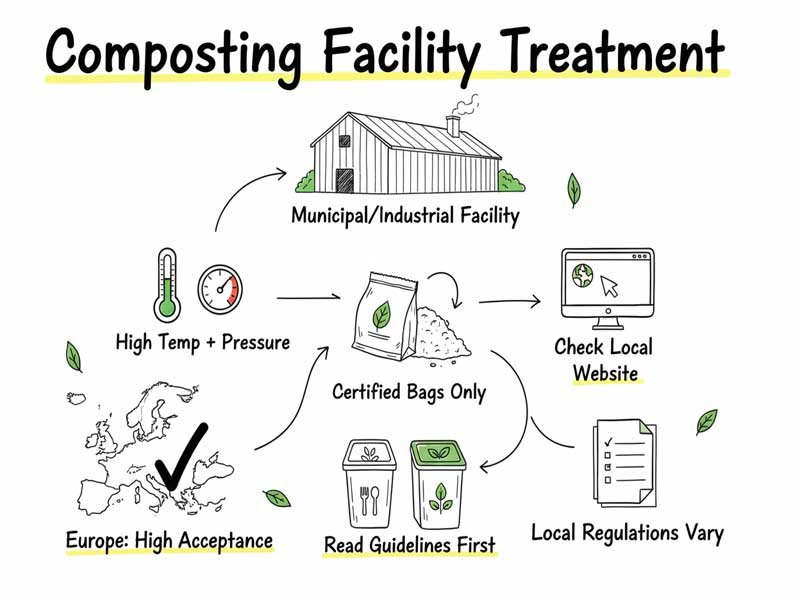
Where Compostable Plastics Should Go
Industrial Composting Facilities (Best Option)
Most compostable plastics are designed for industrial composting facilities.
These facilities provide:
- High, stable temperatures
- Controlled humidity
- Active microbial environments
Under these conditions, certified compostable plastics can fully decompose within the required timeframe.
If your area offers food waste, organics, or FOGO collection, this is usually the correct destination.
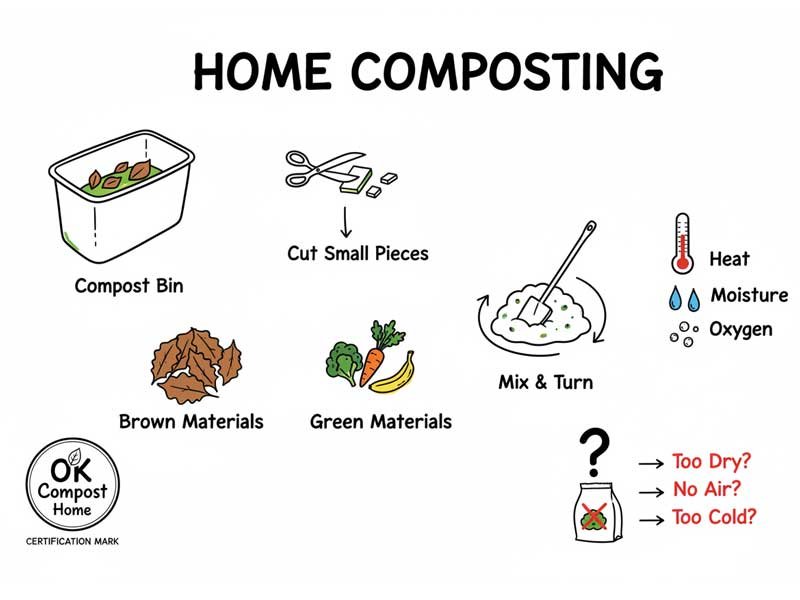
Home Composting (Only If Certified)
Only products explicitly certified for home composting should be placed in home compost bins.
Examples of home compostable standards include:
- AS 5810
- OK Compost HOME
If a product is only labeled industrial compostable, it should not be home composted.
Learn more here:
Where Compostable Plastics Should NOT Go
Recycling Bins
Compostable plastics should never be placed in recycling bins.
They are chemically different from conventional plastics and can contaminate recycling streams, causing entire batches to be rejected.
Compostable does not mean recyclable.
Natural Environments
Compostable plastics are not designed to break down in nature.
They should never be thrown into:
- Soil or gardens
- Rivers or oceans
- Parks or open environments
Even compostable plastics require managed composting systems to break down properly.
Landfill (When Avoidable)
If composting is available, landfill should be avoided.
In landfills:
- Decomposition is slow or incomplete
- Some compostable plastics may produce methane
- Environmental benefits are largely lost
Landfill is a last resort, not a preferred option.
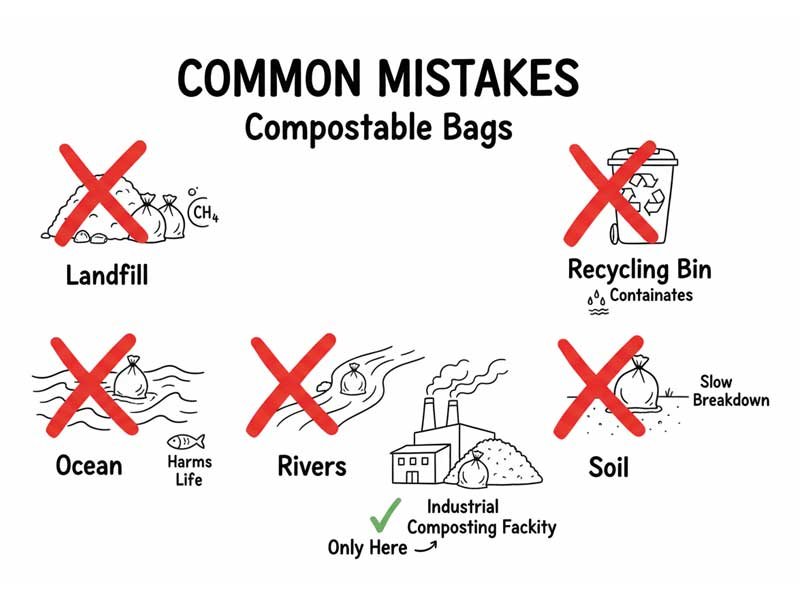
Common Compostable Plastic Disposal Mistakes
Do not assume:
- Compostable plastics break down naturally in soil or oceans
- Compostable plastics belong in recycling bins
- All compostable plastics are home compostable
- Certification guarantees acceptance everywhere
Do:
- Check certification labels
- Follow local waste rules
- Use composting systems only when available
- Treat compostable plastics as general waste when no composting exists
Incorrect disposal causes contamination and undermines composting systems.
Why Recycling Facilities Reject Compostable Plastics
Recycling systems are engineered to process specific plastic polymers.
Compostable plastics differ in melting point, density, and chemical behavior from recyclable plastics such as PET or HDPE.
During recycling, compostable plastics cannot be reliably identified or separated and may degrade during processing.
Even small amounts of compostable plastic can contaminate an entire recycling batch, leading to material rejection and economic loss.
For this reason, recycling facilities explicitly prohibit compostable plastics.
How to Identify Genuine Compostable Plastics
To avoid confusion:
- Look for recognized compostable certification marks
- Check whether the product is industrial or home compostable
- Avoid products that rely only on vague biodegradable claims
Clear labeling and certification are essential for proper disposal and system acceptance.
What If My Area Doesn’t Accept Compostable Plastics?
This is a common situation.
If your area does not have:
- Industrial composting facilities
- Organics or food waste collection
- Certified home composting capability
Then follow local guidance. In many cases, general waste may be the only option.
While this reduces environmental benefits, incorrect disposal into recycling or nature causes more harm.
How Disposal Rules Differ by Region
Compostable plastic disposal rules are not universal. They depend on local infrastructure, regulations, and collection systems.
United States
In the U.S., most compostable plastics are accepted only where industrial composting or food waste programs exist.
BPI certification is commonly required, and acceptance varies by city and state.
European Union
In the EU, compostable plastics are typically governed by EN 13432 standards.
Some countries accept certified compostable plastics in organic waste streams, while others prohibit them entirely.
Australia
In Australia, compostable plastics may be accepted in FOGO or organics systems if they meet AS 4736 or AS 5810 standards.
Local council rules always take priority.
Always follow local guidance—even certified products may be rejected if infrastructure is not available.
Compostable Plastics vs Compostable Bags
Compostable bags are a subset of compostable plastics.
They follow the same disposal rules:
- Industrial composting when available
- Home composting only if certified
- Never recycling
Compostable bags are commonly used with food waste and organics collection, but acceptance still depends on local systems.
FAQ
Can compostable plastics go in recycling bins?
No. Compostable plastics contaminate recycling streams and should not be recycled.
Are compostable plastics home compostable?
Not always. Only products certified for home composting should be used in home compost bins.
Do compostable plastics break down in landfills?
Not reliably. Landfill conditions are not designed for composting.
How do I know if a product is truly compostable?
Check for recognized compostable certifications and clear labeling.
Is disposal different for biodegradable plastics?
Yes. Biodegradable and compostable materials follow different rules. See biodegradable vs compostable.
Disposal Guidance for Brands and Buyers
For brands, retailers, and procurement teams, proper disposal guidance is as important as material selection.
If you supply compostable plastics:
- Clearly label disposal instructions
- Specify industrial vs home composting
- Align claims with local waste systems
- Avoid vague biodegradable language
Clear disposal communication reduces contamination, compliance risk, and consumer confusion.
Conclusion:The Right Way to Dispose of Compostable Plastics
- Use industrial composting whenever available
- Home compost only if explicitly certified
- Never place compostable plastics in recycling bins
- Avoid littering or natural disposal
- Always follow local waste guidelines
Correct disposal—not just material choice—is what makes compostable plastics effective.
Final Note
Compostable plastics are not a magic solution. They work only when matched with the right disposal system.
Understanding how to dispose of compostable plastics properly helps protect waste infrastructure, reduce contamination, and ensure that environmental claims deliver real results.