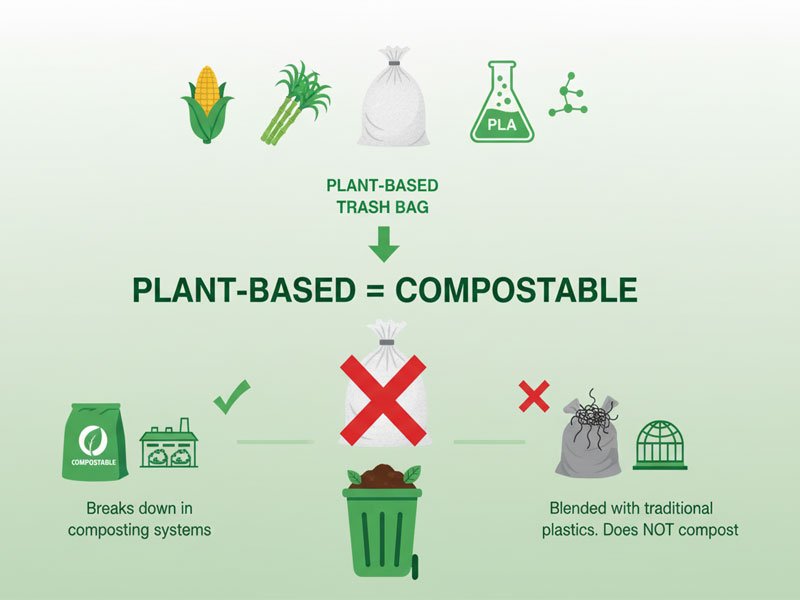
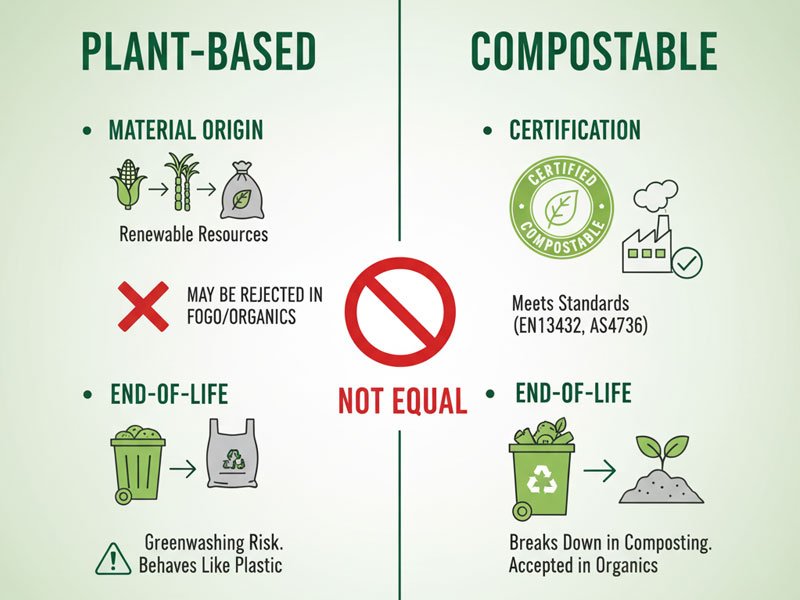
Plant-based and compostable are not the same thing.
“Plant-based” mainly describes where some or all of a material comes from.
“Compostable” describes how a finished product is designed to break down under defined composting conditions.
This difference matters when choosing trash bags.
A bag may contain plant-derived materials but still not be compostable. A certified compostable bag may also contain compostable polymers that are not entirely made from plants.
The practical rule is simple:
If material origin matters, check the actual bio-based content. If compostability matters, check the finished product and its applicable compostability certification.
Last updated: October 5, 2026
What Does “Plant-Based” Mean?
A plant-based material is made partly or fully from renewable biological feedstocks.
Examples can include materials derived from:
- corn;
- sugarcane;
- cassava;
- starch;
- other renewable biomass.
PLA, or polylactic acid, is one example of a polymer that can be made from renewable plant-based feedstocks.
Starch is another common plant-derived component used in some compostable film formulations.
However, the term plant-based does not tell you what happens to the finished bag after use.
A plant-derived polymer may be:
- compostable;
- biodegradable under certain conditions;
- recyclable;
- or neither compostable nor biodegradable.
Material origin and end-of-life performance are two separate questions.
What Does “Compostable” Mean?
A compostable trash bag is designed to break down under specified composting conditions and meet defined performance requirements.
For a certified compostable product, this may involve testing for factors such as:
- biodegradation;
- disintegration;
- limits on certain heavy metals;
- effects on compost quality;
- ecotoxicity.
The exact requirements depend on the applicable standard and certification program.
Common standards include:
- ASTM D6400;
- EN 13432;
- AS 4736;
- AS 5810;
- industrial and home-compostability certification programs.
A product should not be called certified compostable only because one ingredient is biodegradable.
The finished bag specification matters.
Plant-Based vs Compostable Trash Bags: Key Differences
| Question | Plant-Based Trash Bag | Compostable Trash Bag |
|---|---|---|
| What does the term describe? | Material or feedstock origin | End-of-life performance |
| Does it contain renewable material? | Usually partly or fully | Not necessarily 100% |
| Is it automatically compostable? | No | Designed for defined composting conditions |
| Is it automatically biodegradable? | No | Biodegradation is part of compostability requirements |
| Is it automatically home compostable? | No | Only where specifically suitable/certified |
| Can it contain fossil-derived polymers? | Depends on formulation | Yes, some compostable formulations can |
| Is compostability certification implied? | No | Certification may be used to substantiate the claim |
| Does “plant-based” prove disposal performance? | No | No—specific certification and conditions still matter |
The biggest mistake is treating these two labels as synonyms.
They describe different product characteristics.
Are Plant-Based Trash Bags Always Compostable?
No.
A trash bag can be made partly from renewable feedstocks and still behave much like conventional plastic at the end of its life.
One example is bio-based polyethylene.
It can be made using renewable feedstocks, but its basic polymer structure is still polyethylene. That does not make it compostable.
This is why a claim such as:
“Made from plants”
does not answer:
“Can this bag go into a composting system?”
You need more information.
Check the actual material, finished-product specification, and any relevant compostability certification.
Are Compostable Trash Bags Always 100% Plant-Based?
No.
A compostable product does not have to be made entirely from renewable plant feedstocks.
Some compostable film formulations combine plant-derived materials such as PLA or starch with other biodegradable compostable polymers.
The important point is:
Compostability is about finished-product performance, not simply the source of every ingredient.
This is why “100% plant-based” and “certified compostable” should not be used as interchangeable claims.
Is PBAT Plant-Based?
Usually, conventional PBAT should not be described as plant-based.
PBAT stands for polybutylene adipate terephthalate.
It is a flexible biodegradable polyester commonly used in compostable films because it can improve properties such as:
- flexibility;
- toughness;
- tear performance;
- film processing.
Conventional commercial PBAT is generally made from fossil-derived feedstocks, although bio-based production routes also exist.
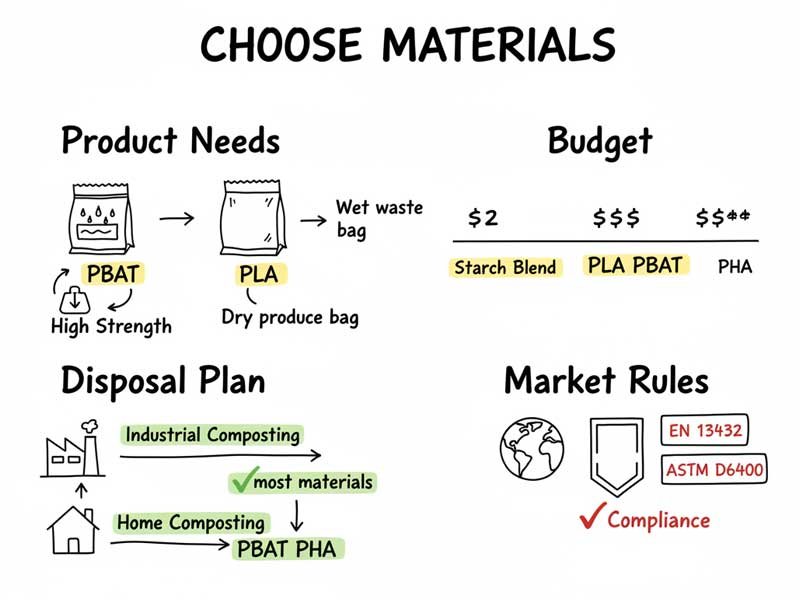
For this reason, a trash bag made from a PLA/PBAT/starch formulation should not automatically be described as:
100% plant-based
unless its actual bio-based content has been measured or otherwise verified.
A more accurate description is often:
a compostable formulation containing plant-derived components
when that is supported by the actual formulation.
Why Are PLA, PBAT and Starch Often Used Together?
Each material can contribute different properties.
PLA
PLA can be derived from renewable feedstocks and can add stiffness to a compostable formulation.
PBAT
PBAT is flexible and is often used to improve toughness and film handling.
Starch-Based Components
Starch may add renewable-content material and can form part of certain compostable blends.
The final film is designed around the required balance of:
- strength;
- flexibility;
- processing;
- thickness;
- sealing;
- compostability performance.
For buyers, the key point is not simply the ingredient list.
The finished bag should meet the required performance and certification needs.
Plant-Based vs Biodegradable vs Compostable
These three terms are often mixed together, but they answer different questions.
| Term | What It Mainly Describes |
|---|---|
| Plant-based | Where some or all of the feedstock comes from |
| Biodegradable | Ability to be broken down biologically under certain conditions |
| Compostable | Biodegradation and disintegration under defined composting conditions and performance criteria |
A product can be plant-based without being compostable.
A product can be biodegradable without meeting a recognized compostability standard.
And a compostable product does not have to be 100% plant-derived.
This is why buyers should avoid judging a bag from one environmental claim alone.
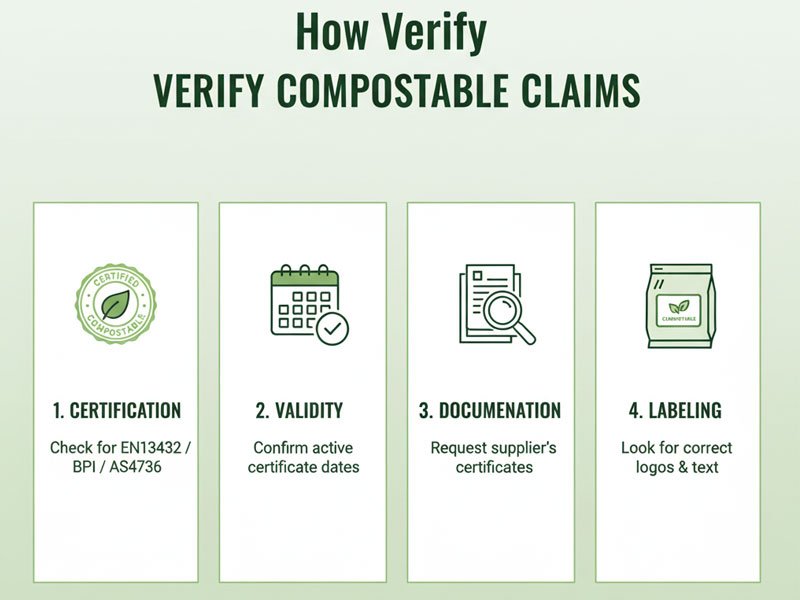
How Can You Verify a Compostable Trash Bag?
Start with the finished product.
Do not stop at the raw material.
Check the Applicable Standard
Ask which standard the product is intended to meet.
For example:
- ASTM D6400;
- EN 13432;
- AS 4736;
- AS 5810.
Check the Certificate Scope
A certificate should be reviewed to see what it actually covers.
Important variables may include:
- formulation;
- thickness;
- film color;
- printing;
- additives;
- bag construction.
Check the Finished Bag
A certified resin does not automatically mean every finished bag made from that resin is covered.
Printing, masterbatch, thickness, adhesive, or other changes can affect the finished specification.
Check the Composting Environment
Industrial compostability and home compostability are not the same.
A product suitable for an industrial composting facility should not automatically be assumed to be home compostable.
Check Local Acceptance
Even a certified compostable bag may not be accepted by every local composting program.
Collection rules differ.
For ORIZON factory and certification information, see: Manufacturer & Certification Verification Center
What Should B2B Buyers Ask a Supplier?
For bulk purchasing, “plant-based” is too broad a specification by itself.
Ask more specific questions.
1. What part of the formulation is bio-based?
Do not assume the whole film comes from plants.
2. Which ingredients are plant-derived?
Ask whether renewable-content materials include PLA, starch, or other components.
3. Does the formulation contain PBAT?
If yes, ask how the supplier describes its feedstock origin.
4. Is the finished bag certified compostable?
A raw-material certificate is not the same as finished-product coverage.
5. Is the bag industrial or home compostable?
These are different claims.
6. Does the certification cover the required thickness, color and print?
A custom bag may differ from the originally tested configuration.
7. Will the target waste system accept the bag?
Certification and local acceptance should be checked separately.
For B2B procurement, these questions are more useful than asking only:
“Is it plant-based?”
Which Claim Should Buyers Prioritize?
That depends on the project.
If Renewable Content Is the Priority
Ask for information about:
- bio-based content;
- plant-derived feedstocks;
- formulation.
If Compostability Is the Priority
Ask for:
- the applicable compostability standard;
- finished-product certificate;
- certificate scope;
- intended composting environment.
If Both Matter
Specify both separately.
For example:
“We require a certified compostable trash bag and also want to understand the percentage of renewable bio-based content.”
That is much clearer than asking for a “plant-based compostable bag.”
For OEM or wholesale projects, review our compostable trash bag manufacturing options and specify bio-based content separately if it is part of your sourcing requirement.
Can Plant-Based Trash Bags Go in Home Compost?
Not automatically.
A plant-based claim alone tells you nothing about home-composting performance.
A bag should only be treated as suitable for home composting when the product is specifically designed and, where applicable, certified for that environment.
Industrial composting and home composting operate under different conditions.
Temperature, moisture, microbial activity, and process control can all differ.
Do Compostable Trash Bags Break Down in Landfill?
Compostable certification is based on defined composting conditions.
A landfill is not the same environment.
Conditions may be:
- oxygen-limited;
- dry;
- compacted;
- biologically different from a managed composting system.
For that reason, buyers should not assume that a compostable bag will rapidly break down in landfill simply because it carries a compostability certification.
Compostable products work best when there is an appropriate collection and composting route.
FAQ
Are plant-based trash bags compostable?
Not necessarily.
Plant-based describes material origin, while compostable describes end-of-life performance under defined conditions. A plant-based bag needs separate evidence if compostability is being claimed.
Are compostable trash bags 100% plant-based?
Not always.
Certified compostable formulations may include plant-derived materials as well as other compostable polymers.
Is PBAT plant-based?
Conventional PBAT is generally made from fossil-derived feedstocks, although bio-based production routes exist. It is better described as a biodegradable compostable polyester rather than automatically calling it plant-based.
Are plant-based trash bags biodegradable?
Some may be, but plant-based content alone does not prove biodegradability or compostability.
Always check the actual material and finished-product claims.
Can plant-based trash bags go in home compost?
Only if the finished product is specifically suitable for home composting.
A generic plant-based claim is not enough.
Do compostable trash bags break down in landfill?
Compostable certification does not guarantee rapid breakdown in landfill. Composting standards are based on specific composting conditions.
Conclusion
The simplest way to understand the difference is:
Plant-based describes where the material comes from.
Compostable describes how the finished product is designed to behave at the end of its life.
They are related concepts, but they are not the same.
For B2B sourcing, treat bio-based content and compostability as two separate specifications.
If compostability matters, check the finished product, the applicable standard, and the certificate scope.
If renewable content matters, ask for information about the actual formulation and verified bio-based content.
Looking for Custom Compostable Trash Bags?
ORIZON manufactures custom compostable trash bags for B2B, OEM, and private-label programs.
Custom size, thickness, color, printing, roll configuration, and packaging are available.