AS4736 Certification (Industrial Compostable Standard)

Table of Contents

询盘表单

When you look for true industrial compostable products, you may see the term AS4736 Certification. This standard tells you that a material can break down in a commercial composting facility safely and without leaving harmful waste. In this article, I explain what the AS4736 standard means, how it works, and how you can check if a compostable bag or package is really certified.

AS4736 Certification

What Is AS4736 Certification?

AS 4736:2006 is the Australian standard for industrial compostable plastics. It applies to materials such as compostable bags, food waste bags, films, and other certified compostable packaging.

The standard’s goal is simple:

to ensure that compostable products decompose safely and in a controlled manner in commercial composting facilities.

Products that pass comprehensive testing will be approved by accreditation bodies such as the Australian Bioplastics Association (ABA). These products may also bear the “Seedling Logo,” used in Australia and New Zealand to indicate that a product is industrially compostable.

If a product is certified under AS4736, it means that it is not only biodegradable but also tested and verified to be environmentally safe.

If you want to understand how AS4736 compares with AS5810, you can read our full guide on AS5810 vs AS4736. It explains the key differences between industrial and home compostable standards, so you can choose the right option for your products and waste programs.

Requirements of the AS4736 Standard

The test requirements for AS4736 are detailed and strict. Here is what a product must show to be certified:

Biodegradation (About 90% Within 180 Days)

The material must break down into carbon dioxide, water, and biomass.
In industrial composting, this must happen at a high temperature (around 50–60°C). Most certified materials meet about 90% biodegradation within 180 days under these controlled compost conditions.

Disintegration (No Visible Plastic Left After 12 Weeks)

The product must fall apart during composting.
After 12 weeks in a commercial compost facility, no large pieces should remain. Most of the particles must be smaller than 2 mm, so they do not harm the final compost.

Ecotoxicity and Plant Safety Tests

The compost made from the material must support plant growth.
Tests check if plants, soil, or even earthworms are harmed. AS4736 certified products must show no toxic effects.

Heavy Metal and Hazardous Substance Limits

The product must stay under strict limits for heavy metals like lead, cadmium, or mercury.
These limits keep the compost safe for soil and agriculture.

Organic Content Requirements

Most AS4736 certified materials contain a high percentage of organic or bio-based carbon.
This supports composting and makes sure the product will not leave microplastic residue.

These requirements set AS4736 apart from basic “biodegradable” claims. The certification gives proof through real tests—not marketing words.

AS4736 Certification Process

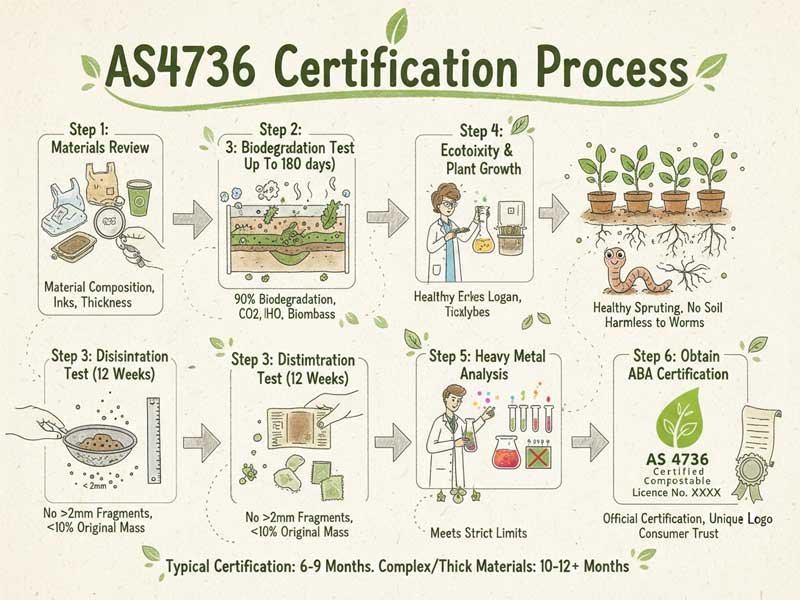
AS4736 Certification Process: How Industrial Compostable Products Get Approved

The certification process for AS 4736 ensures that compostable plastics and packaging materials meet strict biodegradation and eco-safety requirements.

Here is how the full certification workflow typically works:

Step 1 — Material & Product Review (Pre-Assessment)

The accredited laboratory reviews:

  • material composition

  • polymer blend or bio-based resin formula

  • ink and colorant ingredients

  • thickness and structure

  • multi-layer film combinations

This stage identifies potential risks early (e.g., non-compostable additives).

Step 2 — Biodegradation Testing (Up to 180 Days)

The product is tested under controlled industrial composting conditions at 50–60°C, simulating commercial composting systems.

To pass, the material must:

  • reach approximately 90% biodegradation,

  • convert into CO₂, water, and biomass,

  • leave no persistent microplastic residue.

Step 3 — Disintegration Testing (12 Weeks)

The product must physically fall apart in composting conditions.

Requirements:

  • no visible fragments >2 mm

  • fewer than 10% of original mass remaining

This ensures safe integration into compost heaps.

Step 4 — Ecotoxicity & Plant Growth Tests

Laboratories analyze the composted material to ensure:

  • healthy plant germination

  • no soil toxicity

  • no harmful effects on earthworms or soil microbiology

This guarantees the compost remains environmentally safe.

Step 5 — Heavy Metals & Hazardous Substances Analysis

Testing confirms compliance with strict limits for:

  • lead

  • cadmium

  • mercury

  • nickel

  • chromium

  • cobalt

This prevents contamination in agricultural soils.

Step 6 — Accreditation by ABA (Australian Bioplastics Association)

Once all tests pass:

  • The company receives an official AS4736 certificate

  • A unique Seedling Logo license number

  • Permission to apply the certified industrial compostable mark on packaging

This stage ensures traceability and consumer trust.

Typical Certification Timeline

Most certifications require:

  • 6–9 months for full biodegradation + disintegration tests

  • Additional time for multi-layer structures or retesting

Complex or thick materials may need 10–12 months.

AS4736 Certification Costs: What Businesses Should Expect

The cost of AS 4736 certification varies depending on product type, layers, additives, and testing complexity. Below is a typical cost structure.

Cost ItemDescriptionTypical Range (AUD)
Application FeeDocumentation review / formula assessment$300 – $1,000
Laboratory TestingBiodegradation, disintegration, ecotoxicity$7,000 – $15,000+
Ink / Adhesive TestingRequired for printed or coated materials$500 – $2,000
Additional RetestingIf samples fail or require reformulation$1,000 – $5,000
Seedling Logo License FeeAnnual certification mark usage$500 – $2,000 / year
Renewal Fee (every 3–5 years)Reassessment & extended certificationSimilar to initial testing

Factors that increase cost:

  • thicker films
  • multi-layer laminates
  • specialty barrier coatings
  • complex color printing
  • large SKU ranges needing separate certifications

Providing a clear cost breakdown increases trust and improves B2B conversion.

Why AS4736 Matters for Your Business

If you work with food waste programs, retail packaging, or municipal collection, you may already know how important industrial compostable standards are. AS4736 Certification helps you in several ways:

1. It Meets Australian Regulatory Needs

Many regions in Australia accept only AS4736 industrial compostable packaging for organic waste programs. Having this certification helps you meet compliance rules and avoid penalties.

2. It Is Accepted in Commercial Composting Facilities

A product with AS4736 approval is designed specifically for commercial composting systems used by councils and waste companies.
This helps reduce landfill waste and supports real recycling through composting.

3. It Reduces Plastic Waste

Certified industrial compostable materials help lower the amount of plastic going into soil and ocean environments.

4. It Builds Trust

When your customers see the certificate or Seedling Logo, they know you are using verified and safe compostable materials—not untested “greenwashed” products.

Compostable Eco Friendly Plastic Bags Wholesale

Industries and Applications That Require or Prefer AS4736 Certified Compostable Packaging

AS 4736 industrial compostable certification is essential across industries where organic waste is collected and processed in commercial composting systems.

1. Municipal FOGO Programs (Food Organics & Garden Organics)

Councils rely on AS 4736 certified:

  • compostable bin liners

  • food scrap bags

  • organics collection bags

to prevent contamination in composting facilities.

2. Retail & Supermarkets (Woolworths, Coles, Aldi)

Large retailers frequently require:

  • AS4736 certified produce bags

  • compostable checkout bags

  • certified food packaging

  • compostable film wrappers

This ensures compliance with sustainability guidelines.

3. Food Service & Commercial Kitchens

Restaurants, cafés, catering, and QSR chains use AS4736 certified:

  • compostable food waste bags

  • takeaway packaging

  • compostable tableware

Certified packaging helps them align with zero-waste initiatives.

4. Organics Recycling Companies & Composting Facilities

Compost operators prefer verified compostable bags to reduce contamination rates.

5. Waste Management Companies

Collection services must ensure bag integrity and proper disintegration in industrial compost environments.

6. Sustainable E-commerce & Packaging Brands

Brands using compostable mailers and packaging films rely on AS 4736 certification to:

  • avoid greenwashing claims
  • meet eco-packaging guidelines
  • ensure compostability claims withstand audits
AS4736 Fits Into Australia’s Compostable Packaging

How AS4736 Fits Into Australia’s Compostable Packaging Laws and Organics Recycling Programs

AS 4736 certification is more than a technical compostability standard—
it is deeply connected to Australia’s national sustainability targets, organics recycling programs, and waste regulations.

Understanding this regulatory framework helps businesses stay compliant while choosing certified industrial compostable packaging that meets council and retailer requirements.

AS4736 and the National Packaging Targets (2025 & Beyond)

Australia’s 2025 National Packaging Targets promote:

  • increased use of compostable packaging,

  • reduction of contamination in organics recycling streams,

  • improved circular economy outcomes.

Under these guidelines, compostable packaging must be certified to AS 4736 before brands can claim it is industrially compostable or commercial composting–approved.

Without certification, compostable claims may be considered misleading under Australian Consumer Law.

Role of AS4736 in APCO (Australian Packaging Covenant Organisation) Requirements

APCO encourages businesses to use verified compostable materials when packaging is unsuitable for recycling (e.g., food-contaminated items).

AS4736 certification supports APCO compliance because it ensures:

  • the packaging breaks down safely in commercial composting systems,

  • there is no heavy metal contamination,

  • all organic waste bags used for FOGO or industrial composting meet environmental safety standards.

AS4736 and FOGO (Food Organics & Garden Organics) Programs

Across Australia, councils increasingly rely on FOGO systems to divert food and organic waste away from landfill.

Most councils require:

✔ AS4736-certified bin liners
✔ AS4736-certified compostable waste bags
✔ AS4736-compliant compostable packaging

This ensures the waste stream stays free from non-compostable plastics.

Legal & Compliance Implications

If a company markets packaging as “compostable” in Australia without valid AS4736 certification, it risks:

  • failing retailer sustainability audits

  • rejection from municipal compost programs

  • penalties for misleading environmental claims

  • contributing to contamination issues in composting facilities

This is why AS4736 is not just recommended—it is the recognized industrial compostable compliance standard for the Australian and New Zealand markets.

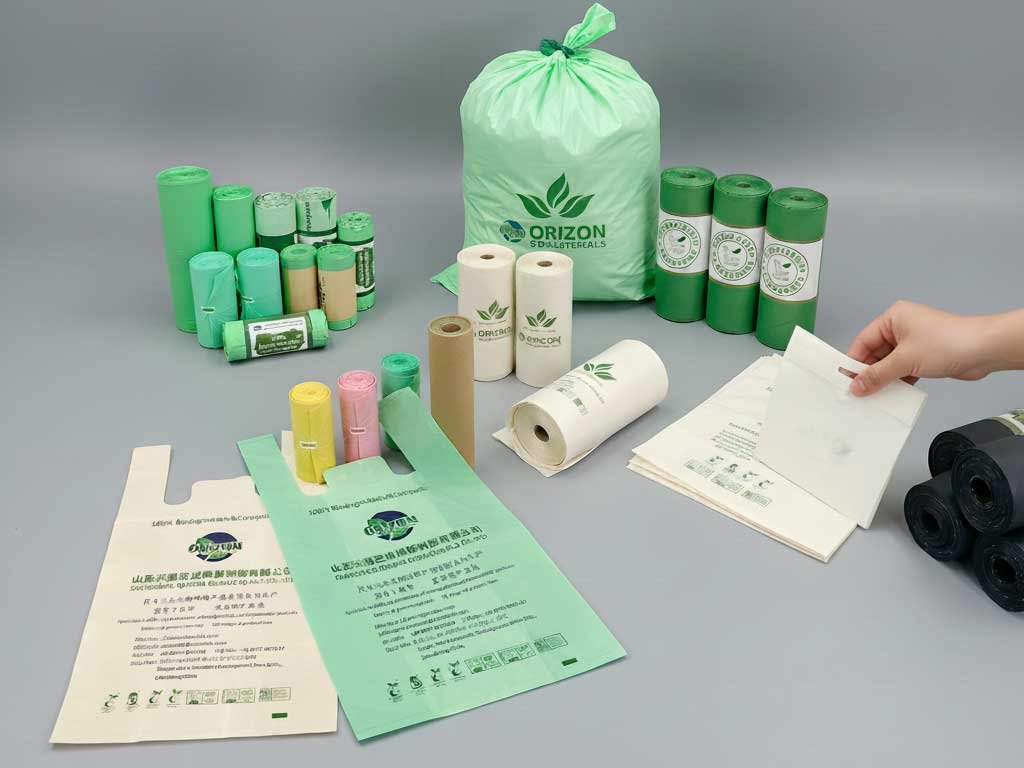
Best Compostable Trash Bags of different sizes

Our AS4736 Certified Products

We offer industrial compostable products that meet the full AS4736 certification requirements. Each item below connects to a real certificate number so you can check and confirm compliance.

Product NameSpecificationMaterialCertificate No.Download
Compostable Waste Bag10L compostable bin liners / 20L compostable bin liners / 30L  compostable bin linersPlant-based resinAS4736-ABAP10126PDF
Compostable Shopping Bag30×50 cm / 35×60 cmCompostable blendAS4736-ABAP10126PDF
Compostable Packaging FilmCustom sizesBio-polymer filmAS4736-ABAP10126PDF

If you need the full reports or Seedling Logo use approval, I can share the documents with you.

How to Verify AS4736 Certified Products

Many people on consumer forums and social media talk about “fake compostable bags.” I have seen this problem too. Some bags claim to be “biodegradable,” yet they do not meet any real compostable standard.

Here is what you can check:

1. Look for the Exact Certificate Number

A real AS4736 certified product will show a clear certificate ID.
You can ask the supplier for the document and check if the product name matches.

2. Check the Seedling Logo Authorization

The Seedling Logo should include a license number.
If a product prints the logo without a number, it may not be approved.

3. Confirm the Supplier Name on the Certificate

The manufacturer on the certificate should match the company selling the product.
If the names do not match, ask for clarification.

4. Avoid Common Greenwashing Claims

Here are red flags:

  • “Biodegradable” with no certificate

  • No testing information

  • No report on heavy metal limits

  • No composting instructions

A real AS4736 certificate solves these problems because the product has already passed strict industrial compostable testing.

Typical Failure Scenarios During AS4736 Testing (and How to Avoid Them)

1. Film Too Thick to Disintegrate in 12 Weeks

  • Disintegration test fails due to slow fragmentation

  • Solution: reduce thickness or adjust polymer blend

2. Ink or Pigment Contains Non-Compliant Metals

  • Heavy metal test exceeds limits due to colored printing

  • Solution: switch to certified compostable ink systems

3. Multi-Layer Structure Contains Non-Compostable Barrier

  • Barrier layer does not biodegrade

  • Solution: use compostable barrier coatings

4. Additives Not Disclosed

  • Certification delayed due to missing material safety data

  • Solution: ensure full SDS and ingredient disclosure

AS5810 vs AS4736
AS5810 vs AS4736

AS4736 vs AS5810 (Industrial vs Home Compostable)

Many people ask how AS4736 compares to AS5810, which is a home compostable standard.

Here is a simple comparison:

CriteriaAS4736AS5810
Compost EnvironmentIndustrial facilityHome compost bin
Temperature~50–60°C~20–30°C
Time to Break DownAbout 180 daysSlower
LogoSeedling LogoHome Compostable Logo
Typical UseWaste bags, packagingLight bags, small items

If you need a product for home composting, look for AS5810.
If your product is going to a municipal or commercial compost site, AS4736 is the right standard.

Download AS4736 Certificates

You can download the full certification documents here:

  • AS4736 Certificate (PDF)

  • Test Report (PDF)

  • Seedling Logo License (PDF)

If you need extra information for compliance checks or tenders, I can provide the full package.

AS4736 Certified vs Non-Certified Compostable Packaging: Key Differences and Risks

CriteriaAS4736 CertifiedNon-Certified “Compostable”
Scientifically tested✔ Yes❌ No
Acceptable in FOGO programs✔ Required❌ Often rejected
Composting performance proven✔ Verified❌ Not guaranteed
Legal protection for environmental claims✔ Compliant❌ High greenwashing risk
Traceable certificate✔ Unique ID❌ None
Accepted by composting facilities✔ High acceptance❌ Low acceptance

Business risks of non-certified compostable products

Non-certified products can lead to:

  • rejection by councils and waste collectors

  • contamination of compost streams

  • fines or legal issues for misleading claims

  • failed retailer sustainability audits

  • damage to brand reputation

For the Australian market, AS4736 is the official benchmark of credible compostability.

Limitations of AS4736 Certified Products in Real Composting Systems

Even if a product meets AS 4736 requirements, real-world composting conditions may vary:

  • Some industrial composters run shorter cycles than laboratory tests

  • Composting temperatures may not always stay at 50–60°C

  • Items with thicker sections may break down more slowly

  • Contamination tolerance differs between facilities

  • Councils may require additional labeling such as “FOGO-approved”

This helps manage customer expectations realistically.

FAQ About AS4736 Certification

What does AS4736 certified mean?

It means the product passed industrial compostable tests for biodegradation, disintegration, heavy metals, and ecotoxicity.

How long does an AS4736 product take to break down?

Most materials reach about 90% biodegradation within 180 days in industrial compost systems.

Can I compost an AS4736 bag at home?

Industrial compostable products need higher temperatures. If you compost at home, look for AS5810 Home Compostable Certification.

 How do I check if a product is truly certified?

Ask for the certificate number and verify the Seedling Logo license.

Is AS4736 the same as “biodegradable”?

No. “Biodegradable” is vague. AS4736 is a real compostable certification based on strict testing.

How AS4736 Supports APCO and EPR Packaging Requirements

AS4736 certification helps businesses meet:

  • APCO Sustainable Packaging Guidelines

  • Extended Producer Responsibility (EPR) rules

  • Retailer packaging audits

  • Council organics collection specifications

  • National Packaging Targets 2025

Certified industrial compostable packaging reduces contamination, improves compliance, and supports Australia’s transition toward a circular, low-waste economy.

Contact Us for Certified Compostable Products

If you need AS4736 certified bags, packaging, or film, feel free to contact me. I can share certificates, product specs, and sample details to help you choose the right industrial compostable solution.

Related Articles

滚动至顶部

Download Food-Grade Compostable Bags Catalog

下载表单
Get a QUOTE
询盘表单