Biodegradable Trash Bags: Definition, Materials & Limitations
Biodegradable trash bags are waste bags made from materials designed to undergo biological breakdown under suitable environmental conditions.
But the word “biodegradable” alone does not tell you how fast a bag will break down, where that process will happen, or whether the finished bag is suitable for composting.
This guide explains what biodegradable trash bags are, what materials they may contain, how biodegradation works, their potential benefits and limits, and how disposal conditions affect the result.
It also explains an important point: biodegradable does not automatically mean compostable or environmentally better.
Last reviewed: 26 September 2026
What Is a Biodegradable Trash Bag?
A biodegradable trash bag is a waste bag made from materials that can undergo biological degradation through the activity of microorganisms under suitable conditions.
The rate and extent of biodegradation depend on both the material and the environment.
Important factors include:
- Temperature
- Moisture
- Oxygen
- Microbial activity
- Material chemistry
- Film thickness
- Time
This means a biodegradable bag will not necessarily break down quickly in every place where it may be discarded.
A landfill, home compost pile, industrial composting facility, soil and water are very different environments.
The European Environment Agency makes the same distinction: whether a biodegradable plastic breaks down, and how quickly, depends strongly on the material and the conditions it experiences after use.
Are All Trash Bags Biodegradable?
No.
Most conventional trash bags are made from polyethylene, or PE. PE trash bags are not designed to biodegrade as an end-of-life pathway.
Products sold as biodegradable trash bags may use different material systems that are intended to undergo biological degradation under certain conditions.
However, the label itself is not enough.
You still need to know:
- What material is used
- Which environment the claim applies to
- How the claim was tested
- Whether the claim applies to the finished bag
What Are Biodegradable Trash Bags Made Of ?
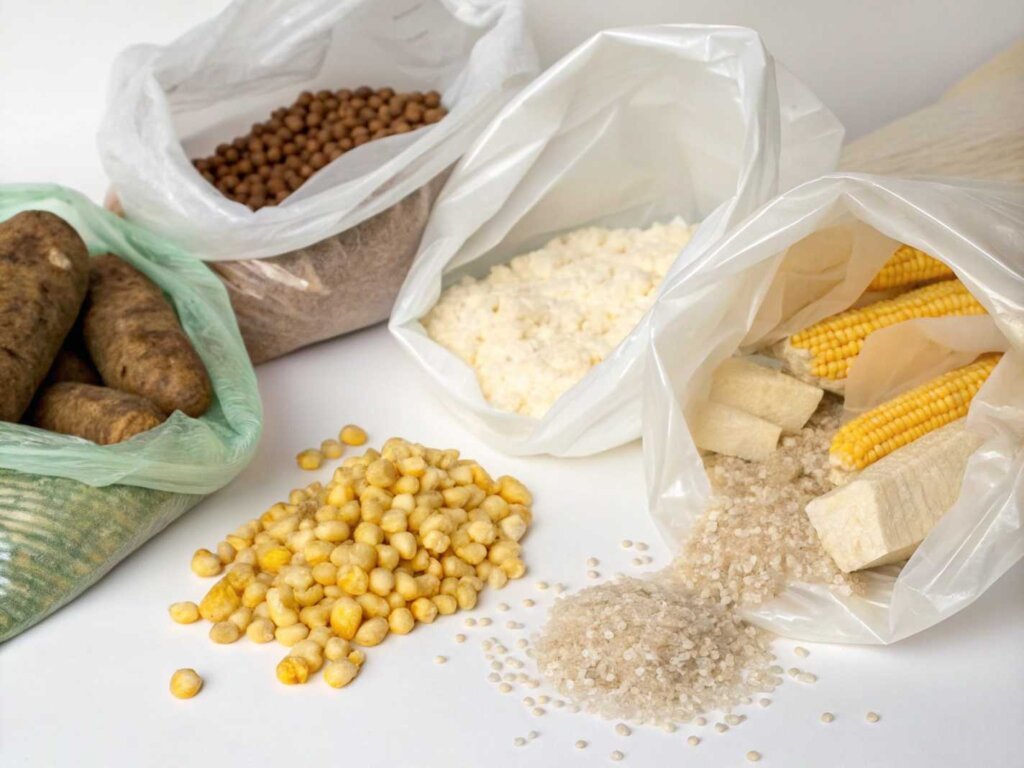
Biodegradable trash bags can be made from different polymer systems.
Depending on the product, materials may include:
- Starch-based blends
- PBAT-based blends
- PLA-containing formulations
- PHA-based materials
- Other biodegradable polymer systems
Some formulations contain renewable plant-derived feedstocks. Others may include polymers made partly or fully from fossil-derived feedstocks.
This matters because bio-based and biodegradable are not the same thing.
As explained in the EEA’s briefing on biodegradable and compostable plastics, bio-based describes feedstock origin, while biodegradability describes how a material can break down under biological conditions.
A material can be bio-based without being biodegradable. A biodegradable polymer can also be produced from fossil-based feedstocks. The EEA makes this distinction clearly in its guidance on biodegradable and compostable plastics.
Material names alone also do not tell you how the finished trash bag will behave.
Film thickness, formulation, printing, additives and bag construction can all affect the final product.

How Do Biodegradable Trash Bags Break Down?
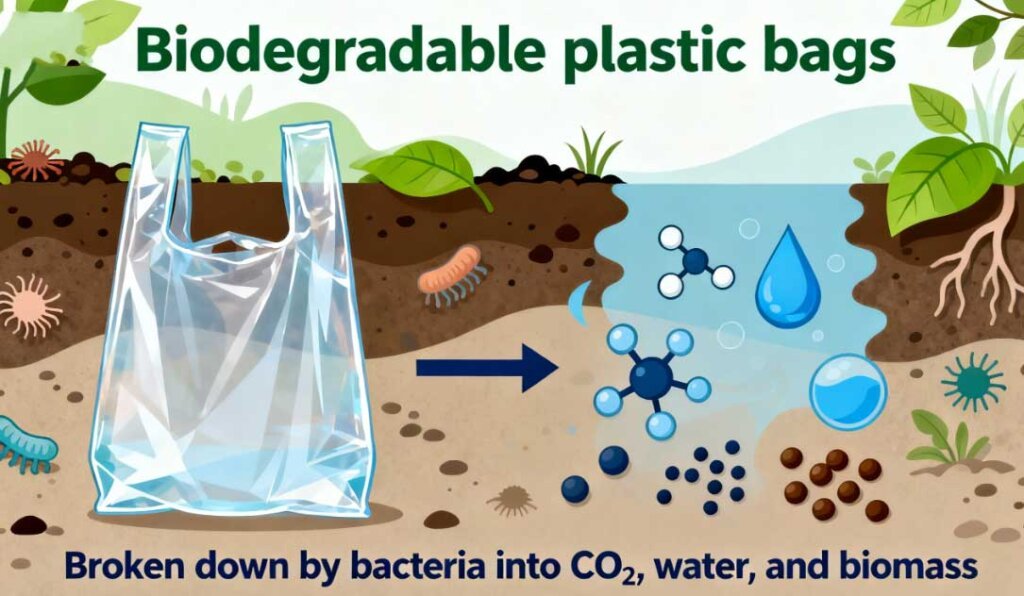
Biodegradation is a biological process.
Microorganisms interact with a material under suitable environmental conditions. How far and how quickly that process proceeds depends on the material and its surroundings.
For plastic bags, conditions can make a large difference.
A material that breaks down under controlled composting conditions may behave very differently in:
- A landfill
- Dry soil
- Cold water
- A home compost pile
- Open litter
- A commercial composting facility
That is why I would not judge a bag from the word “biodegradable” alone.
The more useful question is:
Under what conditions is this product designed to biodegrade?
What Are the Potential Benefits of Biodegradable Trash Bags?
Biodegradable trash bags may offer benefits over conventional polyethylene bags in specific applications, but those benefits depend on the material and disposal conditions.
They are not automatic.
Designed for Biological Breakdown Under Suitable Conditions
Certain biodegradable materials are designed to undergo biological breakdown under defined or suitable conditions instead of persisting in the same way as conventional polyethylene.
The practical benefit depends on whether the bag actually reaches an environment that supports that process.
Some Formulations Use Renewable Feedstocks
Some biodegradable bag formulations include starch or other bio-based inputs.
This may reduce the proportion of fossil-derived feedstock in a particular formulation.
However, renewable content and biodegradability should be treated as separate characteristics.
Some Biodegradable Polymers Can Be Used in Certified Compostable Bags
Certain biodegradable polymers can be developed into finished bags that meet defined compostability requirements.
For example, bags intended for commercial composting may be evaluated against a standard such as ASTM D6400 and may also carry third-party certification where applicable.
In this case, the useful information is the specific compostability scope, not simply the word biodegradable.
The Main Limitation
Biodegradability by itself does not prove that a trash bag has a lower overall environmental impact than a conventional plastic bag.
The EEA similarly notes that biodegradable and compostable plastics can provide benefits in specific uses when the product and local waste-treatment infrastructure are properly matched.
Biodegradable vs Traditional Plastic Trash Bags
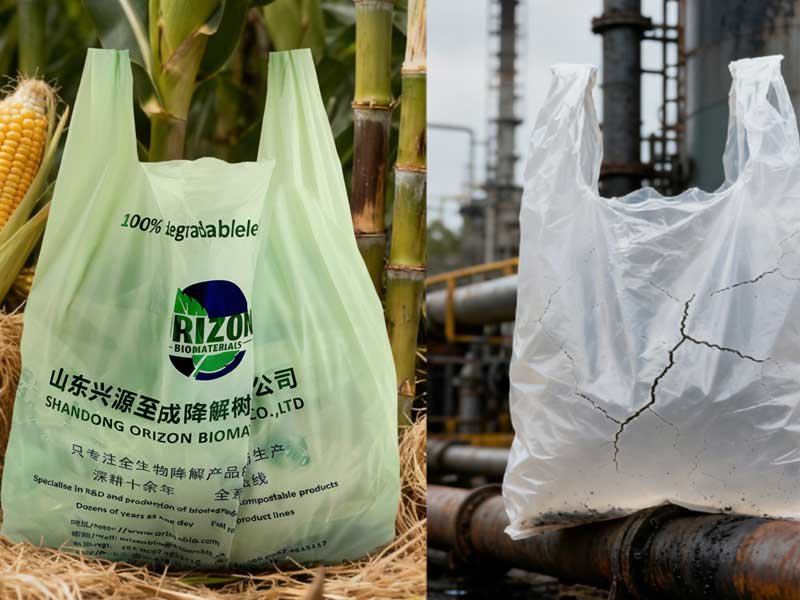
Biodegradable and conventional plastic trash bags can look and perform in similar ways during use.
Their intended end-of-life behavior is different.
| Factor | Biodegradable Trash Bags | Conventional PE Trash Bags |
|---|---|---|
| Main material | Varies by formulation | Mainly polyethylene |
| Biological degradation | May occur under suitable conditions | Not designed as a biodegradation pathway |
| Required conditions | Depend on material and claim | No intended biological degradation route |
| Landfill behavior | May still be very slow | Not designed to biodegrade |
| Compostability | Not automatic | Not compostable |
| Renewable content | Possible in some formulations | Usually primarily fossil-derived |
| Strength | Depends on formulation, thickness and construction | Depends on formulation, thickness and construction |
| Disposal decision | Must match the supported environmental claim | Usually follows conventional waste handling |
The word biodegradable does not automatically make one bag the better choice.
You need to consider the application, performance and actual disposal system together.
How Do Biodegradable Trash Bags Behave in Different Environments?
Biodegradable plastics do not break down at the same rate in every environment.
Temperature, moisture, oxygen, microorganisms and exposure time all matter. 欧洲环境局
| Environment | What Buyers Should Know |
|---|---|
| Industrial composting | Only suitable when the finished product meets the applicable compostability requirements and the receiving program accepts it |
| Home composting | A general biodegradable claim does not prove home compostability |
| Soil | Behavior depends on polymer type, climate and exposure conditions |
| Water | A soil or compostability claim should not be assumed to apply in freshwater or marine environments |
| Landfill | Conditions may slow biological degradation substantially |
| Open environment | Breakdown can be unpredictable and should not be treated as an approved disposal route |
This is why one fixed statement such as “biodegrades in six months” is usually not useful unless the test environment, product and method are also identified.

Do Biodegradable Trash Bags Break Down in Landfills?
A biodegradable label does not mean that a trash bag will quickly break down in landfill.
Landfills often do not provide the oxygen, moisture and other conditions needed for the same biological processes that may occur in a controlled test or composting environment.
The U.S. Federal Trade Commission’s Green Guides warn that unqualified degradable claims can be misleading for solid-waste products that normally go to landfills, incinerators or recycling facilities when customary disposal does not allow the claimed breakdown.
Its Green Guides state that unqualified degradable claims for solid-waste products can be misleading when the products normally go to landfills, incinerators or recycling facilities, because those disposal routes may not provide conditions for complete breakdown within the claimed period.
So I would not treat “biodegradable” as a landfill benefit without evidence that applies to that actual disposal environment.
What Are the Limitations of Biodegradable Trash Bags?
Biodegradable trash bags have several important limits.
No Universal Breakdown Time
The word biodegradable does not give one universal timeframe that applies to every material and environment.
Performance Depends on the Environment
A bag may behave differently in an industrial composting facility, landfill, soil or water.
Biodegradable Does Not Mean Compostable
A general biodegradable claim does not establish industrial or home compostability.
Recycling Can Be Complicated
Biodegradable and compostable polymers should not automatically be mixed into conventional PE recycling streams.
The EEA notes that these materials can currently act as impurities when collected together with conventional plastics.
Broad Environmental Claims Can Mislead
Terms such as:
- Green
- Eco-friendly
- Environmentally friendly
can imply more than the evidence actually supports.
FTC guidance advises marketers not to make broad, unqualified environmental-benefit claims without specific evidence and clear qualification.
Are Biodegradable Trash Bags Compostable?
Not necessarily.
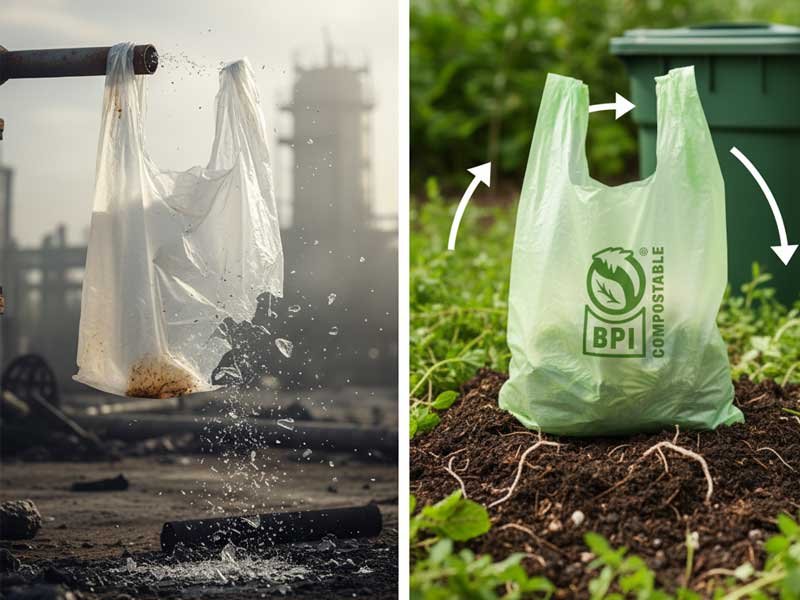
Biodegradable is a broad term describing biological degradation, while compostability refers to performance under defined composting conditions.
A bag described only as biodegradable should not automatically be treated as suitable for industrial or home composting.
Compostable products may be evaluated against requirements covering areas such as biodegradation, physical disintegration, compost quality and applicable material criteria.
Third-party certification may also apply depending on the market and intended composting system.
For a full terminology comparison, see our Biodegradable vs Compostable: Key Differences & Standards guide.
What Makes a Compostable Bag Different?
A compostable bag is more specific than a bag described only as biodegradable.
ASTM D6400-26 is the current ASTM standard specification for plastics and products designed for aerobic composting in municipal or industrial composting facilities.
It establishes requirements for products intended to be labeled as compostable in those controlled facilities.
For a detailed explanation of testing, finished-product scope and verification, see our ASTM D6400 Standard Guide.
Degradable vs Biodegradable Plastic Bags
“Degradable” and “biodegradable” should not be treated as identical terms.
Some plastics are designed mainly to fragment through light, heat, oxidation or additives.
Fragmentation into smaller pieces is not the same as complete biological degradation.
Biodegradable refers specifically to biological breakdown involving microorganisms under suitable conditions.
The EEA also distinguishes oxo-degradable plastics from biodegradable plastics and notes that oxidation can lead to fragmentation into microplastics rather than the same biodegradation pathway.
For buyers, the practical rule is simple:
Ask what breakdown process is being claimed and what evidence supports it.
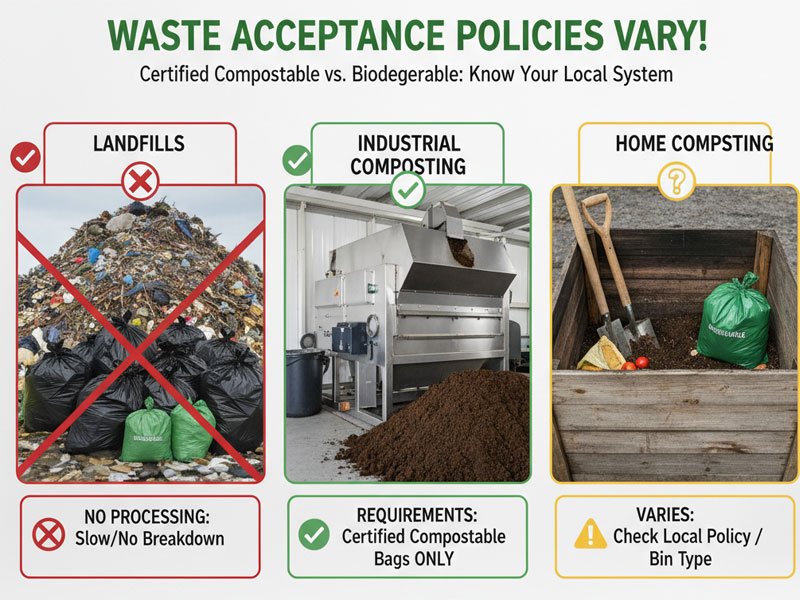
Are Biodegradable Trash Bags Accepted in Composting Programs?
A general biodegradable claim does not guarantee acceptance in a composting or organics program.
Many programs require a defined compostability standard, third-party certification or approved product listing.
In North America, buyers can use the BPI Online Product Catalog to check certified compostable products by company, product name, SKU or item number.
Before using a bag for food waste or organics collection, confirm:
- The required compostability standard
- Whether third-party certification is required
- Whether the exact finished bag is covered
- Whether the receiving facility accepts that product
Certification and local facility acceptance should still be checked separately.
For the difference between home and industrial composting systems, see Home Composting vs Industrial Composting.
Does “Biodegradable” Tell You How Strong the Bag Is?
No.
Biodegradability does not define:
- Tensile strength
- Puncture resistance
- Seal strength
- Leak resistance
- Load capacity
Bag performance depends on the complete specification, including:
- Material formulation
- Film thickness
- Bag dimensions
- Seal construction
- Storage conditions
- Waste type
- Production quality
Two biodegradable bags can therefore perform very differently.
Environmental claims and functional performance should be evaluated separately.
What Should Buyers Verify Before Accepting a Biodegradable Claim?
A useful biodegradable claim should explain what is being claimed, under which conditions, and what evidence supports it.
If I were reviewing a supplier’s claim, I would start with five questions.
1. What Exactly Is Biodegradable?
Does the claim apply to:
- Raw material
- Film
- Finished bag
- Coating
- Printing
- The complete product
Do not assume that raw-material documentation automatically covers every finished bag.
2. Under What Conditions?
Ask where the biodegradation claim is intended to apply.
Examples may include:
- A defined composting system
- Soil
- Another tested environment
A claim without an identified environment gives the buyer much less useful information.
3. What Evidence Supports the Claim?
Ask for relevant:
- Test reports
- Test methods
- Technical documents
- Certification, where applicable
The evidence should match the claim being made.
4. Does the Finished Bag Match the Tested Product?
Compare:
- Material formulation
- Thickness
- Color
- Printing
- Additives
- Bag construction
These details can matter when deciding whether existing documentation applies.
5. Where Will the Bag Go After Use?
The disposal route matters.
A claim is more useful when the product is designed for an end-of-life system that actually exists where the bag will be used.
How Biodegradable Trash Bags Are Typically Manufactured (Overview)
Biodegradable trash bags are generally made by converting suitable polymer formulations into film.
A typical process may include:
- Material blending
- Blown-film extrusion
- Printing, if required
- Bag cutting and sealing
- Perforation or roll conversion
- Packing
Material choice is only one part of the final product.
Thickness, dimensions, seal design and processing conditions also affect how the bag performs in use.
Common Misunderstandings About Biodegradable Trash Bags
“Biodegradable” means the bag disappears anywhere.
No.
Biodegradation depends on the material and environmental conditions.
Biodegradable means compostable.
No.
A biodegradable claim alone does not prove suitability for industrial or home composting.
Plant-based means biodegradable.
No. Bio-based describes material origin. Biodegradable describes biological breakdown.
They are different properties.
Biodegradable means better for landfill.
Not automatically.
Landfill conditions may not support the degradation pathway expected in another environment.
A biodegradable claim tells me how strong the bag is.
No. Strength depends on the complete bag specification.
Breaking into small pieces proves biodegradation.
No. Physical fragmentation is not the same as complete biological degradation.
FAQ
Biodegradable trash bags are waste bags made from materials that can undergo biological degradation through microorganisms under suitable conditions.
The term alone does not define a universal breakdown time or disposal environment.
Not automatically.
Their environmental effect depends on the material, production, intended use and disposal environment.
A broad “eco-friendly” claim should not be treated as proof of a specific environmental benefit.
Some materials are designed for biological breakdown under suitable conditions, and some formulations may use renewable feedstocks.
Certain biodegradable polymers can also be used in certified compostable products.
The benefit depends on the actual end-of-life system.
Not in every situation.
The comparison depends on the material, bag performance and disposal route.
A biodegradable bag may offer little practical end-of-life advantage if it enters an environment that does not support the claimed degradation process.
They may break down slowly or not as expected.
Landfills often lack the same conditions found in controlled biodegradation or composting systems.
A biodegradable label should not be treated as a guarantee of rapid landfill degradation.
Not necessarily.
A general biodegradable claim does not prove that the finished product meets industrial- or home-compostability requirements.
Check what product the claim applies to, the environmental conditions, the evidence behind the claim and whether the finished bag matches the tested or documented configuration.
If compostability is required, verify the applicable compostability standard or certification separately.
Need to Choose Between Biodegradable and Compostable Waste Bags?
This page explains what biodegradable trash bags are and where the limits of the term apply.
If your question is:
Should I choose a biodegradable or compostable waste bag for my application?
read our Biodegradable vs Compostable Waste Bags Buyer Guide.
That guide focuses on:
- Waste type
- Disposal route
- Composting systems
- Certification requirements
- Bag performance
- Finished-product verification
Looking for Certified Compostable Trash Bags?
ORIZON manufactures compostable trash bags for international B2B customers.
We focus on compostable bag projects with defined product specifications and applicable compostability documentation rather than conventional PE bags sold only with broad biodegradable claims.
For actual product sizes, thicknesses, seals, printing, packaging, MOQ and OEM supply, see our Compostable Trash Bags page.