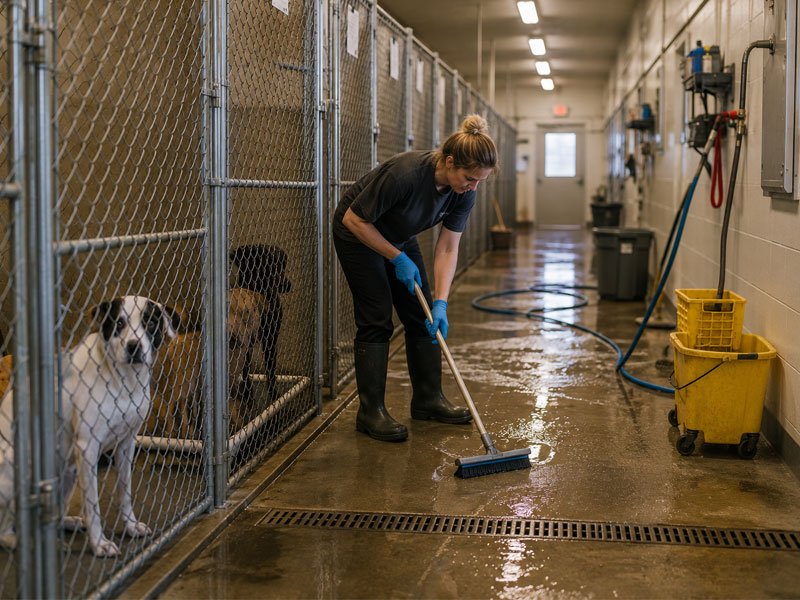
Animal shelters create waste every day.
There is feces, used litter, wet bedding, leftover food, disposable gloves and general rubbish. At the same time, staff must clean kennels, wash bowls, process laundry and prepare spaces for new animals.
These jobs are connected.
If waste is not removed quickly, surfaces are harder to clean. If cleaning tools move between rooms, they may carry contamination. If disinfectant is used on a dirty surface, it may not work as expected.
This is why animal shelter sanitation needs a system.
A practical system connects:
- waste removal;
- surface cleaning;
- disinfection;
- drying;
- staff movement;
- hand hygiene;
- equipment control;
- supply management;
- and record keeping.
Shelters reviewing the wider collection and disposal system can also visit our animal shelter waste management solutions page.
This guide focuses on the daily work. It explains how shelters can organize cleaning, waste handling, staff duties and sanitation reviews without turning the process into an impossible list of rules.
Sanitation procedures should still be developed with a veterinarian experienced in shelter medicine. Product labels and local waste regulations must also be followed.
What Does Animal Shelter Sanitation Mean?
Several terms are often used as though they mean the same thing.
They do not.
Cleaning
Cleaning means physically removing urine, feces, food waste, hair, body fluids and other visible material.
It may include:
- picking up solid waste;
- removing used bedding;
- washing with detergent;
- scrubbing;
- and rinsing.
Cleaning lowers the amount of dirt and contamination on a surface.
Disinfection
Disinfection means applying an appropriate product to a clean surface to reduce or kill remaining pathogens.
A pathogen is a microorganism that can cause disease, such as certain viruses, bacteria or fungi.
Disinfection depends on more than spraying a product.
The surface may need to remain wet for a set contact time. Contact time means the amount of time the product must stay on the surface to work as directed.
Sanitation
Sanitation is the full process that combines cleaning and disinfection.
Drying is also an important final step.
Sterilization
Sterilization is the destruction of all microorganisms, including spores. It is generally used for surgical instruments and other items that must remain sterile.
It is not the normal goal for floors, kennels or general shelter rooms.
The Association of Shelter Veterinarians uses these distinctions in its standards of care and states that sanitation plans should include organic-matter removal, cleaning and disinfection.
A surface may look clean but still need disinfection.
It may also smell strongly of chemicals without being properly cleaned.
Why Animal Shelter Sanitation Requires a System
Animal shelters are different from ordinary homes and offices.
Animals may arrive with an unknown health history. Some may carry a pathogen without showing clear signs of illness. Animals, employees, volunteers, visitors, bowls, leads and cleaning carts may all move through the building.
The shelter may also have:
- frequent animal turnover;
- shared housing areas;
- limited isolation space;
- different animal species;
- high laundry volumes;
- wet floors;
- public adoption rooms;
- and staff working under time pressure.
One missed cleaning task may not cause an immediate problem.
Repeated gaps can build risk.
For example, a litter scoop used in two cat rooms may move contamination between rooms. A rolling waste bin taken through an isolation ward and then into healthy housing may do the same.
A written animal shelter cleaning protocol helps staff know:
- what must be cleaned;
- when it must be cleaned;
- which product to use;
- how long the product must remain in contact;
- what protective equipment is required;
- and who records completion.
The plan should cover all areas where animals are housed or handled, not only kennels. ASV guidance includes enclosures, common-use areas, foster homes and outdoor spaces.
Assign a Sanitation Plan Leader
Every shelter needs one person who owns the sanitation plan.
This does not mean one person does all the cleaning.
The sanitation plan leader may be a:
- shelter manager;
- veterinary technician;
- operations supervisor;
- kennel manager;
- facility manager;
- or another trained employee.
The leader should work with the shelter veterinarian and department supervisors.
Their duties may include:
- maintaining the written shelter cleaning SOP;
- reviewing cleaning products;
- checking product labels and safety data;
- organizing staff training;
- observing cleaning work;
- tracking supply levels;
- reviewing missed tasks;
- and updating the plan during disease events.
Best Friends Animal Society recommends establishing a sanitation plan leader and adjusting the program to match the shelter’s housing, workforce and budget.
Written ownership matters.
When everybody is partly responsible, important tasks may still be missed.
Divide the Shelter Into Risk Zones
One cleaning routine may not suit the whole facility.
A useful first step is to divide the shelter into risk zones.
You may use names, numbers or colors. The exact color system is an internal tool, not an international standard.
Lower-risk zone
This may include:
- healthy adult animal housing;
- adoption rooms;
- low-risk exercise areas;
- staff offices;
- and public areas without direct animal contact.
Medium-risk zone
This may include:
- intake;
- animals with an unknown health history;
- quarantine;
- examination rooms;
- treatment spaces;
- shared corridors;
- and transport receiving areas.
Higher-risk zone
This may include:
- isolation rooms;
- confirmed infectious-disease areas;
- heavily contaminated enclosures;
- and waste-holding areas linked to sick animals.
Each zone should have a clear plan for:
- staff access;
- protective clothing;
- cleaning tools;
- waste containers;
- laundry handling;
- and movement between rooms.
Whenever possible, tools should stay in one zone.
Color-coded brushes, squeegees, scoops and waste bins may help staff see where an item belongs.
A red brush cannot prevent disease by itself.
It can, however, remind a worker not to carry that brush into another room.
Clean From Lower Risk to Higher Risk
The order of work matters.
Staff should generally care for and clean lower-risk animals before moving to higher-risk animals.
The commonly recommended order is:
- Healthy puppies and kittens
- Healthy adult animals
- Unhealthy animals
This order helps reduce exposure of young and healthy animals to contamination from sick animals.
A shelter may need to adjust the order based on its building design and animal populations.
The main principle remains the same:
Do not move from a high-risk area back into a lower-risk area without changing PPE, cleaning hands and dealing with contaminated tools.
Plan staff movement before cleaning starts.
It is easier than trying to correct cross-traffic halfway through the shift.
Spot Cleaning vs Deep Cleaning
Not every enclosure needs the same level of cleaning every day.
Repeatedly moving an animal and removing all familiar scents can add stress. On the other hand, a kennel must be fully sanitized before it is used by a different animal.
Spot cleaning
Spot cleaning may be suitable when:
- the same animal remains in the enclosure;
- the area is not heavily soiled;
- there is no known infectious-disease concern;
- and the shelter protocol allows it.
During spot cleaning, staff may:
- remove feces and urine;
- replace wet bedding;
- remove old food;
- clean a small dirty area;
- provide fresh water and food;
- and tidy the enclosure.
Spot cleaning can reduce handling and help preserve familiar scents.
Deep cleaning
Deep cleaning is a complete cleaning and disinfection process.
It is normally required:
- before a different animal uses the enclosure;
- after an animal leaves;
- when the enclosure is heavily soiled;
- after a known infectious-disease case;
- according to a scheduled cleaning plan;
- or when directed by the shelter veterinarian.
ASV states that enclosures must be completely sanitized before a different animal occupies them, even when the previous animal stayed only briefly or the enclosure does not look dirty.
Outbreak cleaning
Outbreak cleaning is a higher-control process used when disease levels rise or a difficult pathogen is identified.
It may involve:
- different disinfectants;
- longer or carefully controlled contact times;
- more frequent deep cleaning;
- tighter movement controls;
- disposable supplies;
- added PPE;
- and increased review by the veterinary team.
| Cleaning type | Common use | Main purpose |
|---|---|---|
| Spot cleaning | Same animal remains in a lightly soiled enclosure | Remove daily waste with less handling |
| Deep cleaning | Animal change, heavy soil or scheduled sanitation | Fully clean, disinfect and dry the enclosure |
| Outbreak cleaning | Increased disease or a known high-risk pathogen | Follow a pathogen-specific control plan |
ASPCApro also recommends spot cleaning when the same animal remains in the enclosure and deep cleaning between occupants.
Daily Kennel and Enclosure Sanitation Workflow
A written kennel cleaning procedure should be easy to follow.
It should not depend on one experienced employee remembering every step.
The exact method will vary by species, housing type and cleaning product, but a practical workflow may include the following stages.
1. Review the animal’s status
Before entering the enclosure, check:
- animal identification;
- medical notes;
- isolation status;
- behavior warnings;
- feeding instructions;
- and any change in waste, vomit or discharge.
A change in stool, urine or behavior may need to be reported before the material is removed.
2. Prepare supplies
Bring the correct supplies before moving the animal.
These may include:
- gloves;
- protective clothing;
- waste bags;
- laundry containers;
- detergent;
- disinfectant;
- brushes;
- scoops;
- paper towels;
- squeegees;
- and fresh bedding.
This reduces unnecessary movement in and out of the ward.
3. Protect or move the animal
Animals should not be exposed to cleaning sprays, chemical residue or overspray.
For deep cleaning, move the animal to a clean, secure holding area.
Double-compartment housing may allow the animal to stay in one section while the other section is cleaned.
ASPCApro and ASV advise against exposing animals to cleaning chemicals and require enclosures to be dry before animals return.
4. Remove loose items
Remove:
- bowls;
- toys;
- bedding;
- litter pans;
- newspapers;
- and other removable materials.
Place reusable items into the correct cleaning route.
Do not place dirty bowls beside clean bowls.
5. Remove solid and organic waste
Pick up feces, litter, vomit, food and other visible material before washing the surface.
Place waste directly into the correct lined container.
Do not spray solid waste toward drains or other enclosures.
6. Clean the surface
Use the approved detergent or cleaning product to loosen and remove remaining material.
Pay attention to:
- corners;
- gates;
- door handles;
- hinges;
- floor-wall joints;
- feeding points;
- and areas around drains.
A disinfectant with no cleaning action cannot replace this step when organic matter remains.
7. Rinse when required
Follow the cleaning-product instructions.
Remove loosened dirt, detergent and remaining material before applying the disinfectant.
8. Apply the disinfectant
Use the approved shelter disinfection protocol.
Confirm:
- the correct product;
- the correct dilution;
- the correct surface;
- and the required contact time.
Do not guess.
Do not mix different disinfectants. ASPCApro warns that mixing products may create harmful gases or other dangerous solutions.
9. Observe contact time
The surface must remain wet for the time required by the product label or shelter protocol.
A quick spray followed by immediate wiping may not provide proper disinfection.
ASV identifies failure to observe contact time and incorrect dilution as common sanitation errors, especially during outbreaks.
10. Rinse or remove residue when required
Some disinfectants may require rinsing before the enclosure is safe for animal use.
Follow the label.
Products such as bleach and some quaternary ammonium compounds may be harmful if animals contact or ingest residue, even when the product was prepared at a recommended dilution.
11. Remove standing water
Use drainage, squeegees or towels as required.
Standing water can slow drying and support the survival or movement of contamination.
12. Allow the enclosure to dry
The enclosure should be dry before the animal returns.
This step is easy to cut when staff are busy.
It should not be skipped.
13. Replace clean supplies
Return clean:
- bedding;
- bowls;
- water;
- food;
- litter pans;
- and enrichment items.
14. Record completion
Use a paper checklist, whiteboard or digital record.
The record may show:
- time completed;
- person responsible;
- cleaning type;
- supply issue;
- maintenance issue;
- and any health concern reported.
Waste Collection and Containment
Cleaning starts with waste removal.
If staff carry loose waste through the building, place leaking bags on the floor or overload containers, the sanitation system becomes harder to control.
A shelter should identify its main waste streams.
Animal feces and used litter
This includes:
- dog feces;
- cat litter;
- small-animal bedding;
- and other routine animal waste.
Use containers that are:
- easy to access;
- fitted with suitable liners;
- closed where needed;
- and emptied before they overflow.
Outdoor feces should be removed quickly. Grass, soil and gravel cannot be disinfected in the same way as sealed indoor surfaces. ASV states that immediate outdoor feces removal is preferred, while daily removal helps limit environmental buildup.
Soiled bedding
Keep soiled laundry separate from clean textiles.
Remove large pieces of feces, vomit and other organic material before placing bedding in the washing system.
Wet bedding should not sit for long periods in an open corridor.
Food waste
Separate unwanted food according to the shelter’s waste contract and local rules.
Do not allow food waste to remain in animal rooms, where it may create odor or attract pests.
General waste
General waste may include:
- empty packaging;
- paper products;
- non-contaminated rubbish;
- and disposable cleaning materials.
Disposable PPE and cleaning waste
Gloves, shoe covers, masks, wipes and gowns should be removed in the correct area.
Place waste containers where staff can remove PPE without walking through the ward while holding contaminated items.
Sharps, pharmaceutical waste and regulated materials
Needles, blades, medicines, chemical waste, medical materials and deceased animals may be subject to separate laws and collection rules.
They should not be managed as ordinary animal waste unless local requirements clearly allow it.
The wider collection, containment and disposal process is covered in our animal shelter waste management soltions guide.
Plan the Waste Route Through the Shelter
The route from the enclosure to the outdoor waste area matters.
Ask:
- Where does the waste first enter a bag?
- Is the bag carried through clean food areas?
- Does the waste cart pass through adoption rooms?
- Where are full bags held?
- Can the cart be cleaned?
- Does the cart move between isolation and general housing?
- How often is the external container emptied?
The cleanest route is usually the shortest controlled route that avoids food preparation, clean laundry and lower-risk animal areas.
Mobile bins and carts should stay within one area where possible or be sanitized before moving between areas.
A rolling bin can save staff time.
It can also carry contamination throughout the building when it has no assigned zone.
Many sanitation failures happen outside the kennel.
Laundry
Before washing:
- remove solid organic material;
- sort items according to the shelter protocol;
- avoid carrying loose bedding against clothing;
- and do not overload the machine.
After washing, textiles should be fully dried before reuse.
ASV notes that bedding and textiles must be discarded or laundered and thoroughly dried when visibly soiled and before being used by a different animal.
Food and water bowls
Bowls should move through a clear dirty-to-clean process.
Avoid stacking dirty bowls in a clean preparation area.
When pathogens that are hard to remove are a concern, the shelter veterinarian should review whether the normal dishwasher or wash process is sufficient.
Litter pans
Do not clean litter pans in the same sink or at the same time as food bowls.
ASPCApro recommends separating these tasks to reduce cross-contamination.
Toys, leads and grooming tools
Shared items should be:
- easy to clean;
- assigned to one animal when needed;
- or sanitized before being used by another animal.
Items with deep scratches, cracks or porous surfaces may be difficult or impossible to disinfect fully.
A cheap damaged bowl may cost less to replace than to keep cleaning without confidence.
Transport Crates, Traps and Vehicles
Animal transport equipment is part of the shelter sanitation system.
It should not be treated as a separate problem.
Transport cages, traps and vehicle compartments should be sanitized before they are used by a different animal.
A transport cleaning record may include:
- vehicle or crate identification;
- previous animal;
- visible contamination;
- cleaning product;
- disinfectant;
- completion time;
- damage;
- and person responsible.
Pay attention to:
- crate doors;
- handles;
- vehicle floor joints;
- tie-down points;
- loading ramps;
- carriers;
- blankets;
- and shared catch poles.
A clean kennel does little good if an animal is placed into a contaminated carrier.
PPE and Hand Hygiene
Personal protective equipment, or PPE, creates a barrier between a worker and a hazard.
Depending on the task and risk level, PPE may include:
- disposable gloves;
- gowns or smocks;
- waterproof aprons;
- boots;
- shoe covers;
- eye protection;
- and respiratory protection when required by a risk assessment.
The same PPE is not needed for every task.
The shelter should define what is required in each area.
Contaminated PPE should be removed, discarded or sanitized before staff move to another animal group. Staff should clean their hands after removing PPE.
Hand hygiene
Handwashing stations should be available near animal-contact areas.
Soap, running water and single-use drying materials are preferred.
Alcohol-based hand sanitizer may be useful on visibly clean hands, but it should not be the only hand-hygiene method. ASV notes that sanitizer is not effective against some important shelter pathogens, including parvovirus, calicivirus and ringworm.
Chemical safety
Staff must know:
- where the product label is kept;
- how the product is diluted;
- what PPE is required;
- where it is stored;
- what to do after a spill;
- and which products must never be mixed.
OSHA guidance stresses chemical-hazard training and suitable PPE when workers clean and disinfect animal-related environments.
Biosecurity When Staff and Volunteers Leave
Biosecurity means the steps used to reduce the movement of disease between animals, people and places.
It should not end at the shelter door.
A leaving-work procedure may address:
- handwashing;
- work shoes;
- contaminated clothing;
- phones and keys;
- personal bags;
- vehicle surfaces;
- and contact with pets at home.
Practical rules may include:
- keeping work shoes at the shelter;
- changing heavily contaminated clothing before leaving;
- storing personal items outside isolation rooms;
- cleaning shared phones and radios;
- and washing hands before entering a personal vehicle.
The exact steps should match the known risk.
When the shelter has a confirmed outbreak, staff and volunteers should ask the shelter veterinarian about pathogen-specific precautions.
Do not make workers guess.
Odor Control Is Not the Same as Sanitation
A strong smell tells you something is wrong.
It does not always tell you where the problem is.
Common sources include:
- waste not removed quickly enough;
- urine under cracked flooring;
- wet bedding;
- overloaded laundry storage;
- leaking waste bags;
- dirty drains;
- poor airflow;
- standing water;
- and external waste containers.
Strong fragrance may hide the smell for a short time.
It does not remove the source.
When I review an odor problem, I would start with three questions:
- Where is the moisture?
- Where is organic waste staying too long?
- Which surface cannot be cleaned properly?
Then review ventilation and drainage.
Do not increase chemical use simply because a room still smells.
The problem may be a damaged floor, a full bin or a wet drain channel.
Drainage and Surface Condition Matter
Sanitation products cannot repair a broken building surface.
Check for:
- cracked concrete;
- damaged wall coatings;
- missing grout;
- rusted metal;
- deep scratches;
- worn door seals;
- porous wood;
- blocked drains;
- and low points where water collects.
ASV notes that damaged, scratched and porous items may be difficult or impossible to disinfect fully. It also requires practices that prevent standing water in animal housing.
Record facility defects during cleaning.
A crack that is ignored for six months may become a daily sanitation problem.
Staffing and Capacity for Sanitation
A good SOP still needs enough people and time.
ASV and ASPCApro refer to a minimum starting estimate of nine minutes per animal per day for routine enclosure cleaning. The real time may be higher, depending on the housing, animal population, products and contact time.
This estimate does not include every shelter task.
You must also plan time for:
- laundry;
- bowls;
- shared rooms;
- waste movement;
- outdoor areas;
- transport equipment;
- isolation;
- supply restocking;
- and documentation.
A basic calculation is:
Number of occupied enclosures × measured minutes per enclosure ÷ 60
This gives an estimate of daily enclosure-cleaning hours.
For example, 60 occupied enclosures at an observed average of 12 minutes each would require about 12 staff hours for enclosure work alone.
Then add the other tasks.
Measure your own facility instead of assuming one number fits every shelter.
Look for workflow problems
Long cleaning times may come from:
- staff shortages;
- supplies stored too far away;
- poor drainage;
- repeated animal movement;
- unclear instructions;
- shared tools;
- or a product with a long contact time.
Sometimes the worker is not too slow.
The system is.
Train Staff and Volunteers the Same Way
A shelter cleaning SOP should be available in both written and practical form.
New staff should not learn only by watching whoever happens to be on shift.
Training should include:
- cleaning versus disinfection;
- spot cleaning versus deep cleaning;
- room order;
- product dilution;
- contact time;
- PPE;
- hand hygiene;
- waste separation;
- cross-contamination;
- equipment storage;
- and incident reporting.
Post short laminated instructions in each area.
ASPCApro recommends giving staff and volunteers written and verbal instructions, placing reminders in kennel areas and periodically observing how the procedures are carried out.
Observe the work
A signed training form does not prove that the method is being followed.
Supervisors should occasionally observe:
- product preparation;
- waste removal;
- surface coverage;
- timing;
- PPE removal;
- and movement between rooms.
Correct the process without turning every review into punishment.
People are more likely to report a mistake when they know the goal is to fix the system.
Managing Sanitation Supplies and Inventory
Animal shelter sanitation can stop because of one missing item.
Common supplies include:
- waste bags;
- bin liners;
- gloves;
- gowns;
- detergent;
- disinfectant;
- paper towels;
- brushes;
- squeegees;
- laundry containers;
- labels;
- and cleaning records.
ASPCApro includes garbage bags, laundry containers, PPE and separate cleaning equipment among the basic supplies needed in shelter wards.
Track average use
Record how much of each item the shelter uses per:
- day;
- week;
- animal;
- ward;
- or cleaning cycle.
Set a minimum level
The minimum level is the quantity at which a new order must be placed.
It should account for:
- daily use;
- supplier lead time;
- delivery delays;
- seasonal intake;
- and outbreak demand.
Keep an emergency reserve
An outbreak or intake surge may increase the use of:
- gloves;
- disposable gowns;
- waste bags;
- paper towels;
- and disinfectant.
Keep enough reserve stock to continue the approved protocol.
Store products correctly
Follow label requirements for:
- temperature;
- light;
- shelf life;
- diluted-solution stability;
- and separation from incompatible chemicals.
Do not transfer chemicals into unmarked bottles.
What Changes During a Disease Outbreak?
A rise in disease does not always mean the cleaning team failed.
The cause may involve:
- intake health;
- vaccination;
- population density;
- animal movement;
- ventilation;
- housing design;
- stress;
- or several factors at once.
Still, sanitation should be reviewed quickly.
The shelter veterinarian and sanitation leader should check:
- whether the disinfectant covers the pathogen of concern;
- product concentration;
- contact time;
- staff technique;
- room order;
- tool movement;
- PPE use;
- hand hygiene;
- waste routes;
- laundry handling;
- and drying.
ASV identifies wrong product selection, incorrect dilution and missed contact time as common errors during outbreak response.
The shelter may need to:
- increase deep cleaning;
- dedicate more equipment by area;
- use disposable items;
- reduce cross-ward movement;
- strengthen isolation;
- adjust staffing;
- and retrain personnel.
Do not change products every few days without a clear reason.
A stable, correct process is easier to follow and audit.
Animal Shelter Sanitation Audit
A sanitation audit is a structured check of whether the written system is working.
It should review both documents and real work.
Daily checks
- Were required enclosures cleaned?
- Were waste bins emptied?
- Were isolation procedures followed?
- Were contact times observed?
- Were floors dry before animals returned?
- Were health concerns reported?
- Were supplies available?
Weekly checks
- Are tools staying in their assigned zones?
- Are waste carts clean?
- Are drains working?
- Are chemical bottles labeled?
- Are PPE stations stocked?
- Are laundry and bowl routes separated?
- Are damaged surfaces recorded?
Monthly checks
- Are cleaning times realistic?
- Which supplies ran out?
- Which areas have repeat odor?
- Which tasks are often missed?
- Does the shelter need retraining?
- Have animal numbers changed?
- Are product labels and SOPs current?
Useful sanitation KPIs
A KPI is a key performance indicator. It is a measure used to track whether a process is working.
| KPI | What it may show |
|---|---|
| Missed sanitation tasks | Staffing, scheduling or training gaps |
| Average enclosure cleaning time | Real workload and workflow problems |
| Contact-time compliance | Whether disinfectants are used correctly |
| Supply stockouts | Procurement reliability |
| Repeat odor locations | Waste, drainage or surface problems |
| Standing-water incidents | Drainage and drying problems |
| Cross-zone equipment errors | Weak zoning or training |
| PPE stockouts | Safety and procurement risk |
| Waste volume by area | Container and collection needs |
| Retraining events | Parts of the SOP that are unclear |
| Disease trend | One part of a wider health review |
Disease rates should not be used as the only score for the sanitation team.
They are affected by many other factors.
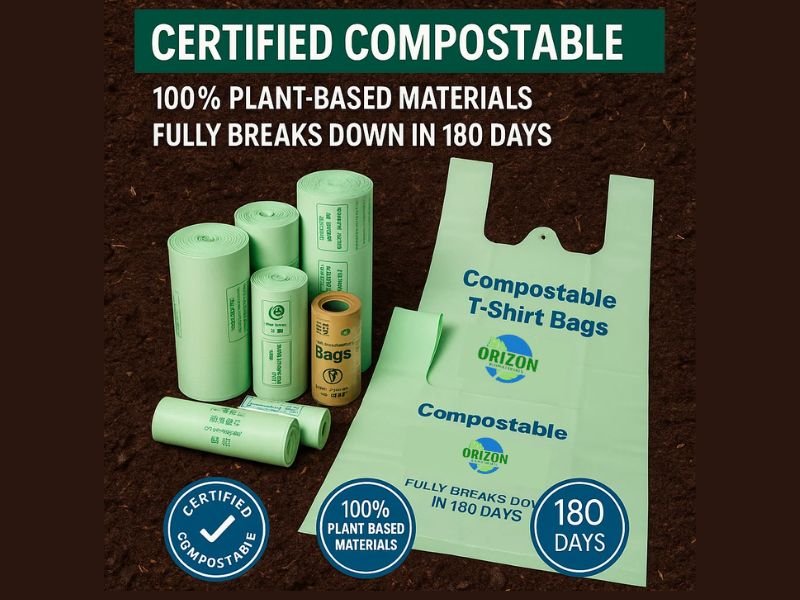
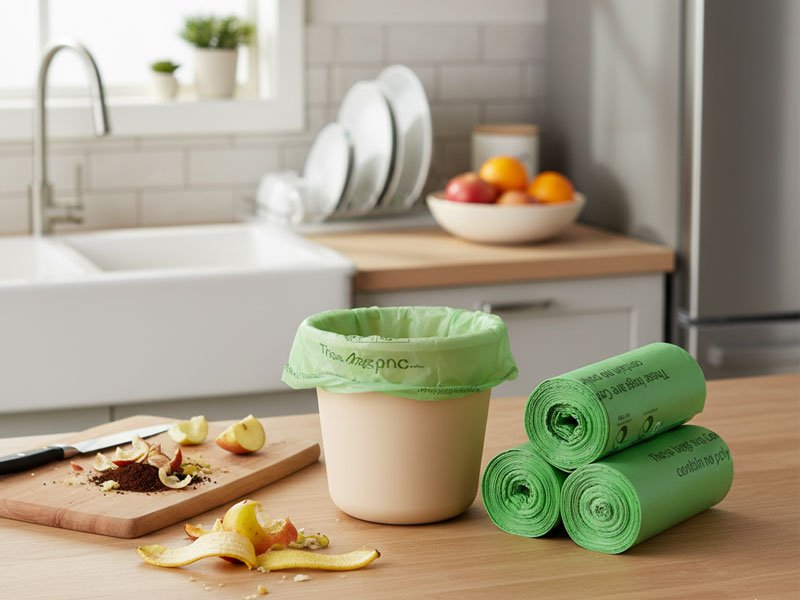
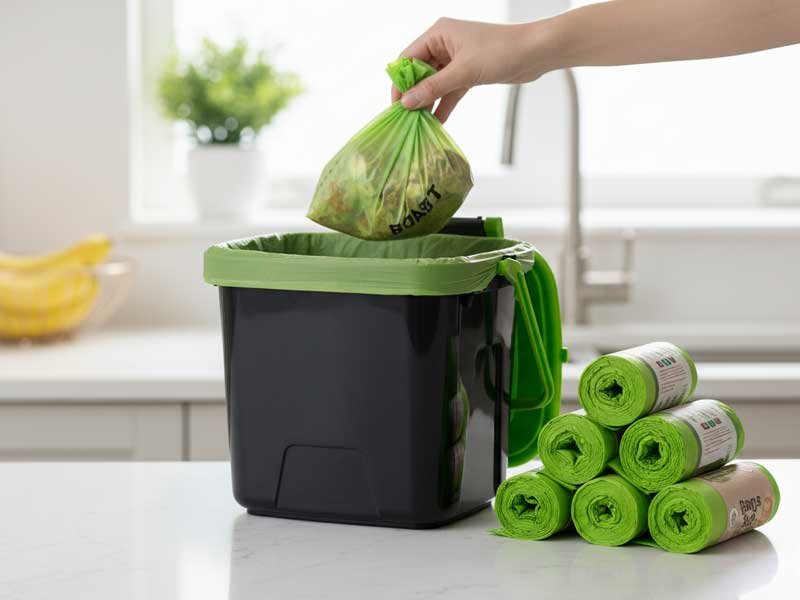
Can Compostable Bags Be Used in Animal Shelters?
Certified compostable bags may be considered for selected animal shelter waste streams.
They are not automatically suitable for every type of shelter waste.
Before using them, confirm:
- what waste will go into the bag;
- whether it is ordinary animal waste or regulated waste;
- the local collection route;
- whether the receiving facility accepts animal waste;
- the required compostability standard;
- storage conditions;
- and how staff will identify the correct bag.
A bag being compostable does not mean the contents are accepted by every composting facility.
It also does not mean the bag can be left outdoors.
Shelters handling wet or heavier waste should evaluate:
- thickness;
- seal strength;
- puncture resistance;
- bin fit;
- closure;
- and time between collection visits.
For facilities comparing reinforced liners, see our heavy-duty compostable garbage bags page.
The final choice should match the actual waste stream and local disposal system.
What to Include in an Animal Shelter Waste Bag RFQ
An RFQ is a request for quotation.
A clear RFQ helps a supplier understand the real use conditions instead of quoting a general bag.
Facility information
Include:
- shelter type;
- number of animals;
- main species;
- operating days;
- location;
- waste contractor;
- and delivery destination.
Waste information
Describe:
- feces and litter;
- wet bedding;
- food waste;
- general rubbish;
- disposable PPE;
- or other intended contents.
State whether the waste is wet, heavy, sharp-edged or stored for more than one day.
Bin information
Provide:
- bin capacity;
- opening width;
- bin height;
- circumference where available;
- and photographs.
The bag should fit the container.
A bag that is too small may tear at the rim. A bag that is too large may collapse into the bin.
Bag specifications
Confirm:
- width;
- length;
- gusset;
- thickness;
- seal type;
- color;
- closure type;
- bags per roll;
- rolls per carton;
- and printing or labels.
Performance requirements
State whether the bag needs:
- stronger puncture resistance;
- liquid containment;
- odor containment;
- easy tying;
- controlled dispensing;
- or color coding.
Certification and disposal requirements
Include:
- required compostability certification;
- destination-market rules;
- facility acceptance;
- labeling;
- and requested documents.
Ordering and logistics
Provide:
- estimated monthly use;
- first order quantity;
- annual forecast;
- delivery schedule;
- carton-weight limit;
- pallet requirements;
- and requested trade terms.
Bulk buyers reviewing broader bag options can also visit our compostable gabage bags wholesale page.
Animal Shelter Sanitation Checklist
Use this checklist as a starting point for an internal review.
Management
- A sanitation plan leader has been assigned.
- A shelter veterinarian has reviewed the protocol.
- SOPs have a revision date.
- Responsibilities are assigned by task and area.
- Staff and volunteers receive practical training.
Risk control
- Animal areas are divided by health risk.
- Cleaning moves from lower-risk to higher-risk areas.
- Tools are assigned by ward or sanitized between wards.
- Isolation PPE is available at the point of use.
- Waste routes avoid clean supply areas.
Kennel sanitation
- Staff know when to spot clean.
- Staff know when to deep clean.
- Organic matter is removed first.
- Products are diluted correctly.
- Contact time is observed.
- Residue is removed when required.
- Enclosures are dry before reuse.
Waste management
- Each waste stream has an approved container.
- Waste bags fit the bins.
- Bags are not overloaded.
- Full bags are moved by a controlled route.
- External waste storage is secure and clean.
- Regulated waste is separated.
Shared equipment
- Bowls and litter pans use separate cleaning routes.
- Laundry is sorted and fully dried.
- Transport crates are sanitized between animals.
- Vehicles are included in the cleaning plan.
- Damaged and porous items are replaced.
Staff safety
- Chemical labels and safety information are available.
- Products are not mixed.
- PPE matches the task.
- Handwashing stations are accessible.
- Staff know the leaving-work biosecurity procedure.
Supplies
- Daily use is tracked.
- Minimum stock levels are defined.
- Emergency stock is available.
- Chemicals are stored correctly.
- Waste bag reorder points are documented.
Review
- Daily tasks are recorded.
- Supervisors observe cleaning work.
- Odor and drainage problems are logged.
- Stockouts are reviewed.
- Outbreak procedures are available.
- The SOP is updated when the system changes.
FAQ
What is animal shelter sanitation?
Animal shelter sanitation is the planned process of removing waste and organic material, cleaning surfaces, applying suitable disinfectants when required and allowing areas to dry before animals return.
What is the difference between cleaning and disinfection?
Cleaning removes visible waste, dirt and organic material. Disinfection uses a suitable product on a clean surface to reduce or kill remaining pathogens.
How often should animal shelter kennels be cleaned?
Kennels should be checked and cleaned every day. Spot cleaning may be suitable when the same animal remains in a lightly soiled enclosure. Deep cleaning is required between different animals and in other higher-risk situations.
When should an enclosure be deep cleaned?
An enclosure should be deep cleaned before another animal uses it, when it is heavily soiled, after certain disease cases and according to the shelter’s planned cleaning schedule.
What order should shelter areas be cleaned in?
Shelters should normally move from lower-risk animals to higher-risk animals. A common order is healthy puppies and kittens, healthy adult animals and then unhealthy animals.
Can animals stay in kennels during cleaning?
Animals should not be exposed to cleaning sprays, disinfectants or overspray. During deep cleaning, animals should be moved to a safe, clean area. Double-compartment housing may support cleaning without fully removing the animal.
How can shelters prevent cross-contamination?
Use separate tools by area, control staff movement, change PPE, clean hands, separate dirty and clean items, sanitize shared equipment and follow a lower-risk-to-higher-risk work order.
How much staff time is needed for kennel cleaning?
Industry guidance uses nine minutes per animal per day as a minimum starting estimate for routine enclosure cleaning. Actual time depends on housing, animals, products, contact time and facility layout.
How should animal waste be contained?
Waste should be placed directly into suitable lined containers, kept separate from clean supplies and moved through a controlled route. Regulated or medical waste may require separate handling.
Can compostable bags be used for animal shelter waste?
They may be suitable for selected waste streams when certification, bag performance, local collection and facility acceptance align. They are not automatically suitable for medical or regulated waste.
Build a Sanitation System People Can Follow
Animal shelter sanitation is not one cleaning product or one morning task.
It is a chain.
Waste must be removed. Surfaces must be cleaned. The right disinfectant must be used correctly. Equipment must stay in the right area. Staff need enough time and supplies.
Each link matters.
A practical shelter sanitation plan does not need to be complicated. It needs to be clear, realistic and reviewed regularly.
Start with the daily route:
- where waste begins;
- who removes it;
- where it goes;
- how the surface is cleaned;
- how the area dries;
- and who checks that the work is complete.
Shelters planning the wider collection, containment and disposal system can review our animal shelter waste management solutions page.
For waste-bag specifications, provide the intended waste type, bin dimensions, expected daily use, disposal route and destination market before requesting samples or pricing.