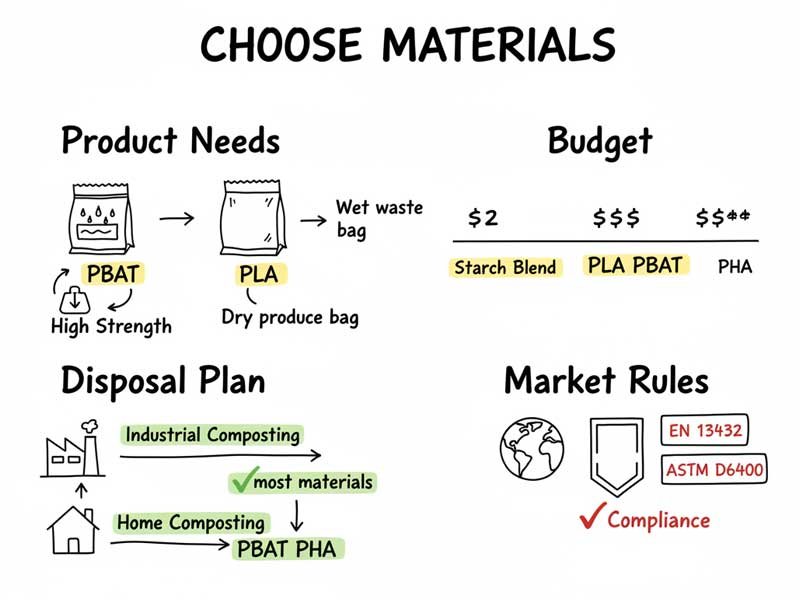
If you are sourcing PPWR compostable mailers for the EU market, one question usually comes first:
Does an EN 13432 compostability certificate make a compostable mailer PPWR compliant?
Not by itself.
A compostability certificate can show that a material or finished package meets defined composting criteria.
But PPWR asks a wider question.
It looks at how packaging should be designed, used, labelled, documented and handled after use.
For compostable mailers, Article 9(3) is especially important.
Why?
Because a normal e-commerce mailer is not one of the packaging formats that Article 9(1) specifically requires to be compostable.
For other biodegradable packaging, Article 9(3) points toward a material-recycling pathway.
That changes how EU buyers should review compostable shipping bags.
This guide explains what PPWR means for compostable mailers, why EN 13432 alone is not enough, and what you should check before placing a bulk order.
For the wider regulatory background, read our PPWR compostable packaging guide.

PPWR Compostable Mailers: The Short Answer
Can a compostable mailer be sold in Europe?
Yes, depending on the product, market and applicable rules.
Does a compostability certificate automatically make it fully PPWR compliant?
No.
For a compostable mailer, buyers should review at least four separate questions:
- Is the mailer packaging under PPWR?
- Which Article 9 pathway applies?
- What does Article 6 require for recyclability?
- What technical evidence supports the finished mailer?
This is the main point of the page.
Compostability and PPWR compliance are related, but they are not the same thing.
What Is a Compostable Mailer?
A compostable mailer is a flexible shipping bag designed to contain and deliver products while using materials intended to meet defined compostability criteria.
Common applications include:
- clothing;
- accessories;
- books;
- lightweight retail goods;
- subscription products;
- e-commerce orders.
The material may contain biodegradable polymers such as PBAT and PLA, sometimes combined with starch and other approved ingredients.
A mailer may also include:
- colour masterbatch;
- printing ink;
- adhesive strips;
- release liners;
- double sealing strips;
- tear strips.
These details matter.
A plain film and a finished printed mailer are not always the same certification question.
If you are comparing sizes, printing and B2B formats, see our compostable mailer bags.
Are Compostable Mailers Packaging Under PPWR?
Yes, in normal e-commerce use.
PPWR defines packaging by the function it performs.
Packaging is used to contain, protect, handle, deliver or present products.
A mailer used to ship clothing or another product to a customer clearly performs a packaging function.
That means PPWR generally applies to the mailer as packaging.
This is different from some standalone bags such as waste-collection bags, where the first question may be whether the product performs a packaging function at all.
For mailers, the packaging question is usually easier.
The harder question is:
Which PPWR end-of-life pathway applies?
Why Article 9 Matters for Compostable Mailers
Article 9 of Regulation (EU) 2025/40 deals with compostable packaging.
It creates three main paths.
| PPWR Article 9 path | What it means |
|---|---|
| Article 9(1) | Certain packaging must meet compostability requirements |
| Article 9(2) | Member States may require certain additional packaging to be compostable |
| Article 9(3) | Other biodegradable packaging follows a material-recycling pathway |
A normal e-commerce mailer is not one of the packaging formats specifically listed in Article 9(1).
That is important.
It means you should not assume:
“It is compostable, so Article 9 requires it to be compostable.”
That conclusion is too broad.
For a full explanation of these three paths, see our PPWR Article 9 guide.
Does Article 9(1) Require Compostable Mailers?
No general Article 9(1) rule requires e-commerce mailers to be compostable.
Article 9(1) focuses on specific formats, including certain:
- permeable tea bags;
- coffee bags;
- other beverage bags;
- soft single-serve beverage units;
- sticky labels attached to fruit and vegetables.
These packaging formats are closely linked to organic waste after use.
A standard shipping mailer is different.
It usually carries clothing, household goods or other products.
After use, it normally enters a packaging waste stream rather than a food-waste stream.
That difference helps explain why PPWR treats it differently.
What Does PPWR Article 9(3) Mean for Compostable Mailers?
This is the key section for this page.
Article 9(3) says that, by 12 February 2028, packaging outside the Article 9(1) and relevant Article 9(2) cases—including packaging made from biodegradable plastic polymers and other biodegradable materials—must be designed for material recycling in accordance with Article 6.
This means a compostable mailer cannot be reviewed only through the question:
“Can it compost?”
The buyer must also ask:
“How does this packaging fit the PPWR material-recycling pathway?”
This is a major difference between compostable mailers and some food-related compostable packaging.
It also explains why an EN 13432 certificate alone does not settle the PPWR question.
Official source: Regulation (EU) 2025/40 — EUR-Lex
Does Article 9(3) Ban Compostable Mailers?
No.
Article 9(3) should not be simplified into:
“Compostable mailers are banned.”
That would be too strong.
The important point is that other biodegradable packaging is placed on a material-recycling pathway under PPWR.
So a buyer needs to review whether the packaging design, material and end-of-life route meet the relevant PPWR requirements.
A compostable property may still be technically real.
But it does not remove the recycling question.
That is the balance EU buyers need to understand.
What Does Article 6 Mean for Compostable Mailers?
Article 6 deals with recyclable packaging.
PPWR moves packaging toward recyclability through a phased system.
Detailed design-for-recycling criteria and recyclability performance requirements are introduced according to the PPWR implementation timetable.
For a compostable mailer under the Article 9(3) route, the important principle is that the package must be considered from a material-recycling perspective.
This means buyers should review issues such as:
- material composition;
- compatibility with the relevant recycling stream;
- inks and additives;
- labels and adhesives;
- sealing systems;
- release liners;
- other components.
A bag can look simple.
Its material system may not be simple.
That is why finished-product design matters.
Why EN 13432 Alone Is Not Enough
EN 13432 is an important European standard for industrial compostability.
It helps assess whether packaging can meet defined criteria related to:
- biodegradation;
- disintegration;
- relevant substance limits;
- compost quality.
This is useful evidence.
But EN 13432 does not answer every PPWR question.
It does not by itself tell you:
- whether Article 9(1), 9(2) or 9(3) applies;
- whether the mailer meets Article 6 recyclability requirements;
- whether PPWR labelling rules are met;
- whether packaging minimisation requirements are met;
- whether the correct technical documentation exists;
- whether the finished printed package is covered.
So:
EN 13432 certification ≠ automatic PPWR compliance.
If you need a detailed comparison, read our PPWR vs EN 13432 guide.
EN 13432 Certificate: Raw Material vs Finished Mailer
This is one of the most important sourcing checks.
Imagine you ask a supplier for:
350 × 450 mm compostable mailer
60 μm
White film
Two-colour printing
Self-seal strip
The supplier sends you an EN 13432 certificate.
Good.
Now ask:
What does the certificate actually cover?
It may cover:
- raw material;
- compound;
- base film;
- a thickness range;
- finished packaging;
- certain colours;
- certain printing conditions.
Those are different scopes.
A finished mailer may include more than the main film.
It may contain:
- PBAT;
- PLA;
- starch;
- colour masterbatch;
- ink;
- adhesive;
- release liner;
- sealing strip;
- tear strip.
You need to know how these components are treated within the finished-product evidence.
A Simple Finished-Mailer Check
Before approving a compostable mailer, I would ask:
| Item | What to check |
| Base material | Which film formulation is used? |
| Thickness | Is your thickness covered by available evidence? |
| Colour | Is the masterbatch included in the product system? |
| Printing | What ink system is used? |
| Adhesive | Is the self-seal adhesive relevant to the certification scope? |
| Release liner | What material is it made from? |
| Tear strip | Is there an additional component? |
| Finished product | Does evidence apply to the finished mailer or only the resin? |
| Market | Which EU Member State? |
| End-of-life | What waste route is intended? |
That gives you a better picture than asking only:
“Is the material biodegradable?”
Why Adhesive Strips Matter
A mailer often has an adhesive sealing strip.
Sometimes two.
This is a practical example of why finished packaging matters.
The film may have compostability evidence.
The adhesive system may be a separate component.
The release liner may be another material again.
So the final product is not always just:
film + logo.
For a private-label mailer, I suggest reviewing the full construction before approving artwork and mass production.
Ask your supplier to explain:
- adhesive type;
- liner material;
- number of sealing strips;
- whether all parts stay attached after use;
- how those components affect the intended disposal route.
These are simple questions.
But they can prevent problems later.
Does Printing Matter for PPWR Compostable Mailers?
Yes.
Printing becomes part of the finished packaging.
A customer may order:
- one-colour logo;
- two-colour design;
- full surface printing;
- custom Pantone colour;
- warning text;
- disposal instructions.
All of these can affect the final construction or claim.
If a certificate applies to plain film, do not automatically assume it covers every printed version.
Ask whether the printing system, ink and coverage fall within the available evidence.
The same applies to custom colour masterbatch.
A colour change is not only a design choice.
It changes the finished material system.
Compostable Does Not Mean Home Compostable
Another common mistake is to print:
HOME COMPOSTABLE
on a mailer because the material has EN 13432 evidence.
EN 13432 is linked to industrial compostability.
Home composting is different.
A home compost pile normally has:
- lower temperatures;
- less control;
- more variable moisture;
- slower processing conditions.
So:
Industrial compostable does not automatically mean home compostable.
If you want to make a home-composting claim, make sure you have separate evidence for that claim.
Do not make the environmental statement stronger than the documentation.
Should a Compostable Mailer Say “Biodegradable”?
Be careful.
“Biodegradable” is a broad term.
It does not automatically tell a user:
- where degradation happens;
- how long it takes;
- under which conditions;
- what waste route should be used.
For B2B packaging, a more specific claim is usually easier to support.
If the product is certified for industrial composting, use a claim that accurately describes that certification.
Do not suggest that the mailer will:
“break down anywhere”
or:
“disappear in nature.”
That creates a much stronger claim than most compostability evidence supports.
PPWR Labelling and Compostable Mailers
PPWR introduces harmonised packaging labelling requirements.
Article 12 also contains specific labelling rules for packaging covered by Article 9 compostability provisions.
For standard e-commerce mailers, you should first determine which PPWR pathway applies before choosing compostability or disposal wording.
The artwork review should consider:
- packaging material;
- intended waste stream;
- Member State;
- compostability evidence;
- recycling pathway;
- required symbols;
- environmental claims.
Do not design the strongest environmental claim first and look for evidence later.
Reverse that order.
Evidence first.
Artwork second.
Packaging Minimisation Also Matters
PPWR is not only about compostability and recycling.
Packaging minimisation is another important part of the regulation.
For a mailer project, this can affect:
- mailer dimensions;
- excess empty space;
- unnecessary layers;
- extra packaging;
- double packing.
Suppose a product measures:
220 × 300 mm
but the shipping bag is:
450 × 600 mm.
That may create unnecessary material use and empty space.
The right mailer size should balance:
- product fit;
- sealing space;
- protection;
- packing speed;
- material use.
Bigger is not always safer.
Sometimes it is simply more packaging.
What About Double-Seal Compostable Mailers?
Double-seal mailers can be useful for e-commerce returns.
The first adhesive strip closes the original shipment.
The second can be used by the customer for the return.
From a commercial point of view, this may reduce the need for an extra return package.
But the finished construction becomes more complex.
You now need to consider:
- second adhesive strip;
- additional release liner;
- tear strip;
- return instructions;
- final material combination.
That does not mean double-seal mailers are unsuitable.
It means the finished configuration should be part of the compliance and documentation review.
Are Compostable Mailers Better Than Conventional Plastic Mailers Under PPWR?
There is no universal answer.
PPWR does not simply rank materials as:
compostable good
conventional plastic bad
The correct question is:
Which package fits the required end-of-life system?
A compostable mailer may make sense for some brands or markets.
In other cases, a recyclable mono-material mailer may better fit the PPWR recycling pathway.
The answer depends on:
- product use;
- waste system;
- material design;
- recycling infrastructure;
- customer instructions;
- technical evidence.
This is why I would avoid choosing a material based only on a sustainability slogan.
Start with the waste route.
Then choose the package.
PPWR Compostable Mailers vs Conventional Recyclable Mailers
A simple comparison can help.
| Question | Compostable Mailer | Conventional Recyclable Mailer |
| Main environmental route | Compostability claim may exist | Material recycling |
| Article 9(1) mandatory composting? | Usually no for standard mailers | No |
| Article 9(3) relevant? | Yes, for biodegradable packaging outside 9(1)/(2) | Not through biodegradable-packaging rule |
| EN 13432 relevant? | Yes, if industrial compostability is claimed | Usually no |
| Article 6 relevant? | Yes | Yes |
| Finished-product design matters? | Yes | Yes |
| Labelling matters? | Yes | Yes |
| Local waste infrastructure matters? | Yes | Yes |
The purpose of this table is not to say one option always wins.
It shows why the buyer needs to compare the end-of-life pathway, not only the material name.
What Documents Should EU Buyers Ask For?
For a compostable mailer project, I would separate documents into four groups.
1. Compostability documents
Ask for:
- EN 13432 evidence;
- certificate number;
- certificate holder;
- certificate validity;
- scope;
- finished-product coverage where relevant;
- home-compostability evidence if that claim is used.
2. Product documents
Ask for:
- finished-mailer specification;
- material structure;
- thickness;
- dimensions;
- colour;
- printing;
- ink system;
- adhesive information;
- release-liner material.
3. PPWR-related documents
Depending on the applicable requirements, review:
- technical documentation;
- conformity-assessment information;
- EU Declaration of Conformity;
- traceability information;
- product identification;
- labelling information.
4. Commercial documents
These may include:
- packing list;
- carton information;
- batch details;
- commercial invoice;
- shipping documentation.
Do not mix these groups together.
A commercial invoice is not technical compliance evidence.
An EN 13432 certificate is not an EU Declaration of Conformity.
Each document has a different job.
Does the EU Importer Have Responsibilities?
Yes.
When packaging is manufactured outside the EU and imported into the Union, the importer has its own responsibilities under PPWR.
An importer may need to verify matters such as:
- conformity assessment;
- technical documentation;
- manufacturer information;
- required labelling;
- product identification;
- accompanying documents.
This is why the EU buyer should not rely only on a supplier statement such as:
“Our mailers are compliant.”
Ask what supports the statement.
A clear technical file is more useful than a broad promise.
PPWR Compostable Mailer Buyer Checklist
Before approving a bulk order, use this simple checklist.
Product use
- What will the mailer contain?
- Is it single-use?
- Is it intended for returns?
- Which country will receive it?
Construction
- Film material
- Thickness
- Colour
- Printing
- Adhesive
- Release liner
- Tear strip
- Single or double seal
Compostability
- EN 13432 evidence?
- Industrial or home composting?
- Raw-material or finished-product scope?
- Valid certificate?
PPWR
- Article 9(3) reviewed?
- Article 6 pathway reviewed?
- Labelling reviewed?
- Packaging minimisation reviewed?
- Technical documentation reviewed?
Claims
- Compostable
- Industrially compostable
- Home compostable
- Biodegradable
- Recyclable
Make sure each printed claim has evidence behind it.
A Practical Example: Private-Label Compostable Mailer
Suppose you are sourcing:
350 × 450 + 50 mm flap
60 μm
Matte green
Two-colour printing
Double adhesive strip
50,000 bags
The supplier sends an EN 13432 certificate for the base film.
What should you check?
Step 1: Confirm the product
It is an e-commerce shipping package.
PPWR applies.
Step 2: Check Article 9
A standard mailer is not an Article 9(1) mandatory compostability format.
Article 9(3) becomes important.
Step 3: Check material recycling
Review how the biodegradable packaging fits the Article 6 pathway.
Step 4: Check the certificate scope
Does the evidence cover:
- 60 μm?
- matte green?
- two-colour printing?
- adhesive?
- release liner?
Step 5: Check claims
Will the artwork say:
- compostable?
- industrially compostable?
- home compostable?
Match each claim to the evidence.
Step 6: Check documentation
Review:
- product specification;
- technical documentation;
- traceability;
- applicable conformity information.
Now you are reviewing the finished mailer.
Not just the raw material.
Five Red Flags When Buying Compostable Mailers
1. “EN 13432 means full PPWR compliance.”
Too broad.
EN 13432 addresses industrial compostability, not the whole PPWR framework.
2. “All biodegradable mailers should go into compost.”
Not under Article 9(3).
Other biodegradable packaging is directed toward a material-recycling pathway.
3. “Our resin is certified, so every printed bag is certified.”
Check the scope.
4. “Home compostable and industrial compostable are the same.”
They are not.
5. “The same environmental claim works across all EU markets.”
Do not assume this.
Member State requirements and local waste systems can matter.
These statements do not automatically mean the supplier is unreliable.
But they are good reasons to ask for more detail.
How ORIZON Supports Compostable Mailer Projects
ORIZON manufactures compostable bags for B2B customers, including importers, distributors, private-label brands and packaging companies.
Our factory has more than 16 years of manufacturing experience, with around 20,000 m² of production space, 16 automatic production lines, and monthly production capacity of about 500 tons.
For compostable mailers, custom options can include:
- bag width and length;
- flap size;
- film thickness;
- colour;
- logo printing;
- single adhesive strip;
- double adhesive strip;
- tear strip;
- private-label packaging;
- bulk carton packing.
But a custom compostable mailer project should not begin with artwork alone.
I prefer to start with:
- target country;
- product use;
- mailer size;
- thickness;
- material;
- printing;
- seal design;
- certification requirement;
- documentation requirement;
- order quantity.
That gives us a clearer basis for reviewing the finished specification.
You can see our compostable mailer bags for common B2B formats.
For custom sizes, colours, printing and private-label projects, see our OEM compostable bags.
Certification and regulatory suitability should always be checked against the finished mailer, intended use and target market.
FAQ
What are PPWR compostable mailers?
PPWR compostable mailers are not an official EU certification category.
The term is commonly used for compostable e-commerce mailers being reviewed against the requirements of Regulation (EU) 2025/40.
The applicable PPWR pathway depends on the finished packaging and its intended use.
Are compostable mailers required under PPWR?
No general EU-wide rule under Article 9(1) requires standard e-commerce mailers to be compostable.
Other biodegradable packaging is generally addressed through Article 9(3)’s material-recycling pathway.
Does Article 9(3) apply to compostable mailers?
It can.
Article 9(3) covers packaging outside Article 9(1) and relevant Article 9(2) categories, including packaging made from biodegradable plastic polymers.
By 12 February 2028, this packaging must be designed for material recycling in accordance with Article 6.
Does EN 13432 make a compostable mailer PPWR compliant?
No.
EN 13432 supports industrial-compostability assessment.
PPWR also addresses recyclability, packaging design, labelling, documentation and other requirements.
Are EN 13432 compostable mailers banned under PPWR?
PPWR does not simply state that an EN 13432 mailer is banned.
The important issue is that other biodegradable packaging must follow the Article 9(3) material-recycling pathway.
The finished package therefore needs a wider PPWR assessment.
Can a compostable mailer be home compostable?
Only if the product has appropriate evidence supporting a home-compostability claim.
EN 13432 industrial-compostability evidence alone does not automatically support a home-compostable claim.
Does printing affect compostable mailer certification?
It can.
Ink, colour masterbatch, printing coverage and other components become part of the finished packaging.
Check whether the relevant evidence covers the final printed configuration.
Does the adhesive strip matter?
Yes, it can.
Adhesive, release liner and additional sealing components are part of the finished mailer construction and should be considered in the product and end-of-life review.
Are compostable mailers recyclable under PPWR?
This cannot be answered only from the word “compostable.”
Under Article 9(3), other biodegradable packaging must be designed for material recycling in accordance with Article 6.
The finished material system and applicable recycling criteria need to be reviewed.
What documents should EU buyers request from a compostable mailer supplier?
Depending on the project, buyers may need:
- compostability evidence;
- finished-product specification;
- material information;
- printing and adhesive information;
- technical documentation;
- conformity information;
- EU Declaration of Conformity where applicable;
- traceability information.
Conclusion
PPWR compostable mailers cannot be judged by EN 13432 alone.
That standard can provide important evidence about industrial compostability.
But a normal e-commerce mailer is not one of the packaging formats that Article 9(1) automatically requires to be compostable.
For other biodegradable packaging, Article 9(3) creates a material-recycling pathway.
So EU buyers should review:
- the finished mailer;
- Article 9 classification;
- Article 6 recyclability;
- EN 13432 certificate scope;
- printing and adhesive components;
- labelling;
- technical documentation;
- target market;
- environmental claims.
A certificate is useful.
The finished package is what you are buying.
If you are sourcing custom compostable mailers for Europe, send us your target country, mailer size, thickness, colour, printing, sealing design and estimated order quantity.
That gives us a practical starting point for reviewing the specification and available product documentation before production.
This article provides general information for packaging buyers and does not constitute legal advice. Requirements can depend on the finished packaging, intended use, target Member State and later PPWR implementing measures.