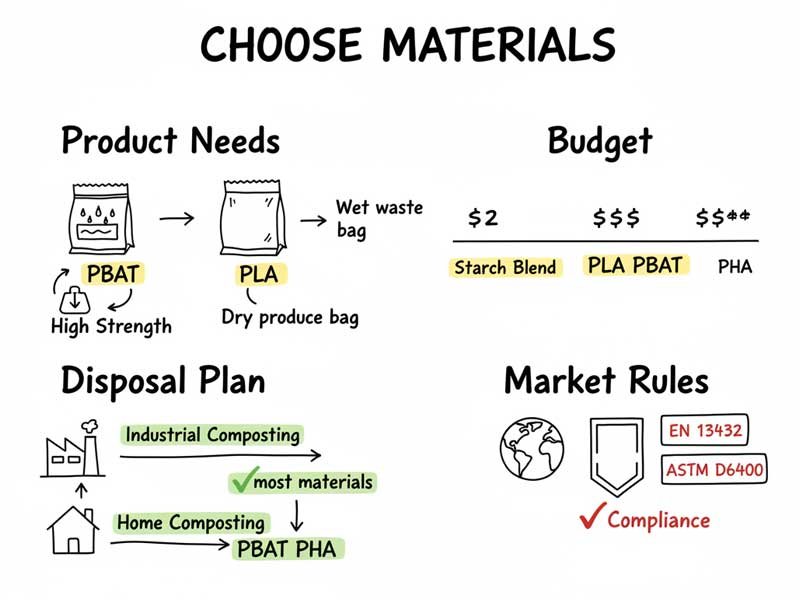
Choosing a compostable bag supplier for the EU market is no longer only about price, lead time, and certificate logos.
Under PPWR, EU buyers need to check whether the supplier can support finished packaging evidence, technical documentation, conformity records, and batch traceability.
This is especially important when sourcing from outside the EU.
A supplier may have a compostable material certificate.
But that does not always mean the finished bag is ready for EU market review.
This guide gives importers, distributors, retailers, private-label brands, and procurement managers a practical way to evaluate a PPWR compostable bag supplier.
Short Answer
A good compostable bag supplier for the EU market should provide more than a certificate.
The supplier should be able to explain:
- What the certificate covers
- Whether evidence is for raw material or finished packaging
- How the finished bag is produced and controlled
- Which technical documentation inputs are available
- How batch traceability works
- How claims, artwork, and carton marking are reviewed
If a supplier cannot answer these questions, the buying risk is higher.
Why Supplier Evaluation Changes Under PPWR
Regulation (EU) 2025/40, known as PPWR, applies to packaging placed on the EU market.
The European Commission states that the Regulation entered into force on 11 February 2025 and will generally apply from 12 August 2026.
For EU buyers, this means supplier evaluation must happen before shipment.
In many cases, it should happen before mass production.
Under Article 18, importers must check that the manufacturer has carried out the conformity assessment, drawn up technical documentation, labelled the packaging correctly, and provided required documents.
That puts pressure on supplier selection.
You need a supplier who can support the importer’s checks.
What a Qualified Compostable Bag Supplier Should Understand
A qualified supplier should understand the difference between selling bags and supporting EU compliance.
For compostable bags, the supplier should be able to discuss:
- PPWR Article 9 compostable packaging requirements
- Article 12 labelling requirements
- Article 14 environmental claims
- Article 15 manufacturer obligations
- Article 16 supplier information obligations
- Annex VII technical documentation
- Annex VIII EU Declaration of Conformity structure
Article 16 is important.
It says suppliers of packaging or packaging materials must provide manufacturers with the information and documentation needed to demonstrate conformity.
In plain English:
If a supplier wants EU business, it should be ready to provide product data and evidence.
Factory Capability: What to Check First
Factory capability still matters.
A supplier with weak production control may also have weak document control.
Before reviewing certificates, check the basic factory profile:
- Years of manufacturing experience
- Production area
- Number of production lines
- Monthly capacity
- Main product types
- Material handling process
- In-process quality control
- Finished product inspection
- Batch coding method
- Repeat-order consistency
You can review our compostable bag factory to understand production capacity, quality control, and traceability setup.
For EU buyers, factory capability should connect to compliance.
A factory should know which production batch used which material batch, which artwork version, and which carton label.
Certifications: Raw Material vs Finished Packaging
This is one of the most important checks.
Many suppliers show a compostable certificate.
But buyers must ask:
What exactly does this certificate cover?
| Certificate Type | What It May Cover | Buyer Risk |
|---|---|---|
| Raw material certificate | Resin or compound | May not cover the finished bag |
| Film certificate | A film structure or thickness range | May not cover final bag, ink, or format |
| Finished product certificate | Specific bag or product family | Still needs scope review |
| Logo licence | Right to use a certification mark | Logo use may be limited by product, holder, and market |
A raw-material-only certificate is not useless.
It is a starting point.
But finished bags may include thickness changes, printing ink, color masterbatch, sealing, drawstrings, adhesive strips, perforation, or retail packaging.
Buyers should compare certificate scope in our compostable certifications guide before approving a supplier.
Technical Documentation and DoC Support
Technical documentation is the evidence file behind the compliance position.
Under Annex VII, technical documentation should describe the packaging and show how it meets the applicable PPWR requirements.
For compostable bags, useful technical documentation inputs may include:
- Finished product specification
- Material composition summary
- Bag size and thickness
- Test reports
- Certificate scope
- Supplier declarations
- Heavy metal or restricted substance data
- Food-contact documents, if applicable
- Artwork and claim review
- Batch traceability method
The EU Declaration of Conformity is different.
The DoC is the signed statement that the packaging meets the relevant requirements.
The technical documentation is the evidence behind that statement.
A supplier should also understand PPWR manufacturer requirements before offering documents to EU buyers.
Traceability: From Resin Batch to Shipment
Traceability is not only a quality-control word.
Under PPWR, importers and suppliers may need to show how packaging can be identified and how evidence connects to the product.
A good compostable bag supplier should be able to link:
- Raw material batch
- Production order
- Machine or line record
- Finished SKU
- Artwork version
- Carton marking
- Inspection report
- Certificate or test file
- Shipment batch
This matters when a buyer repeats an order.
It also matters if an EU authority or customer asks for evidence.
Artwork, Claims, and Carton Marking
Compostable bags often carry claims and logos.
That creates extra risk.
Before mass production, check:
- Compostable claim wording
- Industrial vs home compostable wording
- Certification logo use
- Biodegradable or eco claims
- Sorting or disposal wording
- QR code destination
- Importer information
- SKU and batch information
- Retail box text
- Master carton marking
Claims should match finished packaging evidence.
A supplier should not approve “home compostable,” “plastic-free,” or “eco-friendly” wording without checking the evidence and target market.
EU buyers sourcing from China should also review our PPWR importer requirements guide.
Decision Table for EU Buyers
| Supplier Situation | Risk Level | Buyer Action |
|---|---|---|
| Supplier provides only raw material certificate | High | Ask for finished packaging evidence |
| Supplier explains certificate scope clearly | Lower | Check against final SKU and artwork |
| Supplier has factory batch traceability | Lower | Ask for sample traceability record |
| Supplier cannot provide technical documentation inputs | High | Do not approve mass production yet |
| Supplier says all products use one certificate | High | Check each product type and thickness |
| Supplier supports artwork and claim review | Lower | Keep approved artwork version records |
Questions to Ask Before Requesting a Quote
Before asking for final pricing, send these questions:
- Are you the manufacturer or trading company?
- Which compostable bag products do you produce in-house?
- What certificates apply to this product?
- Are the certificates for raw material, film, or finished bags?
- Can the certificate cover the final thickness and size?
- Can you support EN 13432 or other target-market evidence?
- Can you provide technical documentation inputs under PPWR Annex VII?
- Can you support DoC information under Annex VIII?
- How do you track material batch to finished shipment?
- Can you review artwork claims before printing?
- Can you provide carton marking with SKU and batch information?
- What changes require certificate or evidence review?
If the supplier answers clearly, move to sampling and quotation.
If the supplier avoids the questions, treat it as a warning sign.
Supplier Red Flags
Be careful if a supplier says:
- “Our material certificate covers every finished bag.”
- “All compostable bags use the same certificate.”
- “No need to check ink or thickness.”
- “We cannot show batch traceability.”
- “Technical documentation is the importer’s problem only.”
- “You can print any certification logo.”
- “Biodegradable and compostable are the same.”
- “PPWR compliant” without explaining the evidence basis.
These answers do not always mean the supplier is dishonest.
But they show weak document control.
That can become a real import risk.
B2B Procurement Case
An Italian distributor wants to source compostable shopping bags for retail stores.
Supplier A offers the lowest price and sends a raw material certificate.
The certificate does not show the final bag thickness, handle type, print coverage, or finished product scope.
Supplier B asks for the buyer’s target market, bag size, thickness, artwork, carton marking, and certificate needs.
Supplier B then provides:
- Finished bag specification
- Certificate scope explanation
- Material composition summary
- Artwork claim review
- Batch traceability plan
- Carton marking template
- Technical documentation inputs
Supplier B may not be the cheapest.
But the buyer has a clearer document trail before mass production.
For EU sourcing, that matters.
How Orizon Supports EU Compostable Bag Buyers
Orizon manufactures compostable bags for importers, distributors, wholesalers, retailers, and private-label brands.
We support OEM and ODM projects for:
- Compostable garbage bags
- Compostable shopping bags
- Compostable produce bags
- Compostable mailer bags
- Compostable garment bags
- Compostable dog waste bags
- Custom printed compostable packaging
Our factory has 16 years of manufacturing experience, about 20,000 square meters of production space, 16 fully automatic production lines, and monthly capacity of about 500 tons.
For EU projects, we help buyers review product specifications, material selection, certificate scope, artwork wording, carton marking, and batch traceability before production.
We do not recommend relying only on raw-material certificates.
Instead, we help buyers build a practical evidence package for the finished packaging type.
If you are evaluating suppliers for an EU project, contact Orizon for supplier documents and a quote.
FAQ
How should EU buyers evaluate a PPWR compostable bag supplier?
EU buyers should check factory capability, certificate scope, finished packaging evidence, technical documentation support, artwork review, carton marking, and batch traceability before approving mass production.
Is a raw material certificate enough for compostable bags?
No. A raw material certificate may not cover the finished bag thickness, printing ink, sealing, handle type, adhesive, format, or SKU. Buyers should request finished packaging evidence.
What documents should a compostable bag supplier provide?
A supplier should provide product specifications, material data, certificate scope, test reports, supplier declarations, artwork review records, carton marking, batch traceability, and technical documentation inputs.
What is the difference between a certificate and technical documentation?
A certificate supports one part of the evidence. Technical documentation is the wider evidence file that shows how the packaging meets applicable requirements.
Should buyers check artwork before production?
Yes. Artwork may include compostable claims, certification logos, disposal wording, QR codes, importer information, and carton text. These should match the evidence before printing.
When should buyers contact a supplier for PPWR documents?
Buyers should ask for supplier documents before mass production, and preferably before final quotation if the project involves custom size, printing, certification logos, or EU retail use.
Conclusion
Evaluating a compostable bag supplier for the EU market is about more than checking a certificate.
Under PPWR, buyers should look at factory control, finished packaging evidence, technical documentation support, batch traceability, artwork claims, and carton marking.
The biggest warning sign is a supplier that only shows raw material certificates and cannot explain how they connect to the finished bag.
A better supplier helps you build a clear evidence trail before production starts.
That saves time, reduces risk, and supports long-term EU supply.