China’s Environmental Code took effect on August 15, 2026. Many overseas buyers are asking one question: does China now ban plastic bags?
The short answer is no. China does not ban every plastic bag.
The law and related plastic pollution policies focus on non-degradable plastic bags, certain disposable plastic products, and stronger control of plastic production, sale, use, reporting, recycling, and replacement products.
Short Answer
The China plastic bag ban 2026 should not be understood as a total ban on all plastic bags.
It is better understood as a stronger legal framework for restricting non-degradable plastic bags and disposable plastic products, while encouraging recyclable, easy-to-recycle, degradable, and harmless alternatives.
For B2B buyers, this means supplier claims must be checked carefully. A bag should not be accepted only because it is called biodegradable, degradable, or eco-friendly.
What Changed on August 15, 2026?
The Environmental Code of the People’s Republic of China took effect on August 15, 2026. The National People’s Congress states that the Code was adopted on March 12, 2026 and came into force on August 15, 2026.
The Code brings many environmental laws into one legal framework. For plastic products, the key point is Article 998.
Article 998 says China prohibits and restricts the production, sale, and use of non-degradable plastic bags and other disposable plastic products according to law. It also encourages reducing and recycling disposable plastic products and promoting recyclable, easy-to-recycle, degradable, and harmless alternatives.
What Does China Restrict?
China’s plastic pollution policy has been built step by step. The 2020 policy from the National Development and Reform Commission and the Ministry of Ecology and Environment already set limits for many plastic products.
Key restricted areas include:
- Non-degradable plastic shopping bags in retail places
- Non-degradable disposable plastic tableware in selected foodservice uses
- Non-degradable express delivery plastic packaging in selected phases
- Some disposable plastic hotel supplies
- Very thin plastic shopping bags below specified thickness limits
The rules apply by product type, location, industry, and timeline. They do not simply say that every plastic bag is illegal.
What This Does Not Mean
This does not mean all plastic bags are banned in China.
It also does not mean every biodegradable bag is automatically accepted.
Buyers should avoid these wrong assumptions:
- All plastic bags are banned.
- All biodegradable bags are legally safe.
- Compostable means the same thing in every market.
- A raw material certificate proves the finished bag is compliant.
- A China domestic claim can be used directly in the EU, US, UK, or Australia.
Why B2B Buyers Should Care
If you source bags from China, the 2026 Environmental Code matters because it confirms China’s long-term direction on plastic pollution control.
For importers, distributors, retailers, e-commerce brands, and packaging buyers, this affects:
- Supplier selection
- Product claim review
- Material choice
- Certification requests
- Private-label artwork
- Carton marking
- Long-term supply planning
If your product is sold outside China, you also need to check the rules in your target market. China policy does not replace EU, US, UK, Canadian, or Australian compostability rules.
Biodegradable vs Compostable Bags
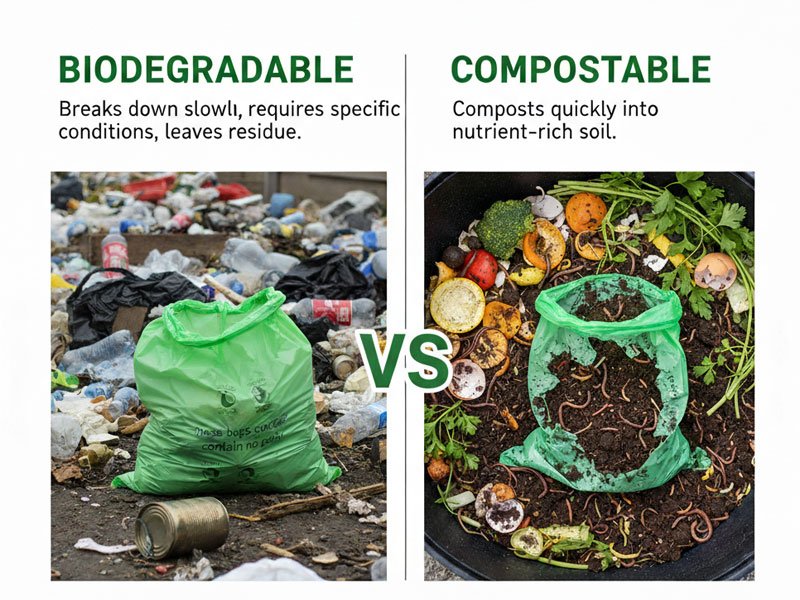
Biodegradable and compostable are not the same.
| Claim | What It Means | Buyer Check |
|---|---|---|
| Biodegradable | The material may break down under certain conditions. | Ask for the test method, time, and disposal condition. |
| Compostable | The product is designed to break down in a composting environment. | Check EN 13432, ASTM D6400, BPI, OK compost, or other target-market proof. |
| Degradable | A broad term that may be unclear. | Do not accept it without a standard and test report. |
| Plant-based | Made partly or fully from biological resources. | Not automatically biodegradable or compostable. |
Buyers should review compostable certifications before approving biodegradable or compostable claims.
Supplier Document Checklist
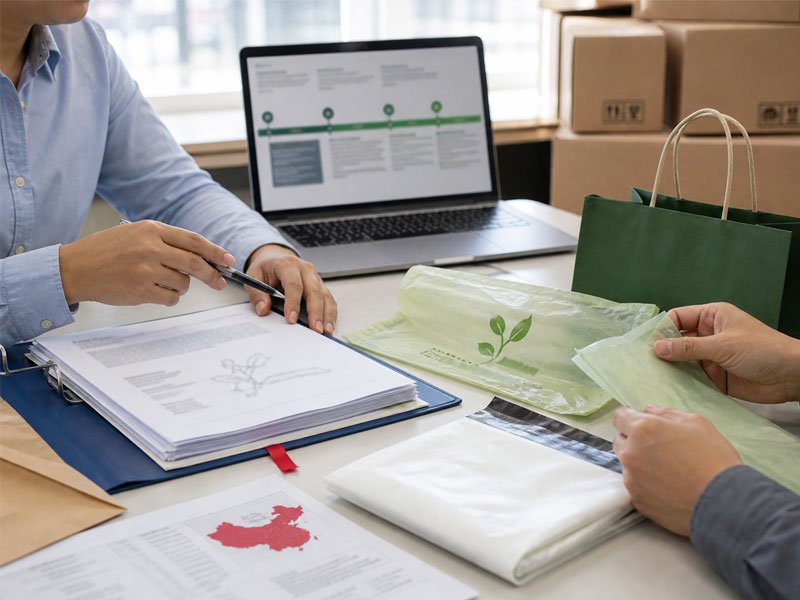
Before approving a Chinese supplier for biodegradable or compostable bags, ask for documents tied to the finished product.
- Finished product certificate
- Test report
- Material declaration
- Thickness range covered by certification
- Color and printing scope
- Supplier declaration
- Artwork claim review
- Batch traceability information
- Target market compliance notes
A raw material certificate is useful, but it may not prove that the finished bag in your order is covered.
Which Products May Benefit from This Policy Direction?
China’s plastic policy encourages reduction, recycling, and suitable alternative products. For B2B buyers, this can create demand for several bag categories.
- Compostable shopping bags for retail checkout programs
- Compostable produce bags for supermarkets and grocery chains
- Compostable mailer bags for e-commerce packaging
- Compostable garbage bags and bin liners for organic waste programs
- Compostable dog waste bags for pet brands and distributors
- OEM and private-label compostable packaging
Buyers can review Orizon’s compostable bag products for B2B sourcing.
Practical B2B Example
A European importer asks a Chinese factory for “biodegradable shopping bags” after reading about China’s 2026 Environmental Code.
The factory offers bags made with degradable material, but only provides a raw material document. The importer wants to sell the bags as compostable in the EU.
This is not enough.
The buyer should ask whether the finished bag is tested under the right compostability standard, whether the certificate covers the bag thickness and printing, and whether the artwork claim is allowed in the target market.
How Orizon Supports Buyers
Orizon is a China-based compostable bag manufacturer serving global B2B buyers. We manufacture compostable shopping bags, produce bags, mailer bags, garbage bags, bin liners, dog waste bags, garment bags, toilet bags, and OEM custom compostable packaging.
Our factory has 16 years of manufacturing experience, about 20,000 square meters of production space, 16 fully automatic production lines, and monthly capacity of about 500 tons.
We support buyers with:
- OEM and ODM projects
- Private-label compostable bags
- Custom size, thickness, color, and printing
- Certification document support
- Batch production control
- Export carton marking
- Long-term wholesale supply
You can review our compostable bag factory for production capacity and batch control.
FAQ
Does China ban all plastic bags from August 15, 2026?
No. China’s Environmental Code does not ban all plastic bags. It prohibits and restricts non-degradable plastic bags and certain disposable plastic products according to law.
What is the China plastic bag ban 2026?
It refers to stronger legal control of non-degradable plastic bags and disposable plastic products under China’s Environmental Code and related plastic pollution control policies.
Are biodegradable bags allowed in China?
Biodegradable or degradable alternatives may be promoted where they meet relevant standards and use requirements. Buyers should still check test reports, standards, and finished product scope.
Are compostable bags the same as biodegradable bags?
No. Compostable bags are designed for specific composting conditions and should be supported by relevant standards or certifications. Biodegradable is broader and may be unclear without test conditions.
Do China rules replace EU or US compostability rules?
No. If the product is exported, buyers must also check the rules, standards, labels, and claims required in the target market.
What should buyers ask Chinese suppliers for?
Buyers should ask for finished product certificates, test reports, material declarations, thickness scope, printing scope, supplier declarations, and batch traceability information.
Conclusion
China’s Environmental Code, effective August 15, 2026, does not mean every plastic bag is banned. The key focus is non-degradable plastic bags and certain disposable plastic products. For B2B buyers, the safer path is to check the exact product, claim, certification, disposal route, and target market rules. Compostable and biodegradable bags can be useful alternatives, but only when the finished product is supported by clear documents and honest claim wording.