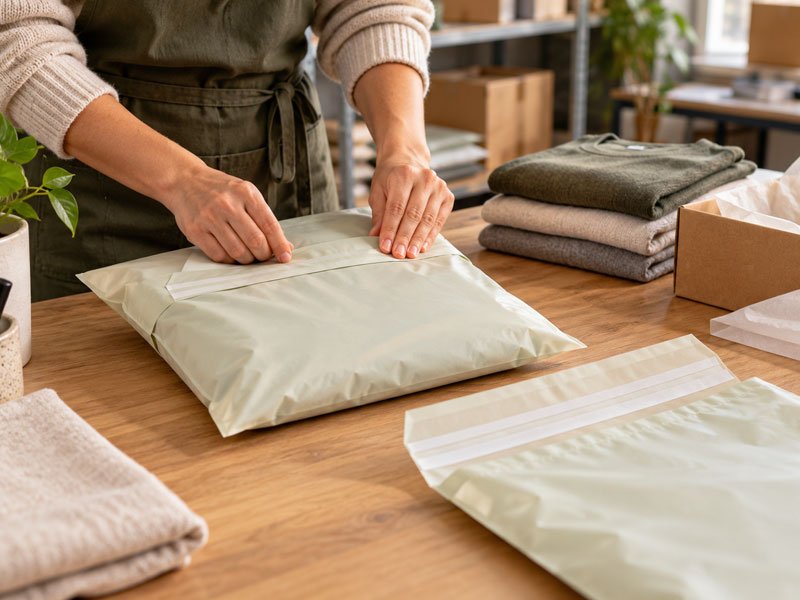
A B2B Guide to Micron, Parcel Weight, Puncture Risk and Shipping Performance.
Choosing compostable mailer thickness is not simply a matter of selecting the highest micron value.
For e-commerce and fulfilment packaging, the finished mailer has to work with the actual shipment:
product type + packed dimensions + parcel weight + product edges + fill ratio + film thickness + seam + closure + handling conditions
A lightweight T-shirt, a folded hoodie, a multi-item apparel order and a small retail box can all require different mailer specifications even when the outside mailer dimensions are similar.
A thicker film may provide additional performance margin, but thickness alone cannot correct:
- an undersized mailer stretched tightly around the contents;
- a product with sharp corners;
- weak seams;
- excessive parcel movement;
- poor sealing;
- unsuitable film construction; or
- handling conditions beyond the intended use.
For B2B projects, mailer thickness should therefore be selected against the actual packed product and confirmed through physical sample testing before bulk production.
Review Your Mailer Specification

What Does Compostable Mailer Thickness Mean?
Flexible mailer film thickness is normally expressed in microns (μm) or mil.
A micron is one-thousandth of a millimetre.
A mil is one-thousandth of an inch.
Micron, Mil and GSM: Do Not Confuse the Units
Microns and mil measure film thickness. GSM measures mass per unit area.
Because GSM depends on material density, there is no universal GSM-to-micron conversion that should be applied across different compostable and conventional plastic films.
For international B2B specifications, use microns or mil as the primary thickness reference and confirm material construction separately.
| Mil | Approx. Micron |
|---|---|
| 1.0 mil | 25.4 μm |
| 1.5 mil | 38.1 μm |
| 2.0 mil | 50.8 μm |
| 2.5 mil | 63.5 μm |
| 3.0 mil | 76.2 μm |
| 3.5 mil | 88.9 μm |
| 4.0 mil | 101.6 μm |
These values are unit conversions only.
They should not be interpreted as a universal recommendation that a particular micron is automatically suitable for a particular shipment.
Two mailers with the same nominal thickness may perform differently depending on film formulation, film consistency, bag dimensions, seams, closure structure and the product packed inside.
Common Compostable Mailer Thickness Ranges for Sample Testing
Buyers often need a practical starting point before requesting samples.
The ranges below can be used to decide which film gauges to compare first. They are sample-testing starting points, not universal performance ratings.
| Nominal Thickness | Approx. Mil | Typical Sample Application | Main Points to Check |
|---|---|---|---|
| 50–60 μm | 2.0–2.4 mil | Single lightweight garments, T-shirts, leggings and other soft goods | Tear resistance, seam condition and normal parcel handling |
| 60–70 μm | 2.4–2.8 mil | General apparel, sweatshirts and small multi-item soft-goods orders | Fill ratio, seam loading, puncture points and closure tension |
| 70–80 μm | 2.8–3.1 mil | Heavier garments, denser multi-item orders and more demanding shipping conditions | Puncture resistance, abrasion, corner stress and repeated handling |
| 80 μm+ | 3.1 mil+ | Higher-risk applications where additional film gauge is being evaluated | Confirm whether increased thickness actually solves the identified failure mode |
These ranges should not be treated as fixed product-to-thickness rules.
A 60 μm mailer carrying a soft folded T-shirt may experience a very different load from a 60 μm mailer wrapped tightly around a rigid retail box.
Likewise, increasing a mailer from 60 μm to 80 μm does not automatically make it suitable for sharp, fragile or crush-sensitive products.
The final specification should be confirmed using the actual:
product + packed dimensions + parcel weight + mailer construction + shipping workflow
and tested as a finished mailer before bulk production.
Why Mailer Thickness Cannot Be Selected by Micron Alone
When buyers request a compostable mailer quotation, they often begin with:
“We need a 60 micron mailer.”
That is useful information, but it does not describe the complete packaging requirement.
For example, a mailer may be 60 μm thick but still experience excessive stress if:
- the bag is too small for the packed product;
- the contents have rigid corners;
- several products are concentrated in one area;
- the parcel is overfilled;
- the seam is carrying most of the load;
- the closure area is under tension; or
- the package experiences rough handling during transport.
A more useful question is:
What film thickness and finished mailer specification will provide sufficient performance for this particular shipment?
Thickness should therefore be evaluated as part of the complete mailer construction.
The Main Factors That Determine Compostable Mailer Thickness
1. Product Type
The first question is what will actually be shipped.
Soft Apparel
Products such as:
- T-shirts;
- leggings;
- socks;
- underwear;
- lightweight fabric products; and
- other flexible soft goods
normally distribute pressure relatively evenly inside the mailer.
They generally create less concentrated puncture stress than rigid products.
For this type of shipment, the objective is usually to find a film specification that provides sufficient:
- tear resistance;
- seam stability;
- handling durability;
- privacy where required; and
- closure performance
without using unnecessary material.
Hoodies, Sweatshirts and Heavier Apparel
A hoodie can create a very different loading condition from a single T-shirt.
It may be:
- heavier;
- thicker when folded;
- more difficult to compress;
- more likely to stretch the mailer near the opening; and
- more likely to create concentrated stress where folds or hardware contact the film.
The correct mailer therefore depends on the packed hoodie dimensions, not simply the garment category.
Multi-Item Apparel Orders
Several garments packed together increase:
- total parcel weight;
- package thickness;
- pressure on seams;
- pressure around the flap;
- local film stretching; and
- the likelihood that the mailer is overfilled.
A mailer that works well for one shirt should not automatically be assumed to work for four shirts simply because they fit inside.
Products With Rigid Components
Products containing:
- zippers;
- buckles;
- metal accessories;
- rigid packaging;
- boxed products;
- hard plastic components; or
- protruding corners
should be reviewed more carefully.
In these applications, puncture risk may become more important than total parcel weight.
2. Parcel Weight Is Important — but Weight Alone Is Not Enough
Parcel weight affects the load applied to:
- the film;
- side or bottom seams;
- the adhesive closure;
- the flap area; and
- any point where the product presses against the bag.
However, two parcels weighing the same amount can behave very differently.
Consider:
Parcel A:
A soft folded sweatshirt distributed across most of the bag.
Parcel B:
A compact rigid box of the same weight with four defined corners.
The total weight may be identical, but Parcel B can create much higher local stress at the corners.
For this reason, thickness selection should consider:
weight + density + shape + edge condition
rather than parcel weight alone.
3. Sharp Edges and Puncture Risk
Puncture occurs when force is concentrated over a relatively small area.
Potential puncture points can include:
- box corners;
- clothing hardware;
- buckles;
- zippers;
- metal parts;
- product packaging corners;
- rigid plastic edges; and
- unevenly packed contents.
Increasing film thickness may provide more performance margin, but it is not always the best solution.
If a product has an aggressive edge, the more appropriate packaging solution may involve:
- changing the way the product is positioned;
- adding internal protection;
- covering the sharp component;
- using a larger mailer to reduce stretching;
- changing the outer packaging format; or
- using a carton instead of relying on a flexible mailer alone.
A compostable mailer is flexible shipping packaging.
It should not be treated as cushioning for fragile or sharp products.
4. Fill Ratio Can Be as Important as Thickness
One of the most common specification problems is selecting a mailer that technically fits the product but becomes too tight after packing.
An overfilled mailer can create continuous tension across:
- the film surface;
- the side seams;
- the flap;
- the adhesive closure; and
- product corners.
This can make a relatively thick film perform poorly.
A Mailer That Is Too Tight
Potential problems include:
- difficult packing;
- excessive stretching;
- stress whitening or deformation;
- increased puncture risk;
- seam loading;
- closure tension; and
- difficulty obtaining consistent seals.
A Mailer That Is Too Large
Oversizing also has disadvantages.
It may increase:
- material use;
- package volume;
- product movement;
- loose film that can snag during handling; and
- shipping inefficiency.
The objective is therefore not to choose the smallest possible mailer or the largest possible safety margin.
The goal is to select a usable packed size with sufficient loading and sealing allowance.
For custom projects, measure the product after it has been folded, bundled or packed exactly as it will enter the mailer.
For more information about made-to-spec dimensions and closure structures, see our Custom Compostable Mailers page.
Measure the Packed Product, Not Only the Flat Product
Mailer size should be selected from the product in its actual fulfilment condition, not only from the garment’s flat dimensions.
Fold and package the item exactly as it will be prepared in the warehouse or fulfilment center, including any inner bag, tissue, labels or accessories that will remain inside the outer mailer.
Then record:
- packed width;
- packed length;
- packed depth or thickness;
- packed weight; and
- any rigid corners or protruding components.
For example, a hoodie may appear relatively compact when measured flat, but after folding it can create significant package depth. If the mailer is selected only from the garment’s flat width and length, the finished parcel may become too tight and place unnecessary tension on the film, seams and closure.
For mailer selection, the relevant dimensions are therefore the final packed-product dimensions, not the unfilled product dimensions alone.
5. Mailer Size Changes the Effect of Thickness
Thickness should not be evaluated independently from mailer dimensions.
A small mailer carrying one lightweight item and a large mailer carrying several garments can use the same nominal film thickness but experience very different loads.
As mailer dimensions increase, buyers should review:
- total packed weight;
- how far the product can move;
- film tension;
- seam length;
- load distribution;
- handling conditions; and
- the pressure placed on the closure.
This is why specifying only:
“60 micron compostable mailer”
is incomplete.
A useful specification should include at least:
mailer size + thickness + product type + packed weight + closure structure
6. Tear Resistance and Puncture Resistance Are Not the Same
These terms are sometimes used interchangeably in purchasing discussions, but they describe different failure risks.
Puncture
Puncture normally begins when a concentrated point presses through the film.
Examples include:
- a box corner;
- a zipper;
- a buckle; or
- a hard product edge.
Tear
A tear may begin from:
- an existing puncture;
- an edge defect;
- a small cut;
- a stressed seam area; or
- excessive stretching.
Once a tear begins, the important question is how the film behaves as the package continues to move and flex.
A mailer specification should therefore not be judged only by whether the empty film “feels thick.”
Testing the finished bag with the actual packed product is more useful.
7. Seam Strength Matters Together With Film Thickness
The film body is only one part of the finished mailer.
A shipping bag can fail at:
- the film;
- a side seam;
- the bottom seal;
- the flap area; or
- the adhesive closure.
If the film becomes stronger but the seam remains the weakest point, increasing thickness alone may not solve the problem.
During sample evaluation, buyers should therefore inspect:
- seal consistency;
- seam alignment;
- seam opening under load;
- film stretching next to the seam;
- tearing initiated near the seal; and
- performance after the mailer has been filled.
The complete finished bag should be tested rather than evaluating only a piece of film.
How to Think About 50, 60, 70 or 80 Micron Mailers
Buyers often compare quotations by nominal micron.
For example:
50 μm vs 60 μm
60 μm vs 70 μm
70 μm vs 80 μm
Within the same film system and finished bag construction, increasing thickness generally means more material is being used and may provide additional margin against stretching, puncture and handling stress.
However, the relationship should not be treated as a simple guarantee.
A higher micron number does not automatically compensate for:
- poor bag sizing;
- sharp product corners;
- excessive fill;
- inconsistent seals;
- unsuitable closure design; or
- inappropriate packaging for the product.
When comparing two thicknesses, use finished samples manufactured to the same:
size + film system + seam structure + closure configuration
and test them with the same product.
That produces a much more meaningful comparison than comparing micron figures from two unrelated specifications.
60 Micron vs 80 Micron Compostable Mailers
A common B2B comparison is whether to use a 60 μm or 80 μm compostable mailer.
Within the same film system and finished-bag construction, an 80 μm mailer contains approximately one-third more film thickness than a 60 μm mailer.
That additional gauge may provide more margin against:
- local stretching;
- puncture;
- surface abrasion;
- repeated handling; and
- pressure from denser packed orders.
However, this does not mean that 80 μm is automatically the better specification.
| Factor | 60 μm | 80 μm |
|---|---|---|
| Material use | Lower | Higher |
| Mailer weight | Lower | Higher |
| Flexibility | Generally more flexible | Generally more substantial |
| Soft apparel | Often a useful sample starting point | May be more than required depending on shipment |
| Multi-item orders | Requires packed-product testing | Provides additional gauge for evaluation |
| Sharp or rigid contents | Thickness alone may not be sufficient | Thickness alone may still not be sufficient |
| Cost | Generally lower within the same construction | Generally higher within the same construction |
For example, a 60 μm mailer may perform well for a single soft garment but fail when tightly packed around a box with rigid corners.
An 80 μm mailer may provide additional puncture margin, but if the box corner remains the dominant failure point, changing the packaging method may be more effective than adding film thickness.
The correct comparison is therefore:
60 μm finished sample vs 80 μm finished sample under the same packed-product test
—not the micron figures alone.
Mailer Thickness by Shipment Profile
The table below is intended to help buyers decide which type of sample to evaluate first.
It is not a universal micron specification.
| Shipment Profile | Thickness Approach | Main Risk to Evaluate |
|---|---|---|
| Single T-shirt / lightweight soft goods | Start with a lighter practical film specification | Tear, seam, handling |
| Socks / leggings / flexible accessories | Light-to-medium sample depending on packed density | Local pressure, seam |
| Hoodie / sweatshirt | Medium-performance sample | Weight, bulk, opening stress |
| Several garments in one mailer | Medium or reinforced sample | Fill ratio, seam load, closure tension |
| Heavy folded textiles | Reinforced sample evaluation | Weight distribution, stretching |
| Clothing with metal hardware | Evaluate puncture risk separately | Buckles, zippers, hardware |
| Small retail box with smooth corners | Physical sample test required | Corner pressure, movement |
| Rigid or sharp-edged product | Do not solve by thickness alone | Puncture / packaging suitability |
| Fragile product | Consider protective packaging rather than flexible film alone | Impact / crushing |
The correct final specification should be established through physical testing.
Choosing Mailer Thickness for T-Shirts
T-shirts are one of the lower-risk mailer applications because they are:
- flexible;
- lightweight;
- easy to fold;
- generally free of hard corners; and
- able to distribute pressure over a relatively broad area.
The main questions are normally:
- How many T-shirts are packed together?
- Are they individually packed first?
- What are the folded dimensions?
- What is the packed parcel weight?
- How tightly will the outer mailer fit?
- Is the mailer used only outbound or also for returns?
A single lightweight garment and a three-shirt order should not automatically use the same specification.
Choosing Mailer Thickness for Hoodies and Sweatshirts
Hoodies create a more demanding mailer application because they can be:
- bulky;
- heavier;
- difficult to compress consistently; and
- thick around seams, hoods and folded areas.
A mailer that is too small may become tightly stretched after loading.
When evaluating a hoodie mailer, test:
- loading ease;
- film stretching;
- seam condition;
- flap closure;
- pressure around folded corners; and
- handling after sealing.
If different hoodie sizes or garment weights are sold under one SKU, test the largest or most demanding packed configuration rather than only the smallest sample.
Choosing Thickness for Multi-Item E-Commerce Orders
Multi-item orders introduce greater variation.
The same mailer SKU may be used for:
- two T-shirts;
- a shirt plus trousers;
- multiple lightweight garments;
- several accessories; or
- a mixed product order.
In these cases, the maximum intended packing condition should be defined.
Important questions include:
- What is the maximum packed weight?
- What is the maximum packed thickness?
- Can rigid and soft products be mixed?
- Does the product move inside the mailer?
- Is the package compressed during fulfilment?
- Will the mailer also be used for returns?
Selecting a thickness based only on the average order can create problems when heavier orders use the same mailer.
What About Small Boxes Inside Compostable Mailers?
A small box inside a flexible mailer changes the loading condition.
Even if the box is lightweight, its corners can create concentrated pressure.
Before using a mailer around a carton, evaluate:
- corner radius;
- box dimensions;
- movement inside the mailer;
- how tightly the film wraps around the corners;
- packed weight;
- drop handling; and
- whether the carton itself requires additional protection.
A thicker film may reduce some risk, but the correct solution may instead be:
- a larger mailer;
- smoother internal packing;
- additional protective material; or
- a different shipping format.
Do not assume that increasing micron automatically makes a flexible mailer appropriate for every boxed product.
Single-Seal and Dual-Seal Mailers May Have Different Requirements
Mailer thickness should also be reviewed together with the intended shipping cycle.
Single-Seal Mailers
A self-adhesive compostable mailer is normally used for the outbound shipment.
Testing should reflect:
packing → sealing → warehouse handling → shipping → delivery
Dual-Seal Return Mailers
A dual-seal compostable mailer may be expected to complete:
outbound shipment → opening → repacking → resealing → return shipment
The mailer may therefore experience more handling than a single-use outbound mailer.
For return-enabled programs, evaluate the complete return workflow rather than assuming that a thickness suitable for outbound delivery is automatically suitable for the second journey.
How to Test Compostable Mailer Thickness Before Bulk Production
The most useful thickness decision normally comes from comparing physical samples under realistic packing conditions.
1. Pack the Actual Product
Do not test only an empty bag.
Pack the same:
- product;
- quantity;
- folding method;
- inner packaging; and
- accessories
that will be used in real fulfilment.
2. Check Loading and Fill Ratio
Confirm that warehouse staff can load the mailer without excessive stretching.
Look for:
- film tension;
- stressed corners;
- difficult loading;
- deformation around the product; and
- insufficient flap area.
3. Inspect Puncture Points
Press and flex the packed mailer around:
- box corners;
- zippers;
- buckles;
- garment hardware;
- product edges; and
- other rigid contact points.
The objective is to identify concentrated stress before mass production.
4. Check Tear and Seam Behaviour
Handle the packed mailer as it would be handled during normal fulfilment.
Inspect:
- side seams;
- bottom seals;
- areas next to seams;
- film near hard corners; and
- the opening area.
A sample that survives when lying flat may behave differently after repeated lifting, flexing and handling.
5. Perform a Packed Drop Evaluation
Drop testing should use the finished packed mailer, not empty film.
The drop height, orientation and number of drops should be agreed according to the buyer’s own shipment and quality requirements.
Inspect the mailer after impact for:
- punctures;
- seam opening;
- tears;
- stretched areas;
- closure movement; and
- damage caused by product corners.
For formal testing programs, the required test method and acceptance criteria should be agreed before testing.
6. Run a Real Shipping Trial
For important B2B programs, a live shipping trial can reveal issues that are difficult to reproduce by hand.
Trial shipments can help evaluate:
- fulfilment handling;
- carrier handling;
- surface abrasion;
- compression;
- corner stress;
- seal condition; and
- final package appearance.
Where possible, test the most demanding normal shipment rather than the easiest SKU.
Define Pass / Fail Criteria Before Testing
| Evaluation | Example of What Buyer May Define |
|---|---|
| Film body | No puncture or through-tear |
| Side/bottom seam | No opening or progressive separation |
| Closure | Remains closed during agreed handling |
| Corner areas | No unacceptable stress damage |
| Film stretch | No excessive permanent deformation |
| Return seal | Remains functional after first opening, if applicable |
| Label area | Label remains attached/readable where part of test |
| Final appearance | Within agreed acceptance reference |
Acceptance criteria should be agreed for the specific project rather than treated as universal ORIZON performance limits.
A Practical Sample Comparison
Instead of asking:
“What is the best micron?”
A more useful sample program is:
Sample A: lower film thickness
Sample B: intermediate film thickness
Sample C: reinforced film thickness
Keep the following variables the same:
- mailer size;
- product;
- packed weight;
- film formulation;
- seal structure;
- adhesive configuration; and
- test process.
Then compare:
| Evaluation Point | Sample A | Sample B | Sample C |
|---|---|---|---|
| Easy to load | |||
| Film stretching | |||
| Puncture resistance | |||
| Tear behaviour | |||
| Seam condition | |||
| Closure condition | |||
| Drop evaluation | |||
| Shipping trial | |||
| Material efficiency |
The target is not automatically the thickest sample.
The target is the lowest practical material specification that consistently meets the approved performance requirement.
Thickness, Material Use and Packaging Efficiency
Increasing thickness increases the amount of film used in each mailer.
For a large B2B e-commerce program, even a relatively small change in film gauge can affect:
- individual mailer weight;
- material consumption;
- carton gross weight;
- bags per carton;
- pallet weight;
- shipping efficiency; and
- packaging cost.
This is another reason not to specify additional thickness without a performance reason.
The objective should be:
sufficient shipping performance without unnecessary material.
Thickness Should Be Locked Into the Approved Specification
For repeat-order programs, “same as previous order” is less reliable than a documented specification.
The approved mailer should record:
| Specification | Example Information to Confirm |
|---|---|
| Mailer type | Self-seal / dual-seal / open-top |
| Body width | Confirmed dimension |
| Body length | Confirmed dimension |
| Flap | Confirmed structure |
| Film thickness | Nominal μm |
| Thickness tolerance | Agreed where applicable |
| Film appearance | Natural / white / black / other |
| Product packed | Reference SKU or shipment type |
| Maximum intended packed weight | Project-specific |
| Seal structure | Confirmed |
| Adhesive structure | Where applicable |
| Reference sample | Approved sample |
| Packing configuration | Confirmed |
For repeat orders, the approved written specification and physical reference sample can be used together.
Nominal Thickness vs Thickness Consistency
A nominal 60 μm specification is a production target, not a statement that every point on every mailer measures exactly 60.0 μm.
For B2B production, the buyer and manufacturer should agree on:
- nominal thickness;
- applicable thickness tolerance;
- measurement method;
- measurement locations;
- sampling method; and
- acceptance criteria.
Thickness consistency matters because local thin areas can become weak points even when the average film gauge appears acceptable.
What Information Should Buyers Send Before Selecting Mailer Thickness?
To review a compostable mailer project, provide as much of the following information as possible:
- Product being shipped
- Number of products per parcel
- Folded or packed product dimensions
- Maximum parcel weight
- Existing mailer size
- Existing mailer thickness
- Current material if known
- Single-seal / dual-seal / open-top requirement
- Sharp corners or rigid components
- Inner packaging configuration
- Return-mailer requirement
- Typical shipping route
- Current packaging problems, if any
- Photos of the packed parcel
- Existing mailer sample where available
If you already use a conventional PE mailer successfully, send the existing mailer and packed-product information as a physical reference.
The previous specification can be used as a starting point for sample development, but the compostable alternative should still be tested as a finished product rather than assumed to perform identically at the same micron.
Thickness Is a Performance Specification, Not a Compostability Claim
Film thickness and transport performance are one part of a mailer project.
Compostability claims, certification applicability and certification-mark use are separate questions and should be reviewed against the applicable current certificate and final finished-product specification.
A thickness value by itself does not establish certification status.
How ORIZON Reviews Compostable Mailer Thickness
For B2B projects, ORIZON reviews mailer thickness together with the complete shipping specification.
The review may include:
product → packed size → parcel weight → product edges → mailer dimensions → film thickness → seal structure → sample → packed-product testing
For projects that already have a working mailer, buyers can provide:
- existing bag dimensions;
- existing thickness;
- existing bag sample;
- packed product;
- shipment weight; and
- current performance issues.
For new e-commerce programs, sample testing is recommended before confirming the final bulk specification.
For available mailer formats, see our Compostable Mailer Bags Wholesale page.
For projects requiring custom dimensions, film thickness, flap or closure structures, see Custom Compostable Mailers.
Compostable Mailer Thickness FAQ
What micron thickness should I use for a compostable mailer?
There is no single micron suitable for every compostable mailer.
The correct thickness depends on the packed product, mailer dimensions, parcel weight, product shape, puncture risk, fill ratio, seam structure and shipping conditions.
Compare physical samples with the actual shipment before approving bulk production.
Is a thicker compostable mailer always stronger?
Not necessarily.
Within the same film system, additional thickness may provide more performance margin, but finished-mailer performance also depends on film formulation, bag size, seams, product shape and closure structure.
A thicker mailer that is badly sized or overloaded can still fail.
What thickness is suitable for shipping T-shirts?
T-shirts are generally a lower-risk soft-goods application, but the final specification still depends on the number of garments, folded dimensions, parcel weight and mailer size.
A physical packed-product sample is a better basis for approval than selecting thickness from the garment name alone.
Do hoodies need thicker mailers than T-shirts?
They may require a stronger specification because hoodies are typically heavier and bulkier.
However, the decision should be based on the actual packed dimensions, weight, fill ratio and handling requirements rather than assuming that every hoodie requires the same micron.
Does a heavier parcel always need thicker film?
Not automatically.
Product geometry matters.
A soft product may distribute its weight across the mailer, while a lighter rigid product with sharp corners can create greater puncture stress.
Weight, shape and edge condition should be reviewed together.
Can I use the same micron as my existing PE mailer?
The existing PE specification is a useful reference, but the same nominal thickness should not automatically be assumed to provide identical performance in another film system.
Test the compostable finished mailer with the actual packed product before bulk production.
Is 60 micron thick enough for a compostable mailer?
It can be a reasonable sample starting point for some lightweight soft-goods shipments, but it is not a universal pass/fail thickness.
Is 80 micron better than 60 micron?
It provides more film gauge within the same construction, but “better” depends on failure mode and application.
Is 2.5 mil the same as 60 micron?
Not exactly. 2.5 mil = 63.5 μm.
60 μm ≈ 2.36 mil.
Is GSM the same as micron?
No. Micron measures thickness; GSM measures mass per area. Density is required to convert between them.
Can increasing thickness prevent sharp objects from puncturing the mailer?
Additional thickness may provide more puncture margin, but it cannot make a flexible mailer suitable for every sharp or rigid product.
Where concentrated edge pressure is high, internal protection, a larger mailer or a different outer packaging format may be more appropriate.
Should return mailers be tested differently?
Yes.
A return mailer may experience outbound shipping, opening, repacking, resealing and a second shipping cycle.
Dual-seal mailers should therefore be evaluated against the intended complete return workflow.
Should I test the film or the finished mailer?
The finished mailer.
Film thickness is only one variable.
The packed-product test should also evaluate seams, closure, dimensions, product movement and local puncture points.
Choose Compostable Mailer Thickness Based on the Shipment
The correct compostable mailer thickness is not determined by one number.
A reliable specification considers:
product type + packed dimensions + parcel weight + sharp edges + fill ratio + film thickness + seam + closure + handling
For lightweight soft goods, unnecessary film thickness can add material without solving a real packaging problem.
For bulky, multi-item or higher-risk shipments, using too light a specification may increase stretching, puncture or seam stress.
For rigid or sharp-edged products, thickness alone may not be the correct solution at all.
The most reliable process is:
define the shipment → select sample specifications → pack the real product → test the finished mailer → approve the final specification
Send Your Mailer Specification
Send us your:
product + packed dimensions + parcel weight + current mailer size/thickness + closure type + shipment requirements
and we can review which compostable mailer specifications should be evaluated before bulk production.