Personalized trash bags are often positioned as a branding upgrade or a sustainability signal—but in practice, many B2B buyers struggle to understand how customization actually works, what technical limits exist, and whether eco claims are reliable.
As a manufacturer supplying compostable and biodegradable trash bags to global B2B markets, we see recurring confusion around printing methods, material selection, certifications, and the risk of greenwashing.
This article explains how personalized trash bags work, from customization workflows and printing processes to material choices and certification verification, helping brands, distributors, and institutional buyers make informed decisions.
What Are Personalized Trash Bags in a B2B Context?
In B2B supply chains, personalized trash bags are not promotional giveaways or consumer novelty items. They are functional waste-management products customized with logos, text, or instructional graphics for professional use.
Typical B2B applications include:
- Hotels and hospitality groups (guest rooms, housekeeping carts)
- Restaurants and food service chains (wet waste and sorting)
- Office buildings and property management
- Municipal and community waste programs
- Events, exhibitions, and public venues
- Cleaning service providers and distributors
Personalization in these contexts usually serves three practical purposes:
- Brand identification – maintaining consistent visual standards across locations
- Operational guidance – printing sorting instructions or usage reminders
- Sustainability communication – signaling compostable or certified materials
Understanding this functional role is essential before evaluating printing methods or materials.
How Personalized Trash Bags Work: From Design to Production
Personalized trash bags are produced through a structured B2B customization workflow. While details vary by manufacturer, the process typically follows six standard steps.
The Standard Customization Process
- Usage and Requirement Confirmation
The buyer defines the application scenario, target market, bag size, load type (dry or wet waste), and regulatory requirements. - Material, Size, and Thickness Selection
Based on usage and compliance needs, materials such as compostable or biodegradable films are selected, along with appropriate thickness for puncture resistance and load stability. - Printing Method Selection
Printing technology, color count, and coverage area are confirmed. Most trash bags use flexographic printing for durability and cost control. - Artwork Submission and Review
Design files (usually AI, EPS, or PDF) are reviewed for print compatibility and adjusted if necessary. - Sampling and Approval
Pre-production samples may be produced to verify print clarity, color accuracy, and bag performance. - Mass Production and Delivery
After approval, the order proceeds to full production and scheduled delivery.
This workflow helps ensure that personalization does not compromise performance, compliance, or supply stability.
How Printing Works on Personalized Trash Bags
Trash bags are flexible, functional products designed for durability rather than decorative precision. As a result, printing methods differ from those used in retail packaging.
Common Printing Methods
- Flexographic printing
The most widely used method for trash bags. It offers good durability, consistent results, and cost efficiency for large volumes. - Gravure printing
Occasionally used for higher-volume programs with more complex graphics, though it increases tooling cost.
Practical Printing Limitations
- Trash bags are not suitable for photo-level detail or fine gradients
- Very small text or thin lines may lose clarity on flexible films
- Large solid color areas can increase ink usage and affect cost
For most B2B applications, simple logos, icons, and clear text produce the most reliable results.
Materials Used for Personalized Trash Bags
Material choice directly affects performance, compliance, and environmental claims.
- Traditional Plastics
Traditional plastic bags, such as polyethylene (PE), are widely used due to their low cost and durability. However, they are difficult to degrade naturally in the environment, leading to long-term plastic pollution problems. Therefore, many countries have restricted their use and implemented plastic bans.
- Biodegradable Plastics
Biodegradable plastics are those that can decompose into naturally occurring substances under the action of microorganisms. However, the types of “biodegradable” products on the market vary greatly, with significant differences in degradation conditions and times. Many products claiming biodegradability fail to specify that effective degradation requires specific industrial composting or anaerobic conditions, which largely misleads consumers. For example, some biodegradable plastics may degrade at the same rate as traditional plastics in ordinary landfills.
- Compostable Plastics
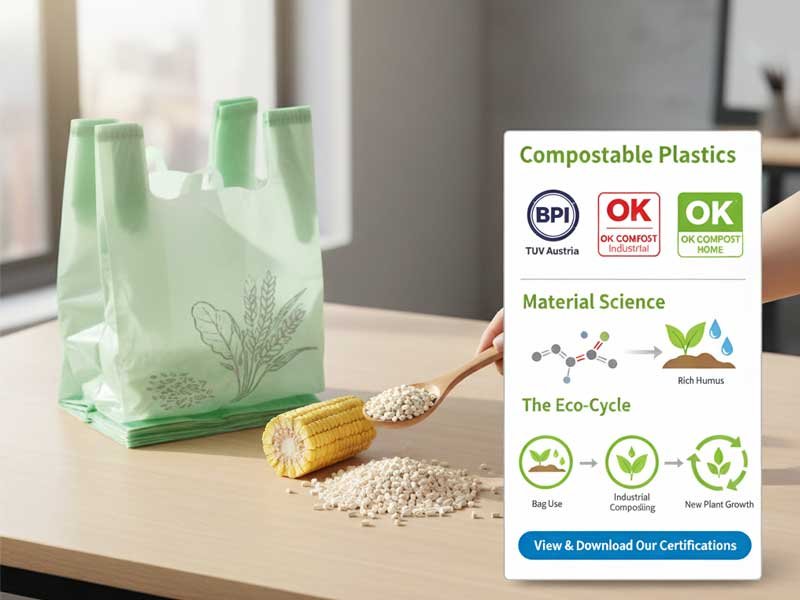
Compostable plastics are a subset of biodegradable plastics, but have stricter definitions and standards. It specifically refers to materials that, under specific composting conditions (usually industrial composting, though some products are also suitable for home composting), can completely decompose into water, carbon dioxide, inorganic compounds, and biomass within a certain timeframe, leaving no toxic residues.
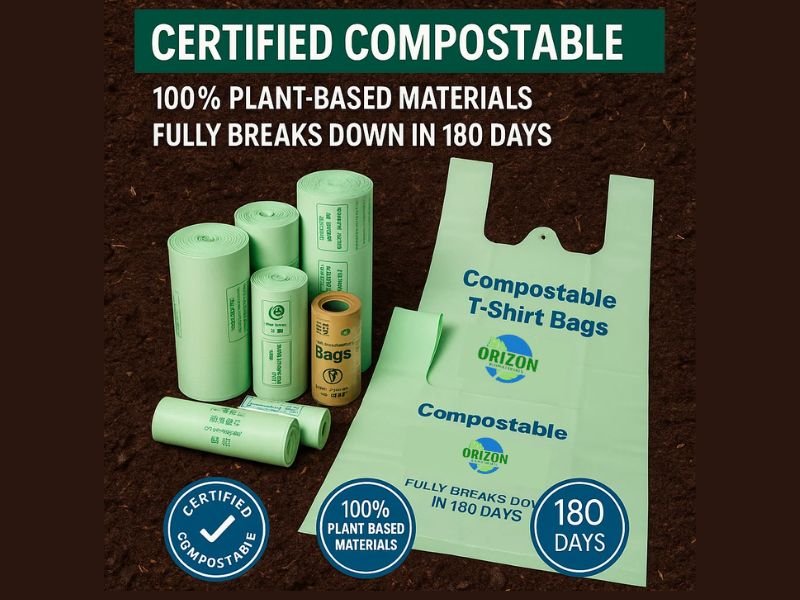
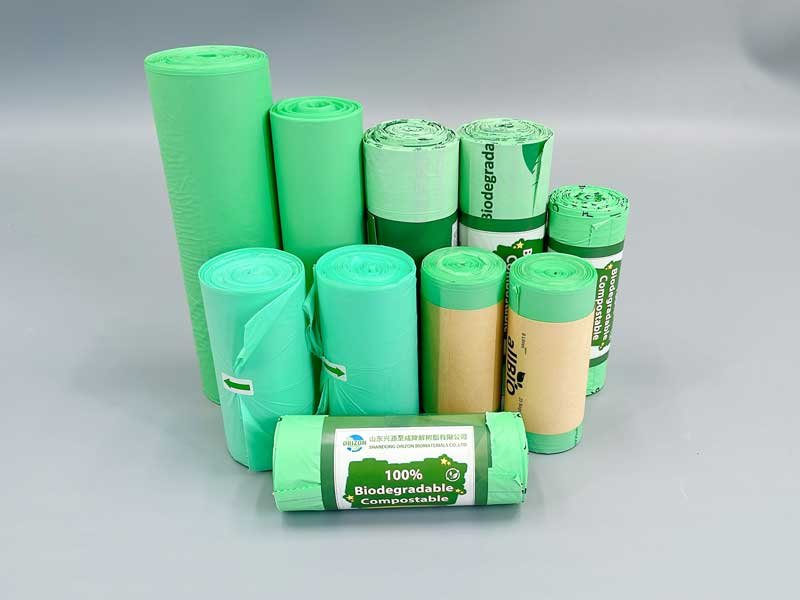
Our personalized compostable garbage bags primarily use materials such as PLA (polylactic acid), PBAT (polybutylene adipate/terephthalate), and corn starch. These materials have all undergone rigorous testing and certification. For example, our products have obtained BPI (Biodegradable Products Institute) certification, comply with EN 13432 (European industrial composting standard), and TUV Austria’s OK Compost Industrial/Home certification (You can click here to view and download our certificate.). These certifications ensure that our environmentally friendly customized garbage bags truly return to nature and do not pollute soil or water bodies.
- Comprehensive Comparison & Selection Guide: Matching Materials to Your Personalization & Eco Goals
To help you make a better choice, we provide a comprehensive comparison of different materials in terms of environmental performance, print quality, toughness, cost-effectiveness, degradation time, degradation environmental requirements, and necessary certifications.
| Feature | Traditional Plastic (e.g., LDPE/HDPE) | Biodegradable Plastic (e.g., PCL/PBS) | Compostable Plastic (e.g., PLA/PBAT/Corn Starch) |
| Environmental Impact | Long-term pollution | Degradable under specific conditions; disposal environment still crucial | Fully decomposes into compost; non-toxic and harmless |
| Custom Print Quality | Excellent | Good | Excellent; some materials might require specific inks |
| Toughness/Durability | Superior | Good; potentially slightly less than traditional plastic | Good; some products can achieve high strength |
| Cost (Relative) | Low | Medium-High | Higher than traditional plastic, but offers greater value |
| Degradation Time | Hundreds of years | Months to several years (specific environment) | 90-180 days (Industrial composting) |
| Degradation Environment | No natural degradation | Requires specific microorganisms and environment | Industrial composting facilities (or home composting) |
| Authoritative Certifications | None | Some available (but require careful scrutiny) | BPI, EN 13432, OK Compost (Highly Recommended) |
By comparing the two, you can more clearly understand the optimal balance between brand personality and sustainability. We are committed to providing high-quality, custom printed compostable garbage bags, ensuring that both your brand image and environmental commitments are achieved.

Does Printing Affect Compostability and Environmental Performance?
Printing itself does not automatically compromise compostability, but how printing is executed matters.
Key factors include:
- Ink type – water-based or low-impact inks are commonly used for compostable products
- Ink coverage – excessive ink coverage may fall outside certification test parameters
- Adhesives and additives – labels or laminates can affect compliance
Certified compostable products are tested as complete systems, including material formulation and allowable printing coverage. Buyers should verify that printed versions fall within the certified scope.
Personalization: Custom Printing Options
1.Custom Printing Design
Custom printing is the most direct and effective way to personalize your garbage bags. We offer a wide range of customization options to meet your unique needs.
- Size and Thickness Selection: We offer a variety of size and thickness options to suit your specific needs (e.g., small sizes for hotel rooms, medium sizes for the food and beverage industry, large capacity for events). Precise thickness selection ensures the bag’s load-bearing capacity and durability.
- Printing Technology and Results: We use gravure flexographic printing technology to ensure your logo, brand information, and design are clear, vibrant, and durable on compostable materials. Even on personalized biodegradable garbage bags, the printing results meet industry-leading standards, with no issues like wear or fading.
- Printing Area, Color Restrictions, and Suggestions: We can achieve full-page or partial printing based on your design requirements. For environmentally friendly materials, we recommend choosing colors that provide good contrast with the bag’s base color to ensure optimal visual appeal. We also use environmentally friendly inks to ensure a green and sustainable product chain.
- Free Professional Design: Tailored to your specific needs, our design team will work closely with you to translate your brand concept into a concrete printing solution.
Many clients face challenges when designing personalized garbage bags. We provide detailed design guidelines. For example, we’ve noticed that certain vibrant colors may appear slightly different on compostable materials, and we’ll provide recommended color combinations. We’ll also share practical tips on optimizing logo and information layout to reduce printing costs, such as reducing the number of colors used or avoiding large areas of solid color printing.
We’ve also summarized common design pitfalls (such as overly small fonts and overly complex patterns) and how to avoid them, aiming to help you start from scratch or optimize existing designs to ensure the final customized printed garbage bags look perfect.

2.Custom Printing Design
- Custom Colors: In addition to standard colors, we can provide custom colors based on your brand colors to enhance brand consistency.
- Bag Types: We offer a variety of bag opening designs, including common flat openings, drawstring bags, and tote bags, to improve the user experience.
- Special Fragrances: (If this service is offered) We can customize eco-friendly fragrances suitable for hotels or specific retail settings.
3.Custom Printing Design
- Request Submission: You can submit your personalized garbage bag requirements through our website or contact us, including size, quantity, material preferences, and a preliminary design draft.
- Design Confirmation: Our design team will communicate with you, providing design suggestions and initial renderings.
- Sample Production (Optional): Before mass production, we can provide samples for your confirmation to ensure the final product meets your expectations.
- Production and Delivery: After confirmation, we will arrange efficient production and inform you of the estimated delivery time.
4.Flexible MOQ and reasonable pricing
We understand that many small and medium-sized enterprises (SMEs) and startups have a strong demand for personalized garbage bags, but are often deterred by the high minimum order quantities (MOQs) of traditional manufacturers.
We are committed to supporting small businesses, offering flexible MOQ policies and designing customized solutions or packages specifically for SMEs. We believe that regardless of business size, everyone should have the opportunity to enhance their brand image and fulfill their environmental commitments through customized printed eco-friendly garbage bags.
Price transparency is a core principle of our service. The final price of personalized garbage bags is influenced by various factors, including: the selected material (biodegradable/compostable), bag size and thickness, number of printing colors and coverage area, order quantity, and specific delivery time. We will provide a detailed quote to ensure you fully understand the cost breakdown, with no hidden fees.

Certifications and How to Verify Eco Claims
One of the most common misunderstandings among buyers is assuming that certifications apply to an entire factory. In reality, compostable certifications apply to specific products, defined by material, thickness, structure, and printing coverage.
When evaluating eco claims, B2B buyers should verify:
- Which certification applies (BPI, EN 13432, OK Compost, etc.)
- Which markets the certification covers
- Whether printing is included in the certified product configuration
- Whether certificates can be independently verified
Clear documentation is essential to avoid greenwashing risks.
Common Design and Procurement Pitfalls to Avoid
Many sourcing issues arise from avoidable design and communication gaps.
Common pitfalls include:
- Submitting artwork in unsupported formats or low resolution
- Using overly small fonts or fine lines that do not reproduce well
- Expecting photographic color accuracy on flexible films
- Selecting thickness without considering wet waste or load weight
- Assuming all “biodegradable” or “compostable” claims are equivalent
Addressing these points early helps prevent delays, rework, and performance complaints.
How Brands Use Personalized Trash Bags in Practice
In real-world applications, personalized trash bags are used to support both operational efficiency and sustainability goals.
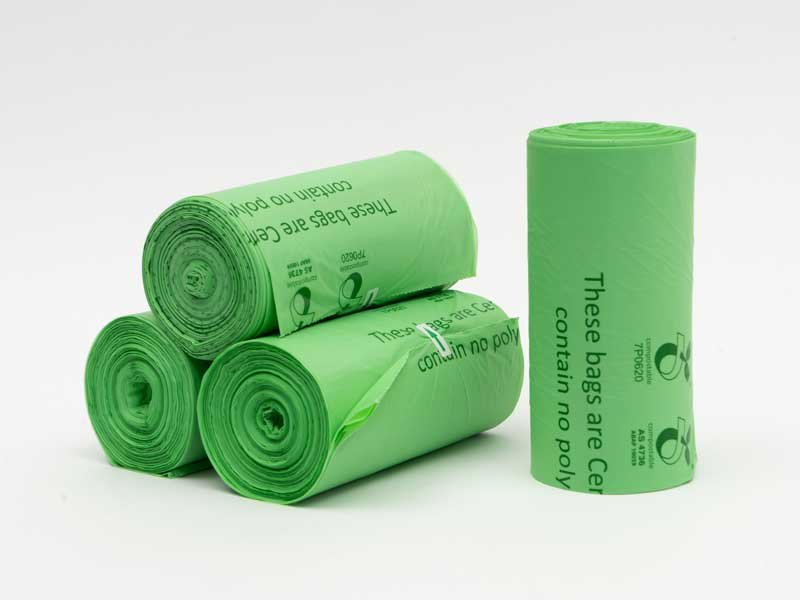
Hospitality groups use branded compostable trash bags to reinforce environmental messaging in guest rooms. Municipal programs print sorting instructions directly on bags to improve waste separation. Event organizers use customized bags to align waste handling with sustainability commitments.
In each case, success depends on aligning material selection, printing design, and usage conditions, rather than focusing on appearance alone.
FAQ
What artwork formats are typically required?
Vector formats such as AI, EPS, or PDF are commonly required to ensure print clarity.
Can compostable trash bags be composted at home?
Only products certified for home composting should be used in home systems. Many compostable products require industrial facilities.
Does printing reduce bag strength?
Properly executed printing does not reduce mechanical performance when specifications are followed.
How should buyers choose size and thickness?
Selection should be based on waste type, load weight, and handling conditions rather than appearance.
Are there alternatives to compostable materials?
Some programs use recycled plastic options, which differ in environmental impact and disposal pathways.
Conclusion
Understanding how personalized trash bags work helps B2B buyers avoid misleading claims, technical mismatches, and compliance risks.
This article focuses on explanation and evaluation.
For OEM production details, material options, and minimum order quantities, please refer to our personalized trash bags manufacturing overview.
Contact our sustainable packaging experts to begin your personalized journey!