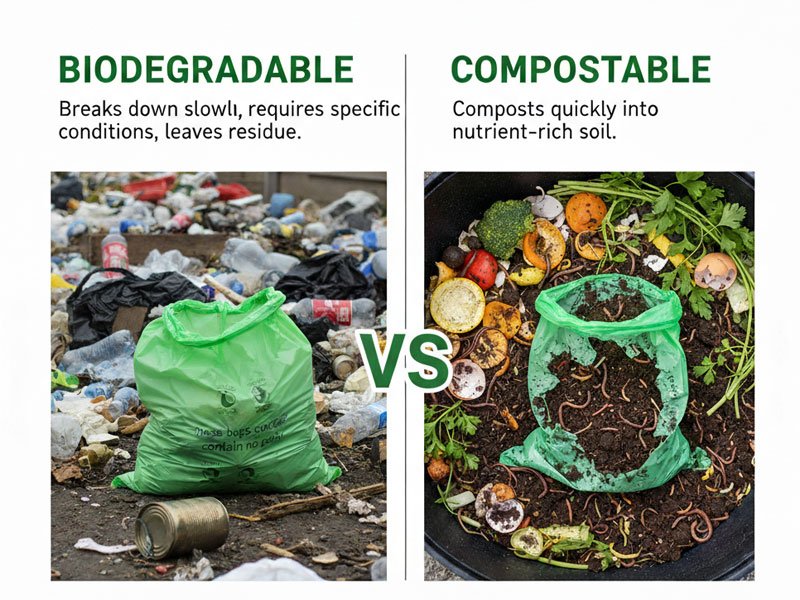
A compostable produce bag can pass the required compostability checks and still fail a buyer’s approval.
That happened in this project.
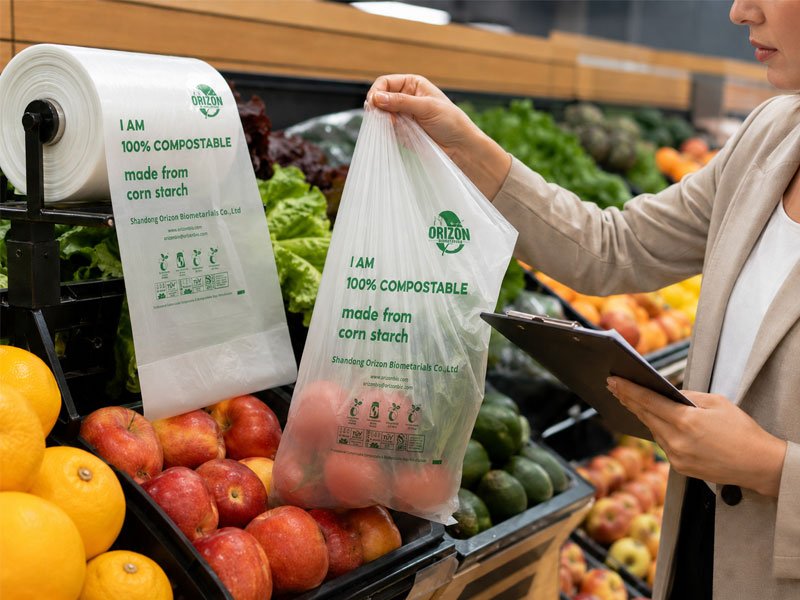
An Australian packaging distributor was developing two compostable produce bag formats for retail use.
The first samples worked as bags.
The size was right.
The rolls could be produced.
The film was compostable.
But there was one problem.
The customer felt the film was too hazy.
For fresh produce packaging, that mattered.
The distributor wanted shoppers to see the fruit and vegetables more clearly through the bag.
So this project became less about finding “a compostable film” and more about balancing:
clarity + 11 μm film + strength + printing + roll design + paper core + dispenser fit.
This case study explains how we approached that problem.
Project at a Glance
| Item | Project Requirement |
|---|---|
| Market | Australia |
| Customer Type | Packaging distributor |
| Application | Supermarket / fresh produce |
| Main Problem | Standard compostable film appeared too hazy |
| Target Thickness | 11 μm |
| Film Requirement | Higher clarity |
| Printing | Green, PMS 348 C |
| Format A | Side-gusset produce bag on roll |
| Format B | Star-seal produce bag on roll |
| Roll Requirement | Existing retail/dispenser system |
| Core | Custom dimensions by format |
| Packing | 6 rolls/carton |
| Commercial Scale | 4,800 rolls across two formats |
| Main Development Goal | Improve clarity without losing roll and functional requirements |
Customer identity is withheld for commercial confidentiality. Project specifications are based on ORIZON production and development records.
The Challenge: The Bag Worked, but the Clarity Was Not Good Enough
The first issue was not bag failure.
It was appearance.
The customer reviewed an initial compostable-film option and felt that the film had too much visible haze.
This is important because supermarket produce packaging has two jobs.
The bag must hold the product.
But it also needs to let shoppers inspect what is inside.
Tomatoes should still look red.
Leafy vegetables should still look fresh.
The surface of fruit should remain reasonably visible.
A bag can therefore meet a basic functional requirement and still fail a retail buyer’s visual requirement.
That was the problem we needed to solve.
Compostability and Clarity Are Two Different Requirements
One lesson from this project was simple:
A compostability requirement does not define optical clarity.
In Australia, AS 4736 is used for commercial compostability verification, while AS 5810 covers home compostability. The Australasian Bioplastics Association runs verification programs for these standards.
Film haze is a different technical property.
ASTM D1003, for example, is specifically used to evaluate luminous transmittance and wide-angle light scattering in transparent plastics.
So two films can meet the same compostability requirement and still look different to the eye.
That distinction became central to this project.
Why We Did Not Simply Make the Bag Thinner
When a buyer wants more clarity, reducing film thickness may sound like an easy solution.
But this project was already targeting approximately:
11 μm
That is a lightweight produce-film specification.
Making the bag thinner just to improve visual appearance could reduce the safety margin for:
- film consistency
- tear performance
- perforation
- produce loading
- roll production
So we did not treat thickness as the main solution.
We kept the target thickness and focused on the film system and finished-film performance.
This is also consistent with what major compostable-material suppliers show publicly: thin compostable fruit and vegetable film can be produced at around the 10–15 μm range while still requiring suitable processing and mechanical performance. BASF lists 10–15 μm for its fruit-and-vegetable film applications and notes that transparent formats are possible.
Novamont has also described compostable fruit-and-vegetable films developed with high transparency together with tear and break resistance.
The question was therefore not:
Can compostable film be clear?
It can.
The real question was:
Can we achieve the clarity this buyer wants within this exact bag and roll specification?
Moving From Standard Film to a Higher-Clarity Film
For this project, we compared the customer’s response to the standard film with a higher-clarity compostable-film option.
We do not publish the exact formulation ratios used in commercial projects.
Those are part of our manufacturing know-how.
What mattered to the customer was the finished result.
We focused on:
- visual haze
- produce visibility
- 11 μm film consistency
- handling
- tear behavior
- sealing
- printing
- roll winding
The higher-clarity film gave the customer a better visual result.
But approving the film alone was not enough.
We still had to make it work as a supermarket roll.
Two Produce Bag Formats Had to Be Developed
The Australian project included two different bag structures.
Rather than publishing the customer’s internal product codes, I will call them Format A and Format B.
Format A — Side-Gusset Produce Bag
The key specification was approximately:
- 260 mm + 56.25 mm + 56.25 mm × 450 mm
- 11 μm
- 250 bags per roll
- 6 rolls per carton
- green printing
- PMS 348 C
The gusset increased usable bag capacity while keeping the roll suitable for produce applications.
But the roll design still had to match the customer’s existing system.
Format B — Star-Seal Produce Bag
The second bag used:
- 380 × 510 mm
- 11 μm
- star-seal construction
- 150 bags per roll
- 6 rolls per carton
- green printing
- PMS 348 C
This bag was larger and used a different bottom construction.
That changed the way the film was converted and wound.
It also required a different paper core.
Clarity Could Not Be Approved Separately From Roll Design
This was one of the most practical parts of the project.
A supermarket does not buy a sheet of clear film.
It buys a roll that needs to work in a dispensing system.
So after changing film performance, we still had to confirm:
bags per roll + core + roll width + roll OD + dispenser fit
as one system.
This is why our compostable produce bags on a roll projects treat film thickness and roll engineering together rather than as separate purchasing decisions. ORIZON’s current roll-product range supports custom core, roll OD, perforation, bag count and other dispenser-related specifications.
Custom Paper Core Specifications
The two bag formats required different core configurations.
Format A Core
Final core specification:
Core ID: 37 mm
Core wall thickness: 4 mm
Core width: 275 mm
Format B Core
Final core specification:
Core ID: 25 mm
Core wall thickness: 5 mm
Core width: 130 mm
These dimensions may look like small details.
They are not.
A change in:
- core ID
- wall thickness
- roll width
- bag count
- film gauge
can change the final roll diameter and how the roll runs in the dispenser.
That is why we recommend measuring the existing supermarket roll rather than asking for:
“standard core.”
Why Roll OD Matters When Film Changes
Imagine keeping:
- the same bag size
- the same core
- the same number of bags
but changing the film construction.
Even when nominal thickness remains similar, the winding behavior and final roll may need to be checked.
If the final roll is too large:
it may not fit the dispenser.
If it is too loose:
it may unwind poorly.
If the perforation is wrong:
shoppers may tear the next bag.
For this project, the higher-clarity film therefore had to pass more than a visual check.
It had to remain compatible with the agreed roll structure.
Printing Also Had to Stay Consistent
The customer required green printing using:
Pantone 348 C
This introduced another approval point.
The film needed to be clearer, but the printed result still had to remain readable and consistent.
We reviewed:
- ink appearance
- print contrast
- registration
- film appearance behind the print
A clearer film can change how printed colors appear compared with a more opaque or hazy film.
So final print approval should be done on the actual production film whenever possible.
Not only on a PDF artwork.
How We Compared the Samples
For buyer approval, we focused on the finished bag rather than the raw-material description.
The practical review included:
1. Produce Visibility
Could fruit and vegetables be seen clearly enough through the film?
2. Film Appearance
Did the film show the level of haze the buyer considered acceptable?
3. Thickness
Could the higher-clarity option remain around the target 11 μm specification?
4. Film Handling
Did it still open and handle properly?
5. Perforation
Could individual bags separate cleanly from the roll?
6. Seal / Bag Construction
Did each bag format remain stable after conversion?
7. Printing
Was the PMS green print acceptable on the final film?
8. Roll Configuration
Did the roll dimensions and cores match the required retail system?
This was more useful than asking one question:
“Is the film clear?”
The Customer Approved the Higher-Clarity Direction
After sample comparison, the customer selected the higher-transparency film direction rather than the earlier hazier option.
That moved the project from material evaluation into final production specification.
The important point is that the approval was not based on transparency alone.
It was based on a complete package:
higher clarity + 11 μm + correct bag construction + printing + paper core + roll configuration.
That is what made the specification commercially usable.
From Sample Development to Commercial Production
The approved commercial program covered two produce-bag formats.
The production mix was:
| Format | Commercial Quantity |
|---|---|
| Format A | 2,400 rolls |
| Format B | 2,400 rolls |
| Total | 4,800 rolls |
With 6 rolls per carton, the combined order represented:
800 cartons
This was no longer a laboratory discussion about film clarity.
It became a production and logistics project.
At that point, consistency mattered as much as the original sample.
What Had to Stay Consistent During Production
For a distributor project, one approved sample is only the beginning.
Commercial production needs repeatability.
Our QC focus included:
- film thickness
- film appearance
- bag dimensions
- print color
- perforation
- sealing
- bags per roll
- core dimensions
- roll winding
- carton quantity
For larger B2B programs, these details need to remain consistent from one production batch to the next.
That is especially important when the bags must run in an existing supermarket dispenser.
What We Learned From This Project
1. “Certified” and “Clear” Should Be Separate RFQ Requirements
Do not write only:
AS 4736 compostable produce bag.
If visual performance matters, also specify:
high clarity / reference sample / agreed visual target.
Australian compostability certification verifies the applicable compostability standard, while optical haze is a separate film property. That separation follows from the different scopes of ABA compostability verification and optical testing such as ASTM D1003.
2. Send the Existing Roll
A physical roll tells the factory more than:
“250 bags per roll.”
We can measure:
- core
- roll width
- OD
- perforation
- winding
- bag dimensions
That reduces guesswork.
3. Do Not Change Thickness Without Checking Roll OD
If you change thickness while keeping the same bag count, the final roll can become larger.
This is why thickness should be selected together with dispenser requirements.
Our separate Compostable Produce Bag Thickness Guide explains this relationship in more detail.
4. Transparency Needs a Finished-Bag Test
Do not approve clarity from a resin sheet or photograph.
Use the finished bag.
Put real produce inside.
Compare it under the same lighting.
If clarity is a formal buying requirement, optical methods such as ASTM D1003 can be used to define haze and luminous transmittance more objectively.
5. High Clarity Is Not Necessary for Every Project
This matters too.
Some buyers care strongly about produce visibility.
Others care more about:
- cost
- renewable content
- secondary food-waste use
- opacity
- printing
A higher-clarity film should therefore solve a real commercial requirement.
It should not be added automatically.
A Simple Checklist for Buyers Facing the Same Problem
If your current compostable produce bag looks too hazy, send your supplier:
| Item | What to Provide |
|---|---|
| Current bag | Physical sample |
| Bag size | Width × length × gusset |
| Thickness | μm |
| Current clarity | Reference sample |
| Bags per roll | pcs |
| Core ID | mm |
| Core wall | mm |
| Core width | mm |
| Maximum roll OD | mm |
| Dispenser | Photo / sample |
| Printing | Artwork + Pantone |
| Certification | Target market requirement |
| Order volume | Rolls / kg / container |
| Packing | Rolls/carton |
Do not ask only:
“Can you make it clearer?”
Give the factory a measurable project.
Why This Case Matters for Produce Bag Buyers
The interesting part of this project was not that we found a “clear compostable bag.”
Transparent compostable fruit and vegetable films already exist in the market. Major material companies such as Novamont and BASF publish transparent produce-film applications.
The real work was making clarity fit the rest of the specification.
That meant balancing:
film + thickness + bag structure + print + roll + paper core + dispenser
without treating any one variable in isolation.
That is how we approach custom produce-bag development.
FAQ: Compostable Produce Bag Clarity Projects
Can compostable produce bags be made with high transparency?
Yes. Compostable produce films can be produced in transparent formats, but the final clarity depends on the film system, processing and finished specification. Major compostable-material suppliers such as BASF and Novamont publish transparent fruit-and-vegetable film applications.
Buyers should still approve the actual finished bag rather than assume all compostable films look the same.
Why can two certified compostable produce bags have different clarity?
Compostability certification and optical clarity evaluate different properties.
Australian AS 4736 and AS 5810 verification relates to compostability, while optical methods such as ASTM D1003 evaluate haze and luminous transmittance. It is therefore possible for certified products to have different visual appearance.
Does reducing film thickness always improve clarity?
No.
Thickness can affect appearance, but film formulation, morphology and processing also matter.
In this project, the target was already around 11 μm, so we focused on improving the film rather than simply reducing gauge.
Why does core size matter in a clarity project?
Because the finished product is a roll, not just a sheet of film.
Changing film behavior can affect winding and roll diameter. Core ID, wall thickness, bags per roll and maximum roll OD all need to remain compatible with the dispenser.
How should buyers compare high-clarity produce bag samples?
Compare samples at the same thickness and under the same lighting.
Use real produce, check both printed and unprinted areas, and test the finished roll in the intended dispenser.
If optical clarity needs a numerical specification, discuss an agreed haze or transmittance test method.
Can ORIZON match an existing supermarket produce roll?
For qualified B2B projects, an existing roll can be used as a reference for dimensions, thickness, core, roll width, OD, perforation and printing requirements. ORIZON’s produce-roll range supports custom roll configurations for supermarket and distributor programs.
Need to Improve Produce Bag Clarity Without Redesigning the Whole Retail System?
If you already have a produce roll that works but the compostable film is too hazy, send us:
- existing roll
- bag dimensions
- thickness
- core specification
- roll OD
- dispenser photo
- print artwork
- target certification
- current clarity reference
We can use the existing operating specification as the starting point for sample development.
View Clear Compostable Produce Bags. ORIZON currently supplies clear/high-transparency produce-bag formats for B2B and OEM projects.
View Compostable Produce Bags on a Roll.
Explore Compostable Produce Bags Wholesale.