ASTM D6400 Standard for Compostable Plastics
- Andrea Chen
- Compostable Packaging Compliance Specialist
Table of Contents
Quick Answer
ASTM D6400 is a standard specification published by ASTM International for plastics and plastic products designed to be aerobically composted in municipal or industrial composting facilities.
It defines requirements used to evaluate whether a plastic product can be identified and labeled for this type of controlled composting environment.
ASTM D6400 covers compostability requirements such as biodegradation, physical disintegration and the quality of the resulting compost. It does not itself certify a product.
The current active edition is ASTM D6400-26.
For the official standard, see ASTM International’s ASTM D6400-26 page.
ASTM currently lists D6400-26 as the active edition and describes it as the specification for plastics designed for aerobic municipal or industrial composting.
Last reviewed: September 29, 2026
What Is ASTM D6400?
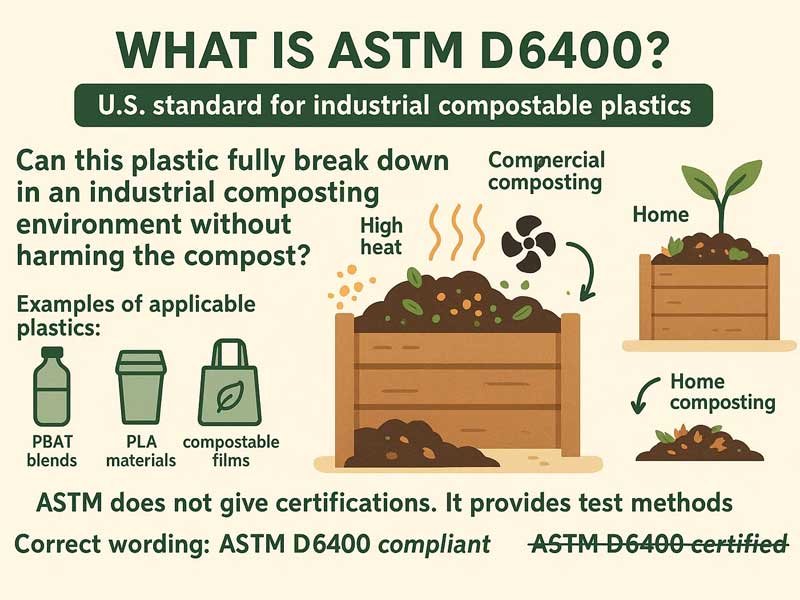
ASTM D6400 is a technical standard specification, not a certification.
Its official title is:
Standard Specification for Labeling of Plastics Designed to be Aerobically Composted in Municipal or Industrial Facilities
The standard covers plastics and products made from plastics that are intended for aerobic municipal or industrial composting systems where controlled composting conditions are achieved.
ASTM D6400 does not by itself demonstrate:
- home compostability
- landfill biodegradation
- marine biodegradation
- certification by a third-party organization
For BPI certification and product-level verification, see our BPI Compostable Certification Guide.
ASTM D6400 Testing Requirements
ASTM D6400 evaluates whether a plastic product can compost satisfactorily under controlled municipal or industrial composting conditions.
The assessment focuses on several core areas:
| Requirement | What Is Evaluated |
|---|---|
| Biodegradation | Whether the material biodegrades sufficiently under controlled aerobic composting conditions |
| Disintegration | Whether the finished item physically breaks down during composting |
| Compost Quality | Whether the resulting compost remains suitable for its intended use |
| Regulated Substances | Whether applicable limits for metals and other regulated substances are met |
| Finished Product | Whether the tested configuration represents the actual item being evaluated |
The exact laboratory test methods and pass criteria depend on the applicable testing and certification scheme.
For buyers, the important point is that ASTM D6400 should be evaluated at the finished-product level, not assumed only because a supplier uses a compostable resin.
Is ASTM D6400 a Certification?
No. ASTM D6400 is a technical standard published by ASTM International. ASTM does not certify individual compostable products under ASTM D6400.
Third-party certification programs may use ASTM D6400 as part of their product assessment.
For example, BPI currently uses ASTM D6400 as the base assessment standard for its Commercial Compostability Certification program. ASTM D6868 and ASTM D8410 may be used as additional assessments for eligible products.
For a detailed explanation, see our BPI Compostable Certification Guide.
How ASTM D6400 Testing Works
ASTM D6400 is a standard specification rather than one single laboratory test.
Evaluation uses applicable test methods to determine whether the material or finished product meets the requirements for aerobic municipal or industrial composting.
The main assessment areas are:
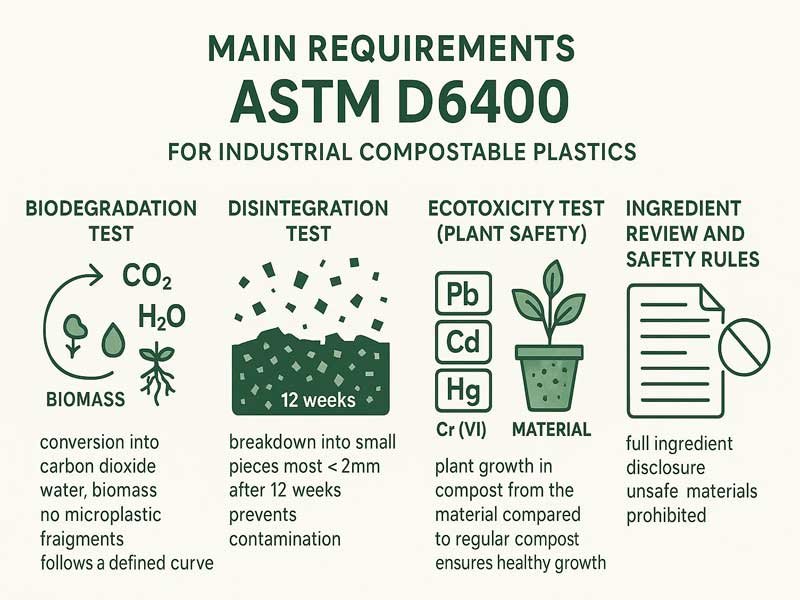
1. Biodegradation
Biodegradation testing evaluates whether the organic carbon in the material can be converted by microorganisms under controlled aerobic composting conditions.
The purpose is to determine whether biological degradation occurs at an appropriate rate under the conditions defined by the applicable test method and standard.
2. Disintegration
Disintegration testing evaluates whether the finished product physically breaks apart during the composting process.
Finished-product thickness, grammage and construction can matter because a thicker or differently constructed product may behave differently from a thinner product made from the same base material.
3. Compost Quality
Evaluation also considers whether the composting process and resulting compost are adversely affected by the material or finished product.
Applicable assessments may include plant-growth, ecotoxicity or other compost-quality criteria depending on the current standard and certification scheme being used.
4. Material & Chemical Requirements
Applicable chemical, regulated-substance and material requirements may also need to be evaluated.
The exact requirements depend on the current ASTM edition, the product construction and any additional rules imposed by the certification program being used.
5. Finished-Product Verification
The product being tested should represent the product that will actually be sold.
Changes to the following may affect whether existing test data or certification documentation can be applied to a new finished product:
- Film thickness
- Material formulation
- Color
- Printing
- Coatings
- Additives
- Product construction
For custom products, existing documentation should therefore be reviewed against the final approved specification rather than assumed to apply automatically.
ASTM D6400 Requirements at a Glance
| Evaluation Area | What It Helps Determine |
|---|---|
| Biodegradation | Whether biological conversion occurs under composting conditions |
| Disintegration | Whether the finished product physically breaks down during composting |
| Compost Quality | Whether the composting process and resulting compost remain suitable |
| Material Requirements | Whether applicable chemical or material limits are met |
| Finished Product | Whether the tested configuration represents the product being sold |
Exact thresholds, test methods and procedures should always be checked against the current ASTM D6400 edition and the applicable certification program.
Is There an ASTM D6400 Certification?
ASTM D6400 itself is a standard specification, not a product-certification program.
When a supplier describes a product as “ASTM D6400 certified,” buyers should ask what documentation is actually being provided.
This may refer to:
– A laboratory test report
– Finished-product test documentation
– Raw-material test documentation
– A third-party certification based on ASTM D6400
These are not automatically equivalent.
For example, BPI uses ASTM D6400 as the base standard for assessment in its Commercial Compostability Certification program.
Therefore:
ASTM D6400 test documentation does not automatically mean BPI certification.
How to Verify an ASTM D6400 Claim
For importers, distributors, private-label brands and product developers, verifying the documentation is often more useful than simply asking whether a supplier “has ASTM D6400.”
Use the following checks before approving a finished product.
Step 1: Identify the Document
Ask whether the supplier is providing:
- A laboratory test report
- A third-party certificate
- A BPI certification or listing
- A raw-material certificate
Do not treat these documents as interchangeable.
Step 2: Check the Finished Product
Confirm that the documentation applies to the finished product being quoted.
Compare:
– Product name or SKU
– Material formulation
– Product construction
– Thickness
– Color
– Printing or coatings
A raw-material report alone does not automatically prove that every finished product made from that material has the same ASTM D6400 status.
Step 3: Check the Laboratory and Test Scope
Identify which laboratory performed the testing and what product configuration was evaluated.
If a third-party certification program is required, confirm that the laboratory, test methods and documentation are acceptable to that program.
Step 4: Verify Third-Party Certification Separately
If BPI certification is required, verify the exact product through BPI’s official product database.
Do not treat an ASTM D6400 test report as proof of BPI certification.
For supplier and SKU verification, see our BPI certification verification guide.
Step 5: Review Any Custom Changes
If the product changes in thickness, color, printing, formulation, coating, additives or construction, confirm whether the existing test or certification documentation still applies.
Step 6: Confirm the End-of-Life Requirement
ASTM D6400 addresses compostability under defined municipal or industrial aerobic composting conditions.
It does not guarantee that every composting facility or collection program will accept every product that meets the standard.
Confirm the requirements of the intended composting or organics program before procurement.
ASTM D6400 vs BPI Certification
| ASTM D6400 | BPI Certification | |
|---|---|---|
| Type | Technical standard specification | Third-party certification program |
| Main purpose | Defines compostability requirements | Evaluates and certifies eligible products |
| Commercial compostability | Technical basis | Uses ASTM D6400 as base assessment |
| Product database | No ASTM certified-product catalog | BPI Online Product Catalog |
| Certification mark | No ASTM D6400 product certification mark | BPI Certification Mark |
| Additional program rules | Not a certification scheme | BPI eligibility and program requirements apply |
A product may have ASTM D6400-related test data without being BPI certified.
BPI certification involves additional program requirements beyond presenting a single ASTM D6400 test result.
Which Products Commonly Use ASTM D6400?
ASTM D6400 is commonly relevant to plastic products intended to make a commercial- or industrial-compostability claim.
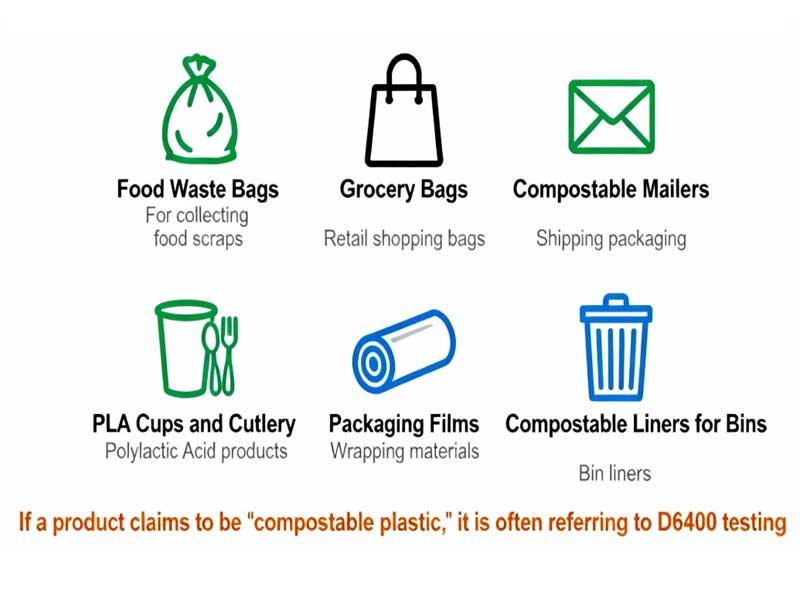
Examples may include:
– Compostable plastic bags
– Food-waste liners
– Compostable bin liners
– Compostable plastic films
– Selected flexible packaging
– Other eligible compostable plastic products
Whether ASTM D6400 applies depends on the finished-product construction and intended claim.
Looking for actual bag specifications, customization, MOQ or bulk supply? See our ASTM D6400 compostable bags page.
ASTM D6400 vs ASTM D6868
ASTM D6400 and ASTM D6868 are both related to commercial compostability, but they apply to different product constructions.
ASTM D6400 primarily applies to compostable plastics and plastic products, such as compostable bags, films and similar plastic items.
ASTM D6868 applies to certain end items that incorporate plastics or polymers as coatings or additives with paper or other substrates, such as eligible coated or laminated fiber-based packaging.
Within BPI’s Commercial Compostability Certification program, ASTM D6400 is the base assessment standard. ASTM D6868 may be used as an additional assessment for eligible product constructions.
For a typical compostable plastic bag or film, ASTM D6400 is therefore the more directly relevant standard.
For a detailed explanation of product eligibility and how ASTM D6400 and ASTM D6868 are used within BPI certification, see our BPI Compostability Certification Guide.
Common Misunderstandings About ASTM D6400
“ASTM D6400 certified” always means BPI certified.
No.
ASTM D6400 is a technical standard specification. BPI is a separate third-party certification program that uses ASTM D6400 as the base standard for its Commercial Compostability Certification.
An ASTM D6400 test report should not automatically be treated as proof of BPI certification.
If BPI certification is required, verify the exact finished product through the applicable BPI documentation or official product listing.
A compostable raw-material certificate automatically covers the finished product.
Not necessarily.
The finished product may differ from the tested raw material in thickness, formulation, color, printing, coatings, additives or construction.
These differences can affect whether existing test or certification documentation applies to the final product.
For custom products, the approved finished specification should be reviewed against the applicable documentation.
ASTM D6400 means a product is home compostable.
No.
ASTM D6400 addresses plastics and plastic products designed for aerobic composting in municipal or industrial composting facilities.
It should not be used as proof of home compostability.
If a home-compostability claim is required, the finished product should be evaluated under an applicable home-composting standard or certification program.
Every commercial composting facility accepts products that meet ASTM D6400.
No.
ASTM D6400 defines technical requirements for compostability under specified municipal or industrial composting conditions, but individual composting facilities and collection programs determine which products they accept.
Product certification and facility acceptance should therefore be checked separately.
FAQ About ASTM D6400
The current active edition is ASTM D6400-26.
ASTM International identifies it as the Standard Specification for Labeling of Plastics Designed to be Aerobically Composted in Municipal or Industrial Facilities.
The current edition was updated on June 15, 2026.
Because ASTM standards can be revised, buyers and product developers should check the current official ASTM edition when evaluating new projects.
ASTM D6400 is a standard specification, not one single laboratory test method.
It defines requirements for plastics and plastic products intended for aerobic municipal or industrial composting and references applicable test methods used to evaluate those requirements.
Testing may address areas such as biodegradation, disintegration, compost quality and applicable material requirements.
ASTM D6400 evaluation covers several areas used to determine whether a plastic product is suitable for aerobic municipal or industrial composting.
These include biodegradation, physical disintegration, compost quality, applicable material or chemical requirements, and the finished-product configuration.
ASTM D6400 is a standard specification rather than one single laboratory test, so the applicable test methods depend on the product and evaluation scheme.
ASTM D6400 itself is not a product-certification program.
A laboratory may test a material or finished product against applicable ASTM D6400 requirements, while an independent certification organization may use ASTM D6400 within its own certification program.
For example, BPI uses ASTM D6400 as the base standard for its Commercial Compostability Certification.
When a supplier says a product is “ASTM D6400 certified,” ask whether they are providing a laboratory test report, finished-product certification, raw-material documentation or another type of compliance record.
Start by identifying exactly what document the supplier is providing and whether it applies to the finished product being purchased.
Compare the documentation with the final product specification, including:
- Product name or SKU
- Material formulation
- Product construction
- Thickness
- Color
- Printing or coatings
If third-party certification such as BPI is required, verify the exact product separately through the certification organization's official product database.
Do not assume that a raw-material certificate automatically covers every finished product made from that material.
No.
ASTM D6400 is a technical standard specification. BPI is a third-party certification program.
BPI uses ASTM D6400 as the base assessment standard for its Commercial Compostability Certification, together with additional BPI eligibility, technical review, labeling and program requirements.
A product may therefore have ASTM D6400-related test data without being BPI certified.
Looking for ASTM D6400 Compostable Bags?
This guide explains the ASTM D6400 standard, its testing framework, finished-product scope and verification process.
If you are sourcing actual compostable bags and need information about available bag types, dimensions, thicknesses, printing, packaging, documentation, MOQ or OEM supply, see our ASTM D6400 Compostable Bags page.
For projects with specific certification requirements, confirm the required standard, third-party certification and receiving composting program before finalizing the product specification.