Biodegradable vs Compostable: What’s the Difference?
This guide summarizes widely used definitions and compostability standards for packaging and waste management.
Are biodegradable and compostable the same? No. Biodegradable describes a material’s ability to break down through biological activity under suitable conditions. The word alone does not specify where that happens, how long it takes, or whether the product belongs in a composting system.
Compostable is a more specific claim. A compostable product must biodegrade and disintegrate under the conditions of an applicable composting standard or certification scheme. Those conditions may relate to commercial composting, home composting, or both.
In short: compostability includes biodegradation under defined composting conditions, but a biodegradable claim does not automatically establish compostability.
The comparison below explains the terms, followed by the difference between home and commercial composting and the meaning of standards, test reports and certification.
Last reviewed: October 3, 2026
Biodegradable vs Compostable at a Glance
| Factor | Biodegradable | Compostable |
|---|---|---|
| Basic meaning | Can be broken down through biological activity under suitable conditions | Designed to biodegrade and disintegrate under defined composting conditions |
| Defined environment | Not necessarily clear from a general claim | Defined by the applicable composting standard or certification |
| Timeframe | A general claim may not identify a specific timeframe | Applicable standards define test conditions and acceptance criteria |
| Physical disintegration | Not necessarily part of a general claim | Normally part of compostability assessment |
| Compost quality | Not implied by the word alone | Applicable compostability standards assess effects on the composting process or resulting compost |
| Industrial composting | Not automatically suitable | Requires applicable industrial/commercial compostability requirements |
| Home composting | Not automatically suitable | Requires a home-compostability scope |
| Certification | Depends on the product and claim | Third-party certification may verify conformity with an applicable compostability standard |
| Local acceptance | Not guaranteed | Still not guaranteed by certification alone |
The key question is therefore not simply:
“Will this material eventually break down?”
A more useful question is:
“Under what conditions is it expected to break down, and how has that claim been verified?”
What Does Biodegradable Mean?
Biodegradable means that microorganisms can contribute to the biological breakdown of a material under suitable environmental conditions.
The rate and extent of biodegradation depend on factors such as:
- Temperature
- Moisture
- Oxygen availability
- Microbial activity
- Material chemistry
- Product thickness
- Surface area
- The surrounding environment
This is why the term biodegradable should not be interpreted as meaning that a product will quickly disappear in every environment.
A material may behave differently in:
- Industrial composting
- Home composting
- Soil
- Fresh water
- Marine environments
- Landfill
The term becomes more useful when the relevant environment, timeframe and testing method are clearly identified.
For a deeper explanation, see our What Is Biodegradable? guide.
The FTC also cautions that broad environmental claims such as “green” or “eco-friendly” can be misleading without clear qualification, and its U.S. guidance places conditions on unqualified degradable claims.
What Does Compostable Mean?
Compostability is a more specific end-of-life concept. Not every biodegradable plastic is compostable. To make a compostability claim, the material or finished product must meet the applicable requirements for a defined composting environment.
A compostable material or product is intended to undergo biological degradation and physical disintegration under defined composting conditions while meeting the requirements of the applicable standard or certification scheme.
Depending on the standard, assessment may consider areas such as:
- Biodegradation
- Physical disintegration
- Effects on the composting process
- Effects on resulting compost
- Chemical or material requirements
The exact criteria depend on the standard and composting environment.
For example, ASTM D6400 covers plastics and products designed for aerobic composting in municipal or industrial facilities. EN 13432 addresses packaging recoverable through industrial composting and biodegradation.
For a more detailed definition, see our What Is Compostable? guide.
Biodegradable vs Compostable: The Main Difference
The main difference is specificity.
A general biodegradable claim describes a biological process but may not, by itself, identify:
- The required environment
- The expected timeframe
- The degree of biodegradation
- Whether physical disintegration is required
- Whether the resulting material is suitable for a composting system
Compostability is tied to a defined composting environment and applicable assessment requirements.
That means:
Compostability is not simply “faster biodegradation.”
It is a defined end-of-life pathway with requirements that go beyond the broad concept of biodegradation.
Biodegradation and Disintegration Are Not the Same
These two terms are often confused.
Biodegradation
Biodegradation refers to biological conversion of a material through microbial activity.
Disintegration
Disintegration refers to the physical breakdown of a product during the composting process.
A product may fragment physically without necessarily completing the required biological degradation.
For compostability assessment, both biological degradation and physical disintegration can therefore matter.
This is one reason why simply observing that a bag or package has “broken into pieces” is not enough to establish compostability.

Does Compostable Always Mean Industrial Compostable?
No.
There are two important categories:
Industrial or Commercial Compostability
Industrial composting facilities operate under controlled conditions that may include managed temperature, moisture, aeration and processing time.
Examples of industrial or commercial compostability frameworks include:
- ASTM D6400
- BPI Commercial Compostability Certification
- EN 13432
- OK compost INDUSTRIAL
- AS 4736
ASTM D6400 specifically covers plastics and products intended for aerobic municipal or industrial composting facilities. ASTM Store
Home Compostability
Home composting normally operates at lower and less controlled temperatures.
A product suitable for industrial composting should not automatically be assumed to be suitable for home composting.
Home-compostability programs include examples such as:
- OK compost HOME
- AS 5810
- BPI Home Compostability Certification
BPI launched its Home Compostability Certification in 2025; it is based on NF T 51-800 and requires commercial certification first. BPIWorld
Australia similarly distinguishes AS 4736 for commercial compostability from AS 5810 for home compostability.
For a detailed comparison, see: Home Composting vs Industrial Composting
How Should Biodegradable and Compostable Products Be Disposed Of?
Disposal depends on the product claim and the local waste system.
Certified industrially compostable products should enter a commercial or municipal composting program only where that program accepts them.
Home-compostable products should only be placed in home compost when the exact product is suitable for home-composting conditions.
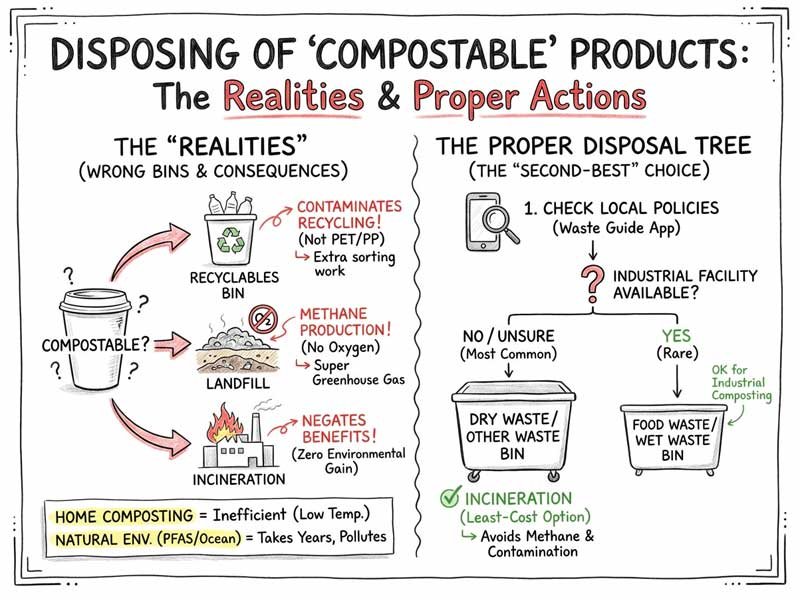
Products labeled only as biodegradable should not automatically be placed in a composting stream. A biodegradable claim alone does not confirm compatibility with either industrial or home composting.
If the local program does not accept the product, follow the instructions provided by the municipality, waste contractor or receiving facility.
Certification and disposal acceptance should therefore be checked separately.

What Standards Are Used for Compostability?
Are Biodegradable and Compostable the Same? Does Compostable Mean Biodegradable
There is no single global compostability standard used for every market and every composting environment.
Common examples include:
| Market / Application | Standard or Program | Main Scope |
|---|---|---|
| United States | ASTM D6400 | Plastics for municipal / industrial aerobic composting |
| North America | BPI Commercial Certification | Third-party commercial compostability certification |
| North America | BPI Home Certification | Home compostability certification |
| Europe | EN 13432 | Industrially compostable packaging |
| Europe / International markets | OK compost INDUSTRIAL | Industrial compostability certification |
| Home composting markets | OK compost HOME | Home compostability certification |
| Australia | AS 4736 | Commercial compostability |
| Australia | AS 5810 | Home compostability |
The standard, certification and intended composting environment should always be distinguished.
For example:
ASTM D6400 is a technical standard specification.
while:
BPI operates a third-party certification program using ASTM D6400 as the base standard for commercial certification. ASTM Store
For more detail on ASTM D6400, see our:
Standard, Test Report and Certification Are Different
These terms are often used as though they mean the same thing, but they do not.
Standard
A standard defines technical requirements or assessment methods.
Example:
ASTM D6400
Test Report
A laboratory test report records the product or material tested, the methods used and the resulting data.
Certification
A certification program independently evaluates whether an eligible product meets the requirements of its certification scheme.
Example:
BPI Commercial Compostability Certification
A product can therefore have ASTM D6400-related test data without necessarily being BPI certified.
Likewise, raw-material documentation should not automatically be assumed to cover every finished product made from that material.
How Can You Tell If a Product Is Truly Compostable?
Look for a claim that identifies the composting environment and the product it covers. “Compostable” alone does not tell you whether the product is intended for a commercial facility or a home compost pile.
Then distinguish the supporting evidence:
- Standard: States the applicable technical requirements, such as ASTM D6400 for plastics intended for municipal or industrial aerobic composting.
- Test report: Shows what material or product was tested and records the results.
- Certification: Confirms that an eligible product was evaluated under a named certification scheme. Check that the certificate or product listing covers the product being described.
Finally, check local collection rules separately. A compostability certification does not guarantee that a particular council or composting facility accepts the item.
Does Plant-Based Mean Biodegradable or Compostable?
No.
Bio-based, biodegradable and compostable describe different characteristics.
Bio-based refers to the origin of some or all of the material’s carbon or feedstock.
Biodegradable refers to biological degradation.
Compostable refers to suitability for a defined composting environment under applicable requirements.
A material can therefore be:
- Bio-based but not compostable
- Fossil-derived but biodegradable under defined conditions
- Partially bio-based and compostable
- Bio-based and compostable
European Bioplastics likewise notes that biodegradability depends on the chemical structure of the polymer rather than whether its feedstock is renewable or fossil-based.
So:
Plant-based ≠ automatically compostable.
Does Biodegradable Mean It Will Break Down in Landfill?
Not necessarily.
Landfill conditions differ significantly from controlled composting conditions.
Factors such as:
- Low oxygen
- Moisture
- Temperature
- Waste compaction
- Microbial conditions
can affect degradation.
A biodegradable or compostable claim should therefore not be interpreted as a guarantee of rapid degradation in landfill.
In the United States, FTC guidance specifically warns that unqualified degradable claims can be misleading for items normally sent to landfills, incinerators or recycling facilities because those disposal routes may not allow complete degradation within the required timeframe for such claims.
Does Certification Mean Every Composting Facility Will Accept the Product?
No.
Technical compostability and local acceptance are related, but they are not identical.
A product may meet an industrial compostability standard while a particular:
- Municipality
- Waste contractor
- Organics program
- Composting facility
still chooses not to accept that product type.
Local programs may consider factors beyond laboratory compostability, including:
- Sorting systems
- Processing technology
- Contamination control
- Program policy
- Local regulations
Certification therefore tells you something important about the product, but it does not replace checking the receiving waste system.
European Bioplastics likewise recommends checking whether industrially compostable products are accepted by the local biowaste service.
Why Environmental Claims Need Context
Terms such as:
- Eco-friendly
- Green
- Biodegradable
- Plant-based
- Compostable
can sound similar to buyers, but they do not communicate the same technical claim.
A useful environmental claim should answer questions such as:
What characteristic is being claimed?
Under what conditions?
According to which standard or evidence?
Which product does the claim apply to?
What is the intended disposal route?
The FTC Green Guides specifically caution against broad, unqualified claims such as “green” or “eco-friendly” because those claims can be difficult to substantiate and may imply more than the evidence supports.
Common Misunderstandings About Biodegradable and Compostable Materials
“Biodegradable” and “compostable” mean the same thing.
No.
Biodegradable is the broader concept. Compostability adds defined composting conditions and additional performance requirements.
Anything biodegradable can go into a compost bin.
No. A biodegradable claim alone does not establish suitability for either industrial or home composting.
Compostable means home compostable.
No. Industrial and home compostability are different scopes.
Plant-based means compostable.
No. Material origin and compostability are separate characteristics.
A compostability certificate guarantees local acceptance.
No. The receiving composting program still decides which products it accepts.
Breaking into small pieces proves biodegradation.
No. Physical fragmentation or disintegration is not the same as biological degradation.
Why the Difference Matters
Understanding the difference between biodegradable and compostable matters in several areas.
Product Claims
Manufacturers and brands need to describe environmental properties accurately.
Packaging Compliance
Different markets may require different standards, labeling or certification.
Waste Collection
The disposal system determines whether a compostability claim is practically relevant.
Procurement
Buyers need to know whether documentation applies to the actual material or finished product being purchased.
Consumer Instructions
Clear disposal instructions help reduce confusion between recycling, industrial composting, home composting and general waste.
FAQ About Biodegradable vs Compostable
No. Biodegradable refers to biological breakdown under suitable conditions. Compostable refers to a defined composting environment and applicable assessment requirements. A biodegradable product is not automatically compostable.
No. Commercial and home composting are different scopes. Check which environment the product’s claim and supporting evidence cover.
No. Plant-based describes material origin; compostable describes performance under defined composting conditions. One does not prove the other.
No. A test report records testing and results. Certification is an evaluation under a named certification scheme. Check whether either document applies to the finished product being described.
Choosing a Waste Bag?
This page explains the terminology and standards behind biodegradable vs compostable.
If your actual question is:
“Should I choose a biodegradable or compostable waste bag for my application?”
see our practical buyer guide: Biodegradable vs Compostable Waste Bags: Which Should You Choose?
That guide focuses on:
- Waste type
- Disposal route
- Bag performance
- Certification requirements
- Finished-product verification