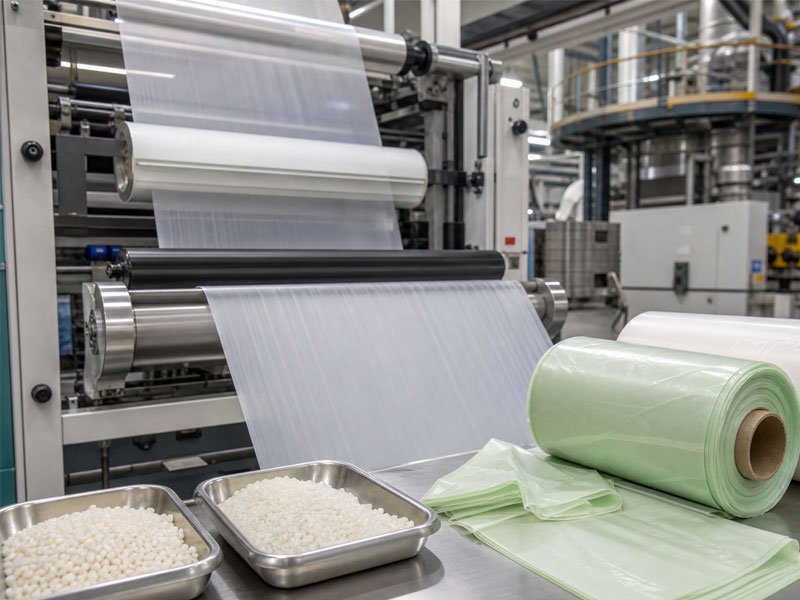
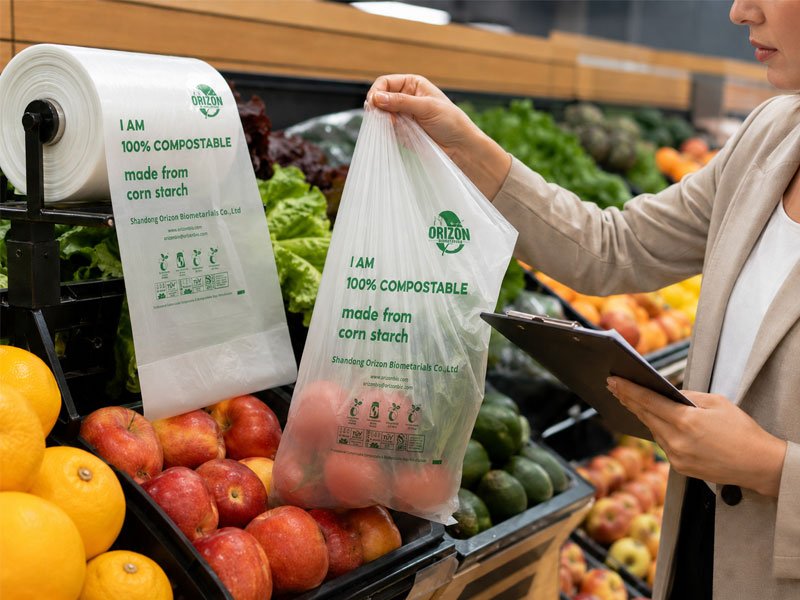
Replacing an HDPE produce bag with a compostable bag sounds simple.
It is not a one-for-one material change.
The bag still needs to open easily, hold the produce, tear cleanly from the roll, fit the existing dispenser and work through storage and store handling.
Then there is another question:
Where will the bag go after use?
That question matters just as much as the material itself.
When I compare compostable vs HDPE produce bags for a supermarket project, I do not start by asking which material sounds more sustainable.
I start with the operating system.
This guide explains how I would compare the two before changing a retail produce-bag program.
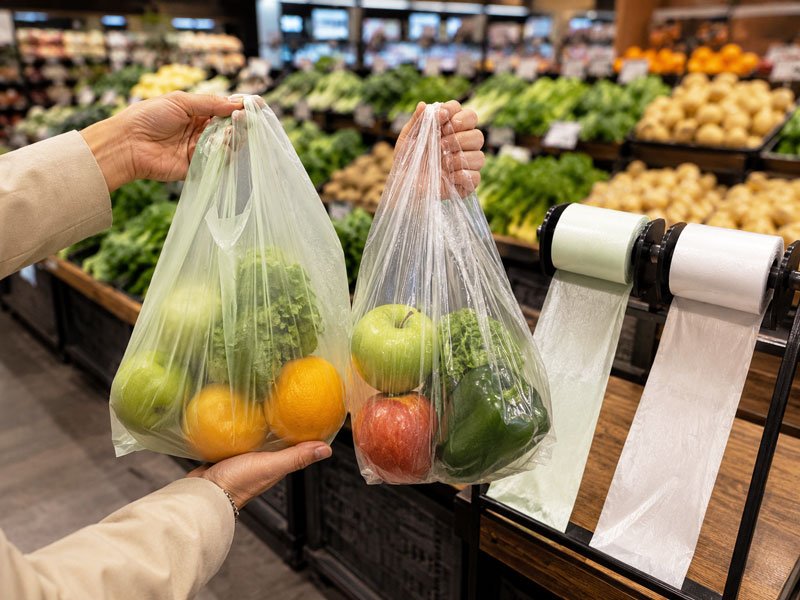
Quick Comparison: Compostable vs HDPE Produce Bags
There is no universal winner.
The better choice depends on the market, waste system and finished specification.
| Factor | Compostable Produce Bags | HDPE Produce Bags |
|---|---|---|
| Clarity | Can range from translucent to high clarity | Depends on resin, gauge and processing |
| Strength | Must be validated by finished-film testing | Must also be matched to gauge and structure |
| Thickness | Often requires formulation-specific testing | Very mature thin-film application |
| Upfront Cost | Often needs a higher-cost material system | Commodity PE usually has a cost advantage |
| Roll / Dispenser | Existing roll may need redesign | Often matches established supermarket systems |
| Storage | Supplier should define shelf life and conditions | Usually less sensitive to compostability-related aging |
| Certification | Compostability certification may be required | No compostability certificate |
| End of Life | Useful only where the intended composting route exists | May enter PE film recycling where accepted; otherwise waste stream varies |
| Food-Waste Reuse | Can be valuable where certified bags are accepted with organics | Normally not suitable for organics composting |
| Best Decision | System-dependent | System-dependent |
The table is a starting point.
It is not enough to approve a conversion.
Start With the Reason for Switching
Before discussing film, ask:
Why are we replacing HDPE?
Possible reasons include:
- local plastic restrictions
- retailer packaging policy
- organics collection
- food-waste reuse
- customer specification
- corporate packaging goals
- distributor demand
These are very different reasons.
For example, Coles replaced conventional fresh-produce bags in its Western Australian stores with certified compostable alternatives that could also be reused for food-scrap collection, subject to local disposal options.
That is a clear system.
The bag has:
first use = produce bag
and potentially:
second use = food-waste collection bag.
That is much stronger reasoning than:
“Compostable sounds greener.”
1. Film Clarity and Produce Visibility
Produce packaging has a visual job.
Customers may want to see:
- color
- ripeness
- surface condition
- product type
through the film.
Do not assume that all compostable films are cloudy.
BASF lists compostable fruit and vegetable films as available in opaque or transparent versions, while Novamont also describes fruit and vegetable film ranging from opaque to transparent.
But do not assume that every compostable formulation will match your current HDPE film either.
Clarity depends on the finished film.
That is why I recommend comparing:
current HDPE sample
against:
proposed compostable sample
under the same lighting and at the same practical gauge.
If the optical difference matters to your retail program, use a defined approval requirement.
Our Compostable Produce Bag Transparency Guide explains how to compare haze and visual clarity more carefully.
2. Strength, Puncture and Seal Performance
A common buyer question is:
“Are compostable produce bags as strong as HDPE?”
There is no useful yes-or-no answer without a specification.
Strength depends on:
- material formulation
- film thickness
- bag dimensions
- extrusion quality
- seal construction
- load distribution
- puncture points
Compostable film can achieve practical thin-film performance. BASF, for example, lists compostable fruit and vegetable film at about 10–15 μm and describes it as tear- and wear-resistant.
But that does not prove that one supplier’s 12 μm compostable bag equals another supplier’s 12 μm HDPE bag.
Test the finished bags.
ASTM D882 covers tensile testing of thin plastic films, while ASTM D1709 measures impact resistance using a falling dart. Seal performance is a separate property; ASTM F88/F88M measures seal strength in flexible materials.
For supermarket trials, laboratory numbers should be combined with actual produce testing.
An apple does not load a film the same way as a laboratory test strip.
3. Thickness Is Not Directly Comparable
This is one of the biggest mistakes in supplier comparisons.
A buyer may say:
“Our HDPE bag is 10 μm, so quote compostable at 10 μm.”
That gives you a starting point.
It does not prove equivalence.
Different film systems can have different:
- tensile behavior
- elongation
- stiffness
- puncture performance
- sealing behavior
So do not buy only by micron.
For ORIZON produce projects, we normally use this as an initial discussion range:
| Application | Starting Range |
|---|---|
| Lightweight supermarket roll | 10–15 μm |
| Standard loose produce bag | 15–18 μm |
| Heavier fruit | 18–20 μm |
| Secondary food-waste use | 20–25 μm |
| Handle / T-shirt produce bag | 20–30 μm |
For many standard projects, 15 μm is a useful first sample point.
For lighter roll programs, 12 μm can also be evaluated.
The final gauge should be validated rather than copied from the HDPE specification.
See our Compostable Produce Bag Thickness Guide for the full selection method.
4. Cost: Compare the Finished Specification
HDPE often wins the first conversation because buyers know its established unit price.
Compostable suppliers usually work with a different resin system, certification requirements and production economics. Current competitor comparison pages also consistently identify higher initial unit cost as one of the main barriers to switching.
But I would not use a fixed statement such as:
“Compostable bags cost 25% more.”
That figure will not stay true across every:
- resin market
- thickness
- size
- quantity
- certification
- country
Instead, compare actual quotations for the same finished requirement.
For example:
Option A — Existing HDPE
10 μm
500 bags/roll
fixed roll OD
Option B — Compostable
12 μm
500 bags/roll
larger OD
Those are not operationally identical if the new roll no longer fits the dispenser.
The real comparison is therefore:
cost per usable store specification
not simply:
resin price per kilogram.
5. Roll Size and Dispenser Compatibility
This is where a material conversion can fail even when the bag itself works.
Suppose you keep:
- the same bag width
- same bag length
- same bags per roll
- same core
but increase film thickness.
More film is now wound onto the roll.
Roll OD may increase.
If the existing dispenser has little clearance, the roll may not fit.
You may then need to:
- reduce bags per roll
- change the core
- change the dispenser
- reduce thickness
- redesign the roll
That can change store operations and cost.
So before replacing an existing HDPE roll, measure:
| Parameter | Existing HDPE |
|---|---|
| Bag width | ___ mm |
| Bag length | ___ mm |
| Thickness | ___ μm |
| Bags/roll | ___ |
| Core ID | ___ mm |
| Core wall | ___ mm |
| Roll width | ___ mm |
| Roll OD | ___ mm |
Then design the compostable replacement around the same operating constraints.
This is why our Compostable Produce Bags on a Roll specification treats thickness, core, bag count, roll OD and dispenser fit as connected parameters.
6. Produce Storage and Film Breathability
This part deserves more attention than it normally gets.
Fruit and vegetables continue to exchange moisture and gases after harvest.
The packaging can affect that environment.
Do not assume:
less breathable = always better
or:
more breathable = always better.
It depends on the produce.
BASF reports that its ecovio fruit-and-vegetable bag film has relatively high water-vapor and oxygen transmission and cites tests in which tomatoes lasted longer in that specific compostable bag system than in polyethylene bags.
That is useful evidence.
But it should not be rewritten as:
“Compostable bags keep all produce fresher than HDPE.”
The result is material- and crop-specific.
A supermarket carrying:
- leafy greens
- apples
- tomatoes
- potatoes
- citrus
may not want exactly the same moisture and ventilation behavior for every product.
For high-volume programs, I recommend testing actual produce under the intended:
- storage temperature
- duration
- cold chain
- bag format
before rollout.
7. Storage and Shelf Life of the Bags
There are two different shelf-life questions:
Produce shelf life
How the film affects the fruit or vegetable.
And:
Packaging shelf life
How long the unused bags remain suitable for use.
Do not mix them up.
For compostable films, ask the supplier to state:
- recommended storage temperature
- humidity conditions
- sunlight restrictions
- carton storage
- expected product shelf life
BASF specifically notes that many factors influence the functionality and shelf life of finished ecovio films and recommends converter and field testing. Its raw-material documentation also defines controlled storage conditions.
For a distributor holding six or twelve months of stock, this matters.
Do not buy a year’s inventory before confirming how the final bags should be stored.
8. Certification and Market Requirements
This is a major difference.
HDPE does not need a compostability certificate because it is not being sold as compostable.
A compostable bag may need third-party certification depending on:
- country
- retailer
- waste program
- product claim
In North America, BPI provides third-party compostability certification based on relevant ASTM standards. BPI also requires product identification and works with composters because correct identification and actual processing infrastructure matter.
Australia uses standards including:
AS 4736
for commercial compostability and:
AS 5810
for home compostability.
The key procurement point is:
Do not buy “compostable material.” Buy a finished specification whose certification and permitted claims match your target market.
For Australian programs, see our AS 4736 Compostable Produce Bags Guide.
9. Waste Stream: Where Will the Bag Actually Go?
This may be the most important comparison in the whole article.
A compostable bag only creates its intended end-of-life route when an appropriate composting system exists and accepts that item.
The European Commission stresses that biodegradation requires suitable receiving conditions and enough time; compostable plastics should therefore be used with a clear understanding of the intended waste-management system.
BPI makes the same issue practical: composting infrastructure and facility acceptance remain important parts of the compostable-packaging system.
So before switching, ask:
Does our local organic-waste collection accept certified compostable produce bags?
Not:
Is the bag certified?
Those are two different questions.
What About HDPE Recycling?
PE film can have a recycling route.
But access varies.
The U.S. EPA states that plastic bags, wraps and films can be recyclable but generally should not be put into ordinary household recycling bins; retail and grocery drop-off programs may accept them.
So HDPE should not automatically be described as:
recyclable
without checking the real collection system either.
The correct question for both materials is:
What collection and processing route actually exists where this bag will be used?
10. Secondary Use as a Food-Waste Bag
Produce bags have an unusual advantage compared with many forms of packaging.
They may have a useful second life.
For example:
buy vegetables
↓
take produce home
↓
reuse bag for kitchen food scraps
↓
send it into an accepted composting stream
Coles explicitly promotes this model for its certified compostable fresh-produce bags in Western Australia.
BASF also positions its compostable fruit-and-vegetable bags as reusable for organic waste collection where local systems accept them.
This can strengthen the case for switching.
But only when:
- the bag is strong enough for the second use;
- the certification matches the disposal route;
- the local collection program accepts it.
Otherwise, do not promise that second use.
When Compostable Produce Bags Make Sense
A compostable option becomes more convincing when several conditions line up.
For example:
- conventional plastic produce bags are restricted
- the retailer has a clear organics strategy
- certified compostable bags are accepted locally
- the bag can be reused for food scraps
- sample performance meets the store requirement
- existing dispensers can be retained or economically adapted
- the retailer accepts the cost difference
- certification and labeling can be managed correctly
When those conditions exist, the change is not just a material substitution.
It can fit a wider waste system.
Coles’ Western Australia program is a useful real-world example because the replacement bag is tied to both fresh-produce use and food-scrap collection rather than being presented only as a different polymer.
When HDPE May Still Be the More Practical Choice
This section is important.
A compostable bag manufacturer should still be able to say when a switch does not make sense.
I would be cautious about conversion when:
- no appropriate composting route exists
- local facilities reject compostable bags
- the project has no compliance or waste-stream reason to change
- the required film performance has not passed testing
- the new roll cannot work with existing dispensers
- the buyer needs long inventory holding but has not validated storage
- the price increase cannot be supported by the program
- the retailer has not trained customers on correct disposal
The European Commission’s position is useful here: alternative single-use materials should not automatically be treated as environmentally superior simply because they are biodegradable or biobased; environmental performance depends on the full system and life cycle.
Even broader life-cycle work on carrier bags has shown why simple “material A is always greener than material B” claims are unreliable; results change with material, weight, reuse and end-of-life assumptions.
So this article should never conclude:
Compostable always wins.
That would be too simple.
How to Run a Supermarket Conversion Trial
Do not replace an entire retail program from a PDF specification.
Run a controlled trial.
Step 1 — Record the Existing HDPE Bag
Measure:
- size
- thickness
- bag weight
- bags/roll
- core
- roll OD
- printing
- dispenser
This is your baseline.
Step 2 — Define Why You Are Switching
Write one sentence.
For example:
We need a certified compostable produce bag that can also enter our approved organics collection program.
If you cannot explain the objective, the project is not ready.
Step 3 — Produce Comparable Samples
Do not compare:
10 μm HDPE
against:
25 μm compostable film
and conclude one is stronger.
Ask the supplier to develop an appropriate compostable specification for the same end use.
Step 4 — Test Clarity
Use real produce.
Check:
- product visibility
- haze
- printing
- customer presentation
Step 5 — Test Strength
Use actual store loads.
Include:
- apples
- citrus
- onions
- potatoes
- vegetables with hard stems
Look for:
- film tearing
- puncture
- seal failure
Where the project requires formal testing, tensile, impact and seal properties can be evaluated separately using recognized film and packaging methods such as ASTM D882, D1709 and F88/F88M.
Step 6 — Test the Roll
Put the roll into the real dispenser.
Check:
- fit
- rotation
- tear
- opening
- roll change
- final bags near the core
Do not only test the first ten bags.
Step 7 — Test Produce Storage
Use the actual cold-chain or shelf conditions.
Do not assume one film’s moisture behavior suits every crop.
Step 8 — Confirm Disposal
Ask the local:
- council
- composting facility
- waste contractor
- retailer waste team
whether the certified bag is accepted.
Certification and local acceptance should both be recorded.
Step 9 — Compare Commercial Cost
Compare:
current annual HDPE cost
against:
proposed annual compostable cost
using the actual approved specifications.
Include changes to:
- bags per roll
- cartons
- pallet quantities
- roll-change frequency
- dispenser replacement
- freight
That gives procurement a much better number than:
$/kg resin.
B2B Switching Checklist
| Question | HDPE Baseline | Compostable Trial |
|---|---|---|
| Bag size | ___ | ___ |
| Thickness | ___ | ___ |
| Bag weight | ___ | ___ |
| Clarity approved? | Yes / No | Yes / No |
| Produce load passed? | Yes / No | Yes / No |
| Puncture passed? | Yes / No | Yes / No |
| Seal passed? | Yes / No | Yes / No |
| Bags/roll | ___ | ___ |
| Core ID | ___ | ___ |
| Roll OD | ___ | ___ |
| Existing dispenser works? | Yes / No | Yes / No |
| Storage approved? | Yes / No | Yes / No |
| Produce storage trial passed? | Yes / No | Yes / No |
| Certification required? | — | ___ |
| Local waste-stream acceptance | ___ | ___ |
| Unit cost | ___ | ___ |
| Annual program cost | ___ | ___ |
| Final decision |
This is the table I would want a procurement team to complete before approving a large conversion.
The Practical Decision
The difference between compostable and HDPE produce bags is not only the resin.
It is the system around the bag.
HDPE may remain practical where cost, established operations and existing waste routes are the priority.
Certified compostable produce bags can make more sense when:
legislation + organics collection + secondary food-waste use + technical performance
all support the change.
For a B2B buyer, the safest process is:
define the reason → test the finished bag → confirm the waste stream → compare total operating cost → then decide.
Not the other way around.
FAQ About Compostable vs HDPE Produce Bags
Are compostable produce bags as strong as HDPE produce bags?
They can meet many supermarket produce applications, but strength should not be assumed from the material name alone.
Film thickness, formulation, bag dimensions, puncture resistance and seal quality all affect finished performance. Buyers should test the compostable bag against the same produce loads and operating conditions used for the existing HDPE bag.
Are compostable produce bags as clear as HDPE bags?
Some compostable films can provide good transparency. BASF and Novamont both offer compostable fruit-and-vegetable film technologies that can be produced in transparent formats.
However, clarity varies by formulation and film construction, so buyers should approve actual samples rather than rely on the word “clear.”
Are compostable produce bags more expensive than HDPE?
They can have a higher upfront unit cost, but there is no reliable universal percentage.
Price depends on film formulation, thickness, bag size, order volume, certification, printing and packing. Compare the approved finished specification rather than using a fixed market premium. Competitor B2B comparisons also identify initial price as a major switching consideration.
Can compostable produce bags use the same supermarket dispenser as HDPE bags?
Sometimes.
Compatibility depends on roll width, core diameter, bags per roll, film thickness and maximum roll OD. A material change can alter the finished roll size even when the bag dimensions remain unchanged.
The existing roll and dispenser should therefore be measured before production.
Can compostable produce bags be reused for food waste?
Yes, some certified produce-bag programs are designed for this second use.
Coles in Western Australia, for example, states that its certified compostable fresh-produce bags can be reused to collect kitchen food scraps and then disposed of through approved composting routes.
Local acceptance must still be confirmed.
Can HDPE produce bags be recycled?
PE film can be recyclable where a suitable film-collection program exists. In the United States, EPA notes that plastic bags and films generally should not enter normal household recycling bins, although many retailers provide separate film collection.
Always check the local collection route.
Does compostable certification mean the bag can go into any compost bin?
No.
Certification identifies tested compostability performance, but actual acceptance still depends on the local collection and processing system. BPI specifically works with composters and identifies infrastructure and acceptance as key parts of the compostable-products system.
Should every supermarket replace HDPE produce bags with compostable bags?
No.
A switch makes sense only when the new bag meets the required technical performance, cost, certification, retail operations and local waste-management conditions.
Where those conditions are missing, retaining the existing system or testing another option may be more practical.
Need to Compare a Compostable Replacement With Your Current HDPE Roll?
If you already use HDPE produce bags, send us:
- one existing bag or roll
- bag size
- thickness
- bags per roll
- core dimensions
- maximum roll OD
- dispenser photos
- typical produce load
- target certification
- destination market
The goal is not simply to copy the HDPE specification.
It is to develop a compostable specification that performs correctly in the same retail system.