If you are sourcing PPWR compostable produce bags for supermarkets, grocery stores or fresh-food retailers in Europe, one question usually comes first:
Does PPWR require produce bags to be compostable?
The short answer is:
Not all produce bags.
PPWR treats several fresh-produce packaging formats differently.
A sticky label on an apple is not treated in the same way as a 12 μm roll bag used for loose vegetables.
A bag filled by the shopper at the produce section is also different from a bag used to pre-pack 750 g of apples before the product reaches the store.
That distinction matters.
For produce bag buyers, there are four main PPWR areas to understand:
- Article 9 — compostable packaging;
- the 15 μm and 50 μm carrier-bag definitions;
- Article 34 — reducing lightweight plastic carrier bags;
- Article 25 and Annex V — restrictions on certain single-use fresh fruit and vegetable packaging from 2030.
So before asking a supplier:
“Is this bag PPWR compliant?”
I suggest first asking:
“How will this produce bag be used?”
That is where the compliance review should begin.
For a wider overview of the Regulation, read our PPWR compostable packaging guide.
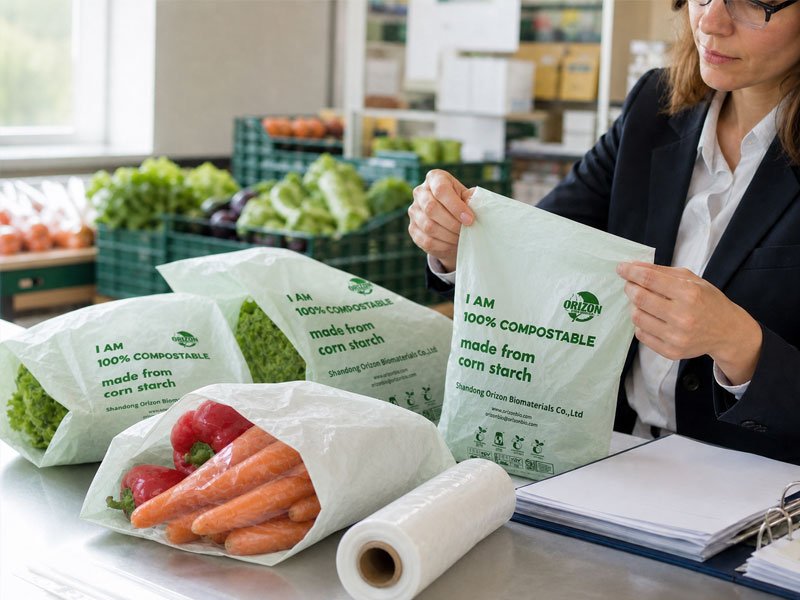
PPWR Compostable Produce Bags: The Short Answer
PPWR does not create one rule saying that all fresh-produce bags must become compostable.
Instead, the answer depends on the packaging format.
| Produce packaging format | Main PPWR issue |
|---|---|
| Sticky label attached to fruit or vegetables | Article 9(1): compostability requirement |
| Very thin bag for loose produce | Carrier-bag rules + possible Article 9(2) Member State requirement |
| Lightweight shopping/produce bag | Carrier-bag rules + possible Article 9(2) requirement |
| Pre-packed fresh fruit or vegetables under 1.5 kg | Article 25 + Annex V restriction from 2030 |
| Other biodegradable produce packaging | Article 9(3) material-recycling pathway may apply |
This is why the phrase “PPWR compostable produce bags” should not be treated as one official EU product category.
The intended use changes the answer.
Are Produce Bags Packaging Under PPWR?
A produce bag filled at a supermarket or grocery store can perform a packaging function.
PPWR defines packaging as an item used to contain, protect, handle, deliver or present products.
It also recognises service packaging: packaging designed and intended to be filled at the point of sale.
A roll bag that a shopper pulls from a dispenser and fills with apples, tomatoes or carrots can therefore fall within the PPWR packaging framework.
This matters because the bag may then be affected by:
- packaging sustainability requirements;
- carrier-bag definitions;
- Member State measures;
- labelling requirements;
- technical documentation;
- food-contact rules.
Do not review the material alone.
Review how the bag is actually used.
Does PPWR Require All Produce Bags to Be Compostable?
No.
This is one of the most common misunderstandings around PPWR compostable produce bags.
Article 9(1) specifically requires sticky labels affixed to fruit and vegetables to meet the applicable industrial-composting pathway by 12 February 2028.
It does not say:
“Every produce bag must be compostable.”
A produce bag needs a different classification.
For thin bags used with loose fruit and vegetables, the important question often becomes whether the bag qualifies as a:
- very lightweight plastic carrier bag; or
- lightweight plastic carrier bag.
These categories are dealt with differently under PPWR.
For the full Article 9 structure, read our PPWR Article 9 guide.
What Is the 15 μm Rule for Produce Bags?
PPWR defines a very lightweight plastic carrier bag as a plastic carrier bag with a wall thickness below:
15 μm
This category matters because many supermarket produce bags are made at thin gauges.
For example:
10 μm produce bag
12 μm produce bag
14 μm produce bag
can all fall below the 15 μm threshold.
That does not automatically mean they must be compostable.
But it does place them in the PPWR category of very lightweight plastic carrier bags.
That classification can affect:
- Article 9(2);
- national compostability rules;
- carrier-bag reduction measures;
- the Annex V restrictions from 2030.
Thickness is therefore not only a production specification.
It can be a regulatory classification point.
What Is the 50 μm Rule?
PPWR defines a lightweight plastic carrier bag as a plastic carrier bag with a wall thickness below:
50 μm
This is a wider category.
For example:
- 18 μm bag;
- 20 μm bag;
- 25 μm bag;
- 30 μm bag;
- 40 μm bag;
are all below 50 μm.
A bag below 15 μm is already very lightweight, while the broader lightweight category covers plastic carrier bags below 50 μm.
This becomes especially relevant when a produce bag can also be used as a carrier bag.
So when you send an RFQ to a supplier, do not provide only:
Size: 300 × 400 mm
Also provide:
Thickness: 12 μm
Intended use: loose fruit and vegetables
Market: Germany
Those extra details help determine which rules may be relevant.
Does “Compostable” Mean the Bag Is Not a Plastic Carrier Bag?
No.
This is an important point.
A compostable produce bag made from biodegradable polymers can still fall within the PPWR definition of plastic.
PPWR defines plastic broadly as a material consisting of a polymer that can function as the main structural component of packaging, except for natural polymers that have not been chemically modified.
The Regulation also separately identifies biodegradable plastics within its packaging categories.
So a PBAT/PLA-based compostable produce bag should not automatically be treated as outside the plastic carrier-bag rules simply because it can compost.
In practical terms:
Compostable plastic can still be plastic under PPWR.
That means the 15 μm and 50 μm classifications still matter.
Can EU Member States Require Produce Bags to Be Compostable?
In some cases, yes.
Article 9(2) gives Member States flexibility to require:
- very lightweight plastic carrier bags;
- lightweight plastic carrier bags;
to be compostable where the conditions set out in the Regulation are met, including suitable bio-waste collection and treatment systems.
This means the answer may differ by country.
A produce bag specification intended for one Member State should therefore not automatically be copied into another market.
For B2B buyers, I would avoid writing this in an RFQ:
Market: Europe
That is too broad for some compostable bag projects.
It is better to write:
Market: France
or:
Markets: Germany, Austria and Belgium
Then the national requirements can be checked before the artwork and final specification are approved.
Why Member State Differences Matter
PPWR is an EU Regulation, but it still gives Member States choices in several areas.
Compostable carrier bags are one example.
Member States can also use national measures to reduce plastic carrier bag consumption.
Those measures may include:
- restrictions;
- economic instruments;
- national reduction targets;
- other measures allowed under the Regulation.
So two bags with the same:
- size;
- thickness;
- material;
- certification;
may still need a different market review depending on where they are sold.
This is especially important for distributors that supply several EU countries.
Do not treat an EU-wide customer base as one local waste system.
Article 34: PPWR Also Tries to Reduce Lightweight Carrier Bag Use
Compostability is only one part of the picture.
Article 34 requires Member States to take measures to achieve a sustained reduction in the consumption of lightweight plastic carrier bags.
The PPWR benchmark is no more than 40 lightweight plastic carrier bags per person per year, or the equivalent target by weight, with the target continuing each year after 2025.
Member States may use measures such as:
- marketing restrictions;
- economic instruments;
- national targets.
The Regulation also allows Member States to exclude some very lightweight bags from this reduction obligation where they are needed for hygiene or used as sales packaging for loose food to help prevent food waste.
This creates an important distinction.
A thin produce bag may be considered necessary for a real food-handling purpose.
But that does not mean every very lightweight bag gets an automatic exemption.
The use case matters.
The 2030 Rule Many Produce Bag Buyers Miss
There is another PPWR rule that deserves just as much attention as Article 9.
Article 25 and Annex V.
From 1 January 2030, certain single-use packaging formats listed in Annex V cannot be placed on the market.
One of those categories is:
single-use plastic packaging for less than 1.5 kg of pre-packed unprocessed fresh fruit and vegetables.
The Annex gives examples such as:
- nets;
- bags;
- trays;
- containers.
This is a major point for fresh-produce packaging buyers.
But it applies to pre-packed fresh fruit and vegetables.
That is not exactly the same use case as a thin bag taken from a roll and filled by the customer in the produce section.
These two situations should not be mixed together.
Loose Produce Bag vs Pre-Packed Produce Bag
This distinction is worth making very clear.
Scenario A — Loose produce bag
A supermarket has a roll of bags beside the apples.
The shopper takes one bag and fills it with six apples.
This may be service packaging and may fall within the very lightweight or lightweight carrier-bag rules.
Important issues can include:
- 15 μm / 50 μm classification;
- Article 9(2);
- Member State requirements;
- Article 34;
- food-contact compliance.
Scenario B — Pre-packed produce
A supplier packs:
750 g of apples
inside a single-use plastic bag before the product is offered for sale.
That brings the Article 25 / Annex V restriction for pre-packed unprocessed fresh fruit and vegetables under 1.5 kg into the discussion from 1 January 2030.
These are two different regulatory questions.
Do not use one answer for both.
Are There Exceptions to the 1.5 kg Produce Packaging Restriction?
Yes.
Annex V allows Member States to establish exemptions where there is a demonstrated need.
Examples include cases where packaging is needed to avoid:
- water loss;
- loss of turgidity;
- microbiological hazards;
- physical shocks;
- oxidation.
There can also be an exemption where packaging is needed to prevent organic and non-organic produce from being mixed, subject to the conditions set out in the Regulation.
So the 2030 rule should not be simplified into:
“All plastic bags for fruit and vegetables under 1.5 kg are banned.”
That statement would be too broad.
The product, purpose and applicable national exemption need to be checked.
Does a Compostable Bag Escape the 2030 Restriction?
Do not assume it does.
The Annex V restriction is written around single-use plastic packaging.
As discussed earlier, biodegradable or compostable polymer packaging can still fall within PPWR’s plastic framework.
So a buyer should not assume:
“This bag is compostable, therefore the 2030 fresh-produce packaging restriction does not apply.”
That needs a proper classification review.
This is another reason why compostability should not be treated as a shortcut around the rest of PPWR.
What Does Article 9(3) Mean for Produce Packaging?
Article 9(3) is also relevant to biodegradable packaging that does not fall within Article 9(1) or a qualifying Article 9(2) route.
By 12 February 2028, other packaging—including packaging made from biodegradable plastic polymers—must be designed for material recycling in accordance with Article 6, without harming other recycling streams.
So there are really two questions:
Can the material compost?
and
Is composting the PPWR pathway that applies to this packaging?
Those questions can have different answers.
This is why an EN 13432 certificate alone does not determine whether a produce package meets all applicable PPWR requirements.
For the difference between the regulation and the compostability standard, read our PPWR vs EN 13432 guide.
Does EN 13432 Make a Produce Bag PPWR Compliant?
No.
EN 13432 remains an important European reference for industrial compostability.
But it does not answer every produce-packaging question.
For example, it does not by itself determine:
- whether the bag is below 15 μm or 50 μm;
- whether Article 9(2) applies in the target Member State;
- whether Article 34 measures affect the bag;
- whether Annex V restrictions apply;
- whether food-contact rules are met;
- whether the finished printed bag is within the certification scope;
- whether PPWR technical documentation is complete.
So if a supplier says:
“This produce bag is EN 13432 certified, therefore it is fully PPWR compliant.”
ask for more detail.
A better question is:
“Which requirements apply to this exact produce bag in my target market?”
Raw Material Certificate vs Finished Produce Bag
This is another common sourcing issue.
Imagine you are buying:
260 + 60 × 2 × 450 mm
12 μm
Green tint
Printed one colour
250 bags per roll
The supplier sends you an EN 13432 certificate for the compostable compound.
That is useful.
But it does not automatically answer everything about the finished bag.
Ask:
- Does the evidence cover the finished film?
- Does it cover 12 μm?
- Does it cover the colour masterbatch?
- Does it cover printing?
- Which ink system is used?
- Is the bag intended for food contact?
- Which EU Member State will receive it?
The specification and certificate should be reviewed together.
Food-Contact Compliance Is a Separate Question
Produce bags can come into direct contact with food.
That means food-contact requirements may also apply.
EU food-contact rules are separate from compostability certification and PPWR.
The European Commission explains that materials intended to come into contact with food must comply with the EU food-contact framework, including Regulation (EC) No 1935/2004 and any relevant material-specific rules.
This creates another important distinction:
Compostable does not automatically mean food-contact compliant.
And:
Food-contact compliant does not automatically mean PPWR compliant.
For produce packaging, you may need to review all three:
- PPWR;
- compostability;
- food-contact requirements.
Different documents support different claims.
What Should EU Buyers Check for Food-Contact Produce Bags?
If a compostable produce bag will directly touch fresh produce, ask the supplier about:
- intended food-contact use;
- material formulation;
- applicable food-contact testing;
- Declaration of Compliance where required;
- migration testing where relevant;
- production conditions;
- traceability.
The exact document set can depend on the material and application.
Do not use a compostability certificate as a substitute for food-contact documentation.
They answer different questions.
Official source: European Commission — Food Contact Materials legislation.
Thickness Is More Than a Cost Question
Bag buyers often discuss thickness only in terms of:
- price;
- strength;
- puncture resistance;
- bag weight.
Under PPWR, thickness can also change regulatory classification.
Consider three products:
| Thickness | PPWR carrier-bag category |
| 12 μm | Very lightweight plastic carrier bag |
| 25 μm | Lightweight plastic carrier bag |
| 55 μm | Not within the below-50 μm lightweight category |
That can change which rules you need to review.
So when comparing supplier quotations, make sure all suppliers are quoting the same:
- dimensions;
- thickness;
- material;
- bags per roll;
- printing;
- intended use.
Otherwise you may not be comparing the same product.
A Practical Example: 12 μm Compostable Produce Bag
Imagine you are an EU supermarket distributor sourcing:
Compostable produce bags
12 μm
250 bags per roll
Green
One-colour print
For loose fruit and vegetables
How should you review it?
Step 1 — Check thickness
12 μm is below 15 μm.
It falls within the very lightweight plastic carrier bag definition.
Step 2 — Check use
The bags are provided for loose fruit and vegetables at the point of sale.
This is different from pre-packed 1 kg fruit packaging.
Step 3 — Check Article 9(2)
Confirm whether the target Member State requires or permits compostability for this carrier-bag category under the relevant conditions.
Step 4 — Check Article 34
Review the Member State’s carrier-bag reduction measures and whether the loose-food use falls within an applicable exception.
Step 5 — Check compostability evidence
Does it cover:
- 12 μm film;
- green colour;
- printing?
Step 6 — Check food-contact requirements
The bag touches fresh food.
Review the applicable food-contact documentation.
Step 7 — Check artwork
Do not print a disposal claim until you know:
- the compostability route;
- Member State rules;
- certificate scope.
Now you are reviewing the finished product.
Not just the resin.
A Second Example: 1 kg Pre-Packed Apples
Now change the scenario.
A producer wants to pre-pack:
1 kg of apples
in a single-use plastic bag before they reach the supermarket.
That brings another issue into the picture.
From 1 January 2030, Article 25 and Annex V restrict single-use plastic packaging for less than 1.5 kg of pre-packed unprocessed fresh fruit and vegetables, subject to the exemptions allowed by the Regulation.
In this case, asking:
“Is the bag compostable?”
is not enough.
The first question may become:
“Can this packaging format be placed on the market for this use after 2030?”
That is a very different buying decision.
Five Questions to Send Your Produce Bag Supplier
If you are sourcing PPWR compostable produce bags, these five questions can save time.
1. What thickness is the finished bag?
Ask for μm, not only grams per bag.
2. How will the bag be used?
Loose produce?
Checkout?
Pre-packed produce?
3. What exactly does the compostability certificate cover?
Raw material?
Film?
Printed finished bag?
4. Is the product intended for food contact?
If yes, ask for the relevant food-contact documents.
5. Which country is the product being made for?
This matters because Member State rules can affect carrier bags and compostability requirements.
These five questions are more useful than asking only:
“What is your price per roll?”
Common Mistakes When Buying Compostable Produce Bags
Mistake 1: “PPWR requires all produce bags to be compostable.”
No.
Article 9(1) specifically addresses sticky fruit and vegetable labels. Produce bags need their own classification.
Mistake 2: “A 12 μm produce bag and a 30 μm shopping bag are regulated the same way.”
Not exactly.
Both can be within plastic carrier-bag categories, but <15 μm has its own very-lightweight definition.
Mistake 3: “Compostable bags are not plastic under PPWR.”
Do not assume this.
Biodegradable polymer packaging can still fall under PPWR’s plastic framework.
Mistake 4: “EN 13432 proves the whole product is PPWR compliant.”
No.
Check the finished product and the applicable PPWR pathway.
Mistake 5: “The 2030 fruit and vegetable rule applies to every loose produce bag.”
No.
The Annex V provision specifically addresses pre-packed unprocessed fresh fruit and vegetables below 1.5 kg, while very lightweight bags have a separate Annex V entry and exceptions.
These distinctions matter.
What Documents Should EU Produce Bag Buyers Ask For?
For a B2B produce bag project, I would separate the documents into four groups.
Compostability documents
- EN 13432 evidence;
- certificate number;
- certificate holder;
- validity date;
- product scope;
- finished-product coverage.
Product documents
- size;
- thickness;
- material structure;
- bags per roll;
- colour;
- printing;
- ink system;
- product specification.
Food-contact documents
Where relevant:
- applicable food-contact declaration;
- migration testing;
- supporting compliance information;
- traceability.
PPWR-related documents
Depending on the project:
- technical documentation;
- applicable conformity-assessment information;
- product identification;
- traceability;
- EU Declaration of Conformity;
- labelling information.
Each document has a different purpose.
Do not replace one with another.
PPWR Compostable Produce Bag Buyer Checklist
Before approving a bulk order, check the following.
Use
- Loose produce?
- Pre-packed produce?
- Checkout bag?
- Other use?
Thickness
- Below 15 μm?
- Below 50 μm?
- 50 μm or above?
Market
- Which EU Member State?
- What carrier-bag rules apply?
- Are compostability requirements in place?
Article 9
- Does Article 9(1) apply?
- Is Article 9(2) relevant?
- Does Article 9(3) become relevant?
2030 restrictions
- Is the produce pre-packed?
- Is it unprocessed?
- Is it below 1.5 kg?
- Does an Annex V exemption apply?
Certification
- Raw material or finished bag?
- Industrial or home compostability?
- Thickness covered?
- Colour covered?
- Printing covered?
Food contact
- Is direct food contact intended?
- What documentation is available?
Artwork
- Compostability claim
- Disposal wording
- Required symbols
- Market language
Check these before mass production.
PPWR Produce Bag Decision Table
A simple table can help procurement teams.
| Product | Main issue to check |
| Fruit/vegetable sticky label | Article 9(1) compostability |
| 10–14 μm loose produce bag | Very lightweight category + Article 9(2) + Article 34 + Annex V |
| 15–49 μm carrier-style produce bag | Lightweight category + Article 9(2) + Article 34 |
| Pre-packed produce bag under 1.5 kg | Article 25 + Annex V from 2030 |
| Other biodegradable produce packaging | Article 9(3) may direct it toward material recycling |
This table is a starting point.
It does not replace a product-specific legal review.
How ORIZON Supports Compostable Produce Bag Projects
ORIZON manufactures compostable bags for B2B customers, including produce distributors, supermarket suppliers, packaging wholesalers, importers and private-label buyers.
We have more than 16 years of manufacturing experience.
Our production facility covers around 20,000 m², with 16 automatic production lines and monthly capacity of approximately 500 tons.
For compostable produce bags, common custom options include:
- bag width and length;
- side gussets;
- film thickness;
- bags per roll;
- paper-core size;
- colour;
- printing;
- roll format;
- carton packing;
- OEM private label.
But for EU projects, I prefer to start with the use case.
Tell us:
- target country;
- loose or pre-packed produce;
- bag size;
- thickness;
- material requirement;
- roll quantity;
- printing;
- food-contact requirement;
- compostability requirement;
- order quantity.
Then the product specification can be reviewed against the available certification and documentation.
For standard B2B formats, see our compostable produce bags.
For custom sizes, printing, colours and private-label projects, see our OEM compostable bags.
Certification and regulatory suitability should always be checked against the finished bag, intended use and target market.
FAQ
What are PPWR compostable produce bags?
“PPWR compostable produce bags” is not an official EU certification category.
The term is commonly used for compostable fresh-produce bags being reviewed against the applicable requirements of Regulation (EU) 2025/40.
The correct requirements depend on the bag thickness, use and target Member State.
Does PPWR require produce bags to be compostable?
Not all produce bags.
Article 9(1) specifically requires sticky labels attached to fruit and vegetables to meet compostability requirements.
Some produce bags may instead fall within the very lightweight or lightweight carrier-bag categories under Article 9(2).
What is the PPWR 15 μm rule?
PPWR defines a very lightweight plastic carrier bag as a plastic carrier bag with a wall thickness below 15 μm.
This category is important for many thin bags used with loose fruit and vegetables.
What is the PPWR 50 μm rule?
PPWR defines lightweight plastic carrier bags as plastic carrier bags below 50 μm.
Member States have obligations to reduce consumption of these bags and may introduce additional measures.
Can a Member State require compostable produce bags?
In some cases.
Article 9(2) allows Member States to require very lightweight and lightweight plastic carrier bags to be compostable where the relevant conditions are met.
Always check the target country.
Does EN 13432 make a produce bag PPWR compliant?
No.
EN 13432 supports industrial-compostability assessment, but PPWR also covers product classification, carrier-bag rules, recycling pathways, labelling, documentation and other requirements.
Are compostable produce bags still considered plastic?
They can be.
PPWR’s plastic definition is based on polymer material, and the Regulation separately recognises biodegradable plastic packaging.
A compostable polymer bag should therefore not automatically be assumed to fall outside plastic packaging rules.
What happens to very lightweight produce bags after 2030?
Annex V restricts very lightweight plastic carrier bags from 1 January 2030, but includes exceptions for bags required for hygiene or provided as sales packaging for loose food where this helps prevent food waste.
The specific use should be checked carefully.
Does PPWR ban plastic packaging for fresh fruit and vegetables under 1.5 kg?
From 1 January 2030, Article 25 and Annex V restrict single-use plastic packaging for less than 1.5 kg of pre-packed unprocessed fresh fruit and vegetables.
Member States can provide exemptions for specified needs such as reducing water loss, microbiological risks, physical damage or oxidation.
Is a loose produce roll bag the same as pre-packed fruit packaging?
No.
A roll bag filled by a shopper at the point of sale and a bag used to pre-pack fruit before sale are different use cases.
Different PPWR provisions can therefore apply.
Do compostable produce bags need food-contact documentation?
If the bag is intended to come into contact with food, applicable EU food-contact requirements also need to be considered.
Compostability certification does not replace food-contact compliance documentation.
Conclusion
PPWR compostable produce bags do not follow one simple rule.
The correct approach starts with the bag’s use.
For loose produce bags, check:
- the 15 μm and 50 μm carrier-bag categories;
- Article 9(2);
- Member State requirements;
- Article 34;
- food-contact rules.
For pre-packed fresh produce, also look at:
- Article 25;
- Annex V;
- the 1.5 kg threshold;
- the 2030 restrictions and exemptions.
And for every compostable product, check whether the certification covers the finished bag rather than only the raw material.
A good sourcing question is not:
“Do you have compostable bags?”
It is:
“Can you show me the specification and evidence for the exact bag I plan to sell in my target market?”
If you are sourcing compostable produce bags for Europe, send us your target country, intended use, bag dimensions, thickness, bags per roll, printing requirements and estimated order quantity.
That gives us a practical starting point for reviewing the specification and available product documents before production.
This article provides general information for packaging buyers and does not constitute legal advice. Requirements may depend on the finished packaging, intended use, Member State and later PPWR implementing measures.