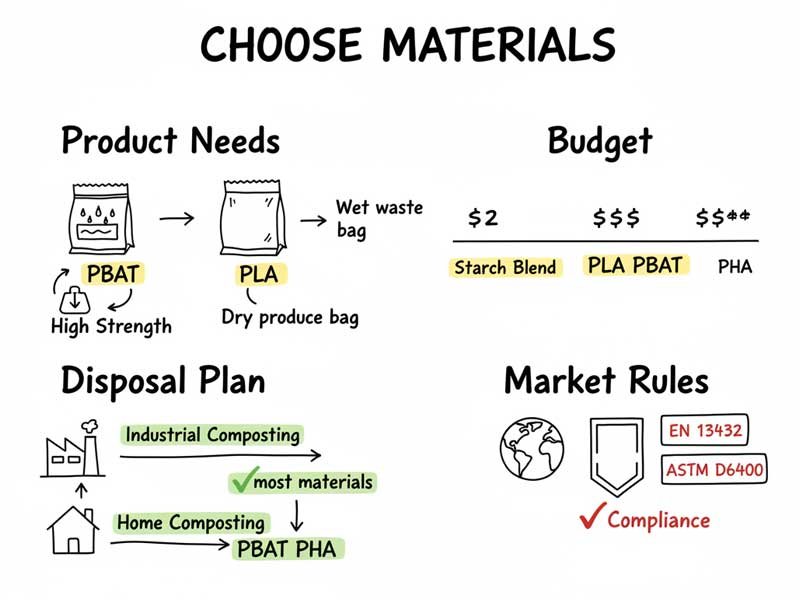
If you import packaging into the EU, labelling is now a compliance topic, not only a design topic.
The PPWR packaging labelling requirements affect how packaging shows material composition, compostability information, reuse information, digital data, and environmental claims.
For importers of compostable bags, this matters before artwork approval.
Once printing plates are made, a small wording mistake can become expensive.
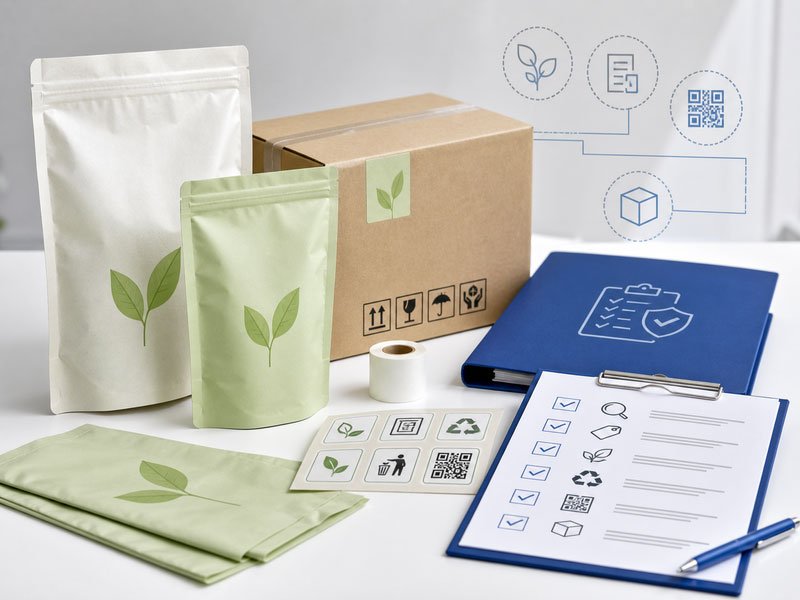
What Are the PPWR Packaging Labelling Requirements?
The Packaging and Packaging Waste Regulation, Regulation (EU) 2025/40, sets EU-wide rules for packaging placed on the EU market.
Article 12 covers labelling of packaging.
The main goal is to help end users sort packaging waste correctly. The label must use harmonised pictograms and show material composition.
For B2B buyers, this means packaging artwork should no longer be treated as only a branding file.
It should be reviewed as a compliance document.
Key Dates EU Importers Should Track
| Requirement | Main Timing |
|---|---|
| PPWR entered into force | 11 February 2025 |
| PPWR generally applies | 12 August 2026 |
| Harmonised material composition label | From 12 August 2028 or 24 months after the relevant implementing acts, whichever is later |
| Reusable packaging label | From 12 February 2029 or 30 months after the relevant implementing act, whichever is later |
| Commission implementing acts for labels | Required by 12 August 2026 under Article 12 |
Important note.
Importers should check the latest European Commission implementing acts before final artwork approval. The PPWR sets the legal timeline, but the final label format and technical specifications come from implementing acts.
Which Packaging Needs PPWR Labelling?
Article 12 says packaging placed on the EU market must carry a harmonised label showing material composition, unless an exception applies.
This can affect:
- Compostable shopping bags
- Compostable fruit and vegetable bags
- Compostable mailer bags
- Compostable garment bags
- Compostable dog waste bags
- Retail packaging
- E-commerce packaging
- Private-label packaging
Transport packaging is generally excluded from the Article 12 material composition label, except e-commerce packaging.
Packaging covered by a deposit and return system is also treated differently.
For importers, the practical question is:
Will this packaging reach an EU end user, retailer, warehouse, collection system, or e-commerce customer?
If yes, check the label rules early.
What Must the Harmonised Label Show?
The harmonised label must show information on material composition. It must help consumer sorting.
Article 12 says the label should be:
- Based on pictograms
- Easy to understand
- Accessible, including for persons with disabilities
- Visible
- Legible
- Durable
If digital information is used, the PPWR also limits how that information is presented. Compliance information should not be mixed with sales or marketing content.
That point matters for QR codes.
A QR code used for packaging compliance should not simply lead to a marketing landing page.
Compostable Packaging Wording Under PPWR
Compostable packaging needs special care.
Under Article 12, for certain compostable packaging covered by Article 9, the label must indicate that:
- The material is compostable
- It is not suitable for home composting
- Compostable packaging is not to be discarded in nature
This is important for compostable bags because buyers often want short claims such as:
- “Compostable”
- “Biodegradable”
- “Eco bag”
- “Plant-based”
- “Plastic free”
Some of these claims may be vague or risky if they are not supported and clearly explained.
A safer approach is to use specific wording tied to the correct standard and disposal route.
Example:
“This bag is certified industrially compostable under EN 13432. It is not suitable for home composting. Do not discard in nature.”
Only use this wording if the product scope and certificate support the claim.
Environmental Claims: What Importers Should Avoid
Article 14 of the PPWR covers environmental claims about packaging properties that are regulated by the PPWR.
A claim may be made only if:
- It relates to packaging properties exceeding the minimum PPWR requirements
- It clearly states whether it applies to the full packaging unit, part of the packaging unit, or all packaging placed on the market by the operator
- It is supported in the technical documentation
This changes how importers should review wording.
Avoid vague claims such as:
- “Eco-friendly”
- “Green”
- “Planet safe”
- “100% sustainable”
- “Zero impact”
- “Completely biodegradable”
Directive (EU) 2024/825 also strengthens EU rules against misleading environmental claims. It targets generic environmental claims and sustainability labels that are not based on a certification scheme or public authority system.
For custom printed compostable bags, the safest rule is simple:
Say only what you can prove.
Mandatory Labels vs Voluntary Claims vs Certification Logos
Importers often mix these three categories.
They are different.
| Item | Meaning | Example | Buyer Action |
|---|---|---|---|
| Mandatory label | Required by law | PPWR harmonised material label | Follow EU format |
| Voluntary claim | Marketing or information claim | “Made with biobased plastic” | Check Article 14 and evidence |
| Certification logo | Mark controlled by certification body | OK compost, DIN CERTCO, BPI | Check licence and certificate scope |
| Supplier statement | Supplier’s own wording | “This bag is compostable” | Ask for test reports and certificate |
| QR code | Digital data carrier | Sorting info or reuse info | Keep compliance info separate from marketing |
A certification logo should not be printed just because the raw material is certified.
The finished bag, thickness, ink, adhesive, and print coverage may affect whether the claim is valid.
What to Check Before Approving OEM Artwork
For OEM and private-label packaging, label review should happen before mass production.
For private-label projects, our OEM compostable bags can be customized by size, thickness, packaging format, and market requirements.
Ask your supplier to check:
- Bag size
- Film thickness
- Material structure
- Printing ink
- Print coverage
- Compostability certificate scope
- Target EU country
- Local language needs
- Required disposal wording
- QR code destination
- Retail carton or inner pack wording
- Whether the buyer’s brand makes the buyer the responsible operator
For artwork, ink, and printing control, see our custom printed compostable bags guide.
Private-label buyers should be careful.
If your brand name is on the bag or retail pack, your responsibility may be higher than a normal distributor.
Decision Table for EU Importers
| Situation | Recommended Action |
|---|---|
| You print “compostable” on the bag | Confirm certificate scope and disposal wording |
| You print “home compostable” | Use only if the product is certified and accepted for that claim |
| You print a certification logo | Confirm logo licence and artwork rules |
| You use a QR code | Keep compliance information clear and separate from marketing |
| You sell in several EU countries | Check language and local EPR/collection requirements |
| You change thickness or ink | Recheck certification and technical documentation |
| Supplier only gives raw material certificate | Ask for finished packaging evidence |
| Artwork includes broad green claims | Replace with specific, evidence-backed wording |
Buyer Checklist for Custom Printed Compostable Bags
Before approving artwork, ask:
- What exact PPWR label rules apply to this packaging type?
- Is the bag sales packaging, e-commerce packaging, or transport packaging?
- Is the packaging compostable under Article 9?
- Is the claim industrial compostable or home compostable?
- Is the certificate for raw material or finished packaging?
- Can the certification logo be printed on this SKU?
- Are ink and print coverage included in the compliance review?
- Does the label need local EU language text?
- Is the QR code used for compliance, marketing, or both?
- Does the technical documentation support every environmental claim?
- Who gives final artwork approval?
- Who keeps the evidence file?
EU buyers can also review our EN13432 compostable bags page for standard-specific sourcing.
Supplier Red Flags
Be careful if a supplier says:
- “You can print any compostable logo.”
- “Raw material certification is enough.”
- “Home compostable and industrial compostable mean the same thing.”
- “Biodegradable is safer than compostable.”
- “No need to check EU label rules before printing.”
- “All EU countries accept the same wording.”
- “The QR code can just go to your homepage.”
- “PPWR compliant” without showing the evidence basis.
These answers may create risk for importers.
They are also a sign that artwork control is weak.
B2B Procurement Case
A private-label brand in Germany wants custom printed compostable mailer bags.
The first artwork says:
“100% eco-friendly biodegradable packaging. Safe for nature.”
The supplier has only a raw material certificate.
That wording is risky. It is broad, unclear, and not tied to a standard or disposal route.
A better artwork version says:
“Industrially compostable where accepted by local facilities. Not suitable for home composting. Do not discard in nature.”
The buyer then asks for:
- Finished bag specification
- EN 13432 evidence
- Certificate scope confirmation
- Ink and print coverage review
- QR code destination check
- Technical documentation support for claims
The second version is less dramatic.
But it is much easier to defend.
How Orizon Supports EU Importers With Label-Ready OEM Bags
Orizon supports importers, distributors, wholesalers, retailers, and private-label brands sourcing custom compostable bags for EU markets.
Our OEM work includes:
- Bag size and thickness confirmation
- Certified material selection
- Custom printing review
- Compostability claim alignment
- Packaging format planning
- Batch traceability support
- Document support for procurement checks
We manufacture compostable garbage bags, shopping bags, fruit and vegetable bags, courier bags, garment bags, dog waste bags, and OEM/ODM custom packaging.
Our factory has 16 years of manufacturing experience, about 20,000 square meters of production space, 16 fully automatic production lines, and monthly capacity of about 500 tons.
For EU projects, we do not recommend printing broad claims first and checking documents later.
We help buyers review label wording, certification scope, and production specifications before mass printing.
That is the better order.
FAQ
What are the PPWR packaging labelling requirements?
The PPWR packaging labelling requirements are EU rules under Regulation (EU) 2025/40. They include harmonised labels for material composition, rules for compostable packaging wording, reuse information, digital data carriers, and environmental claims.
When do PPWR harmonised packaging labels apply?
The harmonised material composition label applies from 12 August 2028 or 24 months after the relevant implementing acts enter into force, whichever is later. Importers should check the latest Commission implementing acts before final artwork approval.
Does compostable packaging need special wording under PPWR?
Yes. For compostable packaging covered by Article 9, the label must indicate that the material is compostable, that it is not suitable for home composting, and that compostable packaging must not be discarded in nature.
Can importers print “eco-friendly” on compostable bags?
Importers should avoid vague environmental claims such as “eco-friendly” unless they can prove the claim under EU rules. Specific, evidence-backed wording is safer.
Is a raw material certificate enough for label claims?
No. A raw material certificate may not cover the finished bag, printing ink, thickness, adhesive, or final product format. Importers should request finished packaging evidence.
Can a QR code be used for PPWR packaging information?
Yes, PPWR allows digital information in certain cases. However, compliance information should be clear and should not be mixed with sales or marketing content.
Conclusion
PPWR packaging labelling requirements will affect how EU importers approve packaging artwork, especially for custom printed compostable bags.
The key is not to treat labels as decoration. Labels, claims, QR codes, and certification marks should all match the product evidence.
For importers, the safest process is to confirm the packaging type, target market, certificate scope, compostability wording, and technical documentation before printing starts.
Clear wording may look less flashy.
But it reduces compliance risk and protects your supply program.