For many private label dog poop bag projects, the choice eventually comes down to 18 micron or 20 micron.
The difference sounds small.
It is only 2 microns.
But that change can affect:
- bag weight
- material consumption
- roll diameter
- dispenser fit
- retail box size
- carton weight
- cost per bag
- product positioning
So which one should you choose?
For many standard private label projects, 18 μm offers a practical balance between material use, roll size and product feel.
A 20 μm bag may make more sense when the brand wants a heavier hand feel, more opacity or a more premium product position.
The right answer depends on the complete product.
Not the micron number alone.
Quick Comparison: 18 Micron vs 20 Micron
| Item | 18 Micron | 20 Micron |
|---|---|---|
| Film thickness | 0.018 mm | 0.020 mm |
| Approx. mil equivalent | 0.71 mil | 0.79 mil |
| Relative film use | 100% | 111.1% |
| Relative output from same film weight | 100% | About 90% |
| Hand feel | Standard / substantial | Thicker / heavier |
| Opacity potential | Good | Usually easier to make more opaque |
| Roll diameter | Smaller | Larger |
| Material cost | Lower | Higher |
| Typical positioning | Standard / premium balance | Premium / heavy-duty |
| Main watch point | Finished performance | Roll size and total cost |
These comparisons assume the same bag dimensions, material formulation and basic production structure.
Real results vary by formulation, film density, winding, color masterbatch, core size and production tolerance.
What Does 18 Micron or 20 Micron Mean?
A micron, written as μm, is one-thousandth of a millimeter.
So:
18 μm = 0.018 mm
and:
20 μm = 0.020 mm
That means 20 μm film is:
20 ÷ 18 = 1.111
or approximately:
11.1% thicker than 18 μm film.
For the same bag size and material density, that also means approximately 11.1% more film mass per bag.
This is where the cost difference starts.
How Much More Material Does a 20 Micron Bag Use?
If everything except thickness stays the same, film weight is roughly proportional to thickness.
For a simple comparison:
18 μm = 100% material reference
20 μm = 111.1%
That does not mean the final retail product will cost exactly 11.1% more.
Why?
Because the finished product includes costs that do not rise directly with film thickness.
These may include:
- paper cores
- printing plates
- printing setup
- labels
- retail boxes
- dispensers
- outer cartons
- inspection
- freight handling
So a useful way to think about it is:
thicker film raises the material portion of the cost—not every part of the finished product cost.
This is why buyers should compare a full quotation instead of simply adding 11.1% to an 18-micron price.
How Does Thickness Affect Bag Weight?
For the same bag dimensions and film formulation, a 20 μm bag should weigh more than an 18 μm bag.
The relationship is simple:
Bag Weight ∝ Bag Area × Film Thickness × Material Density
If size and density stay unchanged, moving from 18 to 20 μm adds approximately 11.1% to the theoretical film weight.
For buyers, bag weight matters because it affects:
- total material required
- rolls produced from one batch
- carton net weight
- shipment gross weight
- landed cost
If your supplier quotes 18 μm and 20 μm at almost the same unit price, ask whether the finished bag weight and actual thickness are also the same as quoted.
Thickness should be checked as part of the production specification.

How Many Fewer Bags Can 500 kg Produce at 20 Micron?
This is one of the most useful comparisons for a B2B buyer.
Assume:
- same bag dimensions
- same material density
- same film formulation
- same production yield
- thickness is the only variable
Because a 20 μm bag uses approximately 11.1% more film per piece, the number of bags produced from the same material weight falls.
The theoretical ratio is:
18 ÷ 20 = 0.90
So:
20 μm output ≈ 90% of 18 μm output
For a simple example:
If 500 kg of film could produce 10,000 rolls at 18 μm under a given specification, the same film weight would theoretically produce around:
9,000 rolls at 20 μm
if everything else stayed equal.
This is a planning example, not a production guarantee.
Actual output depends on finished bag weight, production loss, formulation, core configuration and tolerance.
For this reason, the most accurate MOQ conversion should be based on the approved finished bag weight.
For a full bag-to-roll-to-retail-box calculation, see How Many Dog Poop Bag Rolls Can 500 kg Produce?
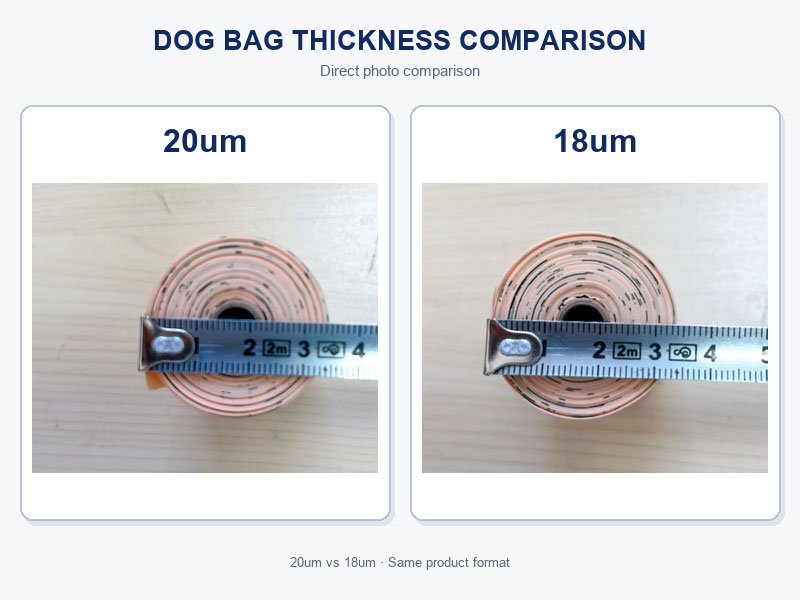
How Does 18 vs 20 Micron Affect Roll Diameter?
This is where the thickness decision starts affecting packaging.
A thicker bag puts more film onto each roll.
If bags per roll stays the same, the finished roll normally becomes larger.
For one ORIZON reference configuration:
| Specification | 18 μm | 20 μm |
|---|---|---|
| Bag size | 23 × 33 cm | 23 × 33 cm |
| Bags per roll | 15 | 15 |
| Roll height | Approx. 6 cm | Approx. 6 cm |
| Roll diameter | Approx. 32 mm | Approx. 34 mm |
This is a reference example, not a universal standard.
Actual roll diameter also depends on:
- paper core size
- film formulation
- winding tension
- perforation
- film stiffness
- production tolerance
Still, the example shows why changing thickness after the box has already been designed can create a packaging problem.
A 2 mm increase does not sound large.
Inside a tight dispenser or retail box, it can matter.
For a deeper explanation of roll dimensions and dispenser fit, see our Dog Waste Bag Size Guide.
Will a 20 Micron Roll Still Fit a Standard Dispenser?
Often yes.
But do not assume it.
Dispenser fit depends on the finished roll—not only the flat bag size.
The important dimensions are:
- roll diameter
- roll height
- paper core diameter
- winding tightness
A 23 × 33 cm bag can fit a common leash-dispenser format at both 18 μm and 20 μm, but the 20 μm roll will normally require slightly more space when bag count stays the same.
That is why I prefer checking the actual roll sample before approving a dispenser or retail box.
The sequence should be:
Bag Specification → Finished Roll → Dispenser / Box
not:
Box Design → Hope the Roll Fits
Does 20 Micron Always Mean a Stronger Dog Poop Bag?
Not necessarily.
Thickness matters.
But it is only one part of finished-bag performance.
Other factors include:
- film formulation
- tensile properties
- puncture resistance
- seal quality
- thickness consistency
- perforation quality
- weak points around the bottom seal
- storage conditions
ASTM D882 covers tensile testing of thin plastic sheeting, while ASTM F88/F88M measures seal strength in flexible materials. Impact resistance of plastic film is addressed separately under ASTM D1709.
That distinction matters.
A dog poop bag can be thick and still perform poorly if the seal is weak or the film is inconsistent.
This is why I would not approve a 20 μm bag simply because the number is larger.
Test the finished bag.

What Should You Test Besides Thickness?
When comparing 18 and 20 micron samples, use the bags as a customer would.
Check:
Opening
Can the user separate the bag quickly?
Perforation
Does it tear cleanly from the roll without damaging the next bag?
Seal
Does the bottom seal stay closed under normal use?
Puncture Resistance
How does the bag handle grass, gravel or firm waste?
Stretch
Does the film stretch without splitting too easily?
Opacity
Can the contents be seen through the film?
Hand Feel
Does the bag feel too light, balanced or unnecessarily heavy for the target market?
Roll Fit
Does the roll fit the intended dispenser and retail box?
A good 18 μm product can outperform a poorly made 20 μm product.
The specification is the starting point.
The finished bag is what the customer uses.
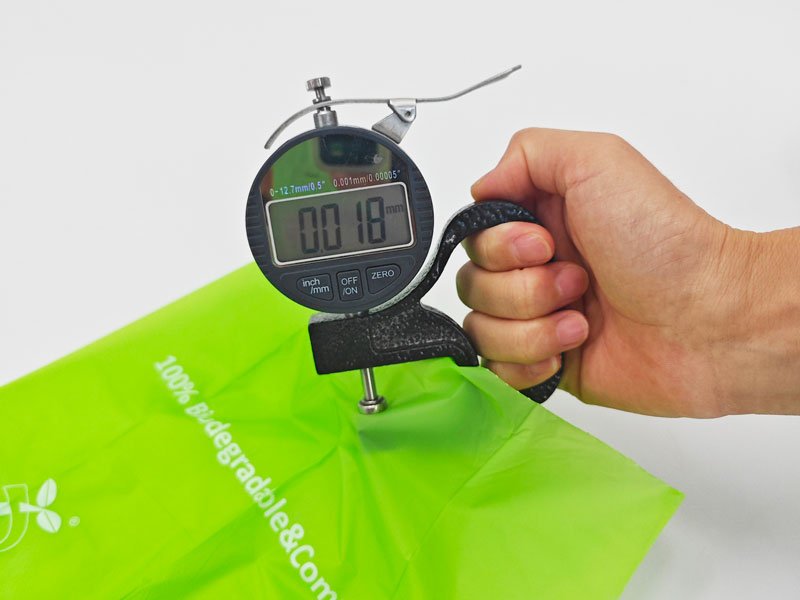
18 Micron: When Does It Make Sense?
18 μm is a practical direction when the project needs a balance between:
- dependable hand feel
- controlled material cost
- compact roll size
- standard dispenser fit
- good packaging efficiency
It can work well for:
- mainstream private label brands
- standard retail packs
- e-commerce products
- refill rolls
- cost-conscious premium positioning
For many buyers, 18 μm is not an “economy” bag.
It can still be a substantial dog waste bag when the film, seal and perforation are well controlled.
One current consumer brand even markets its 18 μm dog poop bag as an extra-thick product.
That shows why thickness should always be read in context.
20 Micron: When Does It Make Sense?
20 μm may make more sense when the product is positioned around:
- thicker hand feel
- premium presentation
- better visual coverage
- large-dog use
- stronger perceived protection
- heavy-duty positioning
A 20 μm bag can give the customer more material between their hand and the waste.
That matters psychologically as well as physically.
Users often describe thin bags as something they do not trust.
But the trade-off is straightforward:
more material → more weight → larger roll → higher material cost
For a premium brand, that may be worth it.
For a highly price-sensitive product, it may not be.
Which One Is Better for Large Dogs?
Do not choose thickness based on dog size alone.
Large-dog owners often care about:
- bag capacity
- puncture resistance
- seal integrity
- hand coverage
- tying space
A small but very thick bag can still be inconvenient for a large dog.
For large breeds, I would evaluate bag size and thickness together.
For example:
23 × 33 cm / 18 μm
may work well for many mainstream products.
A brand targeting larger dogs or premium customers may instead test:
23 × 33 cm / 20 μm
or a slightly larger bag.
Reddit discussions from large-breed owners show the real concern clearly: users complain about bags ripping, needing two bags and not trusting thin film with larger waste loads.
So do not ask only:
“Is 20 micron better?”
Ask:
“Does this finished specification solve the customer’s problem?”
How Does Thickness Affect Opacity?
Thickness can help improve opacity, but thickness is not the only factor.
Opacity also depends on:
- film formulation
- masterbatch concentration
- film color
- pigment
- light conditions
A dark 18 μm film may hide contents better than a lightly colored 20 μm film.
So if opacity is important, put it into the product requirement.
Do not simply write:
“20 micron”
and assume the finished film will look opaque enough.
Approve the physical sample.
How Does Thickness Affect Packaging Cost?
Thickness may affect packaging indirectly.
A larger roll can require:
- a larger retail box
- more internal space
- a different dispenser
- fewer rolls per carton
- a different carton arrangement
This does not happen in every project.
But it needs to be checked.
For example, changing a project from 18 μm to 20 μm after the retail box dieline is finished may mean the rolls no longer fit as comfortably as expected.
That is why the bag thickness should be approved before the final retail packaging dimensions are locked.
If you are developing a branded retail SKU, see our Private Label Dog Poop Bags page for the full product-development process.
Does 20 Micron Increase Shipping Cost?
Potentially.
The main effect is weight.
If each bag uses more material, the total net product weight increases.
Depending on packing configuration, thickness may also affect:
- roll volume
- carton size
- carton gross weight
- pallet weight
- total shipment CBM
For small orders, the difference may be modest.
For hundreds of thousands or millions of bags, it can become meaningful.
This is why large-volume buyers should compare:
cost per bag + carton configuration + freight
rather than only the EXW roll price.
For larger recurring programs, see our Bulk Dog Waste Bags guide.
18 Micron vs 20 Micron Cost: What Should a Buyer Compare?
Ask for both specifications on the same commercial basis.
The quotation should use the same:
- bag size
- bags per roll
- film color
- printing
- paper core
- retail packaging
- carton configuration
- order quantity
- shipping term
Then compare:
| Cost / Specification Item | 18 μm | 20 μm |
|---|---|---|
| Bag weight | Confirm | Confirm |
| Roll weight | Confirm | Confirm |
| Roll diameter | Confirm | Confirm |
| Rolls per carton | Confirm | Confirm |
| Carton gross weight | Confirm | Confirm |
| EXW / FOB unit price | Compare | Compare |
| Freight effect | Compare | Compare |
| Retail positioning | Standard / premium | Premium / heavy-duty |
Without matching specifications, the comparison is not useful.
My Practical Recommendation for B2B Buyers
If you are still deciding between 18 and 20 micron, order both.
Use the same:
size + formulation + color + bags per roll + core
Then compare them side by side.
Do not only touch the film.
Put the roll into the dispenser.
Tear off a bag.
Open it.
Pick up waste.
Tie it.
Check the seal.
Measure the roll.
Put the rolls into the proposed box.
Then decide whether the customer benefit of 20 μm is worth the added material and logistics cost.
That is a much better decision than choosing the larger number from a specification sheet.
18 Micron vs 20 Micron: Final Decision Table
| Choose 18 μm When… | Choose 20 μm When… |
|---|---|
| Cost control matters more | Premium positioning matters more |
| You want a more compact roll | A slightly larger roll is acceptable |
| Standard dispenser fit is important | Dispenser has enough space |
| You want higher output per kg | Lower output per kg is acceptable |
| The 18 μm sample already passes performance tests | 18 μm does not provide the desired feel or opacity |
| Mainstream positioning is the goal | Heavy-duty / premium positioning is the goal |
Neither option is automatically correct.
The best thickness is the one that works for the customer, package and target cost at the same time.
Buyer Checklist Before Approving Thickness
Before confirming 18 μm or 20 μm, check:
- Finished bag weight
- Actual thickness
- Size tolerance
- Easy opening
- Perforation
- Bottom seal
- Leakage
- Stretch
- Puncture performance
- Opacity
- Bags per roll
- Roll diameter
- Dispenser fit
- Retail box fit
- Rolls per carton
- Carton gross weight
For a wider pre-production checklist, see our OEM Dog Waste Bags Checklist.
FAQ
Is 20 micron better than 18 micron for dog poop bags?
Not automatically. A 20 μm bag uses more material and may feel thicker, but film formulation, seal quality, perforation and production consistency also affect performance.
How much thicker is 20 micron than 18 micron?
20 μm is approximately 11.1% thicker than 18 μm.
Does a 20 micron bag cost 11.1% more?
Not necessarily. The film portion uses about 11.1% more material under equal conditions, but printing, packaging, core and other fixed costs do not all increase by the same percentage.
Does 20 micron increase roll diameter?
Usually yes when size and bags per roll stay the same. In one 23 × 33 cm, 15-bag reference configuration, the roll diameter was approximately 32 mm at 18 μm and 34 mm at 20 μm.
Which thickness is better for private label dog poop bags?
18 μm is often a practical balance of cost, feel and roll size. 20 μm may suit premium or heavy-duty positioning. Test both before making the final decision.
Will 20 micron bags fit standard leash dispensers?
They often can, but dispenser fit should be checked using the actual finished roll diameter and height.
How does thickness affect the number of bags produced from 500 kg?
Under the same size, density and production conditions, 20 μm output is theoretically about 90% of 18 μm output because each bag uses more film.
Need Help Comparing 18 μm and 20 μm Samples?
If you are developing a private label dog poop bag, compare both thicknesses using the same size and roll configuration.
ORIZON can prepare suitable reference samples so you can compare:
hand feel → opacity → roll diameter → dispenser fit → packaging
before the final specification is approved.