Updated: 26 August 2026
Large compostable garbage bags are often sold by capacity: 60L, 80L, 120L, 240L or even 360L.
That is useful, but it is not enough.
A 240L label does not tell you the exact width, height, rim shape or overhang needed for your bin. Two bins with the same stated capacity can require different liner dimensions.
This matters even more for large bins, because a small sizing error becomes a bigger problem when the bag is filled with wet food waste, garden material or other dense waste.
In this guide, I will show you how to choose a large compostable trash bag by:
- bin capacity
- actual bin dimensions
- waste type
- film thickness
- bottom seal
- composting requirement
The goal is simple: choose a liner that fits the bin and the waste stream, not just the number printed on the bin.
What Counts as a Large Compostable Garbage Bag?
There is no single global rule that defines where a “large” garbage bag begins.
For practical B2B sourcing, I normally treat liners around 60L and above as the large-bin range.
Typical capacities include:
- 60L
- 80L
- 90L
- 120L
- 160L
- 240L
- 360L
The exact size range depends on the market.
For example, 120L and 240L wheelie bins are common in Australia and Europe, while North American commercial and curbside bins are often described in gallons instead of liters. One current size guide lists 240L as roughly 64 gallons and 360L as roughly 95 gallons.
This is why liter-to-gallon conversion is only the starting point.
The physical bin still needs to be measured.
For buyers who want deeper clarity on gallon, liter, inch and centimeter conversions, our guide on how to choose the correct trash bag size by bin capacity and dimensions explains this in detail.
Large Compostable Garbage Bag Size Guide: 60L to 360L
The table below should be used as a starting point, not as a final production specification.
| Bin Capacity | Typical Use | What to Check First | Common Waste Concern |
|---|---|---|---|
| 60L | offices, kitchens, indoor facilities | rim size and bin height | dry or moderate wet waste |
| 80L | commercial kitchens, shared waste points | opening width and height | wet food waste |
| 120L | small wheelie bins, FOGO systems | rim dimensions, height and overhang | food and organic waste |
| 160L | larger commercial or outdoor bins | actual physical dimensions | mixed organic waste |
| 240L | standard large wheelie bins | full rim size, height and bottom shape | wet, dense or garden waste |
| 360L | high-volume commercial bins | actual bin drawing or measurements | heavy and high-volume waste |
Notice what is missing from this table:
I have not given one “correct” bag dimension for every capacity.
That is intentional.
For example, Ecopack lists one 120L compostable wheelie bin liner at 900 × 1350 mm and one 240L version at 1125 × 1500 mm. BioBag Australia lists its 120/140L liner at 87 × 132 cm and its 240L liner at 113 × 139 cm.
Same capacity class. Different finished dimensions.
That is why capacity alone should not be used as the purchase specification.
Why Bin Capacity Does Not Guarantee the Correct Bag Size
A bin capacity tells you how much volume the container can hold.
It does not fully describe its shape.
Consider two 120L bins.
One may be:
- narrow and tall
while another may be:
- wider and shorter.
Both hold about 120 liters, but the liner width and length may not be the same.
Other factors also change the required fit:
- round vs rectangular shape
- tapered walls
- large top rim
- wheels and internal geometry
- desired fold-over
- bottom shape
This is why good liner selection starts with physical measurements.
Pure Compostables also warns that bag dimensions vary between manufacturers even when the bags are sold for the same capacity range.
For B2B sourcing, I recommend treating:
capacity = product category
and:
width × length = actual production specification.
That distinction prevents many fit problems.
How to Measure a Large Bin for the Correct Liner
You do not need complex equipment.
A tape measure is usually enough.
The key measurements are:
- bin opening
- bin height
- bottom shape
- required overhang
Measure the Bin Opening First
For a round bin, measure the circumference around the widest part of the opening.
A simple starting formula is:
Minimum flat bag width ≈ bin opening circumference ÷ 2
For a rectangular bin, measure the opening width and depth.
A useful starting relationship is:
Minimum flat bag width ≈ bin width + bin depth
These are sizing starting points, not final manufacturing tolerances.
You still need some working allowance so the bag can be placed over the rim without excessive tension.
Commercial liner guides use the same basic principle: the bag opening must cover the full perimeter of the bin, rather than simply match its stated liter capacity.
Measure the Bin Height
Measure from the inside bottom of the bin to the top rim.
Then allow extra length for:
- bottom coverage
- folding over the rim
- tying or handling, if required
A liner that is exactly the same length as the bin height is normally too short.
You need material above the rim.
For large wheelie bins, this overhang becomes especially important because a heavy liner can pull downward when the bin fills.
Measure the Widest Point on a Tapered Bin
Some bins are narrower at the bottom and wider at the top.
Do not size the bag using the middle or bottom measurement.
Use the widest opening.
A liner that looks large enough near the base may still be too tight around the rim.
Do Not Copy a Size Without Checking the Actual Bin
This is one of the most common sourcing mistakes.
A buyer says:
“I need a 240L bag.”
But the real question is:
“What are the dimensions of your 240L bin?”
For standard wheelie bins, an established 120L or 240L liner may work.
For unusual commercial bins, custom dimensions are often safer.
For buyers who need liners made around actual round, square or tapered bin dimensions, our guide on how custom compostable bin liners are sized to fit different bins explains this in detail.
How to Choose by Waste Type
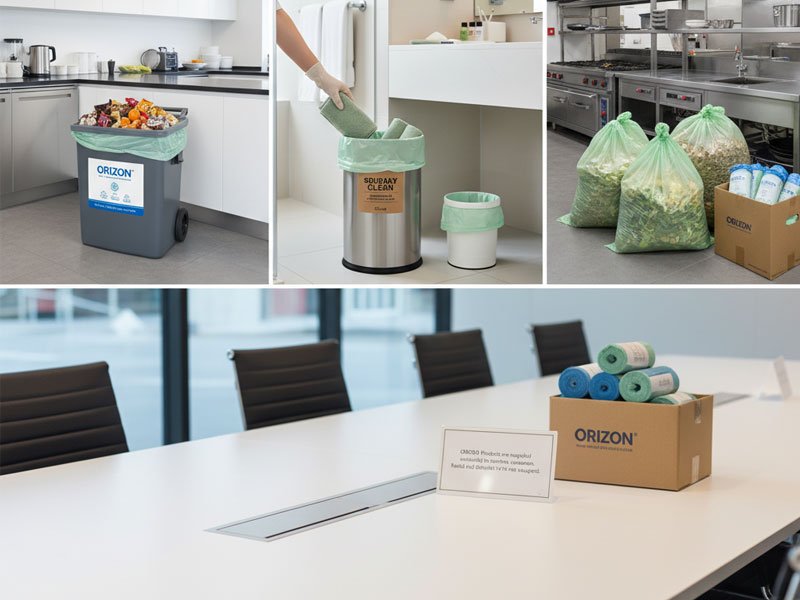
Bag size determines whether the liner fits.
Waste type helps determine whether the liner can handle the job.
These are different decisions.
A 240L liner carrying dry paper does not face the same stress as a 240L liner carrying wet food waste.
Dry and Lightweight Waste
Examples include:
- paper
- tissues
- light packaging
- office waste
- dry facility waste
For these applications, the main concern is often correct fit rather than maximum film thickness.
Using an unnecessarily heavy liner may add material and cost without solving a real problem.
Wet Food and Organic Waste
Wet waste creates different stress.
The liner must handle:
- liquid weight
- grease
- dense food scraps
- pressure at the bottom seal
- longer contact with moisture
Commercial compostable liner suppliers commonly position 80L, 120L and 240L bags for food waste and FOGO applications, with larger liners used in kitchens, hotels, venues and waste rooms.
For wet organic waste, I would pay more attention to:
- film thickness
- seal quality
- bottom structure
- fill weight
- change frequency
A bigger bag is not automatically a stronger bag.
Garden and Yard Waste
Garden waste may include:
- grass clippings
- leaves
- plant stems
- small branches
- wet garden material
The challenge is often puncture rather than only weight.
Sharp stems can stress thin film even when the total bag weight is moderate.
So for garden waste, consider:
puncture risk + load + bag size
together.
For buyers who want deeper clarity on liners for leaves, grass and organic garden material, our guide on compostable yard waste bags provides more application detail.
Wet, Dense or Puncture-Prone Waste
This is where a heavy-duty specification may make sense.
But “heavy-duty” should not simply mean “choose the thickest possible film.”
It should mean the bag is designed around a more demanding load.
That may involve:
- higher thickness
- stronger seal
- improved puncture resistance
- better load distribution
For buyers who want deeper clarity on demanding waste loads, our guide on how heavy-duty compostable garbage bags are specified for wet, dense and puncture-prone waste explains this in detail.
How Much Thickness Do Large Compostable Garbage Bags Need?
Micron is a unit of film thickness.
One micron is one-thousandth of a millimeter.
It is useful, but it should not be treated as a strength score.
Two bags with the same thickness may perform differently because of:
- material formulation
- film consistency
- seal quality
- bag dimensions
- puncture resistance
- production quality
Large compostable garbage bags often need more careful thickness selection because the total load increases quickly as bag volume increases.
For example, ORIZON currently uses typical planning ranges of about 20–30 μm for some 120L wheelie-bin applications, 25–40 μm for some 240L applications and 35–50 μm for some 360L applications. These are application ranges, not universal rules.
The waste type still matters.
A 240L liner for dry paper may not need the same specification as a 240L liner for wet restaurant waste.
That is the key point.
For buyers who want deeper clarity on why micron alone does not determine strength, our guide on how film thickness affects compostable trash bag performance explains this in detail.
Flat Seal vs Star Seal for Large Compostable Garbage Bags
The bottom seal carries a large part of the load.
That makes seal structure more important as liner size and waste weight increase.
Flat Seal
A flat seal has a straight seal across the bottom of the bag.
It can be suitable for:
- dry waste
- lighter commercial waste
- applications where simple construction is sufficient
It is simple and practical.
But the load tends to collect along the bottom seam.
Star Seal
A star-seal bottom folds the film so the bottom opens more evenly.
This can help:
- distribute waste across the base
- fit round bins
- reduce concentrated stress points
- handle wet or mixed waste
Commercial suppliers often use reinforced star-seal structures on larger wheelie-bin liners intended for wet or organic waste.
That does not mean star seal is always required.
Choose the structure according to the waste and bin.
Should Large Compostable Garbage Bags Be Supplied on Rolls?
Often, yes.
But not always.
Roll format is useful for:
- kitchens
- facilities
- municipal programs
- janitorial teams
- wheelie-bin replacement routines
Buyers may specify:
- bags per roll
- paper core or coreless
- perforation
- rolls per carton
- carton weight
Large bags usually have fewer pieces per roll because each bag uses more material.
For example, current large wheelie-bin products on the market may have 5, 12, 16 or 25 bags per roll depending on dimensions and specification.
For B2B projects, bag count should be chosen with carton weight and end-user handling in mind.
Do not treat “more bags per roll” as automatically better.
What About 120L, 240L and 360L Wheelie Bins?
These sizes deserve special attention because they are widely used in outdoor and commercial waste systems.
120L Compostable Garbage Bags
Often used for:
- residential organics
- smaller commercial sites
- apartment waste programs
- food waste transfer
Before ordering, check:
- rim dimensions
- bin height
- required overhang
- waste density
240L Compostable Garbage Bags
240L is one of the most common large wheelie-bin categories.
Typical users include:
- restaurants
- hotels
- schools
- commercial kitchens
- waste rooms
- property managers
A 240L label alone is still not enough.
Current suppliers list different physical dimensions for their 240L products, which is why actual bin fit should be checked.
360L Compostable Garbage Bags
360L liners move into a higher-load category.
At this size, I would not approve a specification based only on liter capacity.
Ask for:
- bin drawing or exact dimensions
- actual waste type
- estimated load
- handling method
- bottom structure
- thickness requirement
This reduces the risk of developing an oversized liner that still fails in use.
For buyers who want deeper clarity on large wheeled bins, our guide on compostable wheelie bin garbage bags for 120L, 240L and 360L bins explains available size and load options.
Certification Does Not Automatically Mean Local Acceptance
This point is easy to miss.
A compostability certification tells you that a product has met requirements under a defined standard and testing system.
It does not mean every local waste collector or composting facility must accept that liner.
For example:
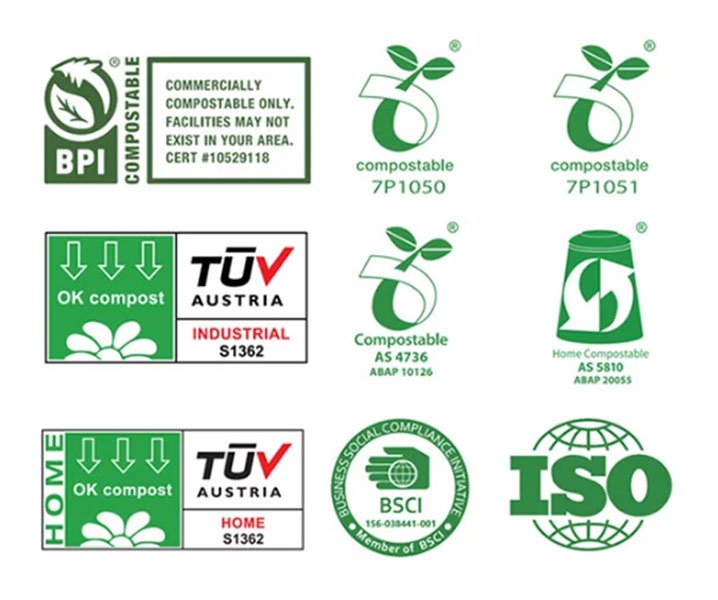
- ASTM D6400 / BPI are commonly used in North America
- EN 13432 is widely used for industrial compostability in Europe
- AS 4736 is used for industrial compostability in Australia
- AS 5810 covers home compostability in Australia
- TÜV offers OK compost INDUSTRIAL and HOME certification systems
But local collection rules can still differ.
This distinction is supported by real facility data. A U.S. survey reported by the Compost Manufacturing Alliance found that some composting facilities accepted certified compostable liner bags while others did not; facilities cited contamination and process concerns among the reasons for rejection.
CMA also separates product certification from facility acceptance in its own system.
So before specifying a large compostable garbage bag for a municipal or commercial organics program, check both:
- required product certification
- local facility or program acceptance
They are related, but they are not the same thing.
For buyers who want deeper clarity on certification scope and market requirements, our guide on how compostable bag certifications apply to finished products and target markets explains this in detail.
Common Mistakes When Choosing Large Compostable Garbage Bags
Mistake 1: Ordering Only by Liter Capacity
“240L” is not a complete specification.
Always check dimensions.
Mistake 2: Using Bag Size to Guess Strength
A large bag is not automatically heavy-duty.
Size and strength are separate decisions.
Mistake 3: Choosing Thickness Without Considering Waste
Dry office waste and wet restaurant waste should not automatically use the same film specification.
Mistake 4: Ignoring the Bin Rim
If the bag is too tight around the top, loading becomes difficult and the liner may tear before it is full.
Mistake 5: Forgetting Overhang
Extra length is needed so the liner can fold over the rim and stay in place.
Mistake 6: Assuming Every Composting Facility Accepts Certified Liners
Check the local organics program before finalizing claims or tender requirements.
What Information Should a B2B Buyer Provide Before Requesting a Quote?
If you are buying for a distributor, brand, commercial facility, waste contractor or municipal program, a good RFQ should include more than “120L bag.”
I recommend providing:
Bin Information
- bin capacity
- opening width and depth, or circumference
- bin height
- bin shape
- required overhang
Waste Information
- food waste
- dry waste
- garden waste
- mixed organic waste
- expected bag load
Bag Specification
- preferred width and length
- thickness
- flat or star seal
- bags per roll
- core or coreless
- color
- printing
Commercial Information
- quantity
- annual usage
- rolls per carton
- target carton weight
- pallet requirement
- destination market
Compliance Information
- target country
- required certification
- required certification marks
- local composting-program requirements
The more precise the input, the less guessing is involved.
That normally leads to a better sample and a more useful quotation.
A Simple Way to Make the Final Choice
If you only remember four things from this large compostable garbage bag size guide, remember these:
1. Start with bin capacity.
Use 60L, 80L, 120L, 240L or 360L to identify the general product range.
2. Confirm the actual bin dimensions.
Capacity does not guarantee fit.
3. Match the bag to the waste.
Wet, dense or sharp waste may need a different thickness and seal from dry waste.
4. Check the composting system.
Certification and local facility acceptance are not the same thing.
That is a much safer way to specify large compostable bin liners than ordering by liter capacity alone.
Need Large Compostable Garbage Bags for Bulk Supply?
This guide explains how to select the specification.
If you are ready to source the product, the next step is to confirm the commercial requirements.
For bulk specifications, custom printing, OEM supply, MOQ and certification documents, view our Compostable Trash Bags Manufacturer page.
For 120L, 240L and 360L wheelie bins:
For buyers who need large liners specifically for wheeled bins, see our 120L, 240L and 360L compostable wheelie bin garbage bags.
For non-standard bins:
For buyers who need dimensions made around an existing bin, our custom compostable bin liner service covers made-to-fit width, length, thickness and packing specifications.