Choosing compostable shopping bags for a retail program involves more than selecting a bag labeled “compostable.” Buyers need to define the bag structure, application, dimensions, side gusset, thickness, expected carrying load, handle design, printing, certification requirements and packing format before a reliable quotation or production specification can be prepared.
A supermarket checkout bag, a grocery carry bag and a branded retail bag may all be described as compostable shopping bags, but they can require very different specifications.
This guide is written for distributors, importers, supermarkets, retail chains and private-label buyers. It explains how to turn an application requirement into a practical shopping bag specification, how to evaluate samples and carrying performance, and what to confirm before bulk production.
If you already know your specification and need commercial pricing, see our Wholesale Compostable Shopping Bags page. For artwork, film colour and branding options, see Custom Compostable Shopping Bags.
Last reviewed: October 23, 2026
What Are Compostable Shopping Bags?
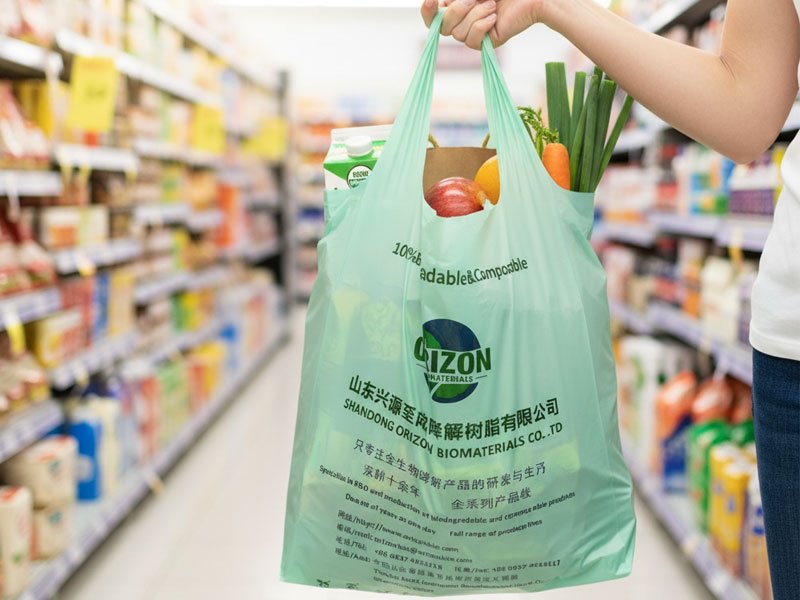
Compostable shopping bags are flexible carry bags designed for a defined composting environment and evaluated against applicable compostability requirements.
For B2B sourcing, the important point is not simply whether the resin or film is described as compostable. The intended finished product should be reviewed against the applicable standard or certification program, including its final formulation, thickness, printing, pigments and other relevant specification conditions.
Compostable shopping bags may be used for supermarket checkout, grocery stores, retail chains, boutiques and other carry-bag applications where the selected structure and certification requirements are appropriate.
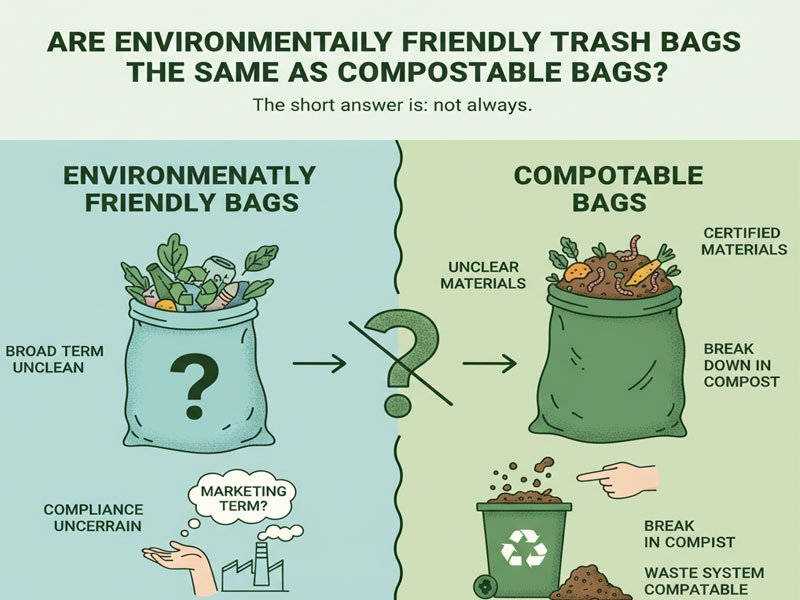
Compostable vs Biodegradable: What Should Buyers Check?
“Biodegradable” is a broad description and does not by itself define a specific composting environment, test method or certification requirement.
“Compostable” should be evaluated against defined compostability requirements for the intended market and disposal environment.
For procurement teams, the useful question is therefore not simply whether a supplier uses the word “biodegradable” or “compostable,” but:
What requirement applies to the finished bag, and does the proposed specification fall within that scope?
For a more detailed terminology comparison, see our Biodegradable vs Compostable guide.
Types of Compostable Shopping Bags
The bag structure should normally be selected before dimensions, thickness and artwork are finalized.
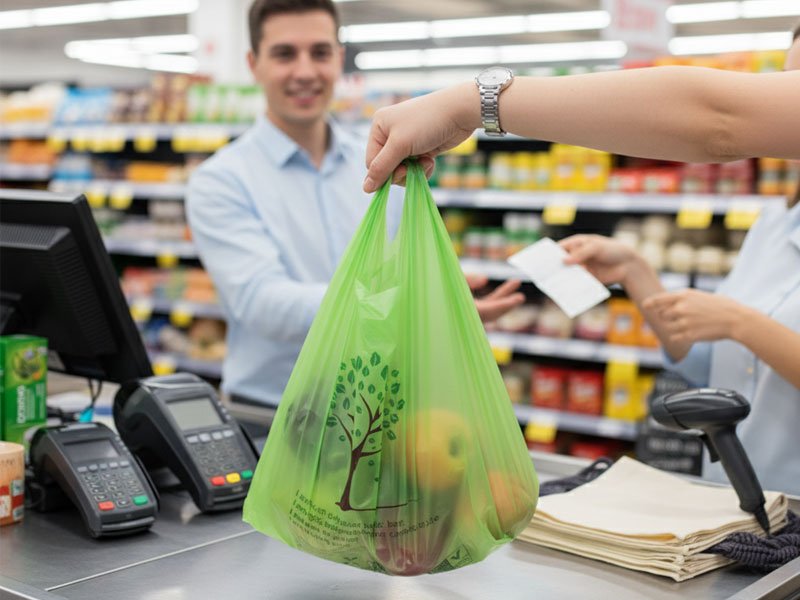
Compostable T-Shirt Bags / Vest Bags
T-shirt bags, also called vest bags or singlet bags in some markets, are commonly used for supermarket, grocery and high-volume checkout applications.
Their integrated handles and side gussets make them suitable for fast loading and mixed retail items.
When specifying a T-shirt shopping bag, buyers should confirm:
- body width;
- side gusset;
- overall length;
- handle proportions;
- expected carrying load;
- thickness;
- film colour;
- printing;
- packing format.
A T-shirt bag should not be selected by flat width alone because the gusset contributes significantly to the usable internal volume.
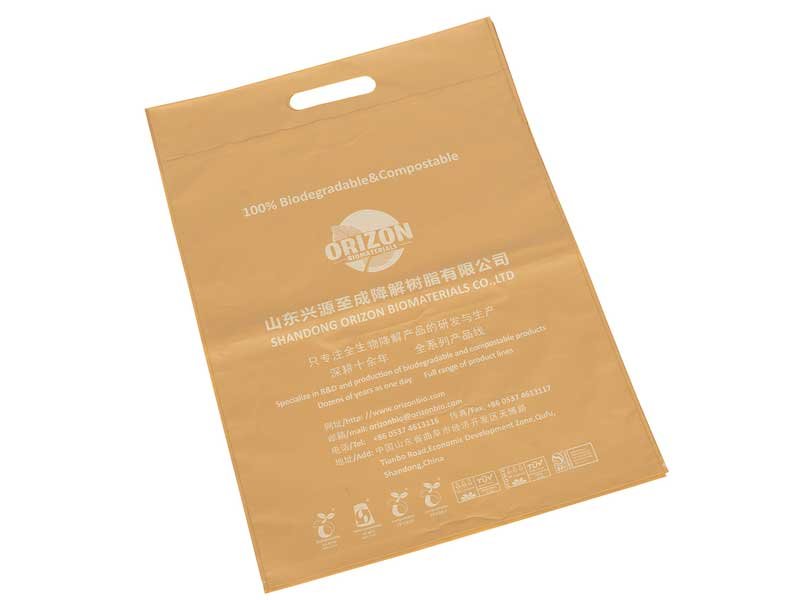
Compostable Die-Cut Handle Bags
Die-cut handle bags provide a flatter body panel and are commonly used for boutiques, apparel retail, specialty stores and branded takeaway programs.
They may provide a larger uninterrupted area for branding than a typical T-shirt bag, but buyers should still allow clearance around the handle opening, edges and bottom seal when preparing artwork.
The final thickness and handle geometry should be selected according to the intended load rather than appearance alone.
Other Custom Carry-Bag Formats
Other carry-bag structures may be reviewed for specific retail projects. They should not automatically be treated as interchangeable with T-shirt or die-cut bags because dimensions, handle construction, sealing, printing area and carrying behaviour may differ.
Compostable Shopping Bags for Retail, Grocery and Checkout Applications
Compostable shopping bags are also commonly sourced as compostable retail bags, grocery carry bags or checkout bags.
The most suitable structure depends on how the bag will actually be filled, carried and distributed.
| Application | Typical Bag Direction | Main Selection Factors |
|---|---|---|
| Supermarkets | T-shirt / vest bags | Checkout speed, gusset, carrying load, bulk packing |
| Grocery stores | T-shirt / vest bags | Product volume, mixed loads, bag opening, handle strength |
| Retail chains | T-shirt or die-cut bags | Repeatable specifications, branding, packing |
| Boutiques | Die-cut handle bags | Appearance, logo area, handle comfort |
| Specialty stores | Die-cut or custom carry bags | Product dimensions, presentation, load |
| Takeaway retail | Carry bag selected around containers | Base dimensions, load distribution, moisture exposure |
| Private-label programs | Custom specification | Artwork, SKU consistency, certification and repeat supply |
There is no single shopping bag specification that is suitable for every retail application. Start with the actual products being carried and the checkout or retail workflow.
How to Choose the Right Shopping Bag Size
Bag size should be based on the intended contents rather than copied from another supplier’s nominal dimensions.
For T-shirt bags, a useful specification format is:
(body width + side gusset × 2) × bag length
For example:
(300 + 80 × 2) × 600 mm
The body width describes the main flat panel, while the side gussets expand when the bag is filled.
For die-cut handle bags without side gussets, size may be stated more simply as:
width × length
When comparing quotations, buyers should make sure suppliers are using the same measurement method. A bag described only as “400 × 600 mm” may not be directly comparable with a gusseted bag using a different dimension convention.
What Should Be Considered When Selecting Size?
The specification should allow for:
- product width and depth;
- number of items per bag;
- container or box dimensions;
- required space above the load;
- handle area;
- ease of loading;
- the way the bag expands when filled.
Using a bag that is unnecessarily large increases film usage, unit weight, carton weight and freight volume. A bag that is too small may create excessive stress around the handles, side folds or seals.
Why Side Gusset Size Matters
The side gusset is not simply an extra dimension on a drawing. It affects how much usable volume the bag develops when opened.
A wider gusset can help accommodate bulky grocery items, takeaway containers or mixed retail products, but it can also change:
- finished bag weight;
- film consumption;
- body-panel proportions;
- printable area;
- packing configuration;
- how the load sits inside the bag.
For this reason, width, gusset and length should be evaluated together.
When replacing an existing conventional shopping bag, providing an actual sample or detailed dimensional drawing is

How to Choose Film Thickness and Carrying Strength
There is no universal micron value that determines whether a compostable shopping bag is “strong enough.”
Carrying performance depends on the complete bag specification, including:
- film thickness;
- material formulation;
- bag width and length;
- side gusset;
- handle geometry;
- seal construction;
- load shape;
- sharp or rigid product edges;
- load distribution;
- actual handling conditions.
Two bags made at the same thickness can perform differently if their dimensions, handles, seals or load conditions are different.
For sourcing purposes, buyers should therefore begin with the intended carrying load and product type rather than specifying thickness alone.
A practical sequence is:
application → product dimensions → expected load → bag structure → size and gusset → initial thickness → sample → carrying test → final specification
For more detailed performance guidance, see our Compostable Shopping Bag Load Capacity: Thickness, Gusset & Handle Strength guide.
Handle Design and Carrying Performance
Handle structure affects both carrying performance and user experience.
T-shirt bags use integrated handles connected to the bag body and are normally selected for efficient supermarket and grocery checkout.
Die-cut bags use a handle opening cut into the upper body panel and are often selected where a flatter presentation and larger branding area are preferred.
When evaluating handles, buyers should consider:
| Factor | Why It Matters |
|---|---|
| Intended load | Higher or irregular loads create more stress around the handle area |
| Bag width | Changes load distribution across the upper section |
| Handle geometry | Influences comfort and local stress concentration |
| Walking distance | A bag carried only from checkout to car may have different requirements from one carried for longer periods |
| Product shape | Boxes, corners and bottles can create uneven loading |
| Film thickness | Should be assessed together with structure and load, not in isolation |
The correct handle design should be confirmed through representative carrying tests rather than assumed from thickness alone.
Custom Printing and Branding Considerations
Printing should normally be planned after the bag structure, dimensions, gusset and film colour are sufficiently defined.
Buyers should confirm:
- one-side or two-side printing;
- number of print colours;
- film background colour;
- logo dimensions;
- artwork orientation;
- usable body-panel area;
- whether any certification or conformity mark is applicable and authorized for the final specification.
The overall bag width is not necessarily the usable printing width. T-shirt handles and gussets reduce the available flat body panel, while die-cut bags require clearance around the handle opening and seals.
For Pantone targets, artwork files, printable areas, logo placement and detailed branding options, see our Custom Compostable Shopping Bags page.
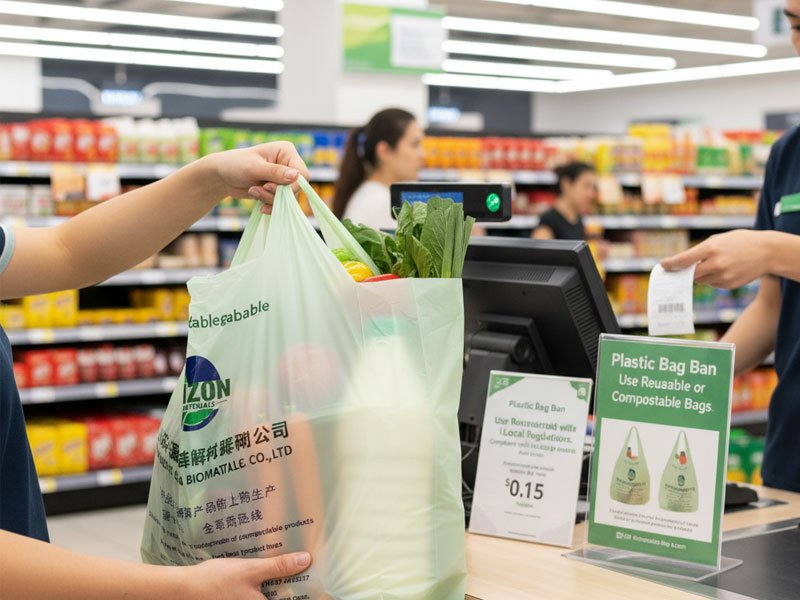
What Certification Does a Compostable Shopping Bag Need?
Certification requirements should be determined from the destination market, intended composting environment and final shopping bag specification.
Common standards and certification programs encountered in international sourcing include:
| Market / Requirement | Common Reference |
|---|---|
| Europe / industrial compostability | EN 13432 and applicable certification schemes |
| United States | ASTM D6400 and BPI certification where applicable |
| Australia / commercial composting | AS 4736 |
| Australia / home composting | AS 5810 |
| Industrial composting certification | TÜV AUSTRIA OK compost INDUSTRIAL where applicable |
| Home composting certification | TÜV AUSTRIA OK compost HOME where applicable |
Standards, certification programs and certification marks should not be treated as interchangeable terms.
ORIZON maintains current third-party certification documentation covering specified shopping bag / check-out bag categories under several programs. This should not be interpreted as meaning that every shopping bag size, thickness, formulation, colour or printed design is automatically covered.
Certification applicability should be confirmed against the applicable current certificate and final finished-product specification before certification claims or conformity marks are used.
Buyers can review current certificate references and documented scope in the ORIZON Verification Center.
Request Samples Before Finalizing the Specification
A specification table can narrow the options, but a physical sample should normally be evaluated before a new shopping bag moves into bulk production.
For an initial sample review, check:
- overall dimensions;
- gusset opening;
- ease of opening the bag;
- film feel;
- usable internal capacity;
- handle comfort;
- seal appearance;
- resistance to local puncture points;
- fit with the intended products;
- print appearance where applicable.
A stock sample can be useful for evaluating general material feel or bag structure, while a customized or pre-production sample may be required when artwork, colour, dimensions or other project-specific details need approval.
How to Run a Practical Carrying Test
A carrying test should reproduce the actual retail application as closely as practical.
1. Load the intended products
Use representative groceries, boxes, containers, bottles or other products rather than testing only with a uniform dead weight.
2. Check how the load sits inside the bag
Look for excessive stretching, sharp contact points, unstable stacking or concentrated stress near the gusset and seals.
3. Carry the bag under realistic conditions
Carry it for a representative distance and observe handle stretch, user comfort and bag deformation.
4. Inspect the handles and seals
Check the handle area, bottom seal, side folds and any other high-stress points.
5. Repeat the test
One successful bag does not establish production performance. Repeat the test using several samples and, where relevant, slightly more demanding load conditions.
6. Approve the specification
Once performance is acceptable, record the agreed dimensions, gusset, thickness, handle construction and other critical specifications for bulk production.
Quality Control Points for Bulk Shopping Bag Orders
Once the specification is approved, incoming or pre-shipment QC should verify the same characteristics that were agreed during development.
Typical inspection points include:
| QC Item | What to Check |
|---|---|
| Dimensions | Width, length and gusset |
| Thickness / bag weight | Consistency with the approved specification |
| Handle | Shape, cut and integrity |
| Seals | Seal formation and obvious weak points |
| Film | Appearance and consistency |
| Printing | Artwork, position, registration and colour reference |
| Quantity | Bags per pack and packs per carton |
| Packing | Carton configuration and markings |
| Identification | SKU or batch information where required |
For repeat orders, maintaining the same approved specification is particularly important because small changes to dimensions, thickness, colour, printing or packing can affect cost, performance and certification applicability.
Packing and Logistics Considerations
Shopping bag packing should be planned together with the finished bag specification.
A change in dimensions, gusset or thickness changes the individual bag weight. This can then affect:
bags per pack → packs per carton → carton gross weight → pallet configuration → freight efficiency
Before bulk production, buyers should therefore confirm the required packing unit, carton quantity, carton markings and delivery method.
Commercial MOQ, carton planning, pallet configuration, Incoterms and quotation details are covered in more depth on our Wholesale Compostable Shopping Bags page.
Compostable Shopping Bag Sourcing Checklist
Before requesting a final quotation or approving production, confirm the following:
| Item | Information to Confirm |
|---|---|
| Application | Supermarket, grocery, boutique, retail, takeaway or other |
| Bag type | T-shirt / vest, die-cut or other approved format |
| Dimensions | Body width, gusset where applicable, length |
| Intended contents | Product type and dimensions |
| Expected load | Approximate weight and load shape |
| Thickness | Initial target confirmed by testing |
| Handle | Style and dimensions |
| Film colour | Natural, white, black or custom target |
| Printing | Colours, sides, artwork and print area |
| Certification | Destination market and applicable requirement |
| Samples | Stock, customized or pre-production as required |
| Testing | Carrying and application testing |
| Packing | Bags per pack, packs per carton and carton marking |
| Logistics | Destination and commercial shipping requirement |
A quotation becomes much more meaningful when these items are defined. Comparing suppliers only on price per bag can be misleading if the underlying specifications are different.
Common Mistakes When Sourcing Compostable Shopping Bags
The most common sourcing problems are usually specification problems rather than material problems.
Typical examples include selecting thickness without defining the actual carrying load, comparing quotations based on different bag dimensions, overlooking gusset size, finalizing artwork before the usable print area is known, assuming a certification automatically applies to every customized specification, and approving a bag without testing it with the intended products.
A more reliable process is to define the application first, then confirm the specification, evaluate samples and approve performance before bulk production.
FAQ
What are compostable shopping bags made from?
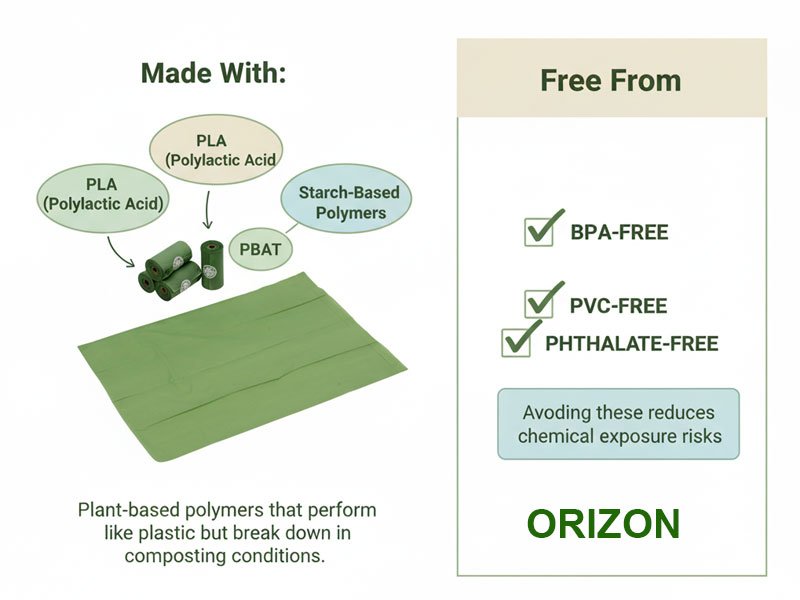
Compostable flexible shopping bags may use blends containing materials such as PBAT, PLA and starch, together with other formulation components.
The material description alone does not establish whether a finished shopping bag meets a particular compostability or certification requirement. Buyers should review the final product specification and applicable certification scope.
Are compostable shopping bags plastic?
Flexible compostable shopping bags are sometimes described as compostable bioplastic bags because they use polymer-based flexible film rather than conventional paper construction.
For B2B sourcing, the more important distinction is whether the finished product meets the applicable compostability requirements for the intended market and composting environment.
What thickness should a compostable shopping bag be?
There is no universal thickness suitable for every shopping bag.
Thickness should be selected together with bag dimensions, gusset, handle structure, material formulation, intended contents and expected carrying load. Representative samples should then be tested before the final specification is approved.
How do I choose the right size and gusset?
Start with the dimensions and quantity of the products that will normally be placed inside the bag.
For T-shirt bags, consider body width, both side gussets and overall length together. The gusset expands the usable internal volume and should not be ignored when comparing bag sizes.
Can compostable shopping bags be custom printed?
Yes, suitable shopping bag projects can be reviewed for custom logo and branding.
Printing should be planned around the usable body panel, film colour, number of print colours and the final bag structure. Certification or conformity marks should only be used where applicable and authorized.
What certification should a B2B buyer request?
That depends on the destination market, composting environment and final product specification.
Buyers should identify the applicable standard or certification program first and then verify that the proposed finished shopping bag falls within the current relevant scope.
Where can I buy compostable shopping bags in bulk?
If you already know the required bag type, dimensions, thickness, printing, packing and destination, see our Wholesale Compostable Shopping Bags page for commercial sourcing, MOQ and quotation information.
Conclusion
A good compostable shopping bag specification begins with the retail application, not with a generic micron value or unit price.
Define the bag type, contents, dimensions, gusset, carrying load and handle first. Then evaluate thickness, printing, certification, samples, carrying performance, QC and packing as one connected specification.
If your specification is already defined and you are ready to compare commercial quantities, packing and delivery terms, continue to Wholesale Compostable Shopping Bags.
If your main requirement is film colour, logo printing or branded artwork, continue to Custom Compostable Shopping Bags.